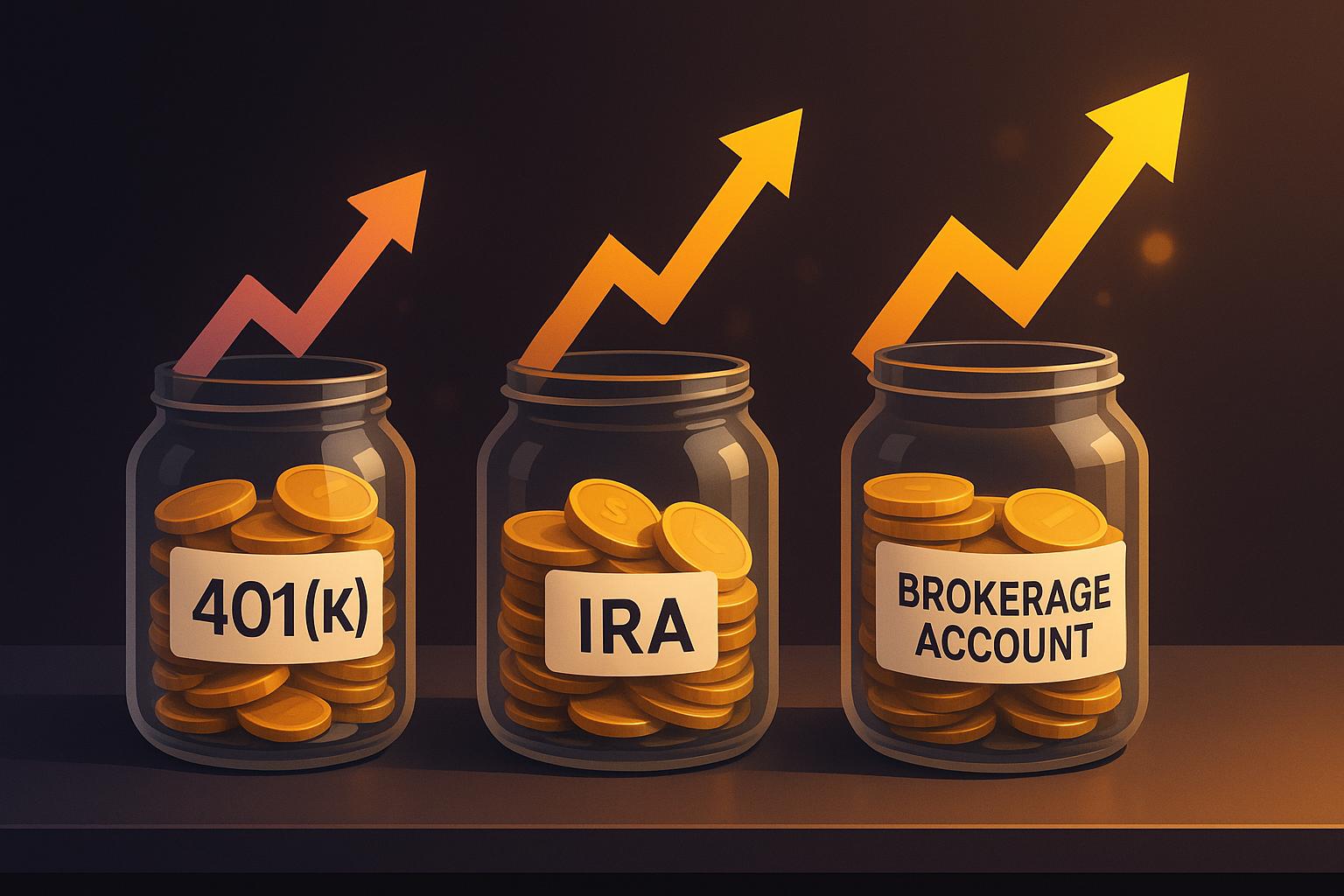
Picking between a 401(k), IRA, or brokerage account depends on your goals, timeline, and tax situation. Here's the quick breakdown:
- 401(k): Best for retirement savings, especially if your employer offers matching contributions. High contribution limits ($23,500 in 2025) and tax advantages make it a solid starting point. However, funds are harder to access, and early withdrawals from your 401(k) or IRA often trigger penalties.
- IRA: Offers more investment flexibility than a 401(k). Comparing Roth vs. traditional IRAs reveals different tax advantages: Roth accounts grow tax-free, while traditional IRAs provide upfront benefits. Contribution limits are lower ($7,000 in 2025), and Roth IRAs have income restrictions.
- Brokerage Account: Perfect for short-term goals or investing beyond retirement limits. No contribution caps, penalties, or required withdrawals, but gains and dividends are taxed.
Quick Comparison
Start with your 401(k) if you have employer matching. Add an IRA for tax benefits and a brokerage account for flexibility. The right mix can help you save smarter and grow your wealth efficiently.
Which Investing Account is Best? (401k vs IRA vs Taxable)
1. 401(k)
A 401(k) is a retirement plan offered by employers, serving as a cornerstone for many Americans' retirement savings. While it offers valuable benefits for growing your wealth over time, it’s important to understand its rules and limitations to make the most of it.
Key Features
- Contribution Limits
The IRS sets annual contribution limits for 401(k) plans, which are typically higher than those for other retirement accounts. For those aged 50 and older, catch-up contributions are also available, allowing you to save more as you approach retirement.
- Employer Matching
Many employers match a portion of your contributions, effectively giving you extra money for your retirement savings. This feature can significantly increase the value of your account over time.
- Vesting Schedules
Vesting determines when you fully own the employer’s contributions. Some companies offer immediate ownership, while others use a gradual schedule over several years. Knowing your plan’s vesting rules is especially important if you’re considering a job change.
- Investment Options
Most 401(k) plans provide a range of investment choices, such as mutual funds, index funds, and sometimes even company stock. While the options might be more limited compared to a brokerage account, they often include diversified, low-cost funds to simplify your decisions.
Tax Implications
401(k) plans offer two main tax structures: traditional and Roth.
- Traditional 401(k): Contributions are made with pre-tax dollars, lowering your taxable income for the year. However, you’ll pay taxes on withdrawals during retirement.
- Roth 401(k): Contributions are made with after-tax dollars, meaning there’s no immediate tax benefit. The upside? Withdrawals, including investment growth, are tax-free in retirement if certain conditions are met.
Both types of plans are subject to required minimum distribution (RMD) rules once you reach a certain age, based on IRS guidelines. Additionally, withdrawing funds before age 59½ usually results in penalties and income taxes, so these plans are best suited for long-term goals.
Suitability for Goals
With higher contribution limits, potential employer matching, and tax advantages, 401(k) plans are a powerful tool for building retirement savings.
- They’re particularly beneficial for individuals in higher tax brackets or those with steady employment who can take full advantage of employer contributions.
- However, due to penalties for early withdrawals and other restrictions, they’re less ideal for short-term financial needs.
- Loan Provisions
Some 401(k) plans allow you to borrow against your balance. This option provides access to funds without triggering early withdrawal penalties, but it reduces your invested savings and may require quick repayment if you leave your job.
This breakdown of 401(k) features provides a foundation for comparing other investment accounts. Up next, we’ll look at how IRAs stack up against 401(k)s in helping you reach your financial goals.
2. IRA
An Individual Retirement Account (IRA) puts you in the driver’s seat when it comes to managing your retirement savings. Unlike 401(k) plans, IRAs give you more freedom to choose your investments and come in two main types: Traditional and Roth.
Key Features
Contribution Limits and Eligibility
In 2025, you can contribute up to $7,000 annually to an IRA - or $8,000 if you’re 50 or older. Anyone with earned income can contribute to a Traditional IRA, though your ability to deduct those contributions may be limited if you’re covered by a workplace retirement plan and your income exceeds certain thresholds. Roth IRAs, on the other hand, have income limits based on your Modified Adjusted Gross Income (MAGI), which could reduce or prevent contributions if your income is too high.
Investment Options
IRAs offer a wide range of investment choices compared to employer-sponsored plans. You can invest in individual stocks, bonds, mutual funds, ETFs, and even REITs. This variety allows you to tailor your portfolio to match your financial goals and risk tolerance.
No Employer Contributions
Unlike 401(k) plans, IRAs don’t come with employer matching contributions. While this means you’re on your own for funding, it also means you’re not restricted by your employer’s plan rules or investment options.
Tax Implications
The tax benefits of an IRA depend on whether you choose a Traditional or Roth account, making this decision a key part of your long-term retirement strategy.
- Traditional IRA: Contributions may be tax-deductible, your investments grow tax-deferred, and withdrawals are taxed as ordinary income. You’ll also need to start taking required minimum distributions (RMDs) at age 73.
- Roth IRA: Contributions are made with after-tax dollars, but your earnings grow tax-free, and qualified withdrawals are tax-free. Plus, Roth IRAs don’t require RMDs during your lifetime.
Early Withdrawal Rules
If you withdraw funds before age 59½, you may face taxes and penalties. However, Roth IRAs are more flexible - you can withdraw your contributions (not earnings) at any time without penalties or taxes. For earnings, early withdrawals may be taxed and penalized unless you meet specific conditions.
Suitability for Goals
The right IRA for you depends on your current financial situation and what you expect in the future.
Tax Bracket Considerations
If you think you’ll be in a higher tax bracket during retirement, a Roth IRA might be the better choice since withdrawals are tax-free. On the flip side, if you expect your tax rate to be lower in retirement, the upfront tax deduction of a Traditional IRA could be more valuable.
Age and Time Horizon
Younger investors with decades ahead of them and rising income potential often benefit from Roth IRAs. The tax-free growth over a long period can make a big difference in building wealth.
Diversifying Retirement Taxes
Using both pre-tax accounts (like a Traditional IRA) and after-tax accounts (like a Roth IRA) can give you more flexibility in managing taxes during retirement. This approach lets you decide which account to draw from depending on your income needs and tax situation.
IRAs are a great addition to employer-sponsored plans or a solid standalone option for those without workplace benefits. Up next, we’ll explore how a brokerage account can further enhance your retirement strategy.
3. Brokerage Account
A brokerage account is one of the most versatile investment tools, giving you full control over what you buy, sell, and when you access your money. While retirement accounts are designed for long-term savings with tax perks, brokerage accounts stand out for their flexibility, making them useful for both additional investments and short-term financial goals. Unlike retirement accounts, which come with strict rules, brokerage accounts let you invest in a wide variety of securities without limitations.
Key Features
No Contribution Limits
One of the biggest advantages of a brokerage account is that there are no caps on how much you can invest. Whether you're putting in a little or a lot, you can adjust your contributions to match your financial goals - something retirement accounts with annual IRS limits can't offer.
Wide Investment Choices
With a brokerage account, you can access an array of investment options, including individual stocks, bonds, ETFs, mutual funds, options, and even commodities. This flexibility allows you to create a portfolio tailored to your risk tolerance and financial strategy.
Quick Access to Funds
Need cash fast? Brokerage accounts make it easy. You can sell investments and withdraw money anytime without penalties. This makes them ideal for short-term goals like building an emergency fund, saving for a home, or making a major purchase.
No Mandatory Withdrawals
Unlike retirement accounts, brokerage accounts don’t require you to take out money at a certain age. Your investments can continue to grow for as long as you want, giving you complete control over your financial timeline.
Tax Considerations
Although brokerage accounts don’t offer the upfront tax benefits of retirement accounts, they come with their own set of tax-related perks:
Taxable Growth
Earnings from dividends and interest are taxed as you receive them. For capital gains, long-term holdings are taxed at lower rates, which can make holding onto investments for a while more appealing.
Offset Gains With Losses
If some investments lose value, selling them can help offset gains elsewhere in your portfolio. This strategy, known as tax-loss harvesting, can help reduce your overall tax bill, though it’s subject to IRS rules and limits.
No Penalties for Early Withdrawals
Because brokerage accounts aren’t tied to retirement, you won’t face early withdrawal penalties. While you’ll still owe taxes on any gains, you have the freedom to access your money when you need it.
These tax rules make brokerage accounts a valuable complement to retirement accounts, offering flexibility in both investing and withdrawing funds.
Ideal Use Cases
Brokerage accounts can be a key part of a balanced financial plan, especially when retirement accounts hit their contribution limits or have restrictions on access. They work well alongside tax-advantaged accounts, providing additional opportunities to invest.
Short- to Medium-Term Goals
Planning for a home down payment, funding a dream vacation, or covering education costs? The liquidity and flexibility of a brokerage account make it a great fit for these kinds of goals.
Investing Beyond Retirement Limits
Once you’ve maxed out contributions to accounts like 401(k)s or IRAs, a brokerage account gives you another way to keep investing. This is especially useful for high earners or those looking to grow their wealth beyond retirement savings.
Tax Diversification
By holding investments in both tax-deferred retirement accounts and taxable brokerage accounts, you can diversify your retirement income and create a more flexible withdrawal strategy. This mix can help you better manage your tax bracket over time.
Active Trading and Advanced Strategies
For those interested in active trading, options strategies, or selecting individual stocks, brokerage accounts provide the freedom to trade without the restrictions that often come with retirement accounts.
Brokerage accounts offer a combination of flexibility, accessibility, and investment options, making them an essential tool for reaching a variety of financial goals. Whether you're saving for something specific or simply looking for more ways to invest, they provide a platform that adapts to your needs.
Tax Rules and Optimization
Grasping the tax rules tied to different account types is essential for shaping a long-term financial strategy. Each account comes with its own tax benefits, withdrawal rules, and penalties, all of which significantly influence your returns over time.
401(k) Tax Benefits and Rules
Contributing to a traditional 401(k) can lower your taxable income for the current year. For instance, a $10,000 contribution in a 22% tax bracket saves you $2,200 in taxes for that year. However, withdrawals during retirement are taxed as ordinary income.
Roth 401(k) contributions work differently. Since they use after-tax dollars, there’s no immediate tax relief, but qualified withdrawals in retirement are entirely tax-free. Keep in mind, though, that withdrawing funds before age 59½ typically results in a 10% penalty plus taxes, unless exceptions like medical expenses or first-time home purchases apply.
Traditional 401(k)s require minimum distributions (RMDs) starting at age 73. While Roth 401(k)s also have RMDs, you can sidestep this requirement by rolling the funds into a Roth IRA.
IRA Tax Considerations
Traditional IRAs allow for tax-deductible contributions if you meet income requirements, but withdrawals are taxed as ordinary income. Roth IRAs, on the other hand, don’t offer an upfront deduction, but they provide tax-free growth and withdrawals during retirement.
For early withdrawals (before age 59½), both types of IRAs impose a 10% penalty. However, Roth IRAs let you withdraw contributions (but not earnings) at any time without penalties.
Income limits can restrict who qualifies for Roth IRA contributions. In 2024, eligibility begins to phase out at $138,000 for single filers and $218,000 for married couples filing jointly.
Brokerage Account Tax Treatment
Brokerage accounts don’t provide tax breaks on contributions, but they offer other advantages. Long-term capital gains are taxed at lower rates - 0%, 15%, or 20% - depending on your income, which is often more favorable than ordinary income tax rates that can climb as high as 37%.
A standout strategy with brokerage accounts is tax-loss harvesting. By selling investments at a loss, you can offset capital gains elsewhere, lowering your overall tax bill. This approach isn’t possible in retirement accounts, where tax implications for selling losing investments differ from taxable accounts.
*Subject to income limits
**Penalty applies only to earnings, not contributions
Maximizing Tax Efficiency with Smart Planning
By understanding the tax characteristics of each account, you can create a strategy that balances tax efficiency with flexibility. Diversifying across account types can help you manage withdrawals strategically. For instance, you might draw from a brokerage account in high-income years to stay in a lower tax bracket, while relying on retirement accounts during years when your income is lower.
Mezzi's Advanced Tax Optimization
Managing tax efficiency across multiple accounts can be tricky, especially when it comes to avoiding errors like wash sales. Mezzi simplifies this complexity with AI-powered tools that monitor your portfolio and provide real-time guidance.
The platform identifies tax-saving opportunities, from smart withdrawal strategies to rebalancing techniques that minimize tax consequences. Traditionally, this level of tax planning was reserved for those working with expensive financial advisors. Mezzi now makes it accessible for self-directed investors, helping you maximize your after-tax returns with ease.
Matching Accounts to Your Goals
Choosing the right account depends on your financial goals, timeline, and tax situation. Let’s take a closer look at how different account types align with specific objectives.
Retirement Planning: The Long Game
When it comes to long-term retirement savings, 401(k)s and IRAs are key players. If your employer offers a 401(k) with matching contributions, that's often the best starting point. Employer matching provides an unmatched return on your contributions.
Take Sarah, a 28-year-old marketing manager earning $65,000 a year. Her company matches 50% of contributions up to 6% of her salary. By contributing $3,900 annually (6% of her income), she gets an additional $1,950 from her employer - a 50% return on her investment right off the bat. After maximizing her 401(k) match, Sarah contributes to a Roth IRA to take advantage of tax-free growth.
Short-Term and Medium-Term Goals
For goals that fall within the next few years, brokerage accounts are a flexible option. Whether you’re saving for a home, starting a business, or building an emergency fund beyond basic savings, these accounts allow penalty-free access to your money.
Consider Mike, who’s saving for a $400,000 home down payment in five years. By investing in a diversified portfolio through a brokerage account, he can withdraw his gains when he’s ready to buy - without penalties. Plus, favorable capital gains tax rates help him keep more of his earnings.
Tax Optimization Strategies
Managing your tax strategy alongside your investments can lead to substantial savings. For example, tax-loss harvesting software allows you to offset gains with losses, potentially reducing your annual tax bill by thousands. Retirement accounts don’t offer this flexibility, making taxable brokerage accounts an important tool for tax planning.
Building Wealth Across Multiple Accounts
A well-rounded approach often involves using a mix of account types. This strategy creates tax diversification, giving you different "buckets" of funds to draw from in retirement depending on your tax situation at the time.
Age-Based Account Priorities
Your life stage plays a big role in deciding which accounts to prioritize. In your 20s and 30s, Roth accounts often shine due to the decades of tax-free growth they provide. By contrast, in your 40s and 50s, traditional accounts may make more sense if you’re in your peak earning years. The immediate tax savings can help, and you might withdraw the funds in retirement when you’re in a lower tax bracket.
Mezzi’s Goal-Based Account Optimization
Coordinating accounts with different tax treatments and withdrawal rules can get complicated. That’s where Mezzi’s AI tools come in. The platform takes a holistic view of your financial situation, analyzing your goals, timeline, and tax considerations to recommend which accounts to prioritize. Instead of managing accounts individually, Mezzi helps you create a unified strategy that minimizes taxes and fees while maximizing your wealth-building potential.
Pros and Cons
Choosing the right account for your investments requires weighing the benefits and limitations of each option. Here's a breakdown of the key features of 401(k) accounts, IRAs, and brokerage accounts, so you can decide how best to allocate your funds.
401(k) accounts shine when employers offer matching contributions. This "free money" is an immediate boost to your savings and hard to replicate elsewhere. Additionally, the high contribution limits - set at $23,500 for 2025 - are especially appealing to high earners looking to maximize tax-deferred savings. However, these accounts come with drawbacks, including restrictions on accessing funds and limited investment choices tied to your employer's plan.
IRA accounts offer greater investment flexibility compared to most 401(k) plans. You can invest in virtually any stock, bond, or fund on the market, giving you more control over your portfolio. The choice between traditional and Roth IRAs adds another layer of customization - allowing you to decide when to pay taxes on your savings. Roth IRAs, in particular, stand out with their tax-free withdrawals in retirement and no required minimum distributions during your lifetime. That said, the annual contribution limit of $7,000 for 2025 can be a constraint, and high earners may face income restrictions that limit or block direct contributions to Roth IRAs. However, strategies like backdoor Roth conversions can help navigate these limits.
Brokerage accounts offer unmatched flexibility. You can access your funds anytime without penalties, invest in any publicly traded security, and take advantage of automated tax-loss harvesting to offset taxable gains. There are no contribution limits, income restrictions, or required distributions, making these accounts ideal for goals beyond retirement or for those who want to save beyond retirement account caps. The downside? These accounts lack tax advantages, and dividends and capital gains are taxable, which can reduce overall efficiency.
Liquidity needs are another critical factor. Retirement accounts like 401(k)s and IRAs are designed for long-term savings, with penalties for early withdrawals. Brokerage accounts, on the other hand, allow you to access your money whenever you need it, making them ideal for emergency funds, short-term goals, or time-sensitive opportunities.
Administrative effort varies by account type. Employer-sponsored 401(k) plans are relatively hands-off, with contributions deducted directly from your paycheck and tax documents provided annually. IRAs require more involvement - you’ll need to open the account, manage contributions, and ensure you stay within annual limits. Brokerage accounts demand the most attention, especially if you’re actively trading or employing tax strategies.
Conclusion
Choosing between a 401(k), IRA, and brokerage accounts isn’t about picking just one - it’s about combining them effectively to reach your financial goals.
Start with your 401(k), especially if your employer offers a match - it’s essentially free money. Be sure to stay updated on the latest 401(k) contribution limits to maximize your savings. Then, consider IRAs and brokerage accounts based on your income and objectives. IRAs are great for tax advantages and flexibility, while brokerage accounts give you easy access to funds for non-retirement goals. Once you’ve built a solid retirement foundation, you can explore options that align with shorter-term needs.
Your personal circumstances will shape your approach. For example, young professionals might lean toward Roth IRAs to enjoy decades of tax-free growth. High earners may focus on maximizing traditional 401(k) contributions to reduce taxable income while using brokerage accounts for extra savings. Meanwhile, those nearing retirement could prioritize tax-efficient withdrawals vs. traditional approaches across their accounts.
Managing multiple accounts can feel overwhelming, but Mezzi’s AI-driven platform simplifies the process. It offers a unified view of all your accounts, delivering actionable insights to help you make smarter investment decisions. With its advanced tax optimization tools, Mezzi can uncover opportunities to save thousands in taxes and fees - services that would typically require costly financial advisors.
Instead of juggling multiple apps and logins, Mezzi gives you a complete financial overview in one place. Its AI-powered recommendations turn account management from a tedious task into a streamlined strategy for growing wealth.
The key to successful investing is finding the right mix of accounts tailored to your goals and using technology to make the most of your financial strategy.
FAQs
Should I choose a Traditional IRA or a Roth IRA based on my income and future tax situation?
Deciding between a Traditional IRA and a Roth IRA hinges on your current income and how you think your tax situation might shift in the future. For 2023, if your income is below $153,000 as a single filer or $228,000 for joint filers, a Roth IRA could be an appealing choice. Why? It offers tax-free growth and withdrawals during retirement, which can be especially appealing if you expect to land in a higher tax bracket later on.
On the flip side, a Traditional IRA might make more sense if your income exceeds the Roth IRA limits or if you’re looking for an upfront tax deduction. This route can be particularly useful if you believe you’ll be in a lower tax bracket once retirement rolls around. As a general rule: if you think your future tax rate will rise, a Roth IRA often works better. But if you expect your tax rate to drop or remain steady, a Traditional IRA might suit you best.
What are the tax differences between withdrawing from a brokerage account, 401(k), and IRA?
When you withdraw money from a brokerage account, the tax treatment depends on how long you've held the investments. If you've owned them for more than a year, any profits are taxed at the lower long-term capital gains rate. But if you've held them for a year or less, those gains are taxed at your regular income tax rate.
For withdrawals from a 401(k) or IRA, the rules are different. These withdrawals are taxed as ordinary income. Plus, if you're under 59½, you might face an additional 10% early withdrawal penalty - unless you meet specific exceptions. Understanding these tax implications can help you plan withdrawals more efficiently and avoid unnecessary penalties.
How can I combine 401(k), IRA, and brokerage accounts to maximize my retirement savings and minimize taxes?
To get the most out of your retirement savings and tax planning, it's smart to take advantage of the specific benefits each account type offers. Start with 401(k)s and traditional IRAs for tax-deferred growth. These accounts let your investments grow without taxes until you withdraw them, which can be especially helpful if you expect to be in a lower tax bracket after you retire. Plus, they can reduce your taxable income now.
Keep a brokerage account in the mix for more flexibility. Unlike retirement accounts, brokerage accounts don’t have age restrictions or penalties for accessing your money. This makes them a great option for non-retirement goals or unexpected expenses. They also give you more freedom when it comes to choosing where to invest.
When it’s time to start withdrawing in retirement, a good strategy is to begin with your taxable accounts. This helps limit the taxes you’ll pay on gains. After that, you can tap into tax-deferred accounts like your 401(k) or IRA. This step-by-step approach can help you manage your tax burden over the years while keeping your investments aligned with your long-term financial goals. By carefully combining and keeping an eye on these accounts, you can stay on track for a secure and comfortable financial future.
Related Blog Posts
- What is a roth ira vs roth 401k?
- What is the difference bewteen a 403(b) and 401(k)?
- The 2024 Guide to Start Investing: From Your First Dollar to a Diversified Portfolio
- Consolidating Accounts for Tax-Efficient Retirement
Deciding between a Traditional IRA and a Roth IRA hinges on your current income and how you think your tax situation might shift in the future. For 2023, if your income is below $153,000 as a single filer or $228,000 for joint filers, a Roth IRA could be an appealing choice. Why? It offers tax-free growth and withdrawals during retirement, which can be especially appealing if you expect to land in a higher tax bracket later on.
On the flip side, a Traditional IRA might make more sense if your income exceeds the Roth IRA limits or if you’re looking for an upfront tax deduction. This route can be particularly useful if you believe you’ll be in a lower tax bracket once retirement rolls around. As a general rule: if you think your future tax rate will rise, a Roth IRA often works better. But if you expect your tax rate to drop or remain steady, a Traditional IRA might suit you best.
When you withdraw money from a brokerage account, the tax treatment depends on how long you've held the investments. If you've owned them for more than a year, any profits are taxed at the lower long-term capital gains rate. But if you've held them for a year or less, those gains are taxed at your regular income tax rate.
For withdrawals from a 401(k) or IRA, the rules are different. These withdrawals are taxed as ordinary income. Plus, if you're under 59½, you might face an additional 10% early withdrawal penalty - unless you meet specific exceptions. Understanding these tax implications can help you plan withdrawals more efficiently and avoid unnecessary penalties.
To get the most out of your retirement savings and tax planning, it's smart to take advantage of the specific benefits each account type offers. Start with 401(k)s and traditional IRAs for tax-deferred growth. These accounts let your investments grow without taxes until you withdraw them, which can be especially helpful if you expect to be in a lower tax bracket after you retire. Plus, they can reduce your taxable income now.
Keep a brokerage account in the mix for more flexibility. Unlike retirement accounts, brokerage accounts don’t have age restrictions or penalties for accessing your money. This makes them a great option for non-retirement goals or unexpected expenses. They also give you more freedom when it comes to choosing where to invest.
When it’s time to start withdrawing in retirement, a good strategy is to begin with your taxable accounts. This helps limit the taxes you’ll pay on gains. After that, you can tap into tax-deferred accounts like your 401(k) or IRA. This step-by-step approach can help you manage your tax burden over the years while keeping your investments aligned with your long-term financial goals. By carefully combining and keeping an eye on these accounts, you can stay on track for a secure and comfortable financial future.