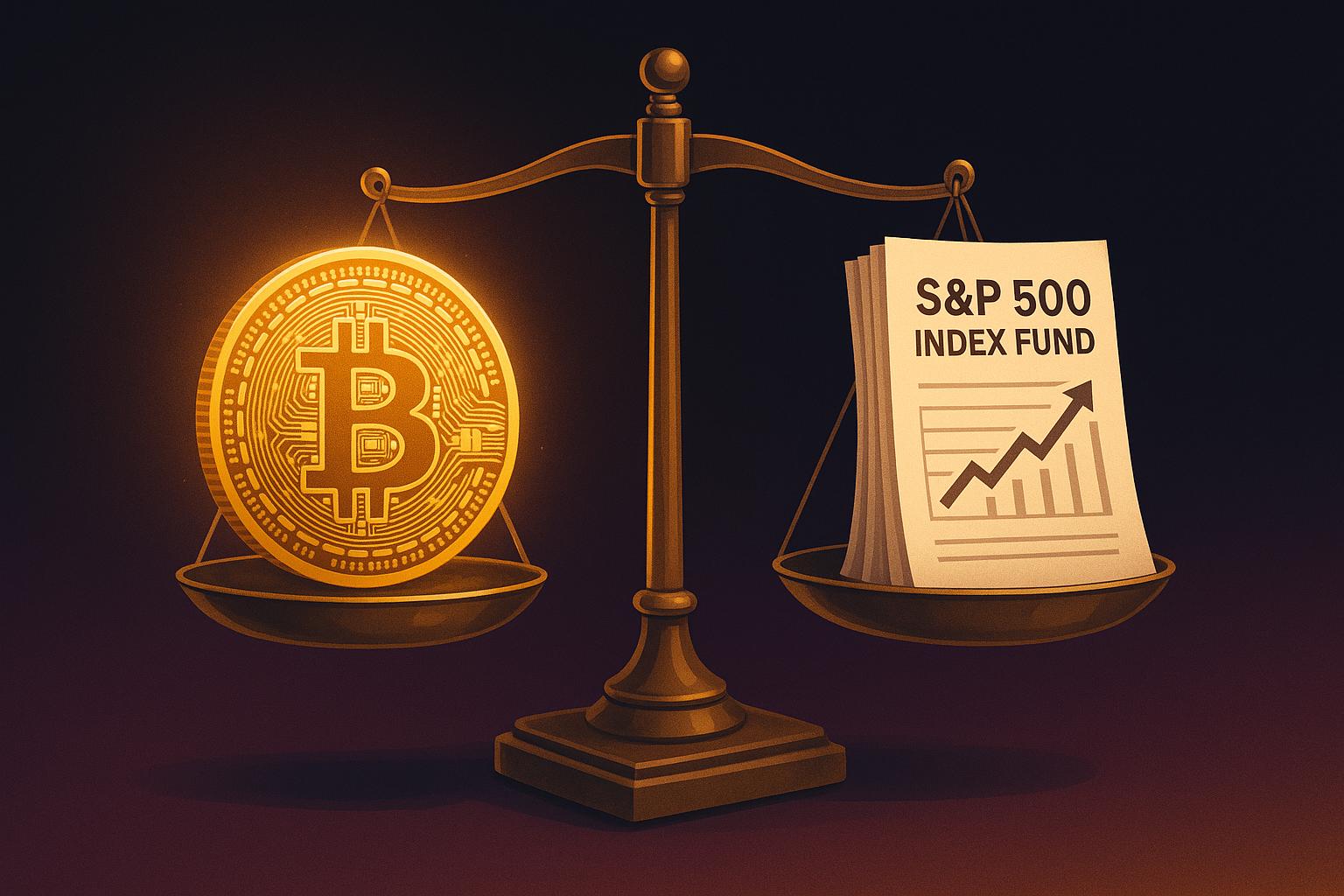
It depends on your investment goals and risk tolerance.
- S&P 500 index funds (like FXAIX, VOO, and SPY) offer steady growth, lower volatility, and broad exposure to 500 top U.S. companies. Over the last five years, S&P 500 index funds have averaged approximately 15.5% annual returns. They’re a safer choice for long-term, stable growth.
- Bitcoin has experienced significantly higher returns over the same period, but with extreme volatility. These figures are based on historical performance and do not guarantee future results. 1,283.6%, but its price swings are unpredictable. It’s better suited for risk-tolerant investors seeking aggressive growth.
If you prefer stability, S&P 500 funds are a better fit. If you’re comfortable with high risk for potentially higher rewards, Bitcoin might align with your goals. Many investors balance both: 80-90% in S&P 500 funds for stability, 10-20% in Bitcoin for growth potential.
Quick Comparison
Your decision should reflect your financial goals, risk tolerance, and investment timeline.
Why Bitcoin Will Outperform the S&P 500
Past Performance and Return Potential
Expanding on the earlier discussion, this section dives into historical returns to provide insights for strategic asset allocation. A look at past performance reveals clear distinctions: S&P 500 index funds are synonymous with steady, long-term growth, while Bitcoin stands out for its rapid but unpredictable returns.
S&P 500 Index Funds: A Foundation for Long-Term Growth
S&P 500 index funds have built a reputation for consistent, compounded growth over decades. These funds have weathered economic crises and shown resilience during tough market conditions. Even after significant market downturns, the index has historically rebounded and resumed its upward climb. This track record makes it an appealing choice for investors seeking stable, long-term returns with a focus on managing risk.
Bitcoin: High Potential, High Volatility
Bitcoin's history is a rollercoaster of sharp gains and steep corrections. Its extreme price swings reflect its volatile nature, making it better suited for those who are comfortable navigating unpredictable markets. While the potential for outsized returns exists, Bitcoin's volatility demands a higher risk tolerance. The comparison below highlights the key differences in performance and risk characteristics.
Performance Comparison Table
This comparison highlights the importance of aligning investments with individual risk tolerance. While Bitcoin can add diversification to a portfolio, its unpredictability calls for a balanced approach. Pairing a small allocation of Bitcoin with the stability of traditional assets like S&P 500 funds can help manage overall risk while exploring growth opportunities.
Risk and Market Swings
When deciding between S&P 500 index funds and Bitcoin, it's crucial to understand their distinct risk profiles. These two investment options behave differently in the market, which can significantly impact your investment journey and results.
Price Swings and Risk of Loss
S&P 500 index funds tend to follow broader economic trends, offering relatively stable price movements. Their diversification across stocks and bonds helps reduce the impact of any single company's performance on your portfolio. On the other hand, Bitcoin is known for its dramatic price swings, which can lead to rapid and significant changes in your investment's value. While this volatility might present opportunities for large gains, it also carries the risk of steep losses. Such unpredictability often triggers emotional reactions, leading to hasty decisions like panic selling during market drops or impulsive buying during upward spikes.
But market behavior isn't the only factor that sets these assets apart - regulatory protections also play a major role.
Regulation and Investor Protections
One of the key distinctions between S&P 500 index funds and Bitcoin lies in their regulatory environments. S&P 500 index funds operate within a well-established framework overseen by the Securities and Exchange Commission (SEC). These funds are registered securities, offering investors clear legal protections and safeguards.
Bitcoin, in contrast, exists in a lightly regulated space. Many cryptocurrency exchanges have been labeled "potentially unlawful" by the SEC. Additionally, crypto investments lack the safety nets provided by FDIC or SIPC insurance. This means that if a crypto exchange is hacked, goes bankrupt, or shuts down, recovering your funds can be extremely difficult. Bitcoin's decentralized nature also means there’s no central authority to help recover lost or stolen assets. Transactions are irreversible, further increasing the risk of permanent losses.
These regulatory differences highlight the importance of aligning your investments with your risk tolerance.
Aligning Investments with Risk Tolerance
Your choice between these two assets should reflect your comfort with risk and your financial objectives. For those who value stability and steady growth, S&P 500 index funds are often a better option. Their historical consistency and strong regulatory oversight make them appealing to more conservative investors.
If you're a moderate investor looking to balance stability with some exposure to higher returns, you might consider allocating a small portion of your portfolio to Bitcoin. This strategy allows you to benefit from Bitcoin's potential upside while keeping the bulk of your investments in the more stable S&P 500.
For those willing to embrace high volatility, a larger Bitcoin allocation might be appropriate. However, it’s crucial to understand the unique risks involved. Unlike traditional investments, Bitcoin losses from security breaches or mistakes are often permanent, as the decentralized system lacks mechanisms for recovery. Proceeding with caution and awareness is essential when navigating this space.
Diversification, Taxes, and Portfolio Planning
Exploring diversification, taxes, and portfolio integration is key to understanding how S&P 500 funds and Bitcoin can play complementary roles in building long-term wealth. Let’s break down these elements to see how they impact your investment strategy.
Diversification: Balancing Stability and Growth
S&P 500 index funds are the go-to choice for diversification. When you invest in funds like FXAIX, VOO, or SPY, you’re essentially spreading your money across 500 of the largest U.S. companies. This includes technology leaders like Apple and Microsoft, healthcare giants such as Johnson & Johnson, and financial powerhouses like JPMorgan Chase. The beauty of this approach? If one company or sector falters, the overall impact on your portfolio is cushioned by the performance of others.
Bitcoin, on the other hand, offers a very different kind of investment. As a single asset, it’s far more concentrated. However, its low correlation with traditional stock markets can make it a valuable diversification tool - when used sparingly. Many financial advisors recommend keeping Bitcoin exposure between 5-10% of your portfolio, striking a balance between its growth potential and the stability provided by S&P 500 index funds.
Finding this balance is crucial, but taxes also play a major role in shaping your investment decisions.
Tax Considerations for US Investors
S&P 500 index funds and Bitcoin are taxed differently, which can influence how you allocate your investments. Index funds benefit from favorable long-term capital gains tax rates if held for over a year. Depending on your income, these rates range from 0% to 20%, which is often lower than ordinary income tax rates. Additionally, index funds are structured to generate fewer taxable events, making them more tax-efficient. You can also use strategies like tax-loss harvesting to offset gains with losses from other investments.
Bitcoin, however, is treated as property by the IRS, which means every transaction - whether buying, selling, or using it - creates a taxable event. Unlike stocks and index funds, Bitcoin isn’t subject to wash sale rules. This means you can sell Bitcoin to realize a loss and immediately repurchase it without waiting 30 days, creating unique tax-saving opportunities.
Tools like Mezzi’s tax optimization features simplify these complexities. For example, they can help you avoid wash sales across multiple accounts and identify ways to save on taxes, ensuring your investment strategy remains efficient.
Portfolio Allocation Strategies
Your ideal portfolio mix depends on factors like your risk tolerance, investment timeline, and financial goals. Here are three popular strategies to consider:
- Conservative Approach (90% S&P 500, 10% Bitcoin): This strategy prioritizes stability while giving you a small stake in Bitcoin’s growth potential.
- Moderate Approach (80% S&P 500, 20% Bitcoin): A middle ground for those comfortable with some volatility in exchange for potentially higher returns.
- Aggressive Approach (70% S&P 500, 30% Bitcoin): Designed for high-risk investors who are focused on long-term growth and can handle significant market swings.
Mezzi’s tools can simplify the process of managing these allocations. The X-Ray feature, for instance, helps you identify hidden concentrations in your portfolio. Say you own both an S&P 500 index fund and individual tech stocks - this tool aggregates your overall tech exposure, ensuring you’re not unintentionally over-invested in one sector.
The Financial Calculator is another valuable resource. It estimates your retirement savings based on factors like your current portfolio value, annual contributions, expected returns, and fees. This can help you visualize how different allocations of S&P 500 funds and Bitcoin might influence your long-term financial goals.
For ongoing portfolio management, Mezzi’s account aggregation feature lets you view all your investment accounts in one place. This streamlines rebalancing, ensuring you maintain your target allocation across various brokerages and account types. Plus, AI-driven recommendations can alert you to rebalancing opportunities, helping you stay aligned with your strategy while minimizing tax impacts.
With both traditional investments and cryptocurrency in your portfolio, regular reviews are essential. Market fluctuations can shift your allocations, so periodic adjustments are necessary to keep your risk profile and investment goals on track.
Choosing the Right Investment for Your Goals
After analyzing performance, risk, and diversification, the next step is to align your investment choices with your personal financial goals.
Depending on your financial situation, risk tolerance, and timeline, you might lean toward S&P 500 funds for stability or Bitcoin for aggressive growth. Each plays a distinct role in a well-rounded portfolio.
S&P 500 vs Bitcoin: What to Consider
S&P 500 index funds, such as FXAIX, VOO, and SPY, offer a blend of stability, diversification, and long-term growth. These funds provide historically consistent returns and the added benefit of dividend income, which may be suitable for beginners or those approaching retirement. On the other hand, Bitcoin caters to investors with a higher risk tolerance, seeking the potential for significant returns despite its price volatility.
A balanced approach often works best. Combining traditional assets like S&P 500 funds with a smaller allocation to Bitcoin can help manage risk while tapping into growth opportunities. Your investment timeline is also key. If you have decades until retirement, you may have room for more Bitcoin exposure. However, if your goals are short-term, a heavier focus on S&P 500 funds might be more prudent.
How Mezzi Can Enhance Your Investment Strategy
Mezzi’s platform simplifies managing both traditional investments and cryptocurrencies with a suite of powerful tools. Its features help you spot hidden risks, ensure proper diversification, and optimize your portfolio for tax efficiency. A retirement savings calculator lets you project potential savings based on your portfolio and planned contributions.
The platform’s unified dashboard aggregates all your investments in one place, making it easier to rebalance as market conditions change using tax-efficient strategies. With AI-driven insights and tailored recommendations, Mezzi helps you make timely decisions - whether it's shifting between S&P 500 funds and Bitcoin or uncovering new opportunities to improve your strategy.
For self-directed investors, Mezzi streamlines portfolio management, making it easier to align your investment choices with your long-term retirement goals.
FAQs
×
×
×
How can I decide the right mix of S&P 500 index funds and Bitcoin for my investment portfolio?
To figure out the right balance between S&P 500 index funds and Bitcoin in your portfolio, start by considering three key factors: your risk tolerance, investment goals, and time horizon. S&P 500 index funds are known for their steady, long-term growth, generally delivering average annual returns of about 10% with lower volatility. On the other hand, Bitcoin offers the potential for higher returns but comes with significantly more price fluctuations and risk in the short term.
A practical strategy might involve dedicating a smaller portion of your investments to Bitcoin if you're comfortable with its unpredictability, while allocating the bulk to diversified index funds for more stability. Over time, you can tweak these allocations as your financial objectives and market conditions evolve. Regularly rebalancing your portfolio is crucial to ensure it stays aligned with your risk preferences and overall investment strategy.
×
×
×
What are the tax differences between investing in Bitcoin and S&P 500 index funds?
In the U.S., Bitcoin is classified as property for tax purposes. This means that any profits you make from selling or trading Bitcoin are subject to capital gains tax, which can vary between 10% and 37%, depending on your income and how long you’ve held the asset. Additionally, earnings from activities like Bitcoin mining or staking are treated as ordinary income and taxed accordingly.
S&P 500 index funds, however, are taxed under a different structure. When you sell these funds, the profits are subject to capital gains tax, with long-term gains taxed at 0%, 15%, or 20%, depending on your income bracket. Dividends from these funds are typically taxed as ordinary income, although some may qualify for lower rates if they meet the criteria for "qualified dividends."
The main difference between the two lies in how often taxable events occur. Bitcoin transactions often result in more frequent tax liabilities, while S&P 500 index funds are usually taxed only when you sell them or receive dividends. This difference can make index funds more appealing for long-term investors, depending on your overall strategy.
×
×
×
How does regulation affect the safety of investing in S&P 500 index funds compared to Bitcoin?
Regulation is a cornerstone of investment security. S&P 500 index funds operate within a robust regulatory framework designed to protect investors, minimize systemic risks, and promote transparency. These measures create a stable and trustworthy option for those looking to invest with confidence.
In contrast, Bitcoin exists in a more fluid and less defined regulatory landscape. This lack of clarity can lead to potential risks, including abrupt legal restrictions or government interventions that may affect its value and security. While Bitcoin holds the allure of high returns, its uncertain regulatory status often brings heightened volatility into the equation.Disclosures:
- Past performance is not indicative of future results. No guarantee of future performance or outcomes is implied.
- This content is for informational purposes only and does not constitute investment advice or a recommendation to buy or sell any security.
- Savings and performance examples are hypothetical and for illustrative purposes only. Actual results will vary based on individual circumstances, portfolio composition, market conditions, and fees.
- Registration does not imply a certain level of skill or that the SEC has approved the company or its services.
Related Blog Posts
- Here are the top performing index funds available through Fidelity
- How did my portfolio perform versus the S&P 500 over the past year?
- Best NASDAQ index options at Vanguard (ETFs vs mutual funds) and how they differ.
- Which NASDAQ index funds can I buy on Merrill Edge, and which have the longest track records?