
AI-driven wealth platforms are reshaping personal finance, but they risk deepening existing inequalities. Here's the issue and how to fix it:
- AI is becoming central to wealth management: By 2028, 80% of investors are expected to rely on AI tools.
- Wealth gaps persist: The average net worth of white families is nearly 10x that of Black families, and AI systems often amplify biases from historical data.
- Barriers to access: Economic challenges, mistrust in AI vs. human advisors, and lack of digital literacy limit adoption, especially in underserved communities.
- Algorithmic bias: AI models trained on biased data can lead to unfair outcomes, like higher loan rates for minorities.
- Solutions: Regular audits, transparent algorithms, and accessible platform design can create fairer systems.
Platforms like Mezzi aim to bridge these gaps by offering affordable, AI-powered financial tools for all users, prioritizing equity, transparency, and privacy.
The Real Danger of AI in Finance - Bias, Monitoring & Compliance Cracks
Root Causes of Disparities in AI Wealth Management
Disparities in AI-driven wealth management are deeply tied to long-standing issues in traditional finance. These challenges, now magnified by artificial intelligence, highlight the urgency for more balanced and fair solutions.
Algorithmic Bias and Data Limitations
AI systems are only as good as the data they learn from. When historical data reflects patterns of discrimination, AI algorithms can unintentionally reproduce and even amplify these biases, perpetuating societal inequalities. For example, limited financial data on lower-income individuals often leads to less accurate predictions, increasing the risk of unfair treatment.
A striking example comes from a 2022 UC Berkeley study on fintech lending. The research found that African American and Latinx borrowers were charged nearly 5 basis points more in interest rates compared to their credit-equivalent white counterparts. This seemingly small difference adds up to a staggering $450 million in extra interest annually.
AI-powered credit scoring and loan approval processes can also exacerbate existing prejudices, putting already vulnerable groups at a disadvantage. Pricing algorithms further complicate matters by raising costs when they detect consumers are unlikely to shop around, a practice that disproportionately affects those with limited access to credit or banking relationships. Even when risk models are designed with fairness in mind, they can unintentionally reinforce inequities across protected groups.
Adding to the problem, many AI systems operate as "black boxes", meaning their decision-making processes are opaque and difficult to scrutinize. This lack of transparency makes it harder for consumers to challenge potentially unfair outcomes. These algorithmic challenges are only one piece of the puzzle - economic barriers also play a significant role.
Economic Barriers to Access
Economic limitations present another major obstacle to the adoption of AI wealth management tools. A gap in digital literacy means that many individuals lack the technical skills needed to navigate these tools effectively. This divide is particularly pronounced in communities that have historically faced limited access to both technology and financial services.
Mistrust in AI further complicates adoption, especially in communities with a history of systemic inequities. As Mohamed Jalloh, PharmD of Partnership Health Plan, explains:
"When you introduce something new, especially something you don't have a lot of information about, it's easy to be scared of it".
These barriers - rooted in economic and social inequality - compound the challenges of creating equitable access to AI-driven financial tools.
Historical Inequities in Financial Systems
The legacy of discrimination in financial services continues to influence how different communities engage with new financial technologies. For many, limited access to traditional financial services has left them less prepared to adopt AI-driven tools.
Data from 2024 paints a clear picture: while 42% of households relied on their bank or financial institution for financial information, only 3% reported using chatbots or robo-advisor apps. Among those not using digital tools, awareness gaps varied significantly by demographic. For instance, just 10% of Asian households reported unfamiliarity with these tools, compared to over 25% of Black, Latinx, and white households. Additionally, 31% of respondents cited a lack of trust in AI tools as a key reason for avoiding them.
Dr. Noah W. Sobe highlighted the broader implications of these disparities:
"Major collective gains also come with worrisome increases in inequality and exclusion and ensuring the proper rollout of something that takes time and attention when we look to the future".
He further noted how the COVID-19 pandemic intensified these challenges:
"The COVID-19 pandemic has really exacerbated these challenges and the inequalities that we face around the globe".
Strategies to Identify and Address Disparities
Building fair AI-driven wealth management systems requires intentional action. Companies need to pinpoint potential issues and implement measures that ensure fair treatment for all users. Below are strategies that outline how to make financial technology more inclusive.
Auditing AI Systems for Bias
Regular audits are crucial for maintaining fairness in AI systems. This involves examining how data is collected, organized, and processed, while ensuring training datasets represent diverse user groups. Accenture reports that 90% of advisors believe AI could help grow their business by over 20% - but only if these systems are built equitably.
One key step is to test data labeling and proxies to catch bias early, optimizing both features and labels. Ricardo Baeza-Yates from NTENT emphasizes:
"Companies will continue to have a problem discussing algorithmic bias if they don't refer to the actual bias itself".
Independent third-party verification can help confirm that biases have been addressed. Additionally, synthetic data - designed to replicate real-world scenarios while excluding sensitive variables - can protect privacy and enhance model performance.
Here’s a quick look at common sources of bias and how they manifest:
SourceDescriptionExample ManifestationsData DeficienciesErrors or lack of diversity in training dataGender bias, demographic imbalancesDemographic HomogeneityLimited population diversity in trainingDiscrimination against minority groupsSpurious CorrelationsProxy variables tied to protected attributesRacial bias linked to zip codesImproper ComparatorsUnfair benchmarking groupsFavoring high-income groupsCognitive BiasesDesigners' assumptions influencing systemsConfirmation bias, selective perception
Rich Caruana from Microsoft highlights the complexity of resolving bias:
"We almost need a secondary data collection process because sometimes the model will [emit] something quite different".
By identifying and addressing these biases through rigorous audits, AI platforms can better meet the needs of diverse users.
Designing Accessible Platforms
Addressing bias is only part of the solution - designing platforms that remove access barriers is equally essential. Gus Alexiou highlights the potential here:
"For users with disabilities, the opportunities for AI to enhance accessibility to digital products and workflows are tantalizing, provided that principles of inclusivity are baked into its design from the outset".
A human-centered approach involves engaging directly with users from various backgrounds to understand their unique needs and preferences. Thoughtfully designed conversational interfaces can bridge communication gaps by recognizing diverse speech patterns and offering tailored interactions.
Automated features like alt text, audio descriptions, and real-time captions are also powerful tools for improving accessibility. With over 25% of Google's new code generated by AI, ensuring that this technology supports accessibility from the start is critical. Educational resources and user-friendly guidance can further help individuals navigate complex financial systems, even if they’re new to AI or advanced financial planning.
Mobile-first design is another key consideration, ensuring seamless navigation on smaller screens. Eamon McErlean, VP and Global Head of Accessibility at ServiceNow, warns:
"Accessibility was an afterthought for many years within the .com world... Thankfully, a lot of companies have since jumped on to resolve and to catch up. But the speed that Gen AI is going right now, accessibility can't be an afterthought because playing catch-up in that arena is going to be exponentially more difficult, and that could end up being dangerous".
Building Transparency and Accountability
Transparency is the cornerstone of user trust in AI-powered wealth management. Users need to understand how these systems work and feel confident in their fairness. Explainable AI can help by breaking down the reasoning behind algorithmic recommendations, enabling users to make informed decisions.
Clear documentation, regular human oversight, and frequent impact assessments are essential for ensuring fairness and accountability. Openly communicating how AI is used - along with the safeguards in place - further strengthens user confidence. Techniques like adversarial training can also help AI systems resist manipulation and minimize errors.
As highlighted in the Zendesk CX Trends Report 2024:
"Being transparent about the data that drives AI models and their decisions will be a defining element in building and maintaining trust with customers".
Ignoring transparency has led to notable failures in the past, underscoring the importance of fairness and accountability. Continuous monitoring is critical, as AI systems can evolve or develop new biases over time. Regular audits ensure these issues are caught and corrected before they affect users.
How Mezzi Addresses Disparities in AI Wealth Platforms
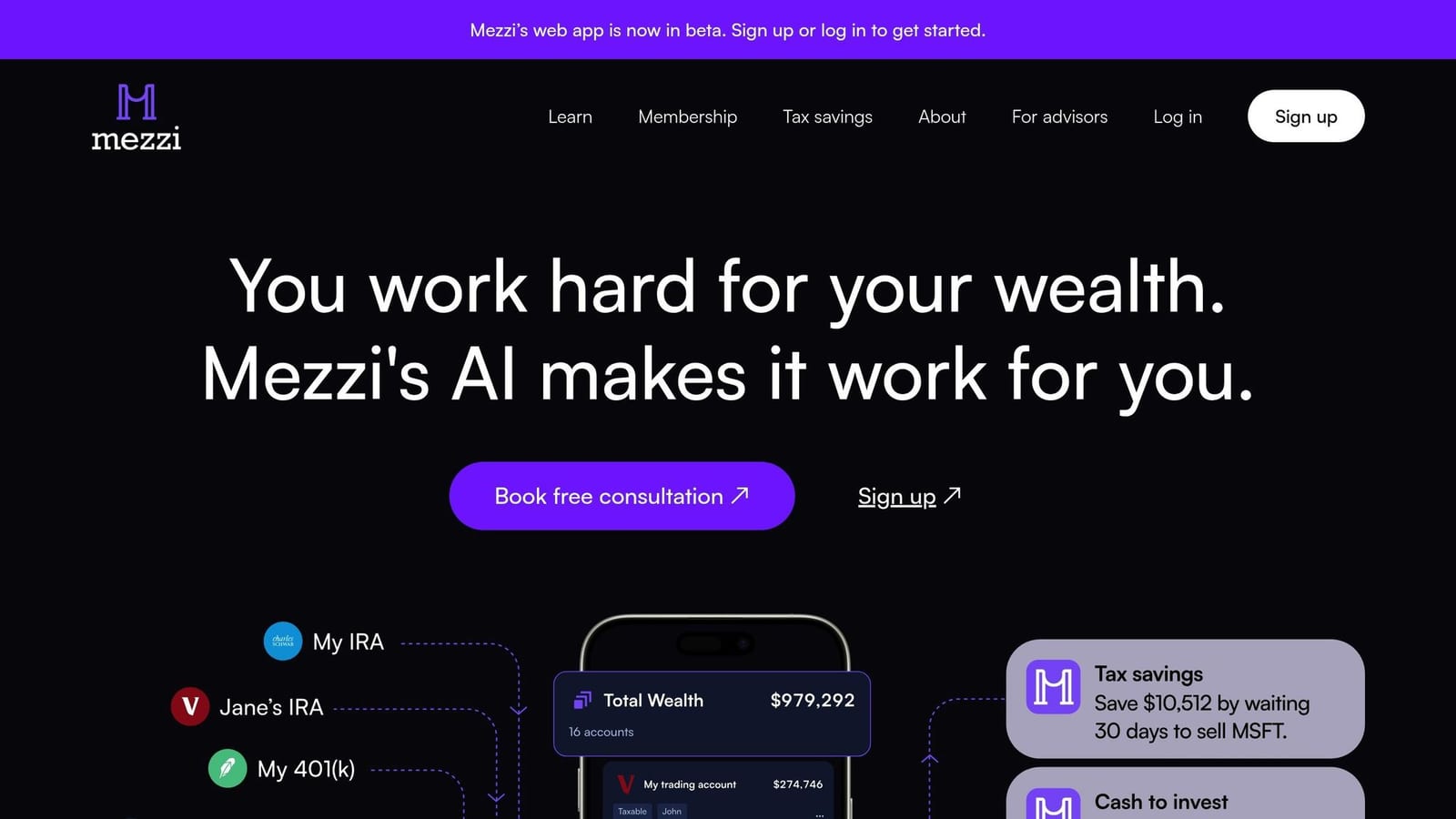
Many AI wealth platforms cater to high-net-worth individuals, leaving everyday investors behind. Mezzi changes that by making advanced financial insights accessible to everyone. Historically, these insights were limited to those who could afford costly financial advisors. Mezzi leverages AI to simplify complex financial analyses, turning them into actionable guidance for self-directed investors. By addressing these long-standing gaps, Mezzi opens the door to tools and strategies that were once out of reach.
As Maureen Doyle-Spare, Head of Banking and Financial Services at UST, and Peter Charrington, UST Advisor and Former CEO of Citi Private Bank, explain:
Artificial intelligence (AI) has quickly become a transformative force in personal finance, powering solutions that empowering individuals to make smarter financial decisions and equipping wealth managers with deeper insights to optimize client outcomes.
Mezzi embodies this transformation by delivering institutional-grade financial intelligence directly to individual investors.
Advanced AI-Powered Insights for Everyone
Mezzi’s AI processes data into real-time, actionable insights, helping users identify opportunities and manage risks across all their accounts.
Take the X-Ray feature, for example. It uncovers hidden stock exposures that users may not even know they have, reducing the risk of concentrating too much in a single area. On top of that, Mezzi’s tax optimization tools automatically avoid wash sales across multiple accounts, helping users avoid costly tax mistakes.
With AI-managed assets projected to hit nearly $6 trillion by 2027 and McKinsey estimating up to $1 trillion in annual value from AI in banking, Mezzi is at the forefront of this financial revolution. By automating routine tasks like portfolio rebalancing with AI, Mezzi delivers efficiency gains of 20–30%, extending these benefits to investors who previously lacked access.
A key feature of Mezzi is its unified account view, which consolidates all financial accounts into one dashboard. This comprehensive perspective allows the AI to conduct cross-platform analyses, offering personalized strategies and optimization opportunities across various accounts and asset classes.
Breaking Barriers with Simple Pricing
Economic barriers often prevent average investors from using advanced wealth management tools. Mezzi tackles this issue with a straightforward pricing model that eliminates traditional advisor fees.
The platform offers a free tier that includes consolidated account views and essential tools. For those seeking more, the Advisory ($39/month or $399/year) provides real-time AI prompts, unlimited chat, in-depth risk analysis, and advanced tax optimization.
Over a 30-year period, Mezzi users could potentially save over $1 million by avoiding traditional advisor fees while still benefiting from sophisticated financial guidance. The platform’s mobile-first design ensures easy access on any device, and tools like professional-grade financial calculators like a retirement goal planner help users plan for the future with confidence.
Prioritizing Security and Privacy
Trust is central to Mezzi’s mission, and the platform backs this up with strong security measures and transparent privacy policies. By partnering with well-established aggregators like Plaid and Finicity, Mezzi ensures that financial data is handled with the highest security standards.
Their privacy policy, updated on November 17, 2023, emphasizes:
Mezzi will never sell your personal or financial information to third parties.
Additionally, Mezzi reinforces this commitment:
The privacy of your financial information is of utmost importance to Mezzi.
The platform is ad-free and designed with privacy in mind, giving users control over their data through account settings or by contacting support. Clear unsubscribe options for communications are also provided, ensuring a user-first approach.
With these security and privacy measures, Mezzi empowers users to confidently manage their wealth using advanced AI tools, knowing their personal and financial information is safeguarded.
Conclusion: Bridging the Gap in AI Wealth Management
The growing disparities in AI-driven wealth management present a significant challenge in modern finance. As we've discussed, these gaps often arise from algorithmic bias, economic hurdles, and long-standing inequities that have left many everyday investors without access to advanced financial tools. The solution lies in prioritizing transparency, accessibility, and fair practices, paving the way for a more inclusive financial future.
The urgency of addressing these disparities is highlighted by striking growth projections. By 2027, AI-powered tools are expected to become the primary source of financial advice for retail investors, with adoption rates reaching 80% by 2028. Robo-advisors alone are projected to manage nearly $6 trillion in assets by 2027. Moreover, 90% of financial advisors anticipate over 20% business growth from AI integration, while over 80% of investors are open to AI-assisted portfolio management. These numbers paint a clear picture: the demand for accessible, AI-driven financial solutions is surging.
Platforms like Mezzi showcase how these challenges can be addressed. By offering affordable pricing and advanced AI insights, Mezzi breaks down traditional barriers, delivering institutional-grade financial intelligence to a broader audience. For instance, the platform estimates it can help users save over $1 million over 30 years. Its strong focus on privacy and security further builds trust, a critical factor given that 62% of wealth management firms recognize AI's transformative potential.
To fully realize these benefits, the industry must adopt hybrid models that blend AI's efficiency with human oversight. The aim isn't to replace human expertise but to ensure that cutting-edge financial guidance is available to everyone - regardless of their wealth or background. With equity and accessibility at the forefront, the future of wealth management can become a tool for empowerment, not exclusion.
FAQs
How can AI-powered wealth platforms impact economic inequality, and what steps can reduce these effects?
AI-driven wealth platforms could unintentionally deepen economic inequality by primarily benefiting those who already possess financial resources and digital know-how. People with higher incomes are typically better positioned to make the most of these tools, while individuals with lower incomes often encounter obstacles like limited access to technology or insufficient digital skills. This divide risks further widening the wealth gap.
Addressing this issue requires expanding access to these financial tools. Initiatives such as digital literacy programs and designing platforms that are intuitive and inclusive can make a big difference. By prioritizing user-friendly systems tailored to diverse needs, companies can ensure financial insights reach a broader audience. On top of that, policies aimed at improving financial education and offering targeted support to underserved communities can play a key role in leveling the playing field and promoting economic fairness.
How does algorithmic bias affect AI-driven wealth management, and what can be done to ensure fairness for all users?
Algorithmic bias in AI-driven wealth management can lead to unequal outcomes by unintentionally reinforcing existing inequalities. This often happens when the training data is biased or incomplete, which can skew results against certain demographics. Take creditworthiness assessments as an example - if the algorithm learns from data that lacks diversity or mirrors historical inequities, it might unfairly disadvantage specific groups.
Addressing this issue requires deliberate action. Using diverse and representative datasets, developing algorithms designed with fairness in mind, and conducting regular audits to spot and mitigate bias are key steps. Equally important is ensuring transparency in how these AI systems operate. When users understand how decisions are made, it fosters trust and reassures them that they’re being treated fairly. By focusing on these efforts, AI-driven wealth management platforms can help build a financial system that works for everyone.
How can AI wealth platforms become more accessible and trustworthy for underserved communities?
Improving access to and building trust in AI-driven wealth platforms for underserved communities requires thoughtful strategies. One effective method is leveraging alternative data sources, such as utility bill payments or shopping patterns, to evaluate creditworthiness. This approach opens the door to financial tools for individuals who lack traditional credit histories, expanding their opportunities.
Another crucial step is designing financial products that are simple, inclusive, and easy to use. These tools should address the specific needs of underserved groups, making them more accessible and engaging. Transparency plays a big role here too - clearly outlining how AI algorithms function and how user data is managed can go a long way in building trust. Additionally, actively seeking feedback from these communities and incorporating their insights into product development ensures the platform genuinely aligns with their needs.
By adopting these strategies, AI wealth platforms can help underserved communities gain greater control over their financial futures and tap into wealth-building opportunities that might have previously felt out of reach.
Mezzi is free to get started. Choose Advisory for unlimited advice and advanced features at $39/month or $399/year. Concierge includes the same, plus hands-on support, at $99/month or $999/year.