
Wealth management services can help grow and protect your money, but the right choice depends on your needs. Here's a quick breakdown:
- Traditional Advisors: Personalized advice, ideal for complex financial situations like estate planning or business sales. Costs range from 1-2% of assets or hourly fees.
- AI Platforms (e.g., Mezzi): Automated tools for real-time portfolio monitoring and tax optimization. Flat fees like $39/month or $399/year make them affordable for smaller, straightforward portfolios. They are particularly effective when you link tax planning with investment tools to maximize returns.
Quick Comparison:
FeatureTraditional AdvisorsAI Platforms (e.g., Mezzi)Cost1-2% of assets annuallyFlat fee ($39/month or $399/year)AvailabilityBusiness hours24/7 accessPortfolio MonitoringPeriodic reviewsReal-time adjustmentsTax OptimizationManual planningAutomated tax-loss harvesting toolsBest ForComplex situationsStraightforward needs
If you prefer hands-on, personalized guidance, traditional advisors are a good fit. For cost-effective, tech-driven solutions, AI platforms like Mezzi might be better. Choose based on your financial goals, tax-efficient wealth building needs, and comfort with technology.
AI vs Human Financial Advisors: Who Manages Wealth Better?
1. Working with Financial Advisors
Financial advisors offer personalized planning and expert insights, tailoring strategies to align with your unique goals and comfort with risk.
Most traditional financial advisors operate under two main fee structures:
Service ModelFee StructureTypical Client ProfileAsset-Based1% – 1.5% of assets annuallyHigh-net-worth individualsHourly ConsultationVariable hourly ratesProject-specific guidance
These professionals bring value by helping shape long-term strategies and providing guidance during market ups and downs. Fiduciary advisors, in particular, are legally required to act in their clients' best interests.
Tax planning is another area where financial advisors excel. They can help:
- Reduce tax liability through strategic investment placement
- Make the most of retirement account distributions
- Structure investments to improve tax efficiency
- Plan the timing of capital gains and losses
Studies show that over 90% of people could benefit from professional financial advice.
When selecting an advisor, consider their experience, certifications, fees, communication style, and investment approach. A strong client-advisor relationship includes regular portfolio reviews and strategy updates.
This personalized approach sets the stage for comparing traditional advisors with AI-driven platforms.
2. Using AI Investment Platforms (e.g., Mezzi)
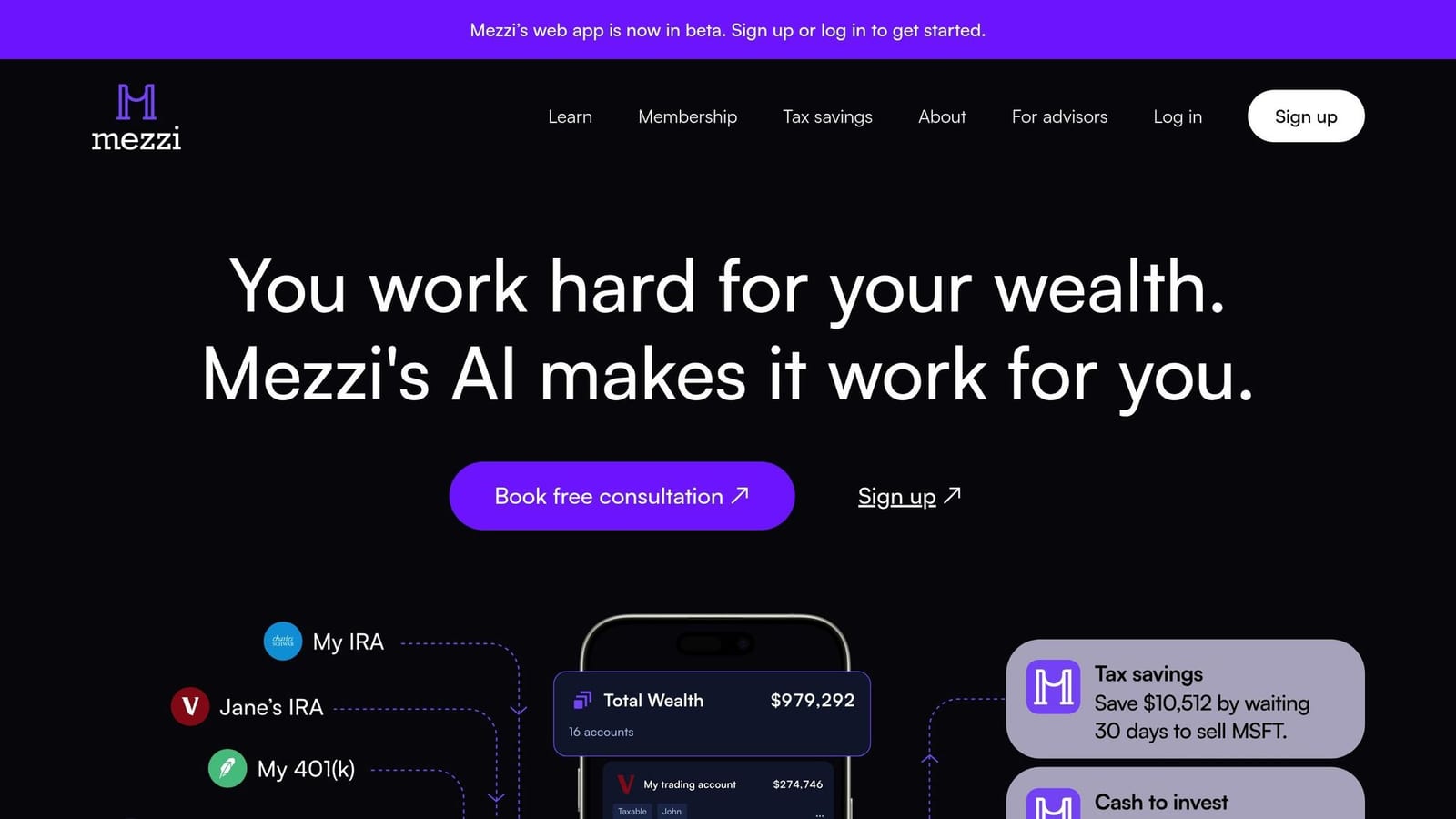
AI investment platforms are changing the game in wealth management by using algorithms to constantly fine-tune portfolios - something that was once the domain of traditional advisors. Unlike their human counterparts, these platforms adjust strategies in real time to improve efficiency.
Take Mezzi, for example. Their platform offers a range of tools designed to help users achieve better financial outcomes over the long term. By optimizing fees for ETFs and mutual funds, users could save around 1% annually, which could translate to an additional $186,877 in retirement savings.
Here’s how Mezzi delivers these benefits across three key areas:
Automated Portfolio Management
Mezzi continuously monitors and adjusts portfolios through secure, read-only account integration with top financial aggregators.
Tax Optimization
Smart tax-loss harvesting can significantly reduce capital gains taxes. For instance, saving $10,221 in taxes through strategic management could grow to $76,123 over 30 years.
Cost-Efficient Structure
Service TierAnnual CostKey FeaturesFreeFree to get startedBasic account consolidation, family collaborationPremium$39/month or $399/yearAI-powered insights, unlimited AI chat, tax/fee optimization
Mezzi’s flat-fee pricing model offers a clear advantage over traditional percentage-based fees. Premium users gain access to advanced tools like real-time AI suggestions and detailed performance analysis, all while keeping full control of their investments.
Benefits and Limitations
Let’s break down the key differences between human advisors and AI-driven platforms. The table below highlights their primary features:
AspectTraditional AdvisorsAI-Powered PlatformsCost Structure1-2% of assets annuallyFlat fee (e.g., $39/month or $399/year for Mezzi Premium)Portfolio MonitoringQuarterly/annual reviewsReal-time, continuous monitoringTax OptimizationManual vs. AI tax planningAutomated tax-loss harvestingPersonalizationTailored guidanceData-driven customizationResponse TimeBusiness hours, scheduled meetings24/7 instant accessComplex SituationsStrong for unique circumstancesBest suited for standard scenarios
Now, let’s explore the specific strengths and limitations of each option in more detail.
Strengths of Traditional Advisors
Human advisors shine in handling intricate financial situations that require a deeper understanding. They are especially helpful during major life events like inheritance planning, selling a business, or navigating a divorce. Their ability to provide tailored advice can also help prevent hasty or emotionally driven financial decisions.
Advantages of AI Platforms
AI-powered platforms bring unique strengths to the table. They offer real-time portfolio monitoring, which allows for immediate adjustments - something that traditional, periodic reviews often miss. Additionally, these platforms are more cost-effective, with flat fees that are easier on long-term returns compared to percentage-based charges. Services like Mezzi make continuous oversight accessible and affordable.
Key Limitations to Keep in Mind
Each approach has its drawbacks:
- Traditional Advisors: Limited availability outside business hours and higher costs can reduce overall investment growth over time.
- AI Platforms: While efficient for routine financial needs, they may fall short in addressing complicated scenarios, such as managing complex trust structures or unusual tax requirements.
AI platforms are a good fit for investors who:
- Have straightforward financial needs
- Are comfortable using technology
- Prefer data-driven decision-making
- Want to maintain direct control over their investments
Ultimately, the best choice depends on your financial goals, comfort with technology, and how much control you want over your investment strategy. Take these factors into account to decide which option works best for you.
Making Your Choice
When deciding between traditional advisors and AI platforms, consider these key factors:
Portfolio Size and Complexity
If your portfolio includes intricate elements like business ownership or trusts, a Certified Financial Planner (CFP) or wealth manager can provide tailored advice. For simpler financial goals, AI platforms offer an affordable way to monitor and manage your investments.
Tax Situation
Evaluate how complex your tax needs are. Automated tax-loss harvesting works well for straightforward cases, but more tax planning and loss harvesting strategies might require professional expertise.
Time and Involvement
Think about how involved you want to be in managing your investments. Traditional advisors are ideal for those who prefer a hands-off approach, while AI platforms are great for individuals who want to actively engage in decision-making.
Cost Considerations
Fees play a big role in your long-term returns. Traditional advisors typically charge a percentage of your portfolio, which can reduce gains over time. On the other hand, AI platforms often use fixed-fee models, such as premium plans costing $39/month or $399/year, which can be especially appealing for smaller portfolios.
Decision Framework
Here’s a quick guide to help you decide:
- **Choose an AI platform if you:**Want 24/7 portfolio monitoring
- Value data-driven decisions
- Aim to minimize fees while keeping control of your investments
- Have a simple tax situation
- **Go with a traditional advisor if you:**Need detailed guidance for complex estate or tax planning
- Are navigating major life changes and want a comprehensive financial strategy
- Prefer face-to-face interactions for making financial decisions
FAQs
How can I choose between a traditional financial advisor and an AI-driven investment platform?
Choosing between a traditional financial advisor and an AI-driven investment platform depends on your financial goals, complexity, and preferences.
AI platforms, often called robo-advisors, are great for straightforward financial needs like basic investing or retirement planning. They’re cost-effective, typically charging 0.25% to 0.50% of assets under management (AUM), and are easy to use.
Traditional financial advisors are better suited for complex situations, such as estate planning or managing significant wealth. They provide personalized guidance but usually charge higher fees, often around 1% to 2% of AUM, with a common minimum investment threshold of $250,000 or more.
For a middle ground, hybrid services combine automated tools with access to human advisors, making them ideal for individuals with growing or mid-career assets. Ultimately, the right choice depends on your budget, financial complexity, and preference for personalized advice versus automation.
How can an AI-powered platform like Mezzi improve tax efficiency and portfolio management?
AI-powered platforms like Mezzi simplify and enhance both tax efficiency and portfolio management by automating complex processes. For example, they can implement tax-loss harvesting, a strategy that involves selling underperforming investments to offset capital gains, reducing your overall tax burden. This process is automated, saving you time and ensuring opportunities aren’t missed.
Additionally, these platforms analyze your portfolio to maximize tax deductions while ensuring compliance with U.S. tax regulations. By leveraging AI, Mezzi helps you make smarter, data-driven decisions to optimize your investments and achieve your financial goals more effectively.
What are the potential downsides of using only AI for managing complex financial situations?
AI-driven platforms bring significant advantages to wealth management, but relying exclusively on them for complex financial situations has its challenges. AI lacks the personal touch needed to fully understand unique life circumstances or emotional factors that can impact financial decisions.
Additionally, AI systems rely heavily on historical data, which may limit their ability to respond effectively to sudden, unprecedented market changes. For the best results, combining AI tools with human expertise can help create a more balanced and adaptable financial strategy.
Mezzi is free to get started. Choose Advisory for unlimited advice and advanced features at $39/month or $399/year. Concierge includes the same, plus hands-on support, at $99/month or $999/year.