
AI-driven tax optimization is reshaping how investors manage taxes by automating strategies that reduce tax burdens and enhance after-tax wealth. Tools like Mezzi simplify complex tasks such as AI tax-loss harvesting, wash sale detection, and asset location, helping self-directed investors save time and money without relying on costly advisors. Here's what you need to know:
- Preparation: Link all financial accounts (taxable, retirement, trust, etc.) and ensure personal tax information is up-to-date. Upload tax documents and confirm compatibility with U.S. tax rules.
- Core Features: AI tools monitor portfolios for tax-saving opportunities, optimize asset placement, and recommend tax-efficient withdrawal strategies. Scenario modeling helps plan for major financial decisions.
- Ongoing Monitoring: Regular reviews, real-time alerts, and detailed reports ensure compliance with tax laws and help avoid mistakes.
Platforms like Mezzi offer advanced tools for managing portfolios, using AI tools for navigating wash sale rules, and providing actionable insights - all for $39/month or $399/year. Whether you're planning for retirement or managing multiple accounts, AI tools can streamline tax planning and boost long-term savings.
Ten Ways to Use AI Tools to Optimize Your Tax Returns” – Free Online Seminar - Mike Nie 2025.04.01
Getting Started: Prerequisites for AI Tax Optimization
Before you jump into using AI for tax optimization, it’s essential to have a well-organized financial setup. This ensures that your AI tools can access accurate and complete data to uncover tax-saving strategies. Here’s how to prepare your finances for AI-driven optimization.
Connect and Organize Financial Accounts
To build a complete financial profile for your AI tool, connect all relevant accounts - not just your primary brokerage account. This includes taxable investment accounts, such as individual and joint accounts from major financial institutions.
Don’t forget to add retirement accounts like 401(k)s, IRAs, and HSAs, as they come with unique tax considerations. If you have trust accounts or 529 education savings plans, include those too. For instance, HSAs offer a triple tax advantage, making them a key component of many tax strategies.
Make sure account ownership and beneficiary details are current across all accounts. Outdated information can lead to errors in tax calculations and missed opportunities for optimization. Once your accounts are linked, update your personal tax details to ensure the AI can tailor its recommendations effectively.
Update Personal and Tax Information
Your tax optimization strategy depends heavily on your personal tax situation. Start by confirming your current filing status and updating your state residency, as tax laws differ by location. Significant life changes, like marriage or having children, can also affect your approach.
Add details about dependents to refine tax credit and education planning. Keep your income sources and projections up to date - whether it’s salary, bonuses, rental income, or business income. Accurate income data helps the AI estimate your tax bracket and determine the best timing for gains or losses.
Gather Tax Documents and Investment Data
Upload your last two years of tax returns along with key investment documents, such as 1099s and K-1s. This historical data gives the AI a clearer picture of your income, deductions, and overall tax situation.
Make sure cost basis information is available for all your holdings. While most brokerages provide this automatically, older investments might require manual input. Have details like purchase dates, original costs, and adjustments (e.g., stock splits or dividend reinvestments) ready.
If you participate in employer stock plans, collect documents related to stock options, employee stock purchase plans (ESPPs), and restricted stock units (RSUs). These often come with complex tax rules that the AI needs to factor into its analysis.
Check Tool Compatibility with U.S. Tax Rules
Ensure the AI tool you choose is up to date with current federal tax brackets and rates. Tax laws change frequently, and outdated data can lead to inaccurate suggestions. Confirm that the tool also supports state-specific tax rules and can handle multi-state tax scenarios, if necessary.
Check if the platform can manage specialized tax situations, such as alternative minimum tax (AMT) calculations, net investment income tax (NIIT), or qualified small business stock (QSBS) exemptions. Additionally, verify that it can detect and apply the wash sale rule across all linked accounts.
Finally, make sure the platform provides clear documentation and audit trails for any recommended transactions. This ensures you’re fully prepared in case of an audit or if you need to review past decisions.
Core Checklist for AI-Driven Tax Optimization
Using AI to streamline tax strategies can save you time and money, but it requires a solid foundation. Once your financial data is verified and organized, these steps can help you leverage AI tools effectively for tax planning.
Verify Data Accuracy and Security
Start by ensuring the AI platform has accurate data from all your financial accounts. Double-check that account balances, holdings, and cost basis details match your actual statements. Even small errors can lead to incorrect tax calculations or missed opportunities.
Next, review the platform's security measures. Look for features like encryption, multi-factor authentication, and read-only access to your accounts. The system should never have the ability to move money or execute trades without your explicit consent.
To maintain accuracy, perform monthly reconciliations, especially after significant transactions.
Enable Tax-Loss Harvesting and Wash Sale Detection
Activate tax-loss harvesting to identify opportunities to offset gains by selling underperforming investments. The AI continuously monitors your portfolio, flagging securities trading below their cost basis and recommending strategic sales to realize losses for tax purposes.
If you have accounts across multiple brokerages, enable automated wash sale detection. This ensures compliance with IRS rules while maximizing your tax benefits. Tailor loss-harvesting preferences to align with your tax bracket and financial goals.
Optimize Asset Location and Withdrawal Order
Let the AI guide you in placing investments in the most tax-efficient accounts. Asset location focuses on where to hold specific investments - taxable or tax-advantaged accounts - for the best tax outcomes. The AI evaluates your tax bracket, cash flow needs, and long-term objectives to recommend optimal placement.
For example, dividend-paying stocks are often better suited for tax-advantaged accounts like IRAs, while growth stocks typically fit well in taxable accounts. Tax-efficient investments, such as equity index funds, are often recommended for taxable accounts. On the other hand, tax-inefficient assets, like bonds or actively managed funds, may be better placed in tax-deferred accounts like 401(k)s.
When it’s time to withdraw funds, AI tools can help you determine the most tax-efficient sequence. This approach minimizes tax liabilities while supporting your long-term financial strategy.
Use Scenario Modeling for Planning
AI-powered scenario modeling allows you to test the tax impact of major financial decisions before taking action. Whether you're considering Roth conversions, a large charitable donation, or a portfolio rebalance, the platform can simulate various outcomes based on market conditions.
You can also model withdrawal strategies during retirement to understand how different sequences might affect your lifetime tax obligations. Planning ahead for significant life events - like receiving a bonus, selling a business, or relocating - can help you proactively manage their tax implications.
Scenario modeling not only enhances your ability to time transactions effectively but also helps shift gains or losses into tax years that are most advantageous for your overall strategy. By incorporating these tools, you can refine your tax approach and make more informed decisions.
Monitoring and Compliance
Keeping an eye on your tax optimization strategies is crucial to staying on track. Regular monitoring ensures your AI-powered solutions comply with ever-changing tax regulations and adapt to shifts in your financial situation. This ongoing oversight not only helps you spot potential issues early but also keeps your tax planning as effective as possible.
Set Up Regular Reviews
Once you've configured your optimization tools, it's essential to check in regularly to ensure everything is running smoothly. Plan for quarterly reviews of your AI-driven tax settings to confirm they align with current tax laws and your financial objectives. Since tax regulations can change, these reviews should be updated accordingly. During these sessions, assess how market conditions are affecting your portfolio’s tax efficiency and whether adjustments to your loss-harvesting thresholds are necessary.
If you experience significant changes in income or your investment timeline, update your platform's parameters. For example, if your income increases by more than 20% or you undergo major life events, such as a job change or retirement, revisiting your strategy can help maintain its effectiveness.
Additionally, monitor investment performance to ensure your tax planning remains optimized. If specific asset classes are consistently underperforming or outperforming expectations, your asset location strategy might need tweaking. While AI-driven tax-loss harvesting outperforms manual methods by adapting automatically, manually verifying these adjustments ensures it’s responding appropriately to major market shifts or changes in your risk tolerance.
Turn On Real-Time Alerts
Real-time alerts can be a game-changer for avoiding costly tax mistakes. These notifications can help you stay ahead of deadlines and prevent errors that might result in unexpected tax liabilities.
Set up alerts for key deadlines, such as minimum required distributions, estimated tax payments, and year-end tax-loss harvesting opportunities. Missing these deadlines can lead to penalties or missed savings, both of which are easily avoidable with timely reminders.
You should also enable alerts for unusual activity or data inconsistencies that might signal errors in your tax calculations. For instance, if the system detects significant changes in cost basis, missing dividend records, or connectivity issues with your financial accounts, these alerts allow you to address problems before they escalate.
Export Reports for Tax Filing
Simplify tax filing by generating detailed reports, such as audit trails, monthly summaries, and year-end tax packages. These reports not only make filing easier but also provide strong support in case of an audit.
The best platforms offer reports that integrate seamlessly with popular tax software or come in formats that tax professionals can easily work with. This automation saves you from the hassle of manually gathering documents from various sources and reduces the risk of overlooking critical information.
For added insight, request scenario comparison reports that show how your AI-optimized strategy performed against a passive approach. These analyses highlight the tangible benefits of your tax optimization efforts, demonstrating the value of your investment in the process. Together, these monitoring steps ensure your AI-driven tax strategy remains proactive and effective.
How Mezzi Improves AI-Driven Tax Optimization
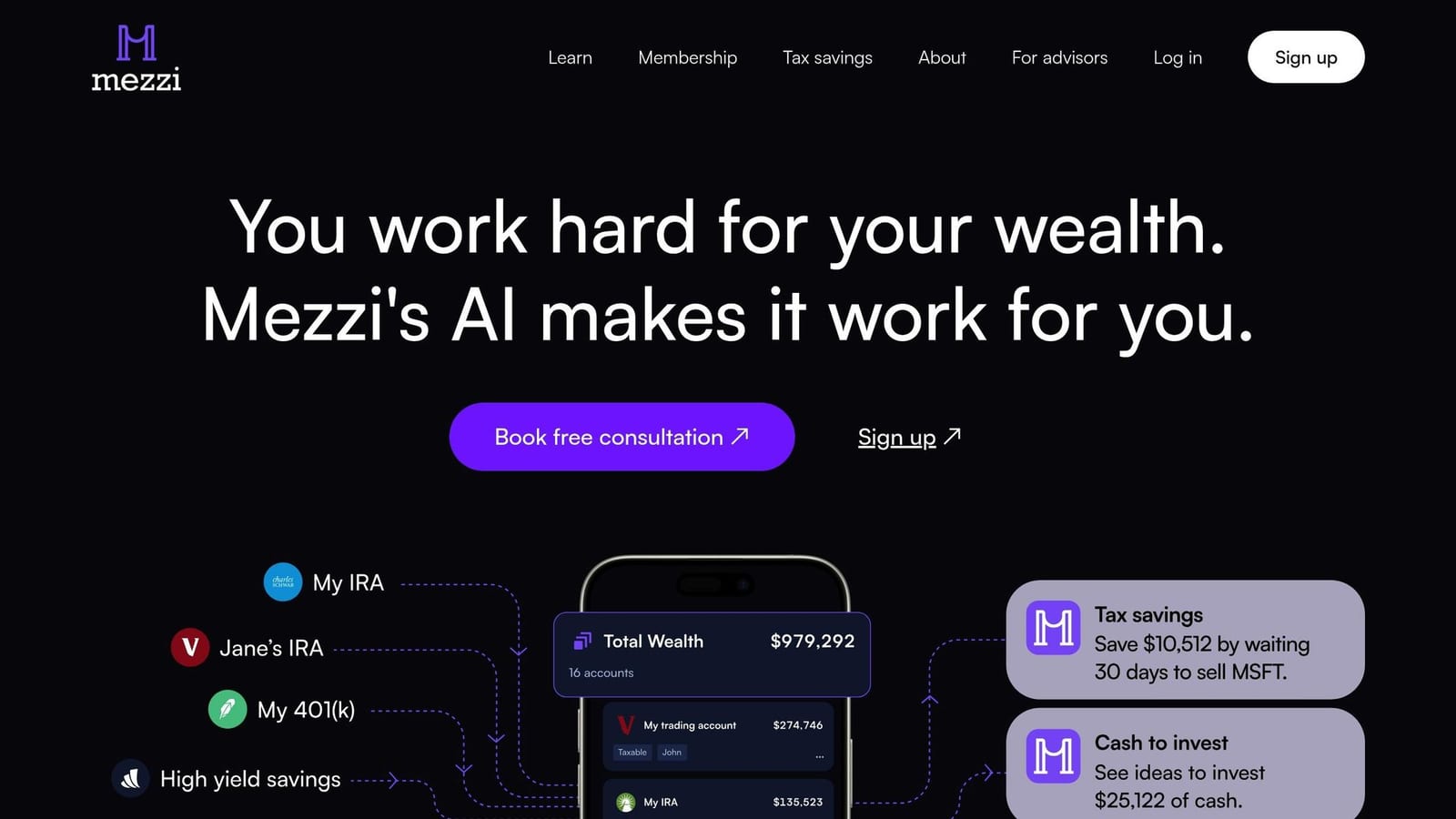
Mezzi brings high-level AI-powered tax insights to everyday investors, offering tools and strategies that were once only accessible through costly financial advisors. By combining advanced automation with intuitive features, it’s designed for self-directed investors aiming to enhance their wealth-building strategies. These tools integrate seamlessly with the tax optimization techniques discussed earlier.
Prevent Wash Sales Across Multiple Accounts
One standout feature of Mezzi is its ability to identify andprevent wash sales across all your investment accounts automatically. This tackles a tricky U.S. tax rule that can cause significant financial losses if overlooked.
The wash sale rule prohibits claiming a tax loss on a security if you buy the same or a substantially identical security within 30 days before or after selling it. While the rule seems simple on paper, it can become a logistical nightmare when dealing with multiple accounts - 401(k)s, IRAs, taxable brokerage accounts, or even accounts under a spouse’s name.
Mezzi’s AI works in real-time, monitoring all your connected accounts to ensure compliance with the wash sale rule. Unlike basic tools, Mezzi’s system spans across accounts, offering a comprehensive safeguard against violations. This cross-account monitoring is especially valuable for active investors who frequently rebalance portfolios or engage in tax-loss harvesting. By analyzing your entire financial landscape - account types, tax brackets, and cash flow needs - Mezzi can suggest the most tax-efficient strategies for asset placement and withdrawals.
Save Costs Through AI-Powered Insights
Mezzi eliminates the need for expensive financial advisors while still delivering expert-level recommendations. Instead of paying high fees, you gain access to continuous, AI-driven insights tailored to your financial situation.
This platform provides actionable advice, adapting in real-time to market shifts and changes in your finances. Whether it’s uncovering tax-loss harvesting opportunities, optimizing asset allocation, or planning withdrawal sequences for retirement, Mezzi offers strategies that can save you thousands in taxes and fees. Unlike generic advice, the recommendations are precise, measurable, and directly applicable to your financial goals.
Use Advanced Tools for Complete Management
Beyond cost savings, Mezzi equips you with advanced tools for managing your financial picture holistically. For example, the X-Ray feature helps spot portfolio overlaps and exposures across your accounts. This is crucial for identifying when you might unintentionally hold the same stocks through different mutual funds or ETFs, which can lead to concentration risks and tax inefficiencies.
The platform also includes a Financial Calculator that goes deeper than standard retirement planning tools. It factors in asset manager fees, providing a clearer picture of how various fee structures and investment choices could impact your long-term wealth. By considering elements like portfolio value, annual contributions, expected returns, and fee scenarios, the calculator offers realistic projections to guide your decision-making.
These tools empower self-directed investors with capabilities that were once reserved for financial professionals. By providing a unified view of all your accounts, Mezzi ensures your tax strategies are well-coordinated and effective across your entire portfolio.
Focus on Security and Privacy
Given the sensitive nature of tax and financial data, Mezzi emphasizes robust security measures. It uses trusted aggregators like Plaid and Finicity to ensure your account information is handled securely and in line with established protocols.
Mezzi also prioritizes privacy. The platform supports Apple login with anonymized email and offers an ad-free experience, ensuring your personal data isn’t monetized through advertising. This privacy-first approach is essential for maintaining trust, especially when dealing with sensitive financial information.
With its strong security infrastructure, Mezzi enables the real-time monitoring and analysis needed for effective tax optimization while safeguarding your personal and financial data. This combination of advanced features and rigorous security helps you plan your financial future with confidence.
Conclusion
AI-powered tax optimization has become a game-changer in modern wealth management, especially for self-directed investors looking to maximize compounding tax savings. These advanced tools can pinpoint tax-saving opportunities and flag compliance risks in seconds - tasks that would take human advisors hours to complete. Plus, they offer continuous monitoring, adapting seamlessly to shifting market conditions and new tax laws.
By leveraging your organized financial data, AI tools do more than simplify processes - they drive meaningful financial advantages. These systems evaluate an investor's entire financial landscape by linking tax planning with investment tools, considering factors like account types, tax brackets, and long-term goals. The result? Tailored recommendations for tax-efficient asset placement and withdrawal strategies, ensuring that small tax savings snowball into significant wealth preservation over decades.
For active, self-directed investors, Mezzi is a standout platform. At just $39/month or $399/year, it provides access to advanced features like cross-account wash sale prevention and real-time tax-loss harvesting. Its AI-driven functionality, strong security protocols, and privacy-focused design make it an ideal choice for managing complex portfolios across multiple accounts. As tax laws and markets evolve, having a tool that updates strategies in real time is crucial for maintaining optimal after-tax returns. Mezzi directly addresses this need, offering a proactive approach to tax-smart investing.
If preserving long-term wealth and reducing tax burdens is your priority, AI-driven tax optimization is no longer optional - it’s essential. Choose a platform that combines cutting-edge technology with the security and dependability required to safeguard your financial future.
FAQs
How does AI improve the efficiency of tax-loss harvesting compared to traditional methods?
AI-powered tax optimization is changing the game for tax-loss harvesting, offering real-time monitoring of both your portfolio and the market. Unlike older methods that depend on occasional reviews, AI works around the clock, analyzing your investments to pinpoint the best opportunities to harvest losses - so you don’t miss a beat.
With automation at the core, AI reduces the likelihood of wash sales and fine-tunes the timing for maximum tax savings. This streamlined process not only boosts after-tax returns but also saves you valuable time, making managing your wealth smoother and more efficient.
How can I organize my financial accounts for effective AI-driven tax optimization?
To make the most of AI-powered tax optimization, start by bringing together all your financial accounts onto a single platform. This will give you a clear, unified view of your assets. Be sure to connect and update accounts like your bank, investment, and retirement accounts, ensuring all details are accurate and current.
Next, categorize your accounts based on your financial goals and strategies. This step helps streamline your financial data and makes it easier to track progress. Regularly reviewing your account information is also key to spotting any discrepancies or missing details. By keeping your accounts well-organized, you'll allow AI tools to deliver precise insights that can help you reduce taxes and manage your wealth more effectively.
How does Mezzi stay up-to-date with tax law changes while keeping my financial data secure?
Mezzi leverages cutting-edge AI tools to keep you informed about changes in tax laws, automatically assessing how updates might affect your financial strategies. This approach helps ensure your tax planning stays both compliant and efficient.
When it comes to safeguarding your financial data, Mezzi doesn't cut corners. Using advanced encryption and stringent access controls, they prioritize your privacy and security. These measures align with top-tier regulatory standards, giving you peace of mind that your information is well-protected.
Mezzi is free to get started. Choose Advisory for unlimited advice and advanced features at $39/month or $399/year. Concierge includes the same, plus hands-on support, at $99/month or $999/year.