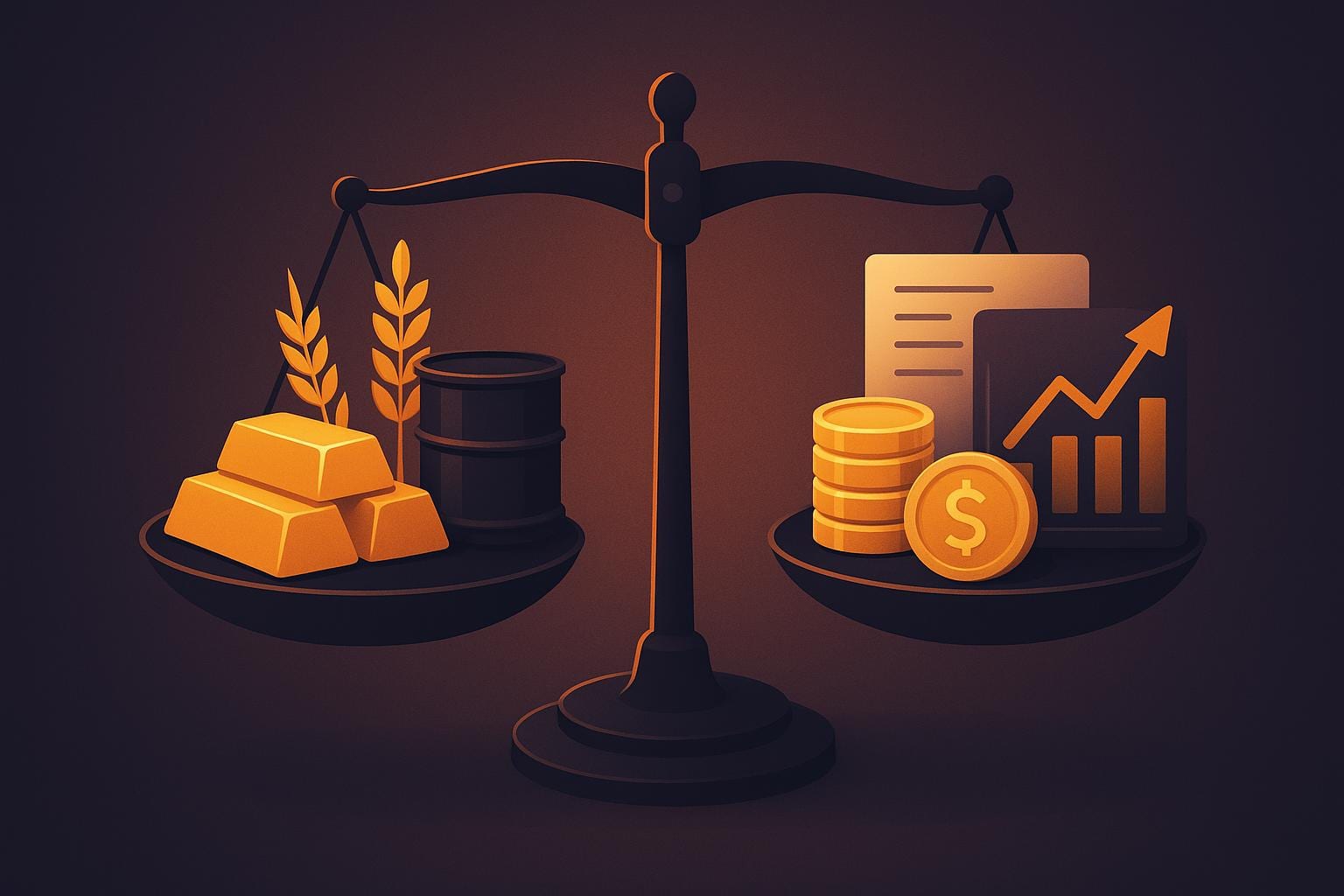
Adding commodities like gold, oil, wheat, or copper to your portfolio can reduce risk and hedge against inflation. These assets often perform differently from stocks and bonds, offering unique benefits. Here's what you need to know:
Key Takeaways:
- Why Commodities? They protect against inflation and have low correlation with traditional assets.
- Main Categories: Hard (e.g., gold, oil) and soft commodities (e.g., wheat, cattle).
- Allocation Tip: Keep commodities at 5–10% of your portfolio based on risk tolerance.
- Tax Implications: Tax rates vary by investment type (e.g., ETFs, futures, or stocks).
- Investment Options: ETFs, mutual funds, futures, or commodity stocks offer different levels of exposure and complexity.
Quick Steps to Start:
- Set Goals & Risk Tolerance: Decide your allocation (5–15%) and align with your timeline.
- Choose Investments: ETFs are easy for beginners, while futures require expertise.
- Understand Taxes: Different structures have different tax rules - plan accordingly.
- Monitor & Rebalance: Regularly review and adjust your allocation to stay on track.
Using top portfolio analyzer tools can simplify management and ensure you're aligned with your financial goals. Ready to explore commodities? Start with this checklist.
How Can You Diversify A Commodity Portfolio? - Commodity Wealth Investor
What to Consider Before Investing in Commodities
Before diving into commodity investments, it’s crucial to weigh several factors to ensure they align with your financial strategy and goals.
Check Your Risk Tolerance and Investment Goals
Commodities are known for their price swings, making them more volatile than traditional assets like stocks or bonds. This volatility is driven by supply and demand dynamics, so it’s important to match your risk tolerance with your investment objectives.
If you’re investing with a long-term horizon - say, retirement in 20 years - you may be better equipped to ride out the ups and downs. On the other hand, if you’re saving for a short-term goal, such as buying a house, the unpredictability of commodities could work against you.
A good rule of thumb is to limit your commodity exposure to 5–10% of your portfolio. If you’re risk-averse or nearing retirement, stick closer to the 5% mark. More aggressive investors with longer timelines might consider allocations closer to 10%.
Your goals also play a role in choosing the right commodities. For example, precious metals like gold are often used as a hedge against inflation, while industrial metals or energy commodities may be better suited for growth during periods of economic expansion.
Once you’ve assessed your goals and risk tolerance, it’s time to think about taxes.
Know the Tax Rules
Taxes on commodities can vary significantly depending on the structure of your investment, so understanding tax optimization for multi-asset portfolios can help you avoid surprises.
- Physical precious metals held through grantor trust ETFs are taxed as "collectibles." Long-term capital gains are capped at 28%, higher than the standard 20% rate. Short-term gains, however, are taxed as ordinary income, which can go up to 39.6%.
- Futures-based commodity ETFs, structured as limited partnerships, follow "mark-to-market" rules. Gains are split, with 60% taxed at the long-term capital gains rate (20%) and 40% taxed as ordinary income, leading to a blended rate of 27.84%. These funds issue Schedule K-1 forms instead of the more straightforward 1099s, adding complexity to tax prep.
- Exchange-traded notes (ETNs) offer simpler tax treatment. Long-term gains are taxed at 20%, while short-term gains are taxed as ordinary income (up to 39.6%). However, ETNs come with credit risk since they are unsecured debt instruments.
For quick reference, here’s how the tax details break down:
StructureTax Rate (Long-Term)Tax Rate (Short-Term)Tax FormAnnual ReportingGrantor Trust28% (collectibles)Up to 39.6%1099No mark-to-marketLimited Partnership27.84% (blended)27.84% (blended)Schedule K-1Yes (mark-to-market)ETN20%Up to 39.6%1099No mark-to-market
High-income investors should also be aware of the 3.8% Medicare surcharge on net investment income. However, this surcharge doesn’t apply to commodity investments held in IRAs. Additionally, if your gains are substantial, you may need to make estimated tax payments throughout the year.
"The taxation of commodity ETF/ETPs is very complicated." - Fidelity
With taxes in mind, the next step is to evaluate your timeline and liquidity needs.
Review Your Time Frame and Cash Needs
After considering risk and taxes, think about how commodity investments fit with your timeline and cash flow requirements. Unlike stocks or bonds, commodities don’t generate ongoing income through dividends or interest. Instead, any returns come purely from price changes.
Short-term investors may find commodities challenging due to their volatility and less favorable tax treatment. For example, short-term gains in grantor trust structures are taxed as ordinary income, with rates as high as 39.6%.
For medium- and long-term investors, commodities can be a better fit. Over time, they offer diversification benefits and can act as a hedge against inflation. However, keep in mind the need for periodic rebalancing, as commodity prices can fluctuate significantly, altering your portfolio’s allocation.
Liquidity is another important factor. Many commodity ETFs and ETNs trade on major exchanges, providing easy access to funds. However, some niche investments may have wider bid-ask spreads, making them less liquid.
Finally, consider how commodities align with your cash flow needs. Since they don’t provide regular income, they may not be ideal if you’re nearing retirement or rely on your investments for steady payouts. Also, factor in costs like storage fees or the expense of rolling over futures contracts, as these can impact your overall returns.
Ways to Invest in Commodities
After assessing your risk tolerance, considering high-net-worth investing strategies, linking tax planning with investment tools, and your investment timeline, the next step is figuring out how to invest in commodities. There are several ways to gain exposure, each with its own benefits and challenges. Options range from commodity ETFs and mutual funds to more direct investments like futures contracts and commodity stocks.
Commodity ETFs and Mutual Funds
Commodity ETFs and mutual funds are popular for their simplicity, offering an easy way to diversify your portfolio with commodity exposure. These options don’t require you to navigate the complexities of futures trading or deal with the logistics of physically storing commodities.
Commodity ETFs trade on major stock exchanges, making them highly liquid and allowing for intraday trading. They typically come with low expense ratios and can be more tax-efficient compared to actively managed mutual funds. A wide variety of ETFs is available, providing exposure to everything from gold to agricultural products.
Mutual funds, on the other hand, are ideal for investors who prefer regular contributions through dollar-cost averaging. No-load index mutual funds, which allow for fractional share purchases, are particularly cost-effective for those making consistent investments.
However, it’s important to note that ETFs and mutual funds focusing on futures contracts operate differently than traditional stock or bond funds. These funds invest in time-limited contracts rather than owning a direct stake in a commodity, meaning their performance may not perfectly mirror the price of the underlying commodity due to contract expirations and rollovers.
Futures Contracts and Commodity Stocks
For those looking for more direct exposure, futures contracts and commodity stocks provide alternative investment options.
Futures contracts give you a way to directly track commodity price movements. When you buy a futures contract, you agree to purchase a specific amount of a commodity at a set price on a future date. While this method offers pure commodity exposure, it comes with substantial risks and complexity. Futures trading often involves margin loans, which can magnify both gains and losses.
Commodity stocks, meanwhile, offer indirect exposure. These are shares of companies involved in producing, storing, or transporting commodities. Their stock prices often move in response to changes in commodity markets. Unlike futures contracts, stocks don’t expire, but they do come with company-specific risks, such as management issues or shifts in market sentiment.
Investment Vehicle Comparison
Here’s a quick comparison of the main ways to invest in commodities:
Investment VehicleProsConsLiquidityCommodity ETFsLow cost, liquid, diversified exposure, tax-efficientPotential tracking errors, bid/ask spread issuesHigh (trades during market hours)Commodity Mutual FundsProfessional management, good for dollar-cost averagingHigher fees, less tax-efficientDaily (based on NAV)Futures ContractsDirect exposure, leverage potentialHigh risk, margin requirements, complex managementHigh, but requires expertiseCommodity StocksNo expiration, simpler structureCompany-specific risks, indirect commodity exposureVaries, generally high**Exchange-Traded Notes (ETNs)**Simple tax treatment, precise trackingIssuer credit risk, potential early redemptionModerate to high
Exchange-traded notes (ETNs) deserve special attention. These are unsecured debt obligations issued by financial institutions and tied to a commodity benchmark. Unlike ETFs, ETNs don’t hold the underlying assets, so they carry issuer credit risk. However, they often provide precise tracking of commodity indices without the complications of futures rollovers.
When considering commodity pools or funds, be cautious of claims that they’ll outperform stock and bond funds during economic downturns. Performance can vary significantly. Always review disclosure documents carefully, focusing on objectives, strategies, risks, and any changes in fund flexibility.
The shift from mutual funds to ETFs highlights investors’ preference for liquidity and intraday trading options. Ultimately, the right investment vehicle depends on your strategy, management approach, and trading goals.
Step-by-Step Commodity Diversification Checklist
Taking a structured approach to adding commodities to your portfolio can help align your investments with your goals and risk tolerance. Use this checklist to ensure your commodity allocation works for you.
Set Your Allocation Targets
Start by defining how much of your portfolio you want to dedicate to commodities. A good rule of thumb is to allocate between 5% and 15%, depending on your risk tolerance and investment timeline. For conservative investors, a 5% allocation might feel more comfortable, while those open to higher risk could aim closer to 15%.
Also, take a close look at your current portfolio. If you're already heavily invested in sectors like energy or materials through stocks, you may want to scale back your direct commodity exposure. The idea is to diversify your investments, not to double down on sectors you're already exposed to.
Pick the Right Investment Options
Choose investment vehicles that match your knowledge level and the type of exposure you want.
- ETFs are a great starting point for beginners. They offer broad exposure and are easy to trade.
- Mutual funds work well for those who prefer making regular contributions.
- Futures contracts provide direct exposure but are best left to experienced traders who understand margin requirements and can handle the risks involved.
- Commodity stocks offer an indirect route. For instance, investing in companies like Newmont Corporation for gold or Archer-Daniels-Midland for agricultural commodities can provide exposure with less complexity compared to futures.
Use Tools for Portfolio Analysis
Advanced tools can help you spot hidden exposures and fine-tune your diversification strategy. For example, portfolio X-ray analysis can reveal overlaps in your holdings. You might discover that your tech stocks already have indirect exposure to commodities, like rare earth metals or lithium used in batteries.
Platforms like Mezzi offer tools that analyze your accounts for correlations and gaps in diversification. Their AI-driven insights can also alert you when your commodity allocation drifts from your targets, making it easier to rebalance before your portfolio veers too far off course.
Minimize Your Tax Burden
Once you've set your allocation and chosen your investments, it's time to think about taxes. Different commodity investments come with varying tax treatments, so optimizing for taxes is key.
- ETFs are generally more tax-efficient than mutual funds.
- Futures contracts can lead to complex tax scenarios, requiring careful planning.
Consider strategies like asset location to decide whether to hold certain investments in taxable accounts or tax-advantaged retirement accounts. Tools like Mezzi can help streamline this process, offering recommendations to minimize your tax burden. For those managing multiple accounts, Mezzi's cross-account optimization can ensure your commodity investments are positioned in the most tax-efficient way, potentially saving you thousands each year.
Review and Rebalance Your Portfolio
Commodities can be volatile, which means your allocation percentages will shift over time. Regular reviews - quarterly for most investors or monthly for those with higher allocations - are essential.
Set specific rebalancing triggers rather than relying solely on calendar-based reviews. For example, if your target is 10% in commodities, rebalance if your allocation drifts to 12.5% or drops to 7.5%. Instead of selling overweight positions, consider redirecting new contributions to underweight areas to avoid triggering taxable events.
Mezzi's platform can simplify this process by notifying you when rebalancing is needed and suggesting tax-efficient strategies. These might include tax-loss harvesting with ETFs, considering holding periods, or prioritizing more tax-efficient accounts for adjustments.
Staying proactive with rebalancing ensures your portfolio aligns with your goals and adapts to any changes in your financial situation.
Tools and Resources for Commodity Diversification
Navigating the complexities of commodity diversification requires the right tools and resources. Without them, managing investments across multiple accounts can quickly become overwhelming. The right platforms not only simplify the process but also provide insights that help you make smarter, more informed decisions.
Using AI Platforms for Portfolio Management
AI platforms are changing the game for portfolio management, offering insights that were once exclusive to high-cost advisors. These tools provide real-time monitoring and proactive alerts, helping you stay on top of your portfolio. For instance, they notify you immediately if your portfolio drifts from your target allocation or if tax-related issues, like wash sale violations, arise across your accounts. Platforms like Mezzi leverage these capabilities to streamline your diversification strategy, making it easier to maintain balance and compliance.
Mezzi's Features for Self-Directed Investors
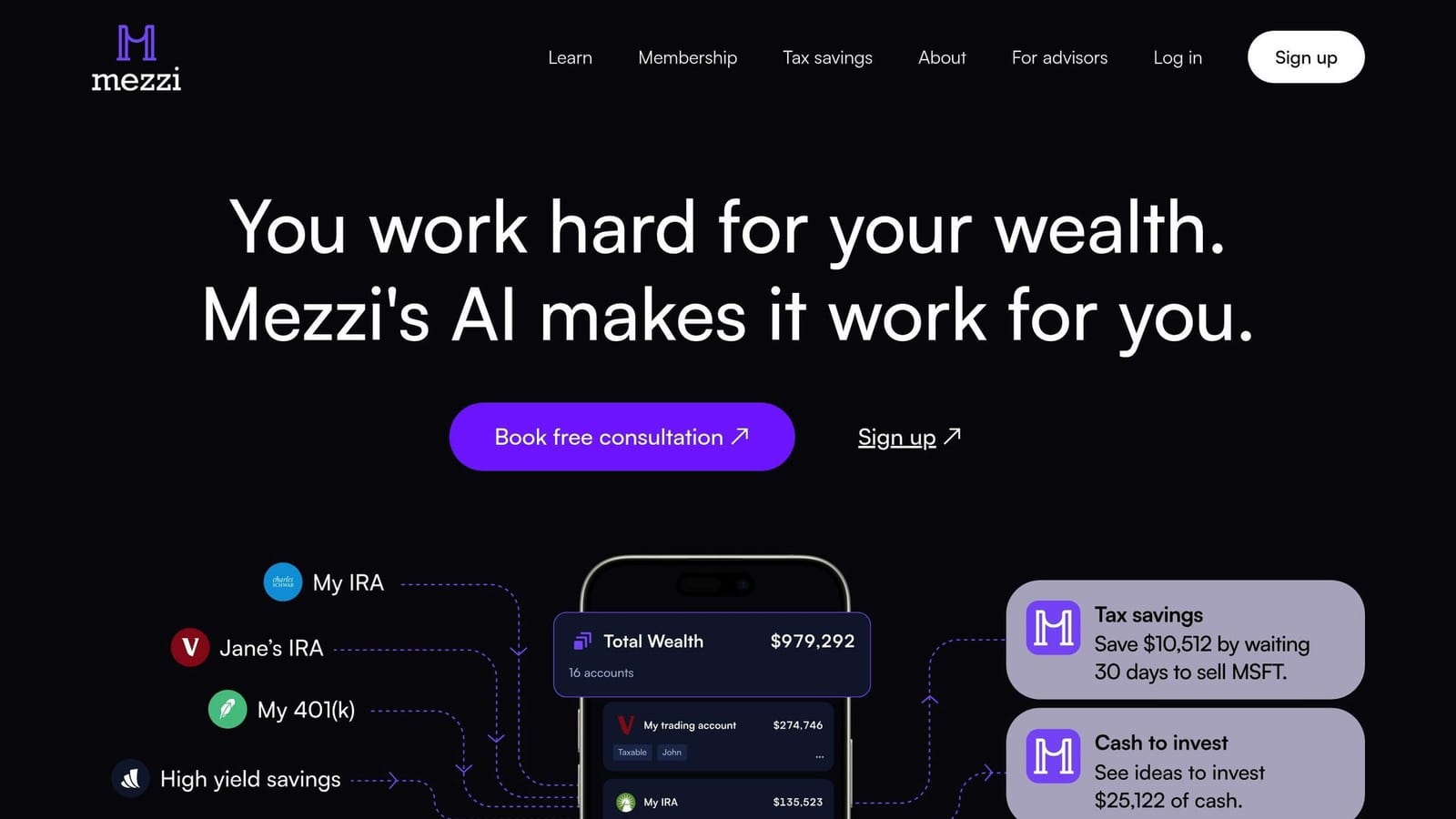
For active investors managing their own portfolios, Mezzi offers a suite of tools designed to simplify commodity diversification. One standout feature is Mezzi's X-Ray tool, which analyzes your portfolio to identify overlapping investments. This can help you avoid unintended concentration in a specific sector. For example, if you're thinking about adding energy commodities, the tool might show that your existing holdings already provide sufficient exposure to that sector.
Another useful feature is Mezzi's Financial Calculator, which incorporates factors like asset manager fees into retirement projections. This allows you to see how various commodity investment options could impact your long-term financial goals. Additionally, Mezzi’s AI-driven platform provides real-time prompts and unlimited chat support, giving you the ability to ask questions about your portfolio and receive tailored guidance based on your financial situation, including tax considerations.
For families juggling multiple investment accounts, Mezzi offers collaborative tools that provide a unified view of all investments. This ensures that your overall commodity allocation remains on track, even when managing accounts across different family members.
Mezzi's Advisory, priced at $39/month or $399/year, delivers ongoing personalized support for self-directed investors, helping you avoid traditional advisor fees while staying in control of your diversification strategy.
Conclusion
Diversifying into commodities offers a solid strategy to shield your portfolio from market swings and inflation. Historical data backs this up: portfolios using the Quantix Commodity Index outperformed traditional 60/40 portfolios between 2000 and 2021, delivering both higher returns and reduced volatility. For instance, in 2025, gold saw a 26.5% rise even as oil prices dropped by 16%.
To build a strong defensive strategy, start by setting clear allocation targets and leveraging advanced portfolio tools. Success hinges on understanding your risk tolerance, being aware of the tax implications tied to commodity investments, and selecting investment vehicles that align with your goals. Whether you prefer broad-based ETFs for diversification or more focused investments in energy or precious metals, every decision should align with your overall financial strategy. This structured approach ensures your investments contribute to long-term financial growth.
Modern platforms like Mezzi simplify this process with AI-driven insights. These tools can help you avoid wash sales, send AI-powered rebalancing alerts, and consolidate your investments, making commodity management more efficient and proactive.
It’s also crucial to regularly review and rebalance your portfolio as market dynamics and personal circumstances change. This ensures you maintain your target allocation while staying open to new opportunities. By following a disciplined approach and using modern tools, commodity diversification can act as a hedge against inflation and bring stability to your portfolio.
Over time, this method could save you over $1 million in advisor fees while optimizing your portfolio management. By combining a clear strategy with cutting-edge technology, you can confidently and precisely implement commodity diversification for lasting financial success.
FAQs
What percentage of my portfolio should I allocate to commodities?
When deciding how much of your portfolio should be allocated to commodities, it’s important to weigh factors like your risk tolerance, investment goals, and the state of the economy. A typical guideline for most investors is to allocate 5% to 10%, with the higher end often seen as a way to help preserve wealth over the long term.
For those who prefer a more cautious stance, sticking closer to 5% might make sense. On the other hand, investors with a higher risk appetite may choose to go up to 10% or even slightly more, depending on their diversification goals and how they view the current market trends. It’s always a good idea to revisit your allocation regularly to ensure it still fits your personal financial situation and reflects shifts in the market landscape.
What are the tax implications of investing in commodity ETFs, futures, and ETNs?
The way commodity investments are taxed depends on the type of investment vehicle you choose - whether it's ETFs, futures, or ETNs. Here's a breakdown of how taxes apply to each:
Commodity ETNs are handled similarly to stocks or bonds. Long-term gains are taxed at 20%, while short-term gains are treated as ordinary income. The good news? Taxes are only triggered when you sell the ETN, making it a straightforward option for many investors.
Futures-based ETFs come with a different tax structure. At the end of each year, gains are "marked to market", meaning they are taxed regardless of whether you sell. Here's how it works: 60% of the gains are taxed at the long-term capital gains rate, and 40% are taxed at the short-term rate. This creates a blended maximum tax rate of 26.8%, which applies no matter how long you hold the investment.
For ETFs that hold physical commodities, the tax treatment is unique. These ETFs typically don’t distribute profits during the holding period. Instead, capital gains are realized and taxed only when you sell the ETF.
Understanding these tax differences is essential to avoid surprises and to align your investment choices with your financial goals. Picking the right vehicle can make a big difference when tax season rolls around.
What’s the best way to monitor and rebalance my commodity investments to stay on track with my financial goals?
To keep your commodity investments on track, start by setting clear allocation targets. Define specific thresholds - like a 5% deviation from your target weights - that will signal when it’s time to rebalance. This method helps your portfolio stay aligned with your financial objectives without overcomplicating the process.
Make it a habit to review your portfolio’s performance regularly. When deciding how often to rebalance, weigh factors such as transaction costs and potential tax consequences. The goal is to maintain your target allocation while keeping costs in check, striking an effective balance that supports your overall investment strategy.
Mezzi is free to get started. Choose Advisory for unlimited advice and advanced features at $39/month or $399/year. Concierge includes the same, plus hands-on support, at $99/month or $999/year.