Investment fees might seem small, but over time, they can significantly reduce your returns due to compounding. A 1% annual fee doesn’t just cost you that percentage - it can mean losing out on decades of potential growth. Many fees are hard to spot because they’re deducted directly from your account or buried in complex documents. Common culprits include fund expense ratios, trading costs, advisory fees, and tax inefficiencies.
Key Takeaways:
- Expense Ratios: Even a 1% fee can cut your returns by 20% over 20 years.
- Trading Costs: Includes commissions, sales loads, and bid-ask spreads.
- Advisory Fees: Often between 1%-1.5%, these compound as your portfolio grows.
- Tax Costs: High turnover can trigger short-term capital gains, reducing after-tax returns.
- Cash Drag: Uninvested cash earns little, weighing down performance.
How to Reduce Fees:
- Switch to low-cost funds like ETFs or index funds.
- Compare your fees to industry averages (e.g., 0.34% for mutual funds in 2024).
- Use tools like Mezzi to analyze your portfolio for hidden costs and tax inefficiencies.
- Consolidate accounts and negotiate lower fees with advisors or brokers.
By identifying and addressing these hidden fees, you can keep more of your money invested and growing over time.
How To Find The Hidden Fees Within Your Portfolio
You can also use an investment fee analyzer to see how these costs impact your long-term growth.
Types of Hidden Fees in U.S. Investment Accounts
Understanding where fees hide is a crucial step in protecting your investments. Whether you have a taxable brokerage account, an IRA, or a 401(k), there are often multiple layers of costs quietly eating into your returns. Let’s break down the main types of fees that can impact your portfolio and how they affect your investments.
Fund Expense Ratios and Management Fees
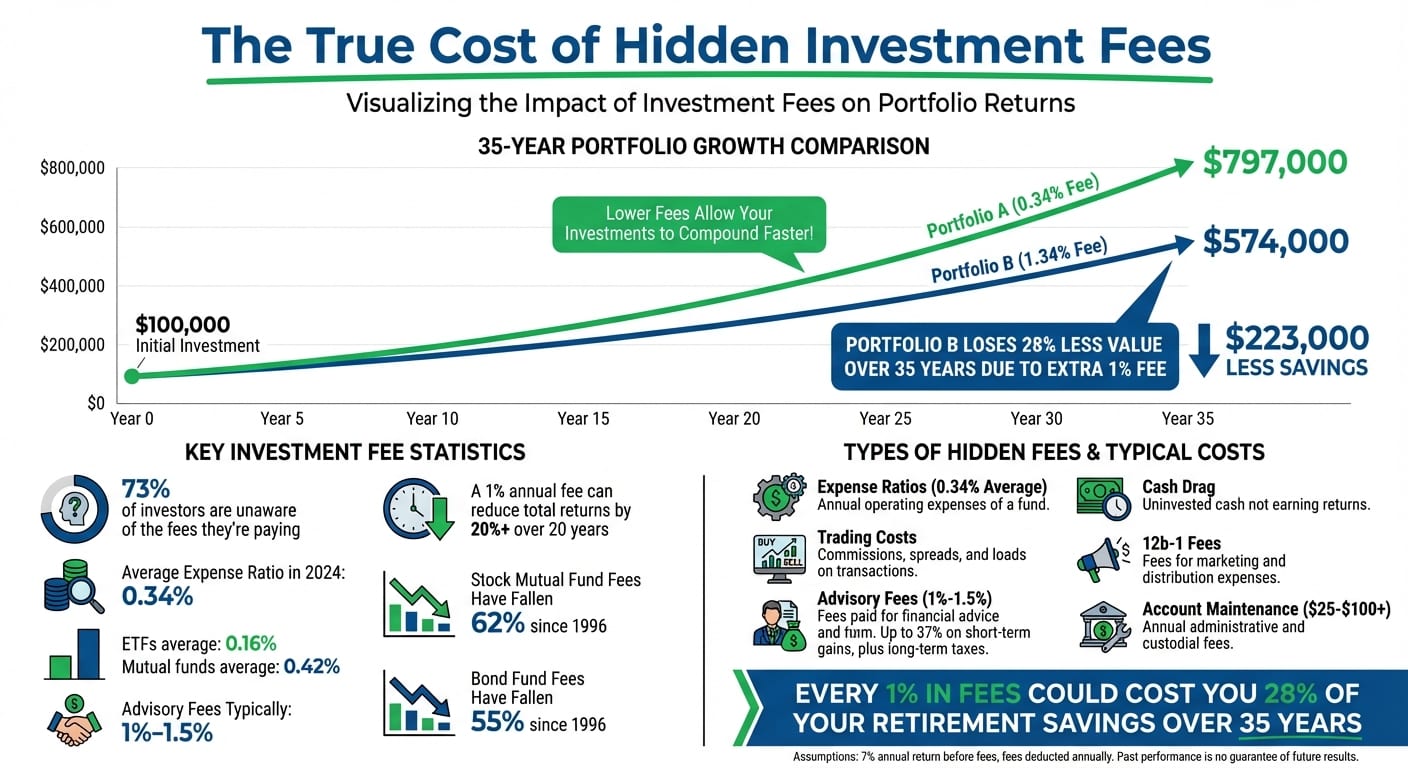
One of the most common hidden costs in investment accounts is the expense ratio. This annual fee is deducted directly from a fund’s assets to cover expenses like management, administration, and marketing. Since these fees are embedded in the fund's net asset value, they don’t show up as separate charges on your statements. Over time, even a seemingly small fee can have a big impact. For instance, a 1% annual fee can reduce your total returns by more than 20% over 20 years.
Another fee to watch out for is the 12b-1 fee, which covers marketing expenses and can continue indefinitely. Funds often come in different share classes, such as institutional and retail, with varying expense ratios. Rolling over a 401(k) into an IRA, for example, could expose you to higher-cost retail share classes.
While competition has driven down costs significantly, with the average expense ratio for mutual funds and ETFs dropping to 0.34% in 2024 - less than half the rate from 20 years ago - many investors remain in high-cost funds without realizing it. Since 1996, fees for stock mutual funds have fallen by 62%, and bond fund fees by 55%. Tools like Mezzi’s AI can help you uncover these hidden costs and compare them to lower-cost alternatives.
Trading and Transaction Costs
Every trade you make comes with costs, and these can add up quickly. Trading commissions are paid to the brokerage firm, while sales loads are one-time charges on mutual funds that reduce your investable capital right from the start. Whether front-end, back-end, or level loads, these fees immediately cut into your portfolio.
Beyond these visible charges, there’s the bid-ask spread - the difference between the price buyers are willing to pay and what sellers are asking. For frequently traded securities, this spread might be small, but for less liquid investments, it can be significant.
If you invest in actively managed funds with high portfolio turnover, you’re likely paying for frequent trades through brokerage commissions and market impact costs, which ultimately get passed on to you. Other transaction fees to watch for include redemption fees for selling shares too soon, surrender charges for early withdrawals from variable annuities, and various brokerage service fees for things like account transfers or wire transactions.
Advisory and Account Maintenance Fees
If you work with a financial advisor, you’re likely paying an annual advisory fee, typically between 1% and 1.5% of your portfolio’s value. While this fee might seem reasonable for professional advice, it compounds over time as your portfolio grows. For example, a 1% fee on a $100,000 portfolio means $1,000 in the first year alone.
Account maintenance and custodial fees are another layer of costs. These flat annual charges, which can range from $25 to $100 or more depending on your account type and provider, cover administrative expenses. Some accounts even have inactivity fees, penalizing long-term investors who prefer to hold their investments rather than trade frequently.
Tax Costs and Cash Drag
Taxes and uninvested cash can quietly diminish your returns. High portfolio turnover can generate short-term capital gains, which are taxed at ordinary income rates - up to 37% for high earners. These tax bills reduce your after-tax returns and can act as an invisible fee.
Cash drag is another hidden cost. When your portfolio holds uninvested cash, it earns little to no return, which reduces your overall gains. While keeping some cash on hand is necessary for rebalancing or withdrawals, holding too much can weigh down your portfolio’s performance over time. Tools like Mezzi can help analyze your portfolio for tax efficiency and ensure your cash is optimally allocated.
How to Find Hidden Fees in Your Portfolio
Uncovering hidden fees in your portfolio doesn’t have to be overwhelming. With a bit of diligence and the right tools, you can identify and address these costs to better manage your investments.
Reading Fund Documents and Account Statements
Start by examining your fund prospectuses and account statements. These documents hold key details about the fees you're paying, some of which may not be immediately obvious. For example, the fund prospectus includes a section titled "Fees and Expenses", where the expense ratio is disclosed. Look at the annual operating expenses table for details on management fees and 12b-1 fees. Additionally, the portfolio turnover ratio can give you an idea of potential trading costs.
Your account statements - whether quarterly or annual - should list advisory fees, account maintenance charges, and transaction costs. However, many fees are hidden in the fine print or rolled into the fund's performance. For instance, a fund showing a 7% return might have actually earned 8% before a 1% expense ratio was deducted. If you own multiple share classes of the same fund, such as institutional or retail, be aware that fee structures can vary significantly. Institutional shares typically have lower expense ratios, while retail shares often include higher fees and 12b-1 charges.
Using Mezzi's AI Tools to Analyze Fees
Manually tracking fees can be tedious and time-consuming, but tools like Mezzi can simplify the process. Mezzi consolidates all your account data into one dashboard, providing a clear view of your portfolio and the fees you're incurring. Its X-Ray feature highlights above-average expenses and inefficiencies across your accounts, making it easier to spot where you might be overpaying.
Mezzi’s AI-powered insights go further by flagging funds with high expense ratios or accounts with excessive advisory fees. The platform also identifies tax inefficiencies, such as investments generating unnecessary short-term capital gains or idle cash balances that could be better utilized. By analyzing your portfolio as a whole, Mezzi can uncover ways to save on taxes and fees, potentially saving you thousands and enabling you to take action to optimize your investments.
Comparing Your Fees to Industry Averages
After identifying your fees, compare them to industry benchmarks to determine if you're paying more than necessary. In 2024, the average fee paid by U.S. fund investors was 0.34%, with ETFs averaging 0.16% and mutual funds at 0.42%. If your portfolio fees are significantly higher, it might be time to explore lower-cost options.
Advisory fees generally range from 1% to 1.5% of assets under management annually. Paying more than this, especially if combined with high fund expenses, can erode your returns. For context, North American family offices managing large portfolios reported total costs averaging 1.42% of assets in 2022, split between internal operating costs and external investment management fees. If your total portfolio costs exceed 1.5%, it’s worth investigating ways to lower these expenses and retain more of your investment growth.
How to Reduce Investment Fees and Improve Returns
Once you've identified hidden fees, it's time to take action. Cutting unnecessary costs can protect your returns and help your investments grow over time. By understanding where your money is going, you can make smarter decisions to manage your portfolio and keep it on track. Here’s how you can reduce fees and improve your returns.
Choosing Lower-Cost Funds and Products
One of the easiest ways to save on fees is by swapping out high-cost funds for ETFs or index funds. These options often provide the same market exposure but at a fraction of the cost. Even small differences in fees can snowball into significant savings over the years, boosting your portfolio's growth potential.
Take a close look at your portfolio to spot overlapping investments. Holding multiple funds that target the same sectors or companies can mean you're paying redundant fees for essentially the same exposure. Consolidating these into a single, low-cost fund can eliminate these extra expenses. Additionally, if you're invested in retail share classes, consider asking your broker about switching to institutional share classes, which typically come with lower fees.
Lowering Advisory and Account Fees
Advisory fees can add up, so it’s worth asking if you’re getting enough value for what you’re paying. Many investors find that with the right tools, they can manage their portfolios independently and sidestep these costs altogether.
It’s also a good idea to review your account statements for hidden charges like maintenance fees, inactivity fees, or transfer fees. If you have multiple accounts, consolidating them can simplify your finances and reduce fees. Don’t hesitate to negotiate with your financial institution for better terms - it could save you more than you think.
Using Mezzi to Improve Tax Efficiency
Cutting fees is just one piece of the puzzle. Taxes can also eat into your returns, potentially reducing them by 1.0% to 1.2% annually. By improving your portfolio’s tax efficiency, you can keep more of your earnings.
One effective strategy is tax-loss harvesting - selling investments that have lost value to offset gains or reduce up to $3,000 of your taxable income. This is where Mezzi comes in. The platform uses AI-driven tax-loss harvesting to identify opportunities, flag short-term capital gains, and recommend optimal holding periods to minimize your tax burden. It even ensures compliance with tax rules by preventing wash sales across your accounts. By reducing your tax drag, Mezzi helps your portfolio grow more efficiently without adding extra risk.
Conclusion: Take Control of Your Investment Costs
Over time, hidden fees can quietly chip away at your portfolio, leaving you with far less than you might expect. According to the Department of Labor, paying just 1% more in annual investment fees could reduce your retirement savings by nearly 28% over 35 years. That's a significant difference that underscores the importance of keeping a close eye on costs.
The good news? These fees aren't set in stone. By reviewing essential documents and comparing fee structures, you can uncover unnecessary charges. Simple steps like shifting to lower-cost index funds or ETFs, consolidating your accounts, and negotiating advisory fees can help ensure more of your money stays invested and working for you.
This is where Mezzi's AI-powered tools can be a game changer. Mezzi's platform dives deep into your portfolio, spotting hidden fees, highlighting tax-loss harvesting opportunities, and preventing wash sales across accounts. These features can help reduce both tax burdens and fees, while real-time insights and actionable recommendations empower you to make smarter investment decisions.
Taking control of your investment costs is about more than saving a few dollars - it's about securing your financial future. With nearly 73% of investors unaware of the fees they're paying, don't let yourself fall into that majority. Every dollar saved on fees is a dollar that can grow and compound over time, giving you the financial freedom you deserve.
FAQs
How can I spot hidden fees in my investment portfolio?
Hidden fees can chip away at your investment returns without you even noticing, so it's crucial to know where they might be hiding. Start by examining your fund prospectuses for details on expense ratios, 12b-1 fees, and sales loads. Don’t stop there - review your account statements for transaction costs, advisory fees, or any other extra charges that might be lurking.
To make this process easier, you can turn to AI-powered tools like Mezzi. These tools can break down the fees across your portfolio in a clear and straightforward way. Once you’ve identified these costs, you can take steps to reduce them, helping your investments work more effectively for your financial goals.
How can I lower advisory and account maintenance fees in my investment portfolio?
To cut down on advisory and account maintenance fees, begin by partnering with a fiduciary who is committed to acting in your best interest. Steer clear of commission-based products, as they often carry higher expenses. Opt for low-cost index funds or ETFs, which usually have lower expense ratios than actively managed funds. Additionally, request a fee audit to uncover any hidden charges and ask your advisor for a clear, detailed breakdown of all costs. These steps can help you retain more of your investment returns while keeping your portfolio efficient.
What is tax efficiency, and how does it affect my investment returns?
Tax efficiency involves using strategies to reduce the taxes owed on your investments. By keeping taxable gains and liabilities low, you can ensure more of your money remains invested, giving it the chance to grow over time. Ultimately, it’s your after-tax returns that determine the real performance of your portfolio.
Consider this: contributing to tax-advantaged accounts like 401(k)s or IRAs can shield your investments from immediate taxation. Holding investments for the long term often qualifies you for lower capital gains tax rates, while practices like tax-loss harvesting can offset gains and reduce your tax bill. Focusing on these tax-efficient methods can play a key role in building your wealth over time.
Related Blog Posts
- Understanding Investment Fees: Hidden Costs to Watch For
- Impact of Fees on Long-Term Investment Growth
- 401(k) Fees: How to Identify Hidden Costs
- Discover wich accounts are losing the most to fees and poor investment choices
Hidden fees can chip away at your investment returns without you even noticing, so it's crucial to know where they might be hiding. Start by examining your fund prospectuses for details on expense ratios, 12b-1 fees, and sales loads. Don’t stop there - review your account statements for transaction costs, advisory fees, or any other extra charges that might be lurking.
To make this process easier, you can turn to AI-powered tools like Mezzi. These tools can break down the fees across your portfolio in a clear and straightforward way. Once you’ve identified these costs, you can take steps to reduce them, helping your investments work more effectively for your financial goals.
To cut down on advisory and account maintenance fees, begin by partnering with a fiduciary who is committed to acting in your best interest. Steer clear of commission-based products, as they often carry higher expenses. Opt for low-cost index funds or ETFs, which usually have lower expense ratios than actively managed funds. Additionally, request a fee audit to uncover any hidden charges and ask your advisor for a clear, detailed breakdown of all costs. These steps can help you retain more of your investment returns while keeping your portfolio efficient.
Tax efficiency involves using strategies to reduce the taxes owed on your investments. By keeping taxable gains and liabilities low, you can ensure more of your money remains invested, giving it the chance to grow over time. Ultimately, it’s your after-tax returns that determine the real performance of your portfolio.
Consider this: contributing to tax-advantaged accounts like 401(k)s or IRAs can shield your investments from immediate taxation. Holding investments for the long term often qualifies you for lower capital gains tax rates, while practices like tax-loss harvesting can offset gains and reduce your tax bill. Focusing on these tax-efficient methods can play a key role in building your wealth over time.