AI is transforming portfolio management, making it easier to handle risks, improve returns, and adapt to market changes. Here's how AI helps build stronger, more resilient portfolios:
- Real-Time Risk Management: AI identifies hidden risks, tracks market changes, and provides instant alerts to help you respond quickly.
- Smarter Asset Allocation: AI uses real-time data to optimize diversification, rebalance portfolios automatically, and align investments with your goals.
- Tax Optimization: AI reduces tax inefficiencies through strategies like tax-loss harvesting with AI and wash sale prevention.
- Efficiency Gains: AI saves time and reduces errors, automating tasks like stress testing and analyzing large datasets.
For independent investors, platforms like Mezzi provide affordable AI-powered tools to consolidate financial accounts, manage risks, and maximize returns - all without high advisory fees.
Key stats:
- 88% of enterprises use AI in portfolio management.
- Family offices using AI report a 23% reduction in portfolio risk exposure.
- AI tools have cut stress-testing time nearly in half.
AI is your partner in navigating market volatility, improving decision-making, and staying aligned with long-term financial goals.
AI Driven Investment Breakthroughs | Ep96
This episode explores how AI use cases in wealth management are redefining how investors protect and grow their capital.
Investment Portfolio Risks You Need to Know
Understanding portfolio risks - essentially the potential for losses when returns don't meet expectations - is a critical part of building resilience. Grasping these risks provides the foundation for recognizing why traditional approaches often fall short in today's fast-paced financial landscape.
Common Portfolio Risk Types
Market risk impacts all investments due to broad economic factors like recessions, inflation, or geopolitical events. Even well-diversified portfolios can face significant losses when markets decline because this risk cannot be eliminated through diversification alone.
Liquidity risk arises when assets cannot be quickly sold or converted into cash without taking a significant discount. During periods of market stress, even typically liquid assets may become difficult to sell at fair prices.
Interest rate risk affects bond values when rates rise. As new bonds offer higher yields, the value of existing bonds drops, making this a key concern for fixed-income investors.
Credit risk refers to the possibility of borrowers defaulting on their obligations. Corporate bonds, for instance, generally carry a higher credit risk compared to government bonds.
While these risks are inherent to investing, manual methods of managing them often struggle to keep up with real-time developments.
Why Manual Risk Management Falls Short
Traditional risk management methods rely heavily on historical data and rigid rules, making it difficult to adapt to the constantly changing nature of financial risks. This backward-looking approach can leave portfolios exposed to emerging threats that don't align with past patterns.
The amount of data required for effective risk management is another hurdle. Manual processes are often overwhelmed by the sheer volume of information. For example, only 3% of asset managers use data that's less than five hours old, creating blind spots for identifying and responding to emerging risks.
Human error further complicates manual risk management. Studies show that nearly 90% of spreadsheets contain mistakes, and half of the spreadsheet models used in large businesses have critical errors. Over the past decade, these spreadsheet-related issues have cost companies more than $11.80 billion in financial losses.
Another challenge is managing interconnected risks across global markets. Financial systems today operate with incredible speed and complexity, featuring high-frequency trading, real-time settlements, and instantaneous cross-border transactions. Traditional models often fail to account for how problems in one area can ripple through entire portfolios.
Static risk registers, a common tool in manual risk management, quickly become outdated as markets evolve. This leaves portfolios vulnerable to threats that should have been identified and addressed.
Security concerns also pose a significant issue. Forty-three percent of family offices have expressed concerns about the security of financial data stored in spreadsheets. Moreover, 83% of respondents from single-family offices identified cyberattacks or data breaches as their biggest operational risk. Handling sensitive financial information manually often amplifies these vulnerabilities.
Finally, human error remains a major factor in cybersecurity breaches. A staggering 95% of breaches are caused by human mistakes, and 68% involve non-malicious actions. Even with the best intentions, manual processes can create security gaps that expose portfolios to risks far beyond market fluctuations.
These limitations highlight the growing need for AI-driven risk management to ensure portfolios remain resilient in an increasingly complex financial environment.
How AI Improves Risk Detection and Management
AI has transformed the way we handle risk by analyzing massive datasets and adapting to new information in real time. This ability to pinpoint hidden threats before they cause harm has become a game-changer for investors looking to safeguard their portfolios.
Finding Hidden Risks and Asset Connections
One of AI's standout strengths is its ability to uncover risks that human analysts might overlook. By processing data from diverse sources - like financial statements, market trends, news articles, social media sentiment, and alternative datasets - AI reveals patterns and correlations that traditional models simply can't detect.
"AI can identify hidden portfolio risks by analysing vast and diverse datasets far beyond human capacity and can uncover complex, non-linear relationships and subtle patterns that might indicate emerging risks. This enables portfolio managers to make more informed decisions and safeguard against volatility and risk that is not evident through conventional analysis." - Ann-Mary Rajanayagam, Strategic AI & Tech Advisor
Take correlation detection, for example. AI can identify complex relationships between seemingly unrelated assets. A family office discovered that during periods of currency volatility, their private credit positions correlated unexpectedly with Asia-Pacific real estate holdings - an insight that traditional models missed entirely. Armed with this knowledge, they restructured their portfolio to avoid concentrated risk exposure.
AI doesn’t just stop at asset correlations. It also exposes vulnerabilities in areas like supply chains. One client, for instance, uncovered critical supply chain risks affecting 17% of their private equity holdings - risks that weren’t visible through traditional sector analysis. These insights allow investors to address external factors impacting their investments.
Another key area where AI shines is detecting style drift. Research indicates that 42% of fund managers experience significant style drift within five years, costing investors an average of 1.8% annually due to unintended risks and tax inefficiencies. For example, one family office discovered that their top-performing manager had shifted from a value-based strategy to momentum investing during a bull market, introducing unexpected exposures across the portfolio.
The results of implementing AI are striking. Family offices using AI tools have reported a 23% reduction in portfolio risk exposure by restructuring just 8% of their holdings based on AI-identified correlations. These capabilities ensure that portfolios remain agile and responsive to changing market conditions.
Continuous Risk Monitoring and Testing
AI doesn’t just identify risks - it keeps watch over them. With real-time monitoring, AI systems track portfolio performance, market trends, and risk indicators, providing immediate alerts when conditions shift. This proactive approach helps investors respond quickly to emerging threats, avoiding the costly aftermath of delayed action.
AI has also revolutionized stress testing. Companies using AI tools for portfolio stress testing have cut analysis time nearly in half while improving accuracy. These tools simulate how portfolios would perform under various economic scenarios, enabling investors to adjust allocations to maintain their desired return levels.
For instance, in April 2025, RiXtrema introduced an AI-powered stress-testing tool that allows financial advisors to input scenarios like "US deflation" or "Middle East conflict." The AI instantly identifies key factors to test - such as oil prices or interest rate shifts - cutting research time from days to seconds and reflecting real-world market dynamics.
Real-time adjustment capabilities further enhance portfolio resilience. AI evaluates economic indicators, historical data, and market volatility to recommend adjustments that align with investor goals. This ensures portfolios remain optimized as conditions evolve, helping investors stay ahead of the curve.
The importance of high-quality data cannot be overstated. Organizations leveraging clean, comprehensive datasets achieve far greater accuracy in their risk assessments compared to those relying on incomplete data. Accurate data is the backbone of effective AI-driven risk management.
AI-Driven Tax Optimization
Risk management isn’t just about avoiding losses - it’s also about maximizing gains, and tax efficiency plays a big role in that. AI systems excel at identifying tax inefficiencies in complex portfolios, offering solutions that can significantly enhance long-term returns.
For example, AI simplifies wash sale prevention and cross-account coordination by monitoring holdings across taxable and tax-advantaged accounts. It determines the best placement for assets based on expected returns and tax implications, preventing inadvertent wash sales while maximizing tax benefits.
Dynamic tax loss harvesting is another area where AI shines. Instead of simply selling off losing positions, AI identifies opportunities to harvest losses while maintaining portfolio exposure through similar securities. This approach optimizes tax benefits without disrupting the overall investment strategy.
AI even addresses the behavioral side of tax optimization. By analyzing decision patterns, AI can identify cognitive biases - like emotional responses to market swings - that lead to tax-inefficient choices. Studies show that recognizing and addressing these biases can improve decision quality by up to 31%.
Finally, AI keeps up with ever-changing tax regulations, ensuring strategies remain compliant and effective. This continuous adjustment adds another layer of resilience to portfolios, helping investors navigate regulatory changes while maintaining efficiency.
AI-Powered Asset Allocation for Stronger Portfolios
Asset allocation is the cornerstone of building a resilient portfolio, and AI has taken this essential practice to a whole new level. By leveraging advanced technology, investors can now create portfolios that not only aim for growth but also stand strong against market volatility. AI’s ability to analyze risks and optimize returns has redefined how asset allocation is approached today.
Smarter and More Adaptive Allocation Strategies
AI has turned asset allocation into an ongoing, data-driven process that evaluates multiple streams of information simultaneously. Unlike traditional methods that often rely heavily on historical data, machine learning models use real-time market data to guide allocation decisions. This allows portfolios to adapt quickly to current conditions.
Using techniques like reinforcement learning and neural networks, AI balances multiple objectives at once - such as risk levels, return goals, and liquidity needs. This approach ensures that portfolios remain aligned with an investor's priorities, even as markets fluctuate.
What’s more, AI tailors investment strategies to individual needs. By analyzing factors like risk tolerance, financial goals, investment timelines, and income requirements, AI crafts personalized allocation plans. It also enables rapid adjustments and trades based on changing market sentiment, making diversification and rebalancing far more effective.
Enhanced Diversification and Automatic Rebalancing
AI doesn’t just improve asset allocation - it also takes diversification to the next level. By uncovering patterns that traditional models might miss, AI becomes especially valuable in volatile markets where conventional diversification strategies often struggle.
Through portfolio rebalancing with AI, AI helps reduce portfolio volatility and improve risk-adjusted returns. This is achieved by continuously analyzing market shifts and making adjustments in real time, ensuring portfolios stay resilient. AI processes a wide range of data to inform these decisions, including:
AI TechnologyKey Features for DiversificationMachine Learning (ML)Detects market patterns, optimizes allocation, and predicts trends Natural Language Processing (NLP)Evaluates financial news, reports, and sentiment to gauge market conditions Predictive AnalyticsAnticipates asset performance and market changes Alternative Data AnalysisIncorporates non-traditional data, such as sentiment and alternative investments, into allocation strategies
Traditional rebalancing often suffers from delays or emotional biases. AI eliminates these issues by automating rebalancing based on pre-set criteria, removing the need for constant manual oversight. It also continuously refines investment models using fresh market data, keeping portfolios aligned with evolving financial goals.
For those interested in integrating AI-driven allocation into their strategies, the process involves setting clear investment goals, understanding risk tolerance, gathering comprehensive data, using AI tools to generate optimized portfolio plans, and regularly reviewing performance to fine-tune strategies.
Mezzi: AI-Powered Platform for Independent Investors
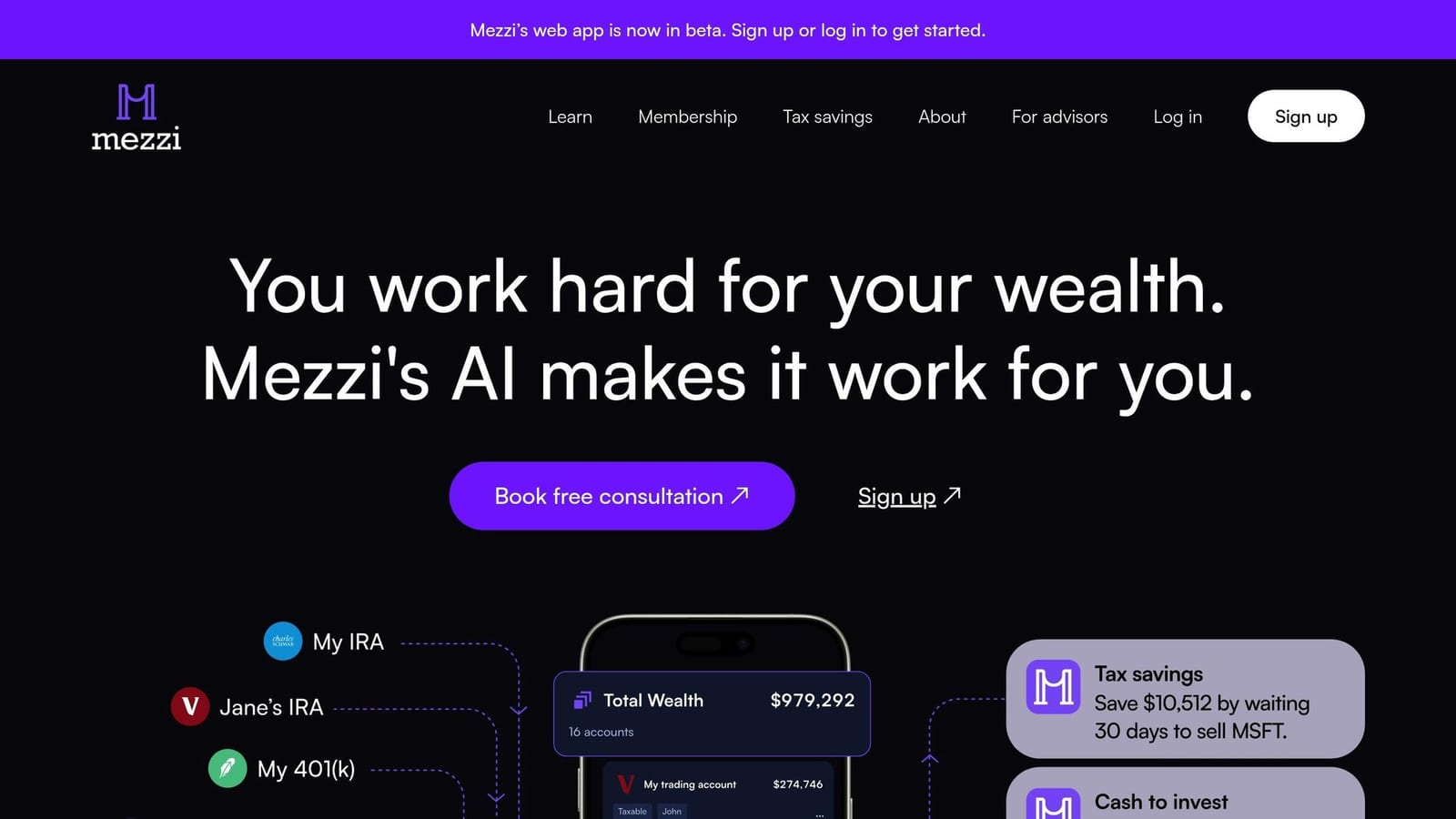
For independent investors looking to build strong portfolios without the hefty advisory fees, Mezzi offers an AI-powered platform that reshapes portfolio management with intuitive tools and advanced analytics.
Mezzi is a wealth building and investment management tool that aims to give users access to insights typically reserved for clients of expensive wealth advisors.
There's an AI For That
Mezzi bridges the gap between affordability and professional-grade financial analysis. By analyzing hundreds of data points, the platform creates tailored investment profiles based on individual goals and risk preferences. This kind of insight - once exclusive to high-cost advisors - is now accessible to all users, aligning with the broader trend of leveraging AI to build resilient portfolios.
Here’s how Mezzi empowers investors to manage risk and maximize returns:
Complete Financial Account Overview
Juggling multiple investment accounts across various brokerages can lead to missed details that might weaken portfolio performance. Mezzi solves this by consolidating all your accounts into a single, integrated dashboard. This unified view not only provides a clearer picture of your finances but also enhances oversight, helping you make more informed decisions.
Mezzi’s AI doesn’t just stop at data aggregation. It performs cross-account analyses to identify potential issues like overlapping investments, concentrated assets, or imbalanced allocations - problems that often go unnoticed when accounts are reviewed in isolation. Whether you want a big-picture view of your combined accounts or a deep dive into individual ones, Mezzi offers the flexibility to suit different strategies and improve risk management.
Advanced Tax Optimization Features
Tax efficiency plays a huge role in building a stronger portfolio, and Mezzi’s AI is designed to uncover opportunities that might otherwise be overlooked. One standout feature is its ability to prevent wash sales across multiple accounts. This ensures you don’t accidentally violate tax rules when selling a security at a loss and repurchasing it within 30 days, which could cancel out potential tax benefits.
By monitoring accounts in real time, Mezzi safeguards your tax-loss harvesting strategies while offering personalized suggestions to minimize capital gains, optimize fund choices, and reduce fees. On average, users save over $1,000 annually in taxes and fees through the platform.
Money and Time Savings
Traditional financial advisors typically charge 1%–2% of assets under management each year, which can significantly eat into long-term returns. Mezzi eliminates these recurring fees while delivering comparable insights and analytical tools, allowing you to reinvest those savings to grow your portfolio.
Additionally, Mezzi saves you time by automating tasks that would normally require hours of manual effort. Instead of tracking performance across multiple accounts or deciphering complex tax rules, Mezzi’s real-time AI prompts and automated analyses provide actionable insights right on the platform. With both free and premium options available - Advisory costs $39/month or $399/year - it’s accessible to a broad range of investors.
Advanced Risk Discovery Tools
Beyond saving money and time, Mezzi strengthens portfolio resilience by identifying hidden risks. For investors managing multiple mutual funds or ETFs, overlapping holdings can lead to unintended concentrations. Mezzi’s Portfolio Overlap Checker is designed to uncover these exposures, helping you maintain a well-diversified portfolio and avoid unnecessary vulnerabilities.
Steps to Build Portfolio Resilience with AI
Strengthen your portfolio using AI by consolidating all your accounts, acting on AI recommendations, and regularly refining your strategies.
Combine and Analyze All Accounts
The first step in building a resilient portfolio with AI is merging all your financial accounts into one platform. This means bringing together brokerage accounts, retirement funds, bank accounts, and other investments, even if they're spread across different institutions.
Why is this important? When everything is in one place, AI can analyze your entire financial picture and spot risks or patterns that may not be obvious. For example, it can uncover unintended concentration risks - like having too much exposure to a single sector - something that might go unnoticed without advanced analysis.
Platforms like Mezzi make this process seamless by automatically importing and syncing data from multiple sources. The AI then dives into the details, examining asset correlations, identifying sector overexposures, and flagging potential vulnerabilities. This consolidated view not only saves time but also reveals hidden connections between your investments, offering insights that manual reviews often miss.
Once you’ve established this unified view, you can start leveraging AI-driven insights to refine your investment strategy.
Use AI-Generated Investment Insights
After consolidating your accounts, the next move is to act on the recommendations generated by AI. These insights are designed to improve diversification, optimize tax efficiency, and minimize risks. AI systems continuously assess market trends, your risk tolerance, and your financial goals to deliver personalized strategies.
For instance, if your portfolio becomes overly concentrated in a single sector due to recent market gains, the AI might suggest reallocating assets to achieve a more balanced diversification. It could also identify opportunities for AI-driven tax-loss harvesting, helping you reduce costs while staying aligned with your long-term goals.
Track and Update Investment Strategies
Applying AI insights is just the beginning - keeping your portfolio resilient requires regular monitoring and adjustments. AI's ability to track market conditions, economic indicators, and portfolio performance ensures that you stay on top of changes.
Set up automated alerts for important shifts or rebalancing opportunities. With its 24/7 monitoring capabilities, AI can help you avoid missing critical moments or letting risks pile up unnoticed. Additionally, quarterly reviews of your portfolio, guided by AI recommendations, can help you stay on track.
AI-powered stress-testing models are another valuable tool. These simulations show how your portfolio might perform under various economic scenarios, giving you a better understanding of potential risks and opportunities.
Dynamic rebalancing becomes effortless with AI. Instead of manually tracking your portfolio's drift from its target allocation, the AI identifies deviations and suggests specific trades to restore balance. This approach not only keeps your portfolio aligned with your risk preferences but also captures opportunities for tax-efficient adjustments.
Think of AI as an ongoing partner in your investment journey. Regularly engaging with its insights and implementing its suggestions creates a feedback loop that strengthens your portfolio over time, helping you navigate market volatility and economic shifts with confidence.
Conclusion: AI's Impact on Portfolio Resilience
AI is reshaping portfolio resilience by driving both asset growth and operational efficiency. Companies leveraging AI have reported an impressive 8% increase in assets under management and a 14% boost in productivity. In fact, 88% of enterprises have already incorporated AI into their portfolio management strategies. This marks a transformative shift in how we approach investment risk and optimization.
One of AI's standout strengths lies in its ability to process massive datasets instantly, uncovering patterns that human analysts might miss. While traditional portfolio management depends heavily on historical data and human judgment, AI-powered systems adapt dynamically to market fluctuations in real time. This continuous monitoring ensures that your portfolio remains aligned with your risk tolerance and financial goals. These capabilities are at the heart of platforms like Mezzi, which exemplify how AI can revolutionize portfolio management.
Mezzi integrates advanced AI tools with broader risk management strategies, offering sophisticated financial analysis tools that were once only accessible through high-cost financial advisors. By making these tools more accessible, Mezzi supports the goal of building stronger portfolios through cutting-edge technology.
The growing adoption of AI in asset management is reflected in market projections. The GenAI market for asset management is expected to surge from $465.3 million in 2025 to $3.1 billion by 2033, with AI-driven portfolio management accounting for over 31.6% of this market. This growth highlights AI's proven ability to improve risk assessment and operational efficiency. For instance, AI systems can simulate market scenarios, detect financial risks in real time, and automate compliance with tax regulations. Large financial institutions have already reported efficiency gains of 15% to 20%, with 71% utilizing AI for fraud detection.
To maximize the benefits of AI in portfolio resilience, it’s essential to view it as a long-term partner in your investment strategy. Continuous monitoring, AI-driven rebalancing, and acting on AI-generated insights create a feedback loop that enhances your portfolio's ability to navigate market volatility and seize new opportunities. With the wealth management market projected to reach $158.70 trillion by 2028, adopting AI-powered tools now can set investors on a path toward sustained growth and financial security.
FAQs
How does AI improve risk management in portfolio management?
AI plays a key role in risk management by analyzing market data in real time, spotting potential risks, and alerting investors to issues as they arise. This enables investors to make quick adjustments to their asset allocation and strategies, helping protect portfolios from sudden market shifts.
Using advanced algorithms, AI can uncover patterns and anomalies that might go unnoticed through human analysis. This not only strengthens portfolio resilience but also provides investors with timely insights, allowing them to make decisions with greater confidence and speed.
How can AI-driven tax optimization help individual investors save money?
AI-powered tax optimization helps investors reduce tax liabilities and boost returns by analyzing their financial data and uncovering ways to improve tax efficiency. This might involve strategies like avoiding wash sales across accounts, fine-tuning tax-loss harvesting, and cutting down on avoidable tax expenses.
With AI, investors can save considerable amounts over time, steer clear of common tax mistakes, and make more informed financial choices - all without the hefty fees that often come with hiring traditional financial advisors. This technology not only trims costs but also makes managing investments easier, giving individuals more confidence and control over their financial future.
How does AI enhance portfolio resilience by improving asset allocation?
AI brings a new level of strength to portfolio management by processing massive amounts of real-time market data. It can pinpoint risks and uncover opportunities, all while automating tasks like risk assessments and rebalancing. This ensures your investments remain aligned with your financial goals and risk preferences.
What sets AI apart is its ability to eliminate human bias and adapt rapidly to market shifts. These AI-driven strategies help cushion the blow of market volatility, enabling sharper, faster decisions that can fortify your portfolio over the long term.
Mezzi is free to get started. Choose Advisory for unlimited advice and advanced features at $39/month or $399/year. Concierge includes the same, plus hands-on support, at $99/month or $999/year.