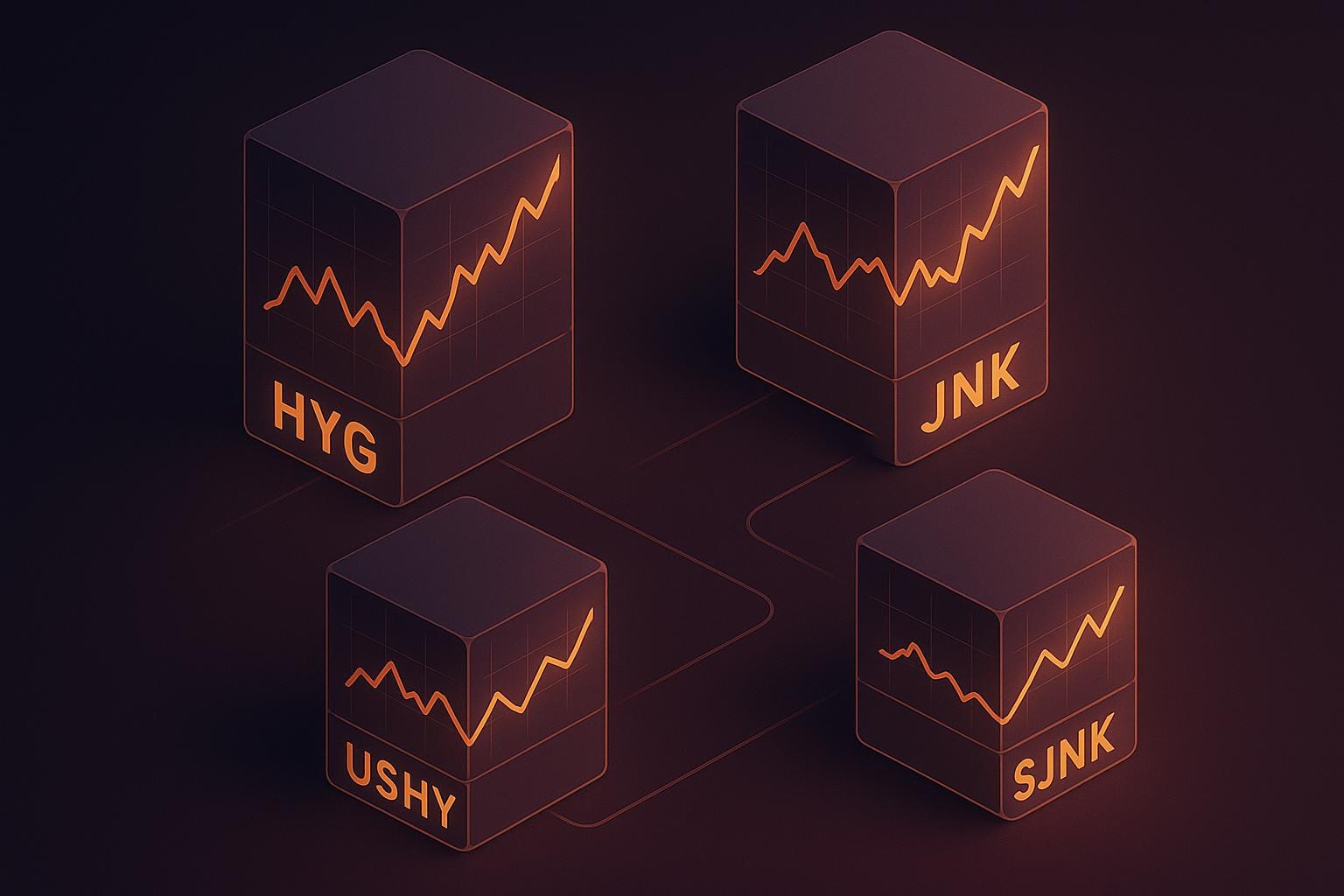
High-yield bond ETFs are a popular choice for income-focused investors aiming to earn higher returns compared to traditional bonds. These funds invest in "junk bonds" - corporate bonds with lower credit ratings but higher yields. However, they come with risks like credit defaults and interest rate sensitivity.
Here’s a quick breakdown of the four top ETFs:
- HYG: Offers liquidity and a large asset base but has a higher expense ratio and moderate yield.
- JNK: Similar to HYG but tracks a different index, providing slight variations in holdings.
- USHY: Lower expense ratio with broad diversification but may face higher volatility.
- SJNK: Focuses on short-term bonds, reducing interest rate risk but with slightly lower yields.
Key takeaway: Choose based on your risk tolerance, income goals, and market outlook. For stability, SJNK is ideal. For higher returns, HYG, JNK, or USHY may suit your needs. Below is a quick comparison to help you decide.
Quick Comparison
Pro tip: Use AI tools to analyze your portfolio, tax-efficient ETF investing, and track performance. This ensures your choice aligns with your financial goals and risk tolerance.
If You Invest in ONE Bond ETF, Make it This One
HYG: iShares iBoxx $ High Yield Corporate Bond ETF
Launched on April 4, 2007, HYG manages total assets of $18,640,200 as of November 4, 2025, and provides broad exposure to U.S. dollar-denominated high-yield corporate bonds. It's a popular choice for income-focused portfolios. Here's a closer look at its portfolio structure, performance, and risk profile.
Portfolio Structure and Holdings
HYG follows the Markit iBoxx $ Liquid High Yield Index, which prioritizes the most liquid high-yield corporate bonds. By focusing on liquidity, the fund minimizes trading costs and manages cash flows more effectively. However, this approach also means it excludes smaller, less-traded bonds, narrowing its overall exposure.
Performance Data and Costs
As of November 4, 2025, HYG delivered returns of 6.38% year-to-date, 7.28% over one year, 9.30% over three years, and 4.46% over five years. The fund's annual dividend yield stands at 5.75%, which is lower compared to some other ETFs, potentially making it less appealing to those prioritizing higher income. Additionally, its expense ratio of 0.49% is on the higher side, which could slightly erode returns over time.
Risk Factors and Investor Fit
With a beta of 0.41, HYG exhibits moderate sensitivity to market movements, offering a balance between stability and exposure to volatility. Its focus on larger, liquid bond issues generally results in better credit quality. However, credit risks inherent to high-yield bonds still apply. This ETF is well-suited for investors who prioritize liquidity and a well-established market presence, even if it means accepting a lower yield. For income-focused investors, it's essential to weigh these factors when considering HYG as part of a diversified fixed-income strategy.
JNK: SPDR Bloomberg High Yield Bond ETF
JNK offers exposure to U.S. corporate bonds that are below investment grade, making it an appealing option for investors looking for higher income potential while understanding the associated risks.
Portfolio Structure and Holdings
JNK tracks an index of high-yield corporate bonds, focusing on securities that are actively traded. This approach ensures liquidity and spreads investments across multiple sectors, reducing reliance on any single issuer. By maintaining broad diversification, the fund aims to balance risk while pursuing its income-focused strategy.
Performance Data and Costs
JNK's management prioritizes cost efficiency, which supports its ability to deliver steady dividend payouts. Its structure is tailored to provide consistent income while keeping expenses in check. Be sure to review its current yield and expense ratio to better understand its income potential and cost-effectiveness.
Risk Factors and Investor Fit
While JNK's diversified portfolio helps reduce the impact of individual bond defaults, it is still exposed to risks such as credit downgrades and rising interest rates. These factors can influence its performance, particularly during periods of economic uncertainty or market volatility. For investors seeking higher yields than those typically offered by investment-grade bonds, JNK could be a fitting choice - provided they are comfortable with the elevated risk level that comes with high-yield investments.
USHY: iShares Broad USD High Yield Corporate Bond ETF
USHY provides access to a broad mix of U.S. dollar-denominated high-yield corporate bonds, appealing to investors looking for income opportunities.
Portfolio Structure and Holdings
The fund holds a diverse collection of high-yield corporate bonds, spanning various credit ratings and sectors. Its strategy also incorporates bonds with different levels of liquidity, which can influence both the fund's yield and its cost structure. This balanced approach aims to spread risk while seeking attractive returns.
Performance Data and Costs
USHY offers competitive yields by tapping into a wide range of high-yield securities. Its expense ratio is comparable to similar funds, but investors should weigh these costs against the income potential. The fund's broad diversification means its performance may not mirror more narrowly focused high-yield bond ETFs. In volatile markets, this diversification can sometimes result in heightened price swings.
Risk Factors and Investor Fit
USHY's diversified approach comes with unique risks. Bonds with varying liquidity levels may experience wider bid-ask spreads during periods of market stress. The fund's exposure to bonds across different credit qualities introduces variable credit risk, while its mix of maturities increases sensitivity to interest rate changes. For investors seeking a diversified entry into the high-yield bond market and who are prepared for potential volatility and liquidity challenges, USHY can be a compelling option.
SJNK: SPDR Bloomberg Short Term High Yield Bond ETF
SJNK is designed for investors looking to earn competitive income through short-duration high-yield corporate bonds while reducing exposure to interest rate fluctuations.
Portfolio Structure and Holdings
The ETF exclusively invests in short-term high-yield corporate bonds issued by companies with credit ratings below investment grade. Its portfolio includes 1,199 bonds, with the top 10 holdings accounting for only 4.89% of total assets. This diversification, paired with its focus on short-term bonds, helps limit the impact of interest rate changes compared to longer-duration options.
Performance Data and Costs
As of November 4, 2025, SJNK manages $5.37 billion in assets and comes with an expense ratio of 0.40%. Its short-duration strategy helps maintain stable performance by reducing sensitivity to interest rate changes while still delivering competitive income.
Risk Factors and Investor Fit
The short-term nature of SJNK's bonds makes it less vulnerable to rising interest rates, as these bonds mature faster, allowing reinvestment at higher rates. However, the fund's exposure to high-yield (junk) bonds introduces credit risk. SJNK is a good fit for investors seeking steady income over a shorter time frame or those concerned about rising rates, provided they are comfortable with the credit risks associated with high-yield bonds.
Side-by-Side ETF Comparison
When looking at high-yield bond ETFs as a source of income, comparing key metrics can help uncover the differences in how each fund approaches its strategy. Some ETFs emphasize liquidity and a proven track record, while others prioritize cost savings, diversification, or managing interest rate risks.
Here are some important factors to consider:
- Expense Ratios: Lower expense ratios mean reduced costs over time, which can be a big advantage for long-term investors.
- Diversification: A fund with a broader range of holdings can spread out single-issuer risk. However, this might also dilute returns from top-performing bonds.
- Duration Risk: ETFs with shorter durations tend to handle rising interest rates better, while longer-duration funds may be more sensitive to rate changes. That said, they could also deliver higher income during stable periods.
- Asset Size: Larger funds often come with better liquidity and narrower bid-ask spreads, which is helpful for frequent trading or managing large positions. Smaller funds, on the other hand, may face wider spreads, especially in volatile markets.
- Credit Quality Focus: Funds vary in their credit strategies. Some adopt a mix of investment-grade and high-yield bonds to balance risk and return, while others stick to lower-rated bonds to chase higher yields.
Each ETF caters to different priorities. One may appeal to those who value liquidity and a solid track record, while another could suit investors seeking broad high-yield exposure. Some might focus on cost savings and diversification, while others aim to reduce interest rate risks. The best choice depends on your income goals, risk tolerance, and market outlook.
How to Choose the Right High-Yield Bond ETF
Picking the right high-yield bond ETF isn’t just about chasing the highest yield. It’s about aligning your choice with your financial goals, comfort with risk, and income needs. The four ETFs we’ve discussed cater to different types of investors, so understanding your own profile is crucial. This foundation will help you use advanced tools to fine-tune your decision-making process.
Matching Risk Tolerance with Income Goals
Your risk tolerance is a key factor when deciding on a high-yield bond ETF. Each of the four ETFs manages risk differently, making them suitable for distinct investor types.
- For conservative investors who value stability over maximum returns, SJNK could be the best option. Its short-term maturity profile makes it less sensitive to interest rate changes, which can be beneficial in a rising rate environment. This ETF is ideal for those seeking steady returns during uncertain times.
- For moderate-risk investors, USHY might be a better fit. Its lower expense ratio offers a cost advantage over the long term, potentially boosting reinvestment outcomes.
- For aggressive investors who are comfortable with higher volatility, HYG, JNK, or even USHY might be appealing. These ETFs have higher sensitivity to interest rates but can provide greater returns during stable market conditions.
Your investment timeline also plays a role. If you’re looking for income over the next few years and expect interest rates to rise, SJNK’s shorter duration could shield you from rate-related risks. On the other hand, if your goal is income over a longer horizon, the broader exposure of HYG, JNK, or USHY might be worth the added sensitivity to interest rate changes.
Additionally, consider your overall portfolio composition. If you already hold assets sensitive to interest rates, like long-term Treasury bonds or REITs, adding SJNK could balance your portfolio by reducing overall rate risk. Conversely, if your portfolio leans heavily toward short-term investments, a longer-duration high-yield ETF may provide helpful diversification.
Using AI Tools for Portfolio Analysis
After assessing your risk and income needs, advanced AI tools can simplify portfolio analysis and optimization. These tools can evaluate how different ETFs fit into your financial picture, saving you from manual calculations.
As financial expert Marc Guberti points out:
Artificial intelligence tools can simplify stock research, and they continue to get better.
This also applies to bond ETFs. AI tools like Mezzi can analyze your complete financial situation, identifying potential overlaps, concentration risks, and tax implications. For example, if you’re considering adding SJNK to a portfolio with long-term bonds, AI can quantify how it would affect your portfolio’s interest rate sensitivity and suggest allocation adjustments.
Tax planning is another area where AI shines. High-yield bond ETFs generate regular income, which may have tax implications. AI tools can help you understand these impacts and recommend strategies, such as holding these ETFs in tax-advantaged accounts.
Performance tracking and simulations are equally valuable. AI can monitor your ETF’s performance and simulate how it might behave under different market conditions. This helps you make informed decisions aligned with both your risk tolerance and future market expectations.
Final Recommendations for Income Investors
When selecting a high-yield bond ETF, it’s important to align your choice with your income goals, risk tolerance, and outlook on the market. Below, we’ve distilled the key points into actionable insights to guide your investment decisions.
Key Strengths of Each ETF
Here’s a quick breakdown of what each ETF brings to the table:
- HYG (iShares iBoxx $ High Yield Corporate Bond ETF): Known for its high liquidity and massive asset base, HYG is perfect for those who value ease of trading and broad exposure to the high-yield bond market. Its diverse holdings make it a solid choice for diversification.
- JNK (SPDR Bloomberg High Yield Bond ETF): Offers broad market exposure similar to HYG but tracks a different index, providing slight variations in holdings and performance. It’s a good alternative for investors seeking comparable risk and return characteristics.
- USHY (iShares Broad USD High Yield Corporate Bond ETF): This ETF stands out for its lower expense ratio, making it a cost-effective option for long-term investors who want to minimize fees while accessing a wide range of high-yield bonds.
- SJNK (SPDR Bloomberg Short Term High Yield Bond ETF): Designed for a more conservative approach, SJNK focuses on shorter-duration bonds. It’s less sensitive to interest rate fluctuations, making it appealing to those concerned about rising rates.
Your choice ultimately depends on what matters most to you: liquidity (HYG), cost efficiency (USHY), or interest rate protection (SJNK). For those looking for a balanced alternative, JNK offers a middle-ground option.
Steps to Take Before Investing
To make the most of your investment, follow these steps:
- Assess Your Portfolio: Determine how a high-yield bond ETF fits into your overall strategy. Think about your investment timeline and whether you anticipate interest rates to rise or fall.
- Understand Your Risk Tolerance: If you’re uneasy with large price swings, SJNK’s shorter duration could be a better fit. On the other hand, if you’re comfortable with more volatility in exchange for potentially higher returns, HYG, JNK, or USHY might be more suitable.
- Factor in Fees: Expense ratios can significantly affect your long-term returns. Even small differences in fees can add up over time, so choose wisely.
- Utilize Tax Optimization Tools: Tools like Mezzi can help you integrate high-yield bond ETFs into your portfolio while minimizing tax liabilities. Features like advanced tax optimization can help avoid wash sales and reduce your overall tax burden.
- Monitor Performance Wisely: Keep an eye on your ETF’s performance, but avoid reacting to short-term market fluctuations. High-yield bonds can experience volatility, so patience is key.
Lastly, consider the tax implications of high-yield bond ETFs. Placing them in tax-advantaged accounts like IRAs or 401(k)s can help maximize your after-tax returns.
FAQs
How do expense ratios affect the long-term returns of high-yield bond ETFs?
Expense ratios are a key factor that can greatly influence your long-term investment returns. These fees, shown as a percentage of your investment, are taken out annually to cover the costs of managing the fund. Over time, especially with compounding, higher expense ratios can eat into your returns in a significant way.
When evaluating high-yield bond ETFs like HYG, JNK, USHY, and SJNK, it’s essential to balance their expense ratios with other factors such as yield and risk. Choosing a fund with a lower expense ratio can help you keep more of your returns, making it an important consideration for investors who prioritize income and are mindful of risk.
What should I consider when deciding between short-term and long-term high-yield bond ETFs?
When choosing between short-term and long-term high-yield bond ETFs, it’s important to match your selection with both your financial goals and how much risk you’re comfortable taking on.
Short-term high-yield bond ETFs generally carry less risk and provide steadier income. This makes them a solid choice for more cautious investors or those planning for shorter investment periods. On the other hand, long-term high-yield bond ETFs tend to involve greater risk but can offer higher potential returns, which might suit investors who are willing to take on more risk or have a longer time horizon.
To make the best choice, take into account factors like how sensitive the investment is to interest rate changes, the credit quality of the bonds, and how quickly you might need access to your money. Weighing these elements carefully can help you find an ETF that aligns with your income goals while keeping risks in check.
How can AI tools help optimize a portfolio with high-yield bond ETFs?
AI tools make portfolio optimization easier by evaluating critical factors such as performance, yields, expense ratios, credit quality, and risk profiles of high-yield bond ETFs. These tools provide insights that assist investors in selecting ETFs that strike the right balance between generating income and managing risk.
Additionally, AI enables investors to track market trends and make timely portfolio adjustments. This ensures their investments remain aligned with their financial objectives and risk tolerance as market conditions evolve.Disclosures:
- This content is for informational purposes only and does not constitute investment advice or a recommendation to buy or sell any security.
- Past performance is not indicative of future results. No guarantee of future performance or outcomes is implied.
- Investing involves risk, including the possible loss of principal. High-yield bonds carry additional risks such as credit risk and interest rate risk.
- Users should not rely solely on AI-driven tools for financial decision-making.
- Savings and performance examples are hypothetical and for illustrative purposes only. Actual results will vary based on individual circumstances, portfolio composition, market conditions, and fees.
Related Blog Posts
- How does JEPI’s yield and risk profile compare to SCHD and DIVO for an income portfolio?
- SCHZ vs AGG: are Schwab’s core bonds meaningfully different?
- Covered-call ETFs during rate cuts: what happens to yield and upside capture?
- What are the risks associated with using JEPI for income (yield mechanics, options overlay, tax character)?
Expense ratios are a key factor that can greatly influence your long-term investment returns. These fees, shown as a percentage of your investment, are taken out annually to cover the costs of managing the fund. Over time, especially with compounding, higher expense ratios can eat into your returns in a significant way.
When evaluating high-yield bond ETFs like HYG, JNK, USHY, and SJNK, it’s essential to balance their expense ratios with other factors such as yield and risk. Choosing a fund with a lower expense ratio can help you keep more of your returns, making it an important consideration for investors who prioritize income and are mindful of risk.
When choosing between short-term and long-term high-yield bond ETFs, it’s important to match your selection with both your financial goals and how much risk you’re comfortable taking on.
Short-term high-yield bond ETFs generally carry less risk and provide steadier income. This makes them a solid choice for more cautious investors or those planning for shorter investment periods. On the other hand, long-term high-yield bond ETFs tend to involve greater risk but can offer higher potential returns, which might suit investors who are willing to take on more risk or have a longer time horizon.
To make the best choice, take into account factors like how sensitive the investment is to interest rate changes, the credit quality of the bonds, and how quickly you might need access to your money. Weighing these elements carefully can help you find an ETF that aligns with your income goals while keeping risks in check.
AI tools make portfolio optimization easier by evaluating critical factors such as performance, yields, expense ratios, credit quality, and risk profiles of high-yield bond ETFs. These tools provide insights that assist investors in selecting ETFs that strike the right balance between generating income and managing risk.
Additionally, AI enables investors to track market trends and make timely portfolio adjustments. This ensures their investments remain aligned with their financial objectives and risk tolerance as market conditions evolve.Disclosures:
- This content is for informational purposes only and does not constitute investment advice or a recommendation to buy or sell any security.
- Past performance is not indicative of future results. No guarantee of future performance or outcomes is implied.
- Investing involves risk, including the possible loss of principal. High-yield bonds carry additional risks such as credit risk and interest rate risk.
- Users should not rely solely on AI-driven tools for financial decision-making.
- Savings and performance examples are hypothetical and for illustrative purposes only. Actual results will vary based on individual circumstances, portfolio composition, market conditions, and fees.