Looking for the best Bitcoin ETF for long-term investing? Here's the bottom line:
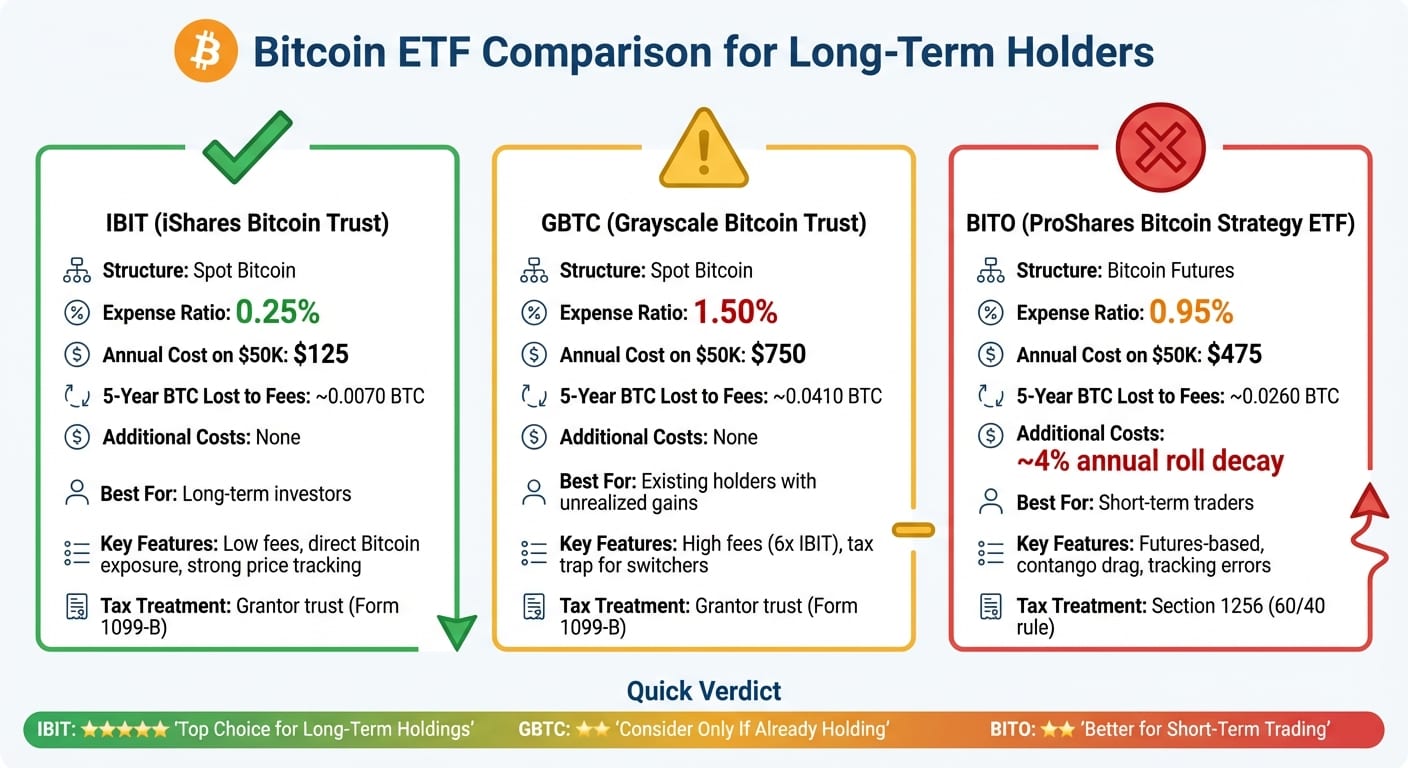
- IBIT (iShares Bitcoin Trust): Low fees (0.25%), direct Bitcoin exposure, and strong price tracking make it a top choice for long-term holders. Ideal for tax-advantaged accounts like IRAs.
- GBTC (Grayscale Bitcoin Trust): High fees (1.50%) and tax inefficiencies hurt its appeal. Existing holders with unrealized gains may face challenges switching to lower-cost options.
- BITO (ProShares Bitcoin Strategy ETF): Futures-based structure introduces roll decay and tracking errors, making it less suitable for long-term strategies despite its 0.95% fee.
Quick Comparison
For long-term growth, IBIT stands out due to its low costs and accurate price tracking. GBTC may suit those already holding it, but its fees are a drawback. BITO is better suited for short-term trading rather than holding over time.
Bitcoin ETFs Ranked and Explained [2025]
IBIT: Structure, Costs, and Performance
The iShares Bitcoin Trust (IBIT) is a spot Bitcoin ETF designed to hold actual Bitcoin in institutional-grade cold storage. Unlike ETFs based on futures, IBIT directly reflects Bitcoin’s price by tracking the CME CF Bitcoin Reference Rate – New York Variant. As of February 20, 2026, the fund held approximately 756,177 BTC, with net assets valued at $51.17 billion.
Fee Structure and Expense Ratios
IBIT charges an annual expense ratio of 0.25%, which is covered by selling small amounts of Bitcoin daily. This process, known as fee drag, slightly reduces the Bitcoin backing per share over time.
For comparison, GBTC’s 1.50% fee is significantly higher. Over five years, GBTC’s fee would amount to approximately 0.0410 BTC. On a $50,000 investment held over the same period, IBIT could save investors about $603 in fees.
Beyond just lower fees, IBIT also stands out for its precise price tracking and strong liquidity.
Tracking Accuracy and Volatility
Because IBIT holds Bitcoin directly, it avoids the roll costs that come with futures-based ETFs. Since its inception, the fund has delivered a cumulative total return of 98.49%, closely matching its benchmark return of 99.39%. The small difference is mainly due to the 0.25% fee and a tight 30-day median bid-ask spread of just 0.02%.
Even during February 2026’s market turbulence - when Bitcoin’s price dropped below $61,000 - IBIT maintained smooth trading. It saw daily trading volumes exceed 80 million shares while keeping its bid-ask spread at a steady 0.02%.
Long-Term Suitability
IBIT’s combination of low fees, accurate price tracking, and strong liquidity makes it an appealing choice for long-term investors. Unlike futures-based funds, IBIT avoids the contango costs tied to rolling contracts. Its large asset base also ensures consistent liquidity. Additionally, IBIT is eligible for IRAs and 401(k)s, offering tax-advantaged growth that direct Bitcoin ownership cannot.
While other spot ETFs like the Grayscale Bitcoin Mini Trust (0.15%), Bitwise BITB (0.20%), and ARK 21Shares ARKB (0.21%) offer slightly lower fees, IBIT’s institutional support from BlackRock and superior liquidity often make it the preferred option for long-term investors.
GBTC: Structure, Costs, and Performance
The Grayscale Bitcoin Trust (GBTC) is a spot Bitcoin ETF that holds physical Bitcoin, with custody handled by Coinbase. On January 11, 2024, it transitioned from a closed-end trust to an ETF. However, unlike many traditional ETFs, it is not registered under the Investment Company Act of 1940. As of February 20, 2026, GBTC manages about 158,000 BTC, representing assets worth roughly $11 billion. While GBTC provides spot Bitcoin exposure, its fee structure and trading history introduce complexities for long-term investors.
Fee Structure and Expense Ratios
GBTC comes with an annual expense ratio of 1.50% - a steep contrast to IBIT's 0.25%. Over time, this significant fee difference can erode returns. Additionally, selling GBTC shares with large unrealized gains can lead to substantial capital gains taxes, often negating the benefits of switching to a lower-cost ETF. These high fees, coupled with tax inefficiencies, make GBTC less appealing for long-term portfolios.
Premiums, Discounts, and Liquidity
Before becoming an ETF, GBTC often traded at premiums or discounts to its net asset value (NAV) due to its lack of a redemption program. Since its ETF conversion, the introduction of a creation and redemption mechanism has helped align its market price with NAV. As of February 20, 2026, the premium/discount to NAV is minimal, at around 0.02%. However, GBTC has shown high short-term volatility, with a 5-day volatility reaching 294.25% as of February 2026. This volatility, combined with its historical fee-related issues, raises questions about its suitability for long-term investments.
Long-Term Suitability
For new investors, there’s little reason to choose GBTC today, especially when alternatives charge fees between 0.15% and 0.25%. To address this, Grayscale introduced the Bitcoin Mini Trust (ticker: BTC), which offers a much lower expense ratio of 0.15%. This provides current GBTC holders a way to lower fees without triggering a taxable event.
Existing GBTC investors should evaluate whether the one-time tax cost of selling is outweighed by the cumulative impact of the 1.50% annual fee over their intended holding period. For those facing a loss, selling to claim the tax benefit and moving to a lower-cost ETF like IBIT or the Bitcoin Mini Trust could be a smart move. When choosing a Bitcoin ETF for the long haul, keeping fees low and managing tax implications should remain top priorities.
BITO: Structure, Costs, and Performance
The ProShares Bitcoin Strategy ETF (BITO) operates differently from spot Bitcoin ETFs, focusing solely on CME Bitcoin futures, swaps, and money market instruments. As ProShares explains:
BITO invests in futures and swaps and does not directly invest in bitcoin
As of February 20, 2026, BITO's portfolio consisted of 70.92% in CME Bitcoin Futures for February 2026 and 25.80% in CME Bitcoin Futures for March 2026. Governed by the Investment Company Act of 1940, BITO offers regulatory protections distinct from spot ETFs and may distribute futures-related gains to shareholders on a monthly basis.
Fee Structure and Expense Ratios
BITO charges an annual expense ratio of 0.95%, which is considerably higher than the fees associated with most spot Bitcoin ETFs. For instance, IBIT's expense ratio is around 0.25%, making BITO's fees nearly four times higher. On a $50,000 investment, BITO's annual fees amount to $475, compared to $125 for IBIT and $750 for GBTC. While BITO's expense ratio is lower than GBTC's 1.50%, it remains significantly higher than the 0.15% to 0.25% range typical of spot ETFs.
Futures-Based Structure and Roll Decay
To maintain its Bitcoin exposure, BITO must regularly sell expiring futures contracts and buy new ones, a process known as "rolling". In a contango market - where futures prices are higher than spot prices - this rolling mechanism can lead to reduced returns over time. ProShares cautions:
The price and performance of bitcoin futures should be expected to differ from the current 'spot' price of bitcoin. These differences could be significant
In December 2025, BITO underperformed Bitcoin's spot price by 1.2% due to contango drag. Over the entire year, this structural issue created an 8.4% performance gap compared to Bitcoin's actual price movement. As Rhys Northwood from AInvest News observed:
BITO's 0.95% fee, combined with contango drag, creates a 'double bleed' for investors
These combined costs - management fees and roll decay - mean that BITO's actual cost of ownership often exceeds its stated expense ratio. This structural inefficiency has a noticeable impact on long-term performance.
Long-Term Suitability
BITO's reliance on futures contracts introduces ongoing performance drag, making it less appealing for long-term investors compared to spot ETFs. The 0.95% expense ratio, coupled with roll decay in contango markets, diminishes BITO's suitability for extended holding periods. For the one-year period ending January 31, 2026, BITO's NAV total return was -21.14%, despite reporting a 12-month yield of 82.01% from distributing futures-related gains.
In contrast, spot ETFs like IBIT provide "pure" Bitcoin exposure by holding the actual asset, ensuring closer tracking of market prices without the basis risk associated with derivatives. While BITO may suit short-term traders or those seeking tax advantages under the 60/40 rule (Section 1256), long-term investors generally prefer spot ETFs to avoid the compounding effects of roll decay and higher fees.
Side-by-Side Comparison: Fees, Tax Treatment, and Risks
For anyone holding Bitcoin over the long haul, understanding fees, tax implications, and risks is key to protecting your investment and boosting returns.
Fee Comparison
The differences in expense ratios among these ETFs can lead to drastically different costs over time. Here's how they stack up:
- IBIT charges a low 0.25% annually.
- GBTC comes in significantly higher at 1.50%.
- BITO falls in the middle with a 0.95% fee.
These fees are covered by selling small portions of Bitcoin daily, which gradually reduces the BTC-per-share ratio.
To put it into perspective, a $50,000 investment in GBTC costs $750 per year, compared to just $125 for IBIT - making GBTC six times more expensive. As btcetfcalc.com explains:
GBTC charges 1.50% annually - six times IBIT's expense ratio. On a $50,000 investment, that's $750 per year versus $125.
Over five years, an investor holding 1,000 IBIT shares (equivalent to about 0.564 BTC) would lose approximately 0.0070 BTC to fees. In contrast, a GBTC holder with the same Bitcoin exposure would lose around 0.0410 BTC. Even a 0.10% fee difference can chip away nearly 1% of Bitcoin exposure over a decade.
BITO's costs go beyond its 0.95% expense ratio. Its futures-based structure introduces roll decay, which has historically caused about 4% annualized underperformance compared to directly holding Bitcoin. Btcetfcalc.com notes:
The fee is fixed as a percentage, but its dollar impact scales with Bitcoin's price. If you're right about BTC going higher, you're paying more in absolute terms for the privilege of holding it in an ETF wrapper.
While fees are important, tax treatment also plays a major role in determining long-term cost efficiency.
Tax Treatment
Both IBIT and GBTC are structured as grantor trusts, meaning they’re taxed like stocks. You only pay taxes on capital gains or losses when you sell your shares. If you hold for at least a year, you qualify for lower long-term capital gains tax rates of 0%, 15%, or 20%, depending on your income. Selling within a year? Gains are taxed at ordinary income rates, which can go as high as 37%. Both funds issue a standard Form 1099-B, making tax reporting simple.
BITO, on the other hand, is treated differently under Section 1256 of the tax code. This rule applies a "60/40" split: 60% of gains are taxed at long-term capital gains rates, while 40% are taxed at short-term rates, regardless of how long you hold the shares. While this setup can be favorable for short-term traders, long-term holders might face annual taxable distributions even if they don't sell their shares, reducing tax efficiency.
Additionally, all three ETFs are subject to the 30-day wash sale rule, as they’re SEC-registered securities. This differs from direct Bitcoin holdings, which aren’t currently subject to wash sale restrictions. For high earners, there’s also the 3.8% Net Investment Income Tax on ETF gains if your income exceeds $200,000 (single) or $250,000 (joint).
Long-term GBTC holders often face a "tax trap." Selling to move into a lower-cost ETF like IBIT triggers capital gains taxes, which might outweigh the potential fee savings over several years. As btcetfcalc.com puts it:
For long-time GBTC holders with large unrealized gains, selling to switch into a cheaper ETF triggers capital gains taxes... Often, the tax bill outweighs years of fee savings.
Risk Assessment
Beyond fees and taxes, each ETF comes with its own set of risks that can impact long-term performance.
IBIT's main risk is fee drag, where Bitcoin-per-share gradually declines as fees are deducted. However, at 0.25%, this effect is relatively minor compared to Bitcoin's daily price swings. Long-term investors should focus on the BTC-per-share ratio to gauge their actual exposure after fees.
GBTC combines high fee drag with the tax trap mentioned earlier, creating a tough situation for holders with large unrealized gains. With its 1.50% annual expense ratio, GBTC holders lose nearly six times more Bitcoin to fees compared to IBIT holders over the same period.
BITO has the most complicated risk profile. Beyond its 0.95% expense ratio, its futures-based structure introduces roll decay due to contango markets, where futures prices are higher than spot prices. Historically, this has caused BITO to underperform Bitcoin's spot price by around 4% annually. Additionally, its tracking error can be significant, as futures prices may deviate from spot Bitcoin prices.
All three funds share custody concentration risk. Both IBIT and GBTC rely on Coinbase Custody for Bitcoin storage, meaning a security breach at this single custodian could impact multiple funds simultaneously. To reduce this risk, some investors diversify across funds with different custodians.
How Mezzi Improves Long-Term Bitcoin ETF Strategies
Managing Bitcoin ETFs across various accounts can get messy fast. Between fees, taxes, and exposure, keeping everything in check is no small task. That’s where Mezzi steps in. By offering real-time tools to simplify cost management, risk assessment, and portfolio diversification, Mezzi brings all your Bitcoin investments into one clear view.
Tax Optimization for Bitcoin ETFs
Tax strategies for Bitcoin ETFs can be tricky, especially with the 30-day wash sale rule in play. Mezzi makes it easier to navigate this rule by enabling issuer swaps. For example, you can sell IBIT (BlackRock) and immediately buy FBTC (Fidelity) to harvest losses while keeping your Bitcoin exposure intact. According to btcetfcalc.com:
The overwhelming consensus among tax professionals is that ETFs from different issuers are not substantially identical, and brokers do not flag cross-issuer ETF swaps as wash sales.
This approach is no small matter. In December 2025, Bitcoin ETFs experienced $825 million in outflows due to tax-loss harvesting strategies. Mezzi’s wash sale prevention feature ensures your transactions across accounts comply with the rule, so you don’t lose valuable deductions by mistake.
For those holding GBTC and eyeing IBIT’s lower 0.25% fee, Mezzi even calculates whether the upfront capital gains tax hit is worth the long-term savings. This helps you avoid falling into a "tax trap" where switching ends up costing more than staying put. These tax optimization tools are seamlessly integrated with Mezzi’s broader portfolio management features.
Portfolio Insights with the X-Ray Feature
Mezzi’s X-Ray feature offers a deeper look into your Bitcoin ETF holdings. It tracks the BTC-per-share ratio to show how fees chip away at your Bitcoin exposure over time.
Beyond that, X-Ray helps you spot custodian concentration risks. For instance, it highlights ETFs like Fidelity’s FBTC, which uses self-custody, giving you options to diversify and reduce counterparty risk.
Account Aggregation Across All Investments
Mezzi doesn’t stop at tax and exposure tools - it also consolidates all your investment accounts into one unified view. Bitcoin ETFs are often spread across brokerage accounts, IRAs, 401(k)s, and even HSAs. Mezzi’s account aggregation feature pulls everything together, saving you from having to log into multiple platforms just to get a full picture of your holdings.
Using trusted aggregators like Plaid and Finicity, Mezzi securely connects your accounts. This complete overview makes it easier to rebalance, spot fee inefficiencies, and execute strategic swaps. Plus, it helps you keep track of tax-loss harvesting across accounts, even when trading the same ETF - a task that’s nearly impossible to manage manually.
With Mezzi, you get all the tools you need to manage your Bitcoin ETFs efficiently, from taxes to portfolio insights, all in one place.
Conclusion: Selecting the Right Bitcoin ETF for Long-Term Holding
Each Bitcoin ETF comes with its own set of advantages and challenges, making the choice highly dependent on your specific investment goals and circumstances.
For those focused on long-term investment, IBIT is a standout option. With its low 0.25% expense ratio, substantial assets under management (AUM), and a minimal 0.02% bid-ask spread, it provides direct spot Bitcoin exposure, competitive fees, and excellent liquidity.
On the other hand, GBTC may not be the best choice for new investors. Its high 1.50% annual fee significantly reduces potential long-term returns. However, if you're already holding GBTC with substantial unrealized gains, selling could trigger a hefty capital gains tax. In such cases, carefully evaluate the numbers or explore alternatives like Grayscale's Bitcoin Mini Trust (BTC), which offers a lower 0.15% fee.
BITO, a futures-based ETF, is less suited for buy-and-hold strategies. With its 0.95% fee and exposure to roll decay, its long-term performance often lags behind spot Bitcoin investments.
Both IBIT and GBTC offer simplified tax reporting and are ideal for tax-advantaged accounts like Roth IRAs, allowing Bitcoin gains to grow without tax burdens.
FAQs
Is IBIT better than buying Bitcoin directly?
For those investing with a long-term perspective, IBIT (iShares Bitcoin ETF by BlackRock) can be a more straightforward option than purchasing Bitcoin directly. With a low expense ratio of about 0.25% and the benefits of a regulated ETF structure, IBIT eliminates the need to manage custody and minimizes security risks. However, it’s worth noting that IBIT doesn’t provide the same level of control as directly owning Bitcoin and could introduce specific tax considerations. This makes it a strong choice for investors who value convenience, reduced costs, and regulatory safeguards over having full ownership of the asset.
When does it make sense to keep GBTC instead of switching?
If you’ve been holding GBTC for the long haul and your cost basis is low, sticking with it might be the smarter move - especially if you’re sitting on significant unrealized gains. Switching to a lower-fee ETF could lead to hefty capital gains taxes, which might cancel out any savings from reduced fees. Unless you’re ready to handle the tax hit or have other gains you can offset, holding onto GBTC often makes more financial sense.
Why can BITO lag Bitcoin even when Bitcoin rises?
BITO might not keep pace with Bitcoin's price increases because it’s a futures-based ETF. Rather than holding Bitcoin directly, it invests in futures contracts. This setup can lead to contango, where futures prices are higher than the current market price (spot price), causing a "drag" on performance over time. On top of that, the process of rolling over contracts and the associated higher costs can result in tracking errors, making it harder for BITO to match Bitcoin's actual performance.
Related Blog Posts
- Which cryptocurrency ETFs, if any, pay distributions, and which currently show the highest trailing yield in my portfolio?
- Compare BITO and similar bitcoin ETFs on expenses, structure (’40 Act vs commodity trust), K-1/1099, and tax treatment.
- What are the historical returns of two tickers (e.g., a bitcoin ETF and a China tech ETF) over the past five years?
- Roth IRA: I have $10,000 earmarked for a bitcoin ETF held for 10 years - what allocation and risks should I consider?
For those investing with a long-term perspective, IBIT (iShares Bitcoin ETF by BlackRock) can be a more straightforward option than purchasing Bitcoin directly. With a low expense ratio of about 0.25% and the benefits of a regulated ETF structure, IBIT eliminates the need to manage custody and minimizes security risks. However, it’s worth noting that IBIT doesn’t provide the same level of control as directly owning Bitcoin and could introduce specific tax considerations. This makes it a strong choice for investors who value convenience, reduced costs, and regulatory safeguards over having full ownership of the asset.
If you’ve been holding GBTC for the long haul and your cost basis is low, sticking with it might be the smarter move - especially if you’re sitting on significant unrealized gains. Switching to a lower-fee ETF could lead to hefty capital gains taxes, which might cancel out any savings from reduced fees. Unless you’re ready to handle the tax hit or have other gains you can offset, holding onto GBTC often makes more financial sense.
BITO might not keep pace with Bitcoin's price increases because it’s a futures-based ETF. Rather than holding Bitcoin directly, it invests in futures contracts. This setup can lead to contango, where futures prices are higher than the current market price (spot price), causing a "drag" on performance over time. On top of that, the process of rolling over contracts and the associated higher costs can result in tracking errors, making it harder for BITO to match Bitcoin's actual performance.