Updated September 26, 2026.
The Boost is Mezzi’s Sunday email about decisions that shape your financial life.
For 2026, the standard employee deferral limit for most 401(k) plans is $24,500. Eligible catch-up contributions can increase that amount. The new Roth catch-up requirement depends on prior-year wages from the employer sponsoring the plan—not household income alone. Confirm how your plan applies it before changing payroll elections.
This edition of The Boost was originally published in April 2026 and has been updated to clarify the rule and planning steps. The question is not simply whether you earn a high salary today. The relevant wage year, employer and plan provisions matter.
The numbers for 2026
| Age category for the year | Standard employee limit | Applicable catch-up | Potential combined amount |
|---|---|---|---|
| Under 50 | $24,500 | None | $24,500 |
| 50–59 or 64 and older | $24,500 | $8,000 | $32,500 |
| 60–63 | $24,500 | $11,250 | $35,750 |
These figures describe the common eligible employee-deferral framework, subject to plan and compensation rules. The special ages-60-to-63 catch-up replaces the regular catch-up for that age band; it is not an additional amount on top of both limits. SIMPLE plans have different limits. IRS 2026 contribution announcement
Employer contributions are a separate part of the plan rules. Do not subtract a match from the employee deferral limit or assume the table describes every total-plan limit.
Who needs the Roth catch-up review?
Beginning in 2026, certain participants whose prior-year wages from the sponsoring employer exceeded $150,000 must make catch-up contributions as Roth contributions. Confirm the applicable wage definition and plan treatment with payroll or the plan administrator. IRS catch-up guidance
That is different from testing joint household income or all investment income. A job change or other employment circumstances can affect the facts relevant to the rule. Ask for the plan’s determination rather than applying a household tax-return total yourself.
The requirement concerns catch-up contributions. It should not be read as automatically requiring every standard employee contribution to be Roth.
What changes in current cash flow?
A Roth contribution does not provide the same current income-tax exclusion as an otherwise eligible pre-tax contribution. If the catch-up amount would previously have been pre-tax, required Roth treatment can affect take-home pay.
For simplified illustration, $8,000 multiplied by an assumed 24% marginal income-tax rate is $1,920. That is not a payroll quote or your final tax effect: applicable federal and state circumstances and other facts can change it.
Review the actual payroll estimate before committing the same contribution amount. The goal is to understand the current cash impact while keeping the retirement objective visible.
What does Roth treatment buy?
Qualified Roth distributions receive favorable tax treatment when the applicable requirements are met. This is different from saying every withdrawal at every time is tax-free. The contribution, account and distribution rules still matter. IRS designated Roth distribution guidance
Compare current and future circumstances with explicit assumptions. A higher current tax cost may support a different future tax mix, but no one knows all future tax rates and household needs with certainty.
Keep the question practical: how does the required contribution treatment fit your broader retirement savings and near-term cash commitments?
What if the plan has no Roth option?
Contact the plan administrator before assuming you can continue a pre-tax catch-up or that a generic article fully describes the plan’s implementation. Ask whether the Roth feature is available, how affected participants are handled and which payroll changes are required.
Get the answer early enough to adjust contributions through the plan’s process. An AI application cannot change the employer’s plan features or override its administration.
If catch-up contributions are unavailable under your circumstances, compare other eligible savings options using the actual rules. An IRA has separate contribution and income requirements; it is not an unlimited substitute.
Check IRA limits separately
The 2026 IRA contribution limit is $7,500, with a $1,100 catch-up for eligible people age 50 and older. Traditional and Roth IRA contributions share the applicable IRA limit, and eligibility or deductibility can depend on compensation, income and workplace-plan coverage. IRS 2026 limits
Do not assume that reaching a workplace-plan limit prevents every IRA contribution, or that it automatically makes the contribution deductible. Those are separate tests.
Your payroll review checklist
Confirm your age category for the year, year-to-date employee contributions, applicable employer-wage test, plan catch-up availability and Roth election process. If you changed employers, bring the relevant contribution records to the review.
Then compare the remaining contribution goal with the pay periods left. Ask payroll about deadlines and any matching rules affected by contribution timing. Do not assume that front-loading contributions has the same result under every employer match arrangement.
Save the confirmation and review the next pay statement to check that the election was implemented as intended.
Connect the decision to the household
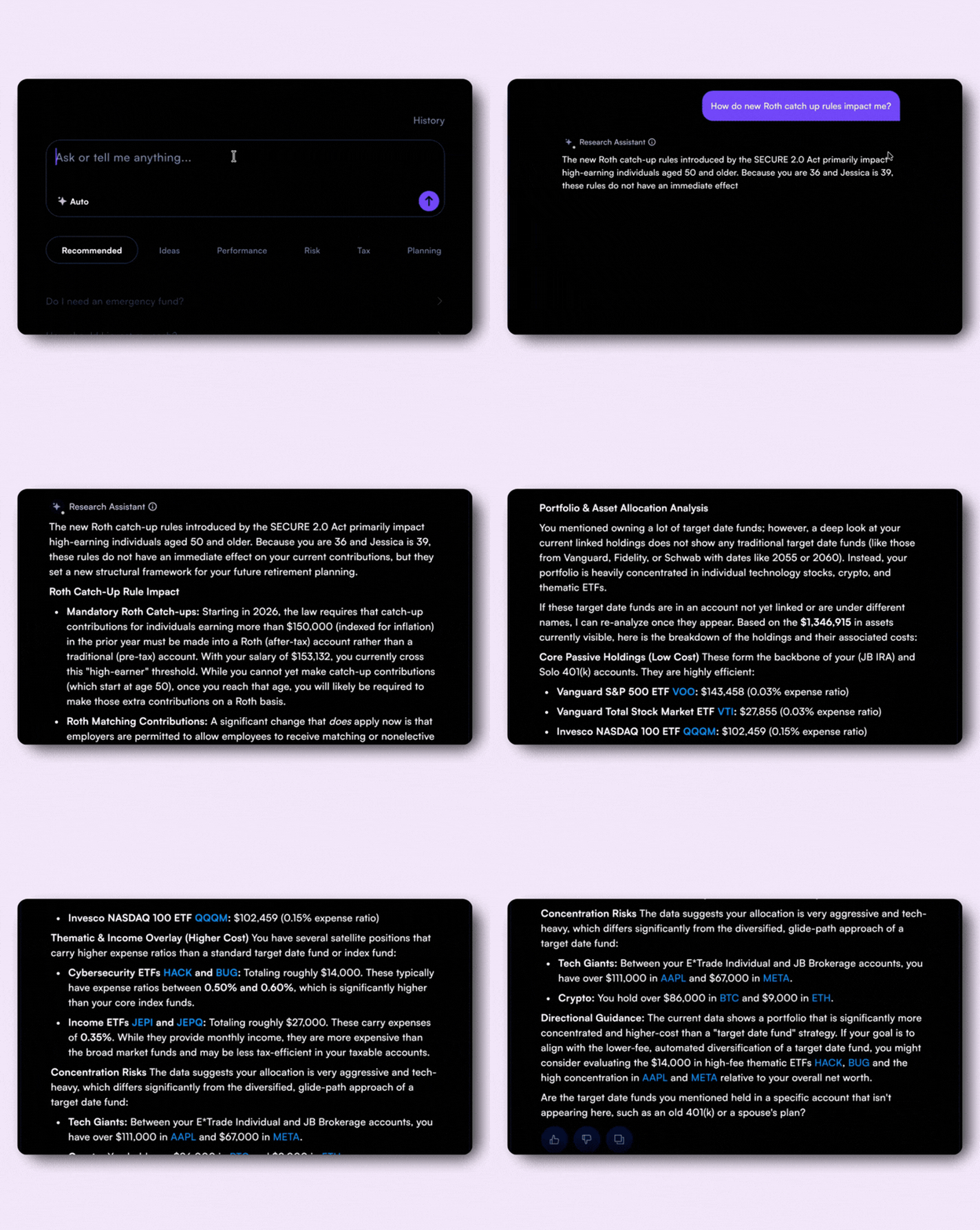
Mezzi can help discuss retirement contributions alongside supported investments, banking, liabilities and goals entered in AI Personalization. That wider picture can clarify whether additional savings conflict with a near-term cash commitment. Mezzi capabilities
Use the plan administrator and IRS records for eligibility and implementation. Mezzi provides guidance rather than determining payroll wages or changing contribution elections.
A useful question is: “After the verified payroll change, how much cash remains for the goals and obligations I have already committed to?”
Frequently asked questions
Is the Roth catch-up test based on household income?
No. The rule uses the applicable prior-year wages from the sponsoring employer. Confirm the wage definition and determination with the plan administrator.
Must every 2026 contribution be Roth?
The requirement concerns affected catch-up contributions, not automatically all standard employee contributions.
Can ages 60–63 add both catch-up amounts?
No. The special $11,250 catch-up replaces the regular $8,000 catch-up for the eligible age band in 2026.
Can Mezzi change my payroll election?
No. Use the employer’s process. Mezzi can help discuss the resulting cash flow and retirement goals.
Put your financial picture to work
Ask how verified tax and contribution facts affect the goals and cash commitments you have already set.
Explore MezziStart with the plan’s verified facts, then connect the contribution choice to the rest of your household.
Published by Mezzi for educational purposes. This is not personalized investment, tax, or legal advice. Prices and features were checked September 26, 2026 and can change. Comparisons use official documentation, not a matched product trial. Examples are illustrative, not customer results. Investing involves risk, including loss of principal. Account information can be incomplete or delayed. SEC registration does not imply approval or a particular level of skill.