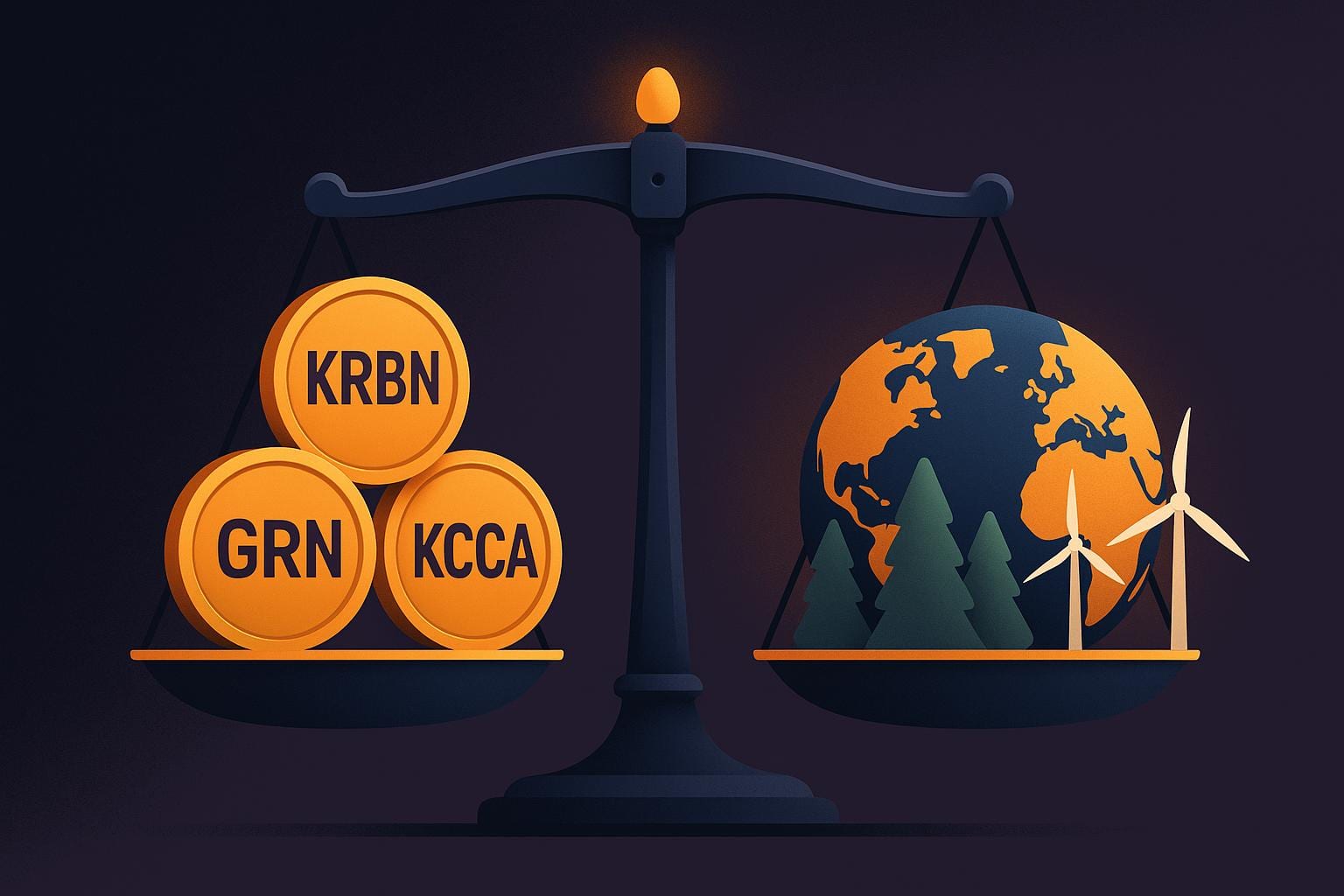
Carbon credit ETFs are gaining attention as a way to invest in emissions trading markets while supporting climate-focused goals. Among the top options are KRBN, GRN, and KCCA, each offering distinct benefits based on their market focus and investment strategy:
- KRBN: Offers global exposure to carbon markets, including the EU and California programs. Best for those seeking diversification.
- GRN: Focuses exclusively on the European Union Emissions Trading System (EU ETS). Appeals to investors confident in Europe's carbon policies.
- KCCA: Targets California's cap-and-trade program. Suitable for those betting on California's aggressive climate policies.
Quick Comparison
Key Takeaway:
Choose KRBN for global diversification, GRN for focused EU exposure, or KCCA for California's dynamic carbon market. Start small (2%-5% of your portfolio) to gauge comfort with these volatile, policy-driven investments.
HOW TO INVEST IN CARBON CREDITS (UPDATE Q2 2022)
KRBN: KraneShares Global Carbon Strategy ETF
KRBN provides a way to tap into global carbon markets by investing in carbon credit futures. These futures are designed to benefit from changing pricing dynamics and regulatory policies.
Fund Structure and Benchmark
This ETF is built around a global carbon index that includes carbon credit futures linked to cap-and-trade systems. It actively manages its portfolio by rolling contracts before they expire and reallocating investments across major regional programs. This approach directly impacts its performance and the level of market volatility it experiences.
Performance and Volatility
KRBN's performance is closely tied to the ups and downs of the carbon credit market. Factors like regulatory changes, shifts in the economy, and energy trends can lead to significant daily price swings, as well as periods of notable gains or losses. That said, its low correlation with traditional asset classes makes it a potential tool for boosting portfolio diversification.
Who Should Consider KRBN
This ETF is a good fit for long-term investors looking for exposure to global carbon markets and who are comfortable with short-term market fluctuations. On the other hand, it may not be suitable for those who prioritize consistent income or prefer lower-risk investments, as it doesn’t pay dividends and its liquidity can vary.
GRN: iPath Series B Carbon ETN
GRN takes a different approach compared to traditional ETFs. Issued by Barclays, this Exchange-Traded Note (ETN) provides focused access to European carbon markets but comes with specific risks investors need to weigh carefully.
Fund Structure and Benchmark
GRN operates as an ETN, meaning it’s essentially an unsecured promise from Barclays to deliver returns tied to the Barclays Global Carbon II TR USD Index. Unlike physically backed exchange-traded commodities (ETCs), GRN doesn’t hold actual assets - it’s backed by cash or high-quality securities. This introduces issuer credit risk: if Barclays encounters financial trouble or defaults, investors could lose their money, even if carbon credits are thriving. This is a key difference from traditional ETFs, which directly hold assets.
The ETN structure exists largely due to European Union regulations. Under the UCITS directive, ETFs in the EU cannot consist of just one component. As a result, single-commodity investments, like carbon emission allowances, are typically structured as ETCs or ETNs rather than standard ETFs.
As of November 28, 2025, GRN manages $15.83 million in assets, making it smaller than some of its competitors. Its expense ratio is 0.75%, covering the costs of maintaining the note and tracking the benchmark. GRN’s strategy zeroes in exclusively on the EU Emissions Trading System (EU ETS).
Focus on EU ETS
GRN’s sole focus is the EU Emissions Trading System, the largest carbon market in the world. This provides investors with direct exposure to European carbon pricing trends, unlike funds that spread investments across multiple regions.
The EU ETS is a compliance-driven market. Companies within the system must either reduce emissions or buy additional allowances as caps tighten over time, which tends to push prices higher. This regulatory framework creates a structural driver for carbon credit values that sets it apart from voluntary carbon markets.
European Union Allowances (EUAs), the primary instrument in the EU ETS, have performed well recently. As of November 28, 2025, EUAs posted returns of 5.91% over one month, 19.18% over one year, and 1.51% over three years. GRN’s concentrated strategy means its performance closely tracks these EU-specific trends.
Risk and Performance Analysis
GRN’s performance has been strong in recent months. Over the three months ending November 28, 2025, the fund delivered a 12.9% return, outperforming alternatives like KRBN (10.6%) and KCCA (1.1%). However, it’s important to remember that past performance doesn’t guarantee future results.
The ETN structure introduces additional risks beyond market volatility. Since GRN is not physically backed, issuer credit risk is a constant concern. This means the fund’s success hinges not just on carbon market trends but also on Barclays’ financial health.
GRN’s exclusive focus on European markets is another double-edged sword. On one hand, the EU’s stringent climate policies and tightening emission caps can drive impressive returns. On the other hand, this geographic concentration makes the fund vulnerable to European regulatory changes, economic shifts, or political developments that could affect carbon pricing.
Additionally, GRN’s relatively small asset base of $15.83 million can lead to wider bid-ask spreads and lower trading liquidity. For investors making larger trades, this could result in higher costs when entering or exiting positions.
For those comfortable with the added complexities of ETNs and seeking targeted exposure to Europe’s carbon markets, GRN offers a direct route to participate in the EU ETS. However, its issuer credit risk, geographic concentration, and specialized structure make it a more niche option compared to broader carbon credit funds.
KCCA: KraneShares California Carbon Allowance Strategy ETF
KCCA zeroes in on California's cap-and-trade program, offering investors a focused way to engage with the state's carbon market. Below, we break down its structure, performance, and suitability for different types of investors.
California Cap-and-Trade Program Exposure
KCCA is designed to track the S&P Carbon Credit CCA Index, which monitors actively traded California Carbon Allowance futures. California's cap-and-trade program, managed by CARB since 2012, reduces carbon allowances by 4% annually to meet its ambitious goals: cutting emissions to 60% of 1990 levels by 2030 and achieving carbon neutrality by 2045.
As of November 28, 2025, KCCA managed $116.6 million in assets, with an expense ratio of 0.91%. A standout feature of this fund is its inflation-linked price floor for carbon allowances, which adjusts annually by 5% plus the Consumer Price Index (CPI). This mechanism adds a layer of protection against inflation, making it a unique aspect of the fund.
Growth Potential and Volatility
KCCA's highly focused strategy comes with both opportunities and risks. California carbon allowances are viewed as one of the most dynamic asset classes in the carbon credit market. For instance, the fund saw an impressive 37% gain in February 2024 compared to the previous year. However, its recent performance has been mixed: a one-year decline of 18.10%, a three-year drop of 1.58%, and an overall decrease of 1.47% since its inception, as of October 31, 2025.
As of November 28, 2025, the fund's net asset value (NAV) stood at $16.31, reflecting a daily decline of 1.45%. Notably, CCA futures had an active trading volume of about $1.5 billion per month as of 2021, showcasing the liquidity in this market. Additionally, KCCA’s low correlation with traditional asset classes makes it a potential tool for portfolio diversification.
Who Should Consider KCCA
KCCA is well-suited for investors who are comfortable with a regional focus and are looking to align their portfolios with California's climate policies. The fund is particularly appealing to those willing to accept higher volatility in pursuit of long-term growth, as California's annual 4% cap reduction creates a structured path for emissions cuts, despite short-term price swings.
For those building a broader carbon credit strategy, KCCA can complement global carbon market investments, offering a more tailored approach. Its inflation-linked price floor also provides a hedge during periods of rising costs. However, its specialized focus may not appeal to investors seeking exposure to multiple carbon markets, as its performance is closely tied to California’s regulatory environment.
KRBN vs. GRN vs. KCCA: Side-by-Side Comparison
When choosing a carbon credit ETF, it's essential to weigh factors like performance, costs, and market focus.
Comparison Table: Key Metrics
This table highlights GRN's cost efficiency, KRBN's global reach, and KCCA's targeted focus on California's carbon market.
Pros and Cons of Each ETF
Here’s a quick breakdown of what each ETF brings to the table - and where they might fall short:
- KRBN: Offers broad diversification across global carbon markets, making it a solid choice for those seeking worldwide exposure.
- GRN: Stands out for its low expense ratio and concentrated focus on Europe's carbon market.
- KCCA: Specializes in California’s carbon market, appealing to investors confident in the state's policy-driven growth, though it carries a higher risk profile.
Matching ETFs to Investor Goals
To align your choice with your financial objectives, consider the following:
- Opt for KRBN if you’re looking for global market exposure and diversification.
- Choose GRN if minimizing expenses and investing in Europe’s market are priorities.
- Go with KCCA if you’re drawn to the opportunities within California’s carbon market and are comfortable with its unique risks.
Each ETF caters to different strategies, so assess your risk tolerance and investment goals before making a decision.
Conclusion: Selecting the Right Carbon Credit ETF
Key Factors for Climate-Linked Investing
Choosing the right carbon ETF requires balancing your environmental priorities with your financial goals. Factors like geographic exposure, expense ratio, risk tolerance, and investment timeline play a crucial role in determining which fund fits your strategy. For example, KRBN provides broad global diversification, spreading risk across multiple carbon markets. On the other hand, GRN and KCCA offer more focused exposure, amplifying potential gains - or losses - based on specific regional policies.
It's also important to consider how an ETF complements your existing portfolio. If you already hold substantial European equities, adding GRN could lead to unwanted overlap. However, if your portfolio lacks climate-focused investments, any of these ETFs could serve as a starting point while contributing to the shift toward a lower-carbon economy. These considerations help frame the decision for the ETF that aligns best with your approach.
Final Recommendations
Each ETF brings a unique focus and risk profile to the table, catering to different investment preferences:
- KRBN offers a globally diversified approach, reducing reliance on any single region's policies. This makes it a solid pick for investors looking to spread regulatory and market risks across multiple jurisdictions.
- GRN stands out for its lower expense ratio and targeted focus on Europe's climate initiatives. It's an appealing choice for those confident in Europe's leadership on carbon reduction and seeking maximum exposure to the EU Emissions Trading System.
- KCCA taps into California's ambitious climate goals, which include aggressive carbon reduction targets and an expanding cap-and-trade program. While the potential for growth is high, this ETF also carries greater volatility due to its focus on a smaller, state-level market.
If you're new to carbon credit investing, consider starting small - perhaps allocating 2% to 5% of your portfolio. This cautious approach lets you gauge your comfort level with the inherent volatility of these investments. Keep a close eye on how these ETFs respond to shifts in climate policies, regulatory updates, and carbon pricing trends. This hands-on experience will help you better understand their role in your broader investment strategy.
FAQs
What are the main risks of investing in carbon credit ETFs like KRBN, GRN, and KCCA?
Investing in carbon credit ETFs carries several risks that are worth noting. One major concern is price volatility. Carbon credit prices can swing sharply due to shifts in market conditions and changes in regulations, making it a potentially unstable investment.
Another significant risk is political and regulatory unpredictability. Since the carbon credit market is heavily shaped by government policies and international agreements, any legislative changes or shifts in enforcement can disrupt supply, demand, and the overall stability of the market.
On top of that, the supply and demand dynamics for carbon credits are still in a state of flux. Variables like industrial activity, advances in technology, and global climate initiatives all play a role in shaping the market's equilibrium and its prospects for future growth.
How do global climate policies and regulations impact the performance of carbon credit ETFs?
The performance of carbon credit ETFs largely hinges on global climate policies and regulations. When governments and organizations enforce stricter rules to cut CO2 emissions, the demand for carbon credits tends to rise, which often boosts their value. For investors in carbon credit ETFs, this creates a chance to capitalize on these shifting market conditions.
Several factors play into this growth, including stricter emission limits, incentives promoting sustainable practices, and increasing awareness about climate change. With these trends likely to gain momentum in the years ahead, carbon credit ETFs present an attractive option for investors who want to align their portfolios with environmental goals while pursuing potential financial gains.
How should I decide the portion of my portfolio to invest in carbon credit ETFs?
When deciding how much of your portfolio to dedicate to carbon credit ETFs, it’s essential to weigh a few critical factors. Start by examining the historical performance, expense ratios, and the underlying assets of each fund. Equally important is evaluating how these ETFs align with your sustainability goals and your personal risk tolerance.
Think about how carbon credit ETFs fit into your broader investment strategy and whether they support your long-term financial objectives. Keep in mind that these funds are subject to shifts in regulatory policies and fluctuations in market demand for carbon credits. To mitigate risk, consider diversifying your portfolio instead of concentrating too heavily on this single asset class.
Disclosures:
- This content is for informational purposes only and does not constitute investment advice or a recommendation to buy or sell any security.
- Past performance is not indicative of future results. No guarantee of future performance or outcomes is implied.
- Always consult with a qualified financial advisor before making investment decisions.
Related Blog Posts
- GDX vs GDXJ vs RING vs SGDM - Best gold-miner ETF for total return
- BKLN vs SRLN vs FTSL - Best senior loan ETF for floating-rate exposure
- DBC vs PDBC vs COMB vs GSG - Best broad commodities ETF for inflation beta
- Carbon Credit Investing: KRBN, GRN, and Direct Offset Markets
Investing in carbon credit ETFs carries several risks that are worth noting. One major concern is price volatility. Carbon credit prices can swing sharply due to shifts in market conditions and changes in regulations, making it a potentially unstable investment.
Another significant risk is political and regulatory unpredictability. Since the carbon credit market is heavily shaped by government policies and international agreements, any legislative changes or shifts in enforcement can disrupt supply, demand, and the overall stability of the market.
On top of that, the supply and demand dynamics for carbon credits are still in a state of flux. Variables like industrial activity, advances in technology, and global climate initiatives all play a role in shaping the market's equilibrium and its prospects for future growth.
The performance of carbon credit ETFs largely hinges on global climate policies and regulations. When governments and organizations enforce stricter rules to cut CO2 emissions, the demand for carbon credits tends to rise, which often boosts their value. For investors in carbon credit ETFs, this creates a chance to capitalize on these shifting market conditions.
Several factors play into this growth, including stricter emission limits, incentives promoting sustainable practices, and increasing awareness about climate change. With these trends likely to gain momentum in the years ahead, carbon credit ETFs present an attractive option for investors who want to align their portfolios with environmental goals while pursuing potential financial gains.
When deciding how much of your portfolio to dedicate to carbon credit ETFs, it’s essential to weigh a few critical factors. Start by examining the historical performance, expense ratios, and the underlying assets of each fund. Equally important is evaluating how these ETFs align with your sustainability goals and your personal risk tolerance.
Think about how carbon credit ETFs fit into your broader investment strategy and whether they support your long-term financial objectives. Keep in mind that these funds are subject to shifts in regulatory policies and fluctuations in market demand for carbon credits. To mitigate risk, consider diversifying your portfolio instead of concentrating too heavily on this single asset class.