
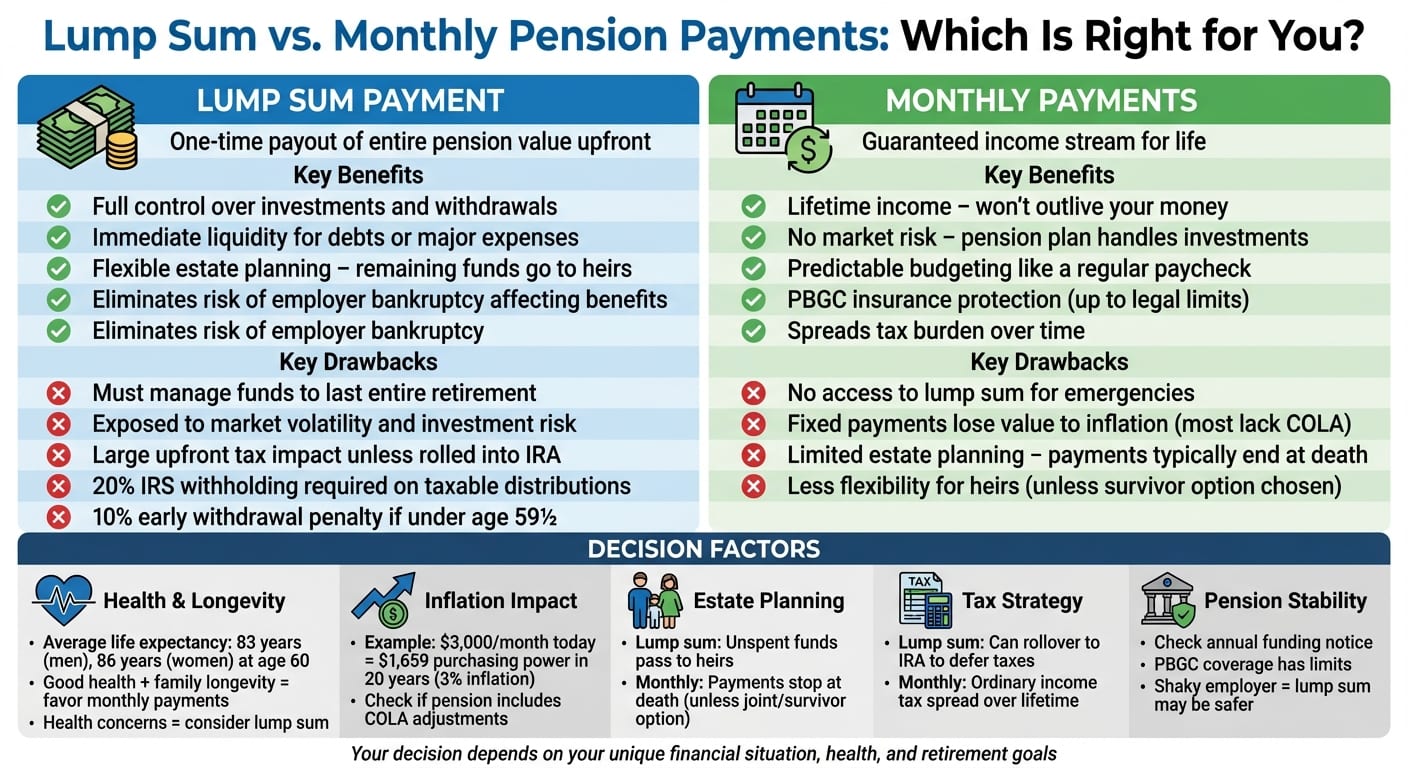
If you're nearing retirement, deciding between a lump sum payout or monthly pension payments is a major financial choice. Here’s the gist:
- Lump Sum: You get all your money upfront. This offers flexibility and control but comes with risks like market fluctuations, longevity concerns, and tax implications. You must manage investments wisely to ensure the funds last.
- Monthly Payments: Provides consistent, guaranteed income for life. This is a key component of diversifying your retirement income to ensure long-term stability. It shifts investment risk to the pension plan but may lack flexibility and lose value over time due to inflation.
Key Factors to Consider:
- Health & Life Expectancy: Longer life expectancy favors monthly payments; shorter may lean toward a lump sum.
- Inflation: Fixed monthly payments can lose purchasing power unless they include adjustments.
- Estate Planning: Lump sums can be left to heirs; monthly payments often stop at death (unless survivor benefits apply).
- Taxes: Lump sums may trigger higher taxes unless rolled into an IRA. Monthly payments spread the tax burden over time.
- Pension Stability: If your employer’s pension fund is shaky, a lump sum might be safer.
Your decision depends on your financial goals, health, and how you want to manage your retirement income sources. Tools like Mezzi can help you analyze your situation and model different outcomes.
Lump Sum vs. Monthly Payments: The Basics
What Is a Lump Sum Payment?
A lump sum payment is a one-time payout that represents the current value of your future benefits. Instead of receiving smaller, regular checks over time, you get the full amount up front. This gives you immediate access to the funds, which you can spend, invest, or roll into an IRA.
This option is appealing to retirees who prefer having control over their money. You get to decide how to invest it, when to withdraw it, and how to manage any remaining balance. But with this freedom comes responsibility - you need to ensure the money lasts through retirement, manage investment risks, and handle the tax implications.
What Are Monthly Payments?
Monthly payments provide a consistent income stream during retirement. These payments are typically tied to defined benefit plans, where your employer takes on the investment risk and guarantees a fixed amount each month.
Most pension plans offer different types of monthly payment options. A single life annuity pays out only during your lifetime and stops once you pass away. A joint and survivor annuity ensures payments continue to your spouse after your death, usually at a reduced rate, such as 50% or 100% of the original amount. A period certain annuity guarantees payments for a specific number of years - like 10 years - and if you pass away during that time, the remaining payments go to your beneficiaries.
The Main Trade-Offs
Choosing between these options boils down to balancing flexibility and security.
A lump sum gives you complete control over how you use your money, allowing for more personalized spending and estate planning. On the other hand, monthly payments provide a reliable income stream that isn't affected by market ups and downs or how long you live. This acts as a kind of safety net, ensuring you won't outlive your income.
With a lump sum, you take on the investment risk yourself, while monthly payments shift that risk to the plan administrator. Additionally, lump sums make it easier to leave unspent funds to your heirs, whereas standard life annuities typically stop payments once you pass away.
Up next, we'll dive into the personal factors that influence this important decision.
Pension: Lump Sum vs Monthly Payments (Guaranteed) - Here’s How To Determine Which Is Better For You
What to Consider Before Deciding
Choosing between a lump sum and monthly pension payments depends heavily on your individual circumstances. Factors like health, expected lifespan, inflation, and what you want to leave behind for your family all play a role in determining the best option.
Life Expectancy and Health
Pensions typically base payouts on standard life expectancy tables, which assume an average lifespan of 83 years for a 60-year-old man and 86 years for a 60-year-old woman. If you're in good health and have a family history of longevity, opting for monthly payments could act as a form of longevity insurance. On the other hand, if your health is less certain, taking a lump sum might help preserve your estate.
Rob Williams, Managing Director of Financial Planning at Charles Schwab, highlights this idea:
If you're in good health and value the protection and income you'll receive if you live longer than average, the annuity option may look more attractive.
To evaluate your options, calculate your break-even point by dividing the lump sum by the annual payment. If you anticipate living well beyond this point, monthly payments might be more beneficial. However, keep in mind that with a single-life annuity, any remaining value typically stays with the employer or insurer if you pass away earlier than expected, rather than going to your heirs.
Inflation and cost-of-living adjustments are also key factors to keep in mind when assessing your future income.
Inflation and Cost-of-Living Adjustments (COLA)
Fixed monthly payments lose value over time without cost-of-living adjustments. For example, a $3,000 monthly pension today might only have the purchasing power of $1,659 in 20 years if inflation averages 3%.
Some pension plans offer COLA increases to help keep up with inflation, but many do not. It's vital to check if your plan includes these adjustments and how they're calculated. Without COLA, even a steady income stream may struggle to cover rising costs in areas like healthcare and housing.
Alternatively, a lump sum invested in a diversified portfolio has the potential to grow and outpace inflation. However, this approach comes with market risks and requires active management to be effective.
Spousal and Survivor Benefits
Monthly pensions often include joint and survivor annuities, which continue paying a portion of your benefit to your spouse after your death - usually at 50% or 100% of the original amount. While this provides financial security for your partner, it reduces your initial monthly payments compared to a single-life annuity.
In contrast, a lump sum provides more flexibility for estate planning. Any unspent funds can be left to your spouse, children, or other beneficiaries according to your wishes. However, careful planning is essential to ensure your spouse has enough financial support if you pass away before using up the funds. Tools like Mezzi's platform can help model these scenarios to optimize your estate planning.
Tax Implications
Both lump sums and monthly payments are taxed as ordinary income, but the timing differs and can significantly impact your tax situation.
A lump sum taken directly may push you into a higher tax bracket unless rolled into an IRA or another qualified retirement plan. Plan administrators are required to withhold 20% for federal taxes if the payout is made directly to you. Additionally, if you're under 59½ and don't roll over the funds, you could face a 10% early withdrawal penalty. Aaron Korthas, Retirement Practice Leader at Fidelity Investments, advises:
If you don't roll the proceeds directly into an IRA or an employer-qualified plan like a 401(k) or a 403(b), the distribution will be taxed as ordinary income and may push you into a higher tax bracket.
A direct rollover avoids these immediate tax issues, maintaining the tax-deferred status of the funds. If you opt for a cash payout, you must deposit the amount into a rollover account within 60 days and cover the withheld 20% from other sources to avoid penalties.
Monthly payments, on the other hand, spread the tax burden over your lifetime, functioning similarly to a regular paycheck. You can adjust your withholding using Form W-4P, making it easier to manage your tax liabilities over time.
Beyond taxes, the stability of your pension plan is another critical consideration.
Pension Plan Solvency and PBGC Coverage
The financial health of your pension plan can directly impact your benefits. Check the annual funding notice to assess its stability. If your employer becomes insolvent, the Pension Benefit Guaranty Corporation (PBGC) steps in, but its coverage has limits.
If your promised benefit exceeds PBGC's cap, you could lose the difference if the plan fails. This risk might make a lump sum more appealing, especially for those with benefits above the PBGC limit.
It's also worth noting that if PBGC takes over your plan, they only provide monthly payments. Lump-sum distributions are available only if the total benefit value is $7,000 or less for plans terminating in 2024 or later. Additionally, some companies transfer pension obligations to insurance providers through annuity buyouts. In these cases, PBGC coverage ends, and your benefits depend on the insurer's financial strength and state guaranty associations.
If your company's financial future seems uncertain or your benefit exceeds PBGC limits, taking a lump sum might allow you to secure the full value of your pension. Just make sure to handle any rollover carefully to avoid unnecessary taxes or penalties. Using tools like Mezzi, you can simulate various scenarios to see how plan stability might affect your long-term income.
Lump Sum: Benefits, Drawbacks, and Risks
Opting for a lump sum means receiving your entire pension benefit upfront. This gives you full control over how to invest and spend the money, but it comes with both opportunities and challenges.
Benefits of a Lump Sum
One clear advantage is the ability to control your investments. You decide how to allocate the funds and when to access them, potentially earning returns that surpass the steady income of monthly pension payments. Another benefit is the flexibility it offers for estate planning. Unlike many pension annuities that stop payments after your death, any unspent portion of a lump sum can be passed on to your heirs.
A lump sum also provides immediate liquidity, which can help you pay off debts or address other financial needs. Additionally, by taking the money upfront, you eliminate the risk of losing future benefits if your former employer goes bankrupt or if the pension fund becomes underfunded.
Drawbacks and Risks of a Lump Sum
Despite the advantages, taking a lump sum carries significant risks that require careful consideration.
The biggest challenge is ensuring your money lasts as long as you do. Unlike monthly pension payments, which provide guaranteed income for life, a lump sum requires disciplined financial management. For example, turning a $150,000 lump sum into a $1,200 monthly income over 18 years would require an annual return of about 6.73%. If you add a 2% cost-of-living adjustment, that target jumps to nearly 9–10%.
Market volatility is another concern. Investments can fluctuate, and a market downturn early in retirement could jeopardize your financial stability. Aaron Korthas, Retirement Practice Leader at Fidelity Investments, emphasizes the risks:
To access those funds for another reason puts the quality of your retirement at risk.
Tax implications also play a major role. Unless you roll the lump sum directly into a qualified retirement account like an IRA, the entire amount is taxed as ordinary income in the year you receive it. The IRS requires a 20% withholding on taxable distributions, and if you're under 59½, you may face an additional 10% early withdrawal penalty unless you complete a direct rollover.
Lump Sum vs. Monthly Payments: Side-by-Side Comparison
This table outlines the core differences between a lump sum and monthly payments, helping you weigh the pros and cons. By understanding these trade-offs, you can better align your choice with your retirement goals and make use of Mezzi's tools to guide your decision-making process.
Monthly Payments: Benefits, Drawbacks, and Risks
Monthly pension payments provide a dependable income stream for life, shifting investment risk from you to the pension plan. Building on the discussion of payment types, this option protects you from market ups and downs but also comes with certain restrictions worth noting.
Benefits of Monthly Payments
A major perk of monthly payments is the promise of lifetime income. No matter what happens in the markets, your check arrives consistently. As Brandon Renfro, CFP®, RICP, EA, explains:
A monthly payment from a pension plan can provide a stable foundation of retirement income. It's an excellent choice for many retirees.
This steady income ensures you won't outlive your resources. Matching this level of financial security with a lump-sum investment would require significant returns, which can be difficult to achieve.
Monthly payments also simplify financial management. You won't need to make ongoing investment decisions, and many private pensions include insurance through the PBGC, adding another layer of security.
While the predictability is appealing, it's essential to consider the potential downsides.
Risks and Limitations of Monthly Payments
One key drawback is the lack of liquidity. Once you start receiving monthly payments, accessing a large sum for emergencies or major expenses is no longer an option.
Inflation poses another challenge. Most private-sector pensions don’t offer cost-of-living adjustments (COLAs), meaning the purchasing power of your fixed payments may decline over time unless you have other inflation-protected assets.
Estate planning can also become tricky with monthly payments. A single-life annuity typically ends when the retiree passes away, leaving little or nothing for heirs. While a joint-and-survivor option can provide ongoing income for a spouse, it often reduces the monthly payment during your lifetime.
These limitations highlight the importance of comparing monthly payments to lump-sum options, which offer more immediate control over your funds.
Comparison Table: Longevity and Estate Planning
Here’s a breakdown of how monthly payments stack up against lump sums when it comes to longevity and estate planning:
How Mezzi Helps You Evaluate Your Pension Options
Deciding between a lump sum and monthly pension payments is not something to tackle without considering your entire financial situation. Your choice should account for all your financial resources, such as your 401(k), IRAs, taxable accounts, and other income streams. Mezzi’s AI-powered platform integrates all these components to help you make an informed decision about your pension.
Bringing All Accounts Together for Clarity
Mezzi uses secure, read-only access through Plaid and Finicity to connect all your accounts - whether it’s a 401(k), brokerage account, Roth IRA, or taxable account. This complete overview is key to providing accurate pension evaluations because every piece of your financial puzzle matters. For example, when considering a pension buyout, it’s crucial to see how it aligns with your broader retirement plan. This connected approach lays the groundwork for a strategy that’s driven by your actual financial data.
Tailored Retirement Planning Using Your Data
Once Mezzi consolidates your financial accounts, it uses your real data to model future scenarios and guide your pension decision. The platform compares how a lump sum might grow against the long-term value of monthly payments, factoring in your unique financial situation.
By running advanced Monte Carlo simulations, Mezzi calculates the likelihood of various investment outcomes. It also evaluates your data against historical market trends to give a clear picture of potential returns. For example, it determines the annual returns you’d need for different payout options and checks if your current portfolio allocation can realistically meet those targets.
Expert Guidance and Tax-Smart Strategies
After analyzing your financial profile and running personalized simulations, Mezzi goes a step further by offering fiduciary advice. As an SEC-registered fiduciary, Mezzi is legally required to prioritize your best interests. This includes identifying tax-saving strategies you might overlook.
If you’re leaning toward a lump sum, Mezzi can determine whether rolling it into an IRA or 401(k) is the smarter move to avoid ordinary income tax and potential penalties if you’re under 59½. It also suggests tax-efficient ways to allocate assets across different account types and highlights rebalancing opportunities to minimize tax liabilities.
With Mezzi, you get insights and strategies that rival those of top-tier financial advisors. From tax savings to personalized guidance, the platform helps you make the most of your pension options based on your actual financial data.
Conclusion: Choosing What Works for You
Deciding between a lump sum and monthly payments hinges on several personal factors, including your income needs, essential expenses, and overall health. Think about your family's longevity and estate plans to determine which option aligns best with your retirement goals.
Taxes are another key aspect to weigh. If you roll a lump sum into a traditional IRA, it retains its tax-deferred status. However, opting to take the lump sum as cash could mean facing ordinary income taxes - and potentially a 10% penalty if you're under 59½. Additionally, check if your pension includes a Cost-of-Living Adjustment (COLA). Most private-sector pensions don’t, which means without COLA, inflation could erode your purchasing power unless you invest the lump sum wisely to counteract that risk.
To make the best choice, consider how your pension fits into the bigger picture of your finances, including your 401(k), IRAs, taxable accounts, and other income streams. Tools like Mezzi can help simplify this process by connecting all your accounts, running advanced simulations to explore different scenarios, and highlighting tax-saving opportunities. It provides the kind of detailed analysis you'd expect from a top financial advisor, tailored specifically to your data rather than relying on generic assumptions.
FAQs
How do I find my pension break-even age?
To figure out your pension break-even age, start by comparing the lump sum you're offered to the total monthly payments you'd receive over time. Simply divide the lump sum amount by the monthly payment to calculate how many months it would take to break even. Then, add that number to your current age to estimate your break-even point.
Keep in mind, though, this isn't the whole picture. Factors like your life expectancy, inflation, and potential investment growth play a big role in this decision. Using retirement planning tools can help you get a more precise estimate and make a more informed choice.
Can I roll my lump-sum pension into an IRA tax-free?
Yes, it’s possible to roll a lump-sum pension into an IRA without triggering taxes. However, this move comes with added responsibilities. You’ll need to manage the funds yourself, which can introduce risks like running out of money in retirement or experiencing losses from poor investment choices or market downturns. Make sure to assess your financial objectives and comfort level with risk before making this decision.
What if my pension plan fails after I retire?
If your pension plan collapses after you’ve retired, it could jeopardize your financial stability - especially if you depend heavily on that guaranteed income. While monthly pensions are designed to provide payments for life, financial troubles or insolvency could lead to reduced or even halted payments. To safeguard your future, it’s smart to evaluate the financial health of your pension plan. Additionally, diversifying your income streams - through personal savings, investments, or private annuities - can help lessen your dependence on a single source.
Disclosures:
- This content is for informational purposes only and does not constitute investment advice or a recommendation to buy or sell any security.
- Past performance is not indicative of future results. No guarantee of future performance or outcomes is implied.
- Savings and performance examples are hypothetical and for illustrative purposes only. Actual results will vary based on individual circumstances, portfolio composition, market conditions, and fees.
- Registration does not imply a certain level of skill or that the SEC has approved the company or its services.
Related Blog Posts
- Social Security vs. Retirement Savings: Balancing Income Sources
- When can you start pulling from a 401k?
- If I add a lump sum to my portfolio, how would it change my annual investment income?
- What portfolio value and withdrawal strategy would generate a specific monthly after-tax income?
To figure out your pension break-even age, start by comparing the lump sum you're offered to the total monthly payments you'd receive over time. Simply divide the lump sum amount by the monthly payment to calculate how many months it would take to break even. Then, add that number to your current age to estimate your break-even point.
Keep in mind, though, this isn't the whole picture. Factors like your life expectancy, inflation, and potential investment growth play a big role in this decision. Using retirement planning tools can help you get a more precise estimate and make a more informed choice.
Yes, it’s possible to roll a lump-sum pension into an IRA without triggering taxes. However, this move comes with added responsibilities. You’ll need to manage the funds yourself, which can introduce risks like running out of money in retirement or experiencing losses from poor investment choices or market downturns. Make sure to assess your financial objectives and comfort level with risk before making this decision.
If your pension plan collapses after you’ve retired, it could jeopardize your financial stability - especially if you depend heavily on that guaranteed income. While monthly pensions are designed to provide payments for life, financial troubles or insolvency could lead to reduced or even halted payments. To safeguard your future, it’s smart to evaluate the financial health of your pension plan. Additionally, diversifying your income streams - through personal savings, investments, or private annuities - can help lessen your dependence on a single source.