
Worried about bank failures? Here's what you need to know to protect your money:
- FDIC Insurance: Deposits up to $250,000 per depositor, per institution, and per ownership category are insured. No insured depositor has ever lost money since 1933.
- Uninsured Funds: Deposits exceeding $250,000 may not be fully recoverable. In 2024, about 40% of U.S. deposits - roughly $7 trillion - were uninsured.
- Ownership Strategies: Use joint accounts, trust accounts, or retirement accounts to increase coverage at one bank.
- Diversify Deposits: Spread funds across multiple FDIC-insured banks to ensure all your money is protected.
- Monitor Bank Health: Tools like Mezzi can help track balances and assess your bank's financial stability using metrics like the Tier 1 Leverage Ratio.
- Prepare for Delays: Even insured funds might be temporarily inaccessible after a failure, so keep a small cash reserve for emergencies.
The key is understanding your coverage, spreading your risk, and staying informed. Use these strategies to reduce the impact of a possible bank failure.
Understanding Bank Failures and FDIC Insurance
What Happens When a Bank Fails
A bank failure occurs when regulators shut down a bank that’s unable to meet its financial obligations. This typically happens when the bank becomes insolvent, meaning its liabilities outweigh its assets. Causes of insolvency can include risky investments, economic downturns, or poor management decisions.
When a bank fails, the FDIC takes on two key roles: insuring deposits and acting as the receiver to manage the failed bank's assets. Often, the FDIC arranges a "Purchase and Assumption" deal, where deposits and assets are transferred to a more stable bank. For instance, after First Republic Bank failed in May 2023, JPMorgan Chase took over its deposits and most of its assets. The transition was seamless, with branches reopening the next business day as Chase locations.
The FDIC typically issues insurance payments within two business days of a bank’s closure. If no buyer is found for the failed bank, the FDIC pays depositors directly through a process called a "Deposit Payoff." For deposits exceeding the insured limit of $250,000, depositors receive a Receiver's Certificate, which entitles them to a share of the proceeds once the FDIC liquidates the bank’s assets. However, this process can take months or even years.
Understanding these procedures highlights how FDIC insurance works to protect depositors and ensure swift access to insured funds.
How FDIC and NCUA Insurance Works
FDIC insurance automatically protects deposits when you open an account at an insured institution - there’s no need to apply or pay a fee. Deposits held under the same ownership at a single bank are combined for coverage purposes, while deposits at different banks are insured separately.
However, FDIC insurance doesn’t cover all financial products. Covered accounts include checking, savings, money market deposit accounts, and certificates of deposit. On the other hand, investments like stocks, bonds, mutual funds, cryptocurrency, life insurance policies, annuities, and the contents of safe deposit boxes are not insured.
For credit unions, the National Credit Union Administration (NCUA) provides similar protection, also insuring deposits up to $250,000. To confirm if an institution is insured, look for the official FDIC sign or use the FDIC's BankFind tool online. Additionally, the FDIC’s Electronic Deposit Insurance Estimator (EDIE) can help calculate your specific coverage based on your account details.
"No depositor has ever lost a penny of insured deposits since the FDIC was created in 1933." - FDIC
What does the FDIC do when your bank fails? (2009) | 60 Minutes Archive
Maximizing Coverage Through Account Strategies
Using Ownership Categories
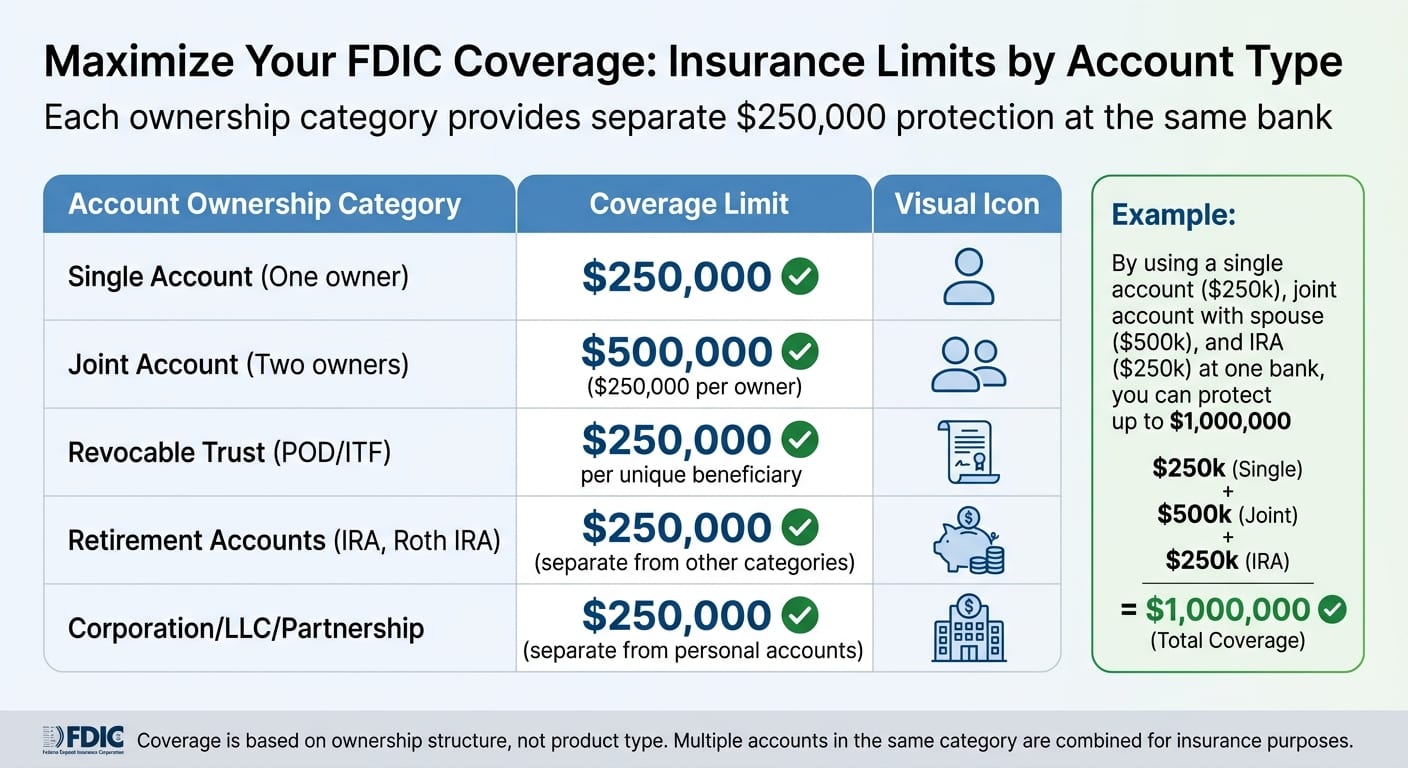
The FDIC offers protection through 14 different ownership categories, each providing a separate $250,000 insurance limit at the same bank. By strategically using these categories, it’s possible to safeguard amounts far exceeding $250,000 at a single institution.
For instance, a joint account with a spouse doubles the coverage to $500,000, as each co-owner is insured up to $250,000. Revocable trust accounts, often referred to as Payable-on-Death (POD) or In-Trust-For (ITF) accounts, can also extend coverage. These accounts insure $250,000 per unique beneficiary, meaning that naming three beneficiaries results in $750,000 in protection at one bank. Additionally, retirement accounts like traditional and Roth IRAs are insured separately, providing another $250,000 in coverage. For businesses, accounts held by corporations, partnerships, or LLCs receive their own $250,000 limit, independent of personal accounts.
It’s important to note that coverage is based on ownership structure, not the type of financial product. For example, multiple accounts within the same ownership category are combined for FDIC insurance purposes.
If your deposits exceed the limits available through these categories, consider diversifying funds across multiple banks.
Spreading Deposits Across Multiple Banks
When your total deposits surpass the coverage limits available through ownership categories, another effective strategy is to distribute funds across multiple FDIC-insured banks. Each independently chartered bank provides its own $250,000 insurance limit. For example, depositing $1 million across four different banks ensures every dollar is protected.
To ensure proper coverage, verify that each bank is independently chartered using the FDIC’s BankFind tool. Remember, branches of the same institution share the same insurance limits. Additionally, be cautious with fintech sweep programs that automatically allocate large deposits among partner banks. If you already hold an account at one of those partner banks, combining balances might exceed the $250,000 limit, leaving some funds uninsured.
Monitoring Bank Health and Account Balances
Tracking Balances and Accounts
Account balances can fluctuate for various reasons - interest accrual, deposits, or unexpected financial gains may push them above the $250,000 FDIC insurance limit. By the fourth quarter of 2024, over 40% of deposits in U.S. banks - around $7 trillion out of $17 trillion - were not insured by the FDIC. This leaves a considerable amount of money exposed in the event of bank failures.
To stay on top of this, it's crucial to maintain accurate records of your accounts and their balances. The FDIC offers a tool called the Electronic Deposit Insurance Estimator (EDIE), which helps you determine your coverage based on account details and ownership categories. If your balance approaches the insurance limit at a single institution, it might be time to redistribute funds or modify your ownership structure.
For additional insights, you can also use Mezzi, a tool designed to analyze your bank's financial health.
Using Mezzi to Monitor Bank Health
Staying informed about your bank's financial health is just as important as tracking your account balances. Although the FDIC oversees more than 5,000 institutions, it's wise to independently verify your bank's stability. Mezzi provides a solution by connecting to your accounts with read-only access and delivering real-time insights about the financial condition of your banks.
One of the key metrics Mezzi monitors is the Tier 1 Leverage Ratio, a critical indicator of a bank's financial stability. Dan Kang, CFO at Mercury, emphasizes:
"The capital ratio you should pay the most attention to is a bank's tier 1 leverage ratio... Typically speaking, the higher the percentage, the healthier the bank".
While the regulatory minimum for this ratio is 4%, a healthier bank typically maintains a ratio closer to 6%, with larger institutions often ranging between 6% and 8%. Mezzi also evaluates other important metrics like Net Interest Margin and Loan-to-Deposit Ratios. A loan-to-deposit ratio nearing or exceeding 100% could indicate that the bank may struggle to cover sudden withdrawals due to limited liquidity.
If Mezzi detects potential red flags - such as a Tier 1 ratio close to 4%, a Net Interest Margin under 3%, or a loan-to-deposit ratio nearing 100% - it sends alerts and suggests diversification strategies. The platform allows you to ask detailed questions about your bank's financial health at any time, providing quick answers without the need to sift through complex financial reports yourself.
Preparing for Quick Access and Excess Funds
Maintaining a Cash Reserve
Once you've assessed your bank's stability and adjusted your account balances, it's wise to prepare for any short-term disruptions. In the event of a bank failure, accessing funds might be temporarily delayed. To navigate this, consider keeping a small amount of cash at home in a secure spot - just enough to cover essential expenses like groceries, gas, and utilities for a brief period. That said, avoid holding large sums of cash at home, as it increases the risk of theft or loss.
It's also a good idea to organize critical documents for easy access. Store copies of your identification, bank contact details, and both sides of your debit and credit cards in a secure folder or digital storage. If you depend on direct deposits, such as Social Security payments, these funds are typically redirected to an acquiring bank or managed by a temporary institution set up by the FDIC.
While a cash reserve can handle immediate needs, knowing how to manage uninsured funds is equally important.
Filing Claims for Uninsured Deposits
If your diversification efforts fall short, filing a claim for uninsured deposits becomes a fallback measure. For amounts exceeding $250,000, the FDIC provides a Receiver's Certificate, which represents your claim on the failed bank's remaining assets. However, this process can take months or even years.
Recoveries from asset liquidation may result in partial payments, but full reimbursement isn't guaranteed. Because of this uncertainty, it's often better to distribute deposits across multiple FDIC-insured institutions or use different ownership categories to stay within coverage limits. These proactive steps can minimize risk and ensure better access to your funds. Tools like Mezzi, which help track your bank's financial health, can also support these efforts by offering insights into potential risks. By combining these strategies, you can maintain liquidity and be better prepared to handle recovery options if a bank failure occurs.
Conclusion
Safeguarding your assets starts with taking clear, deliberate actions. First, confirm that your bank is FDIC-insured, and ensure your deposits stay within the $250,000 coverage limit per ownership category. Since nearly 40% of U.S. deposits may not be insured, consider spreading your funds across multiple banks or using different ownership categories to keep each deposit protected.
When it comes to monitoring your bank's stability, staying informed is essential. Pay attention to financial updates and watch for potential warning signs, like falling equity prices or widening credit spreads. Tools like Mezzi offer real-time insights into the health of your financial institutions, helping you identify risks early. With a consolidated view of your accounts, you can make adjustments to minimize exposure and maintain control over your financial strategy.
For deposits that exceed insurance limits, recovery through FDIC receivership could take time and isn’t guaranteed. Taking steps to diversify your holdings ahead of time is a practical way to reduce risk.
FAQs
How do I calculate my total FDIC coverage across multiple accounts at one bank?
To figure out your FDIC coverage, start with the $250,000 insurance limit for each depositor, per ownership category, at each insured bank. Add together the balances for all accounts within the same ownership category - such as individual, joint, or trust accounts - at the same bank. Each category is insured independently, up to $250,000. If you want to expand your coverage, consider opening accounts in different ownership categories or at other FDIC-insured banks.
What should I do if my balance briefly goes over $250,000 (like after a home sale)?
If your account balance temporarily goes over $250,000, you might want to think about dividing your funds among multiple FDIC-insured banks or using different ownership categories, such as joint accounts or trusts. This approach can help you stay within the FDIC insurance limits. Some bank networks also offer services that automatically spread your deposits across several insured banks, providing an extra layer of protection. These strategies may help keep your money secure, even when it exceeds the standard insurance cap.
Which bank warning signs should I watch for, and how can Mezzi help me spot them early?
When it comes to safeguarding your finances, staying alert to potential red flags is crucial. Some of the primary warning signs include:
- Inadequate risk management: This may indicate that a financial institution isn't prepared to handle market volatility or economic challenges effectively.
- Consistent financial losses: Repeated losses can signal deeper operational or market-related issues.
- Declining capital reserves: A reduction in reserves might suggest the institution is less equipped to absorb shocks.
- Increased regulatory scrutiny: Heightened attention from regulators could point to compliance or operational problems.
- Sudden withdrawal spikes: A surge in withdrawals may reflect waning customer confidence.
Mezzi’s AI tools are designed to help monitor these risks by analyzing regulatory filings and financial reports. By identifying potential trouble early, you may have the opportunity to make adjustments, such as spreading your deposits across multiple institutions or setting up alternative banking arrangements. These steps could help you better shield your finances from potential disruptions.
Disclosures:
- This content is for informational purposes only and does not constitute investment advice or a recommendation to buy or sell any security.
- Past performance is not indicative of future results. No guarantee of future performance or outcomes is implied.
- Savings and performance examples are hypothetical and for illustrative purposes only. Actual results will vary based on individual circumstances, portfolio composition, market conditions, and fees.
- Users should not rely solely on AI-driven tools for financial decision-making.
- All links to external sources are provided for reference only.
Related Blog Posts
- Social Security vs. Retirement Savings: Balancing Income Sources
- Life Events and Business Ownership: Transition Strategies
- What strategies can increase my safety net while maintaining moderate growth?
- How can I optimize savings to buy a car without liquidating investments (timeline, account source, and APY targets)?
To figure out your FDIC coverage, start with the $250,000 insurance limit for each depositor, per ownership category, at each insured bank. Add together the balances for all accounts within the same ownership category - such as individual, joint, or trust accounts - at the same bank. Each category is insured independently, up to $250,000. If you want to expand your coverage, consider opening accounts in different ownership categories or at other FDIC-insured banks.
If your account balance temporarily goes over $250,000, you might want to think about dividing your funds among multiple FDIC-insured banks or using different ownership categories, such as joint accounts or trusts. This approach can help you stay within the FDIC insurance limits. Some bank networks also offer services that automatically spread your deposits across several insured banks, providing an extra layer of protection. These strategies may help keep your money secure, even when it exceeds the standard insurance cap.
When it comes to safeguarding your finances, staying alert to potential red flags is crucial. Some of the primary warning signs include:
- Inadequate risk management: This may indicate that a financial institution isn't prepared to handle market volatility or economic challenges effectively.
- Consistent financial losses: Repeated losses can signal deeper operational or market-related issues.
- Declining capital reserves: A reduction in reserves might suggest the institution is less equipped to absorb shocks.
- Increased regulatory scrutiny: Heightened attention from regulators could point to compliance or operational problems.
- Sudden withdrawal spikes: A surge in withdrawals may reflect waning customer confidence.
Mezzi’s AI tools are designed to help monitor these risks by analyzing regulatory filings and financial reports. By identifying potential trouble early, you may have the opportunity to make adjustments, such as spreading your deposits across multiple institutions or setting up alternative banking arrangements. These steps could help you better shield your finances from potential disruptions.