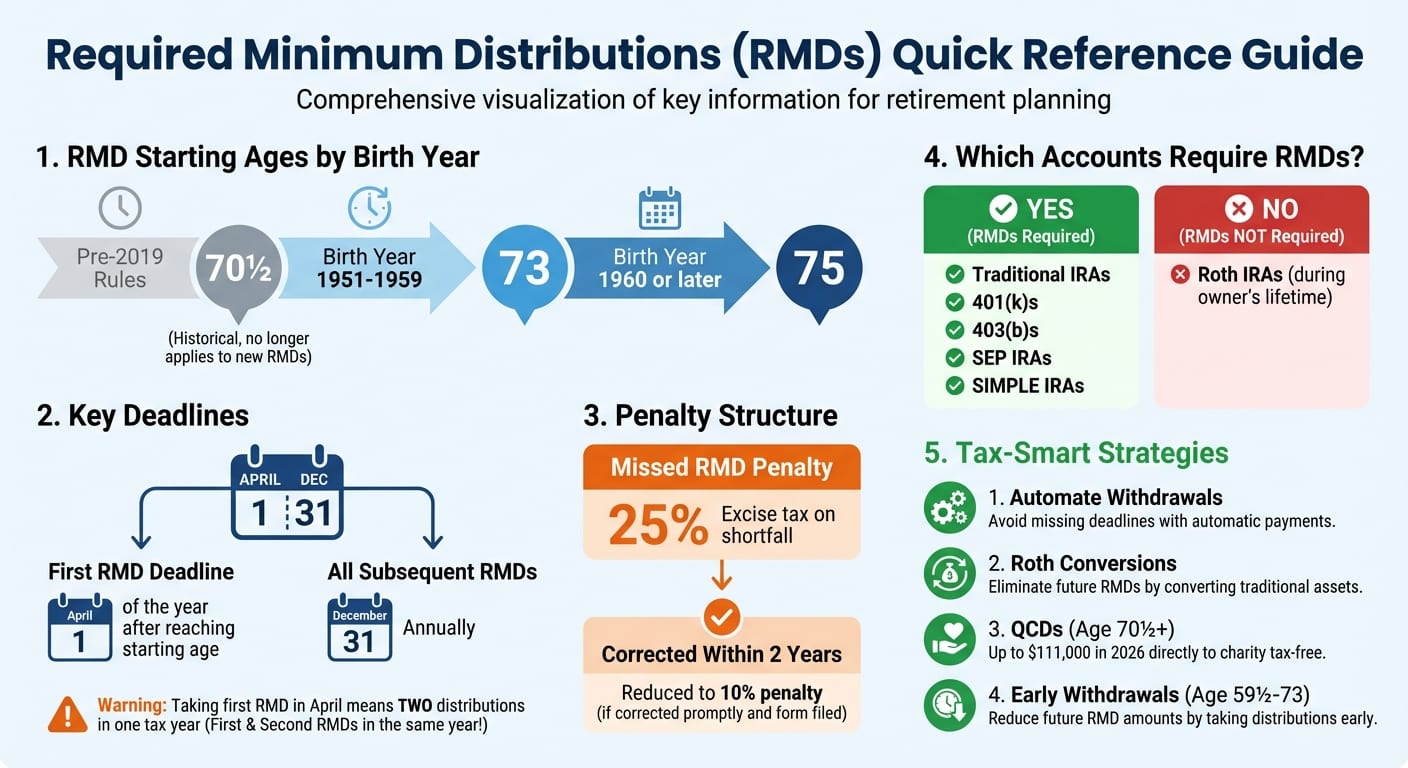
Required Minimum Distributions (RMDs) are mandatory withdrawals from certain retirement accounts like IRAs and 401(k)s. They begin at a specific age, determined by your birth year, and are calculated using your account balance and IRS life expectancy tables. Recent changes under the SECURE 2.0 Act raised the starting age for RMDs to 73 for those born between 1951–1959 and 75 for those born in 1960 or later. Missing an RMD deadline results in a 25% penalty, reduced to 10% if corrected within two years.
Key points to know:
- Which accounts require RMDs? Traditional IRAs, 401(k)s, and similar plans. Roth IRAs are exempt during your lifetime.
- When do RMDs start? April 1 of the year after you reach the starting age.
- How are they taxed? RMDs are taxed as ordinary income, which may impact your tax bracket and Medicare premiums.
- Planning strategies: Automate withdrawals, consider Roth conversions, and explore Qualified Charitable Distributions (QCDs) to minimize taxes.
Understanding RMD rules helps you avoid penalties and manage retirement income effectively. The article below breaks down these rules and offers tips for smarter planning.
Everything You MUST Know about Required Minimum Distributions
Understanding these rules is the first step to minimizing taxes on retirement withdrawals and avoiding heavy penalties.
When Do RMDs Start?
The rules around when you must start taking Required Minimum Distributions (RMDs) have shifted in recent years. Knowing these updated guidelines can help you avoid penalties and better manage your retirement funds.
RMD Starting Age Under SECURE 2.0 Act
The SECURE 2.0 Act of 2022 brought changes to the starting age for RMDs. As of January 1, 2023, the starting age increased from 72 to 73. Beginning in 2033, it will rise again. Your birth year determines when you need to begin taking distributions:
If you were born between 1951 and 1959, you must start RMDs at age 73. For those born in 1960 or later, the starting age is 75. This marks a departure from pre-2019 rules under the original SECURE Act, when RMDs began at age 70½.
However, there’s an important exception for workplace retirement plans. If you’re still working past the RMD starting age and own 5% or less of the business, you can delay RMDs from your employer-sponsored plan until April 1 after you retire. Keep in mind that this exception doesn’t apply to IRAs, SEP IRAs, or SIMPLE IRAs, which must follow the standard RMD rules.
Let’s take a closer look at the deadlines for your first RMD.
First-Year RMD Rules and Deadlines
The deadline for your first RMD is different from the deadlines in later years. You must take your first RMD by April 1 of the year after you reach your starting age. However, withdrawing by December 31 of the same year you reach that age can help you avoid taking two distributions in one tax year. After the first year, all RMDs must be taken by December 31 annually.
If you delay your first RMD until April 1, you’ll also need to take the second RMD by December 31 of the same year. This means two taxable distributions in one year, which could push you into a higher tax bracket.
Andrew Bachman, Director of Financial Solutions at Fidelity, emphasizes the importance of planning:
"If you automate, you could avoid the potentially costly consequences of forgetting to take your RMD".
To simplify the process, many financial institutions offer automated RMD withdrawal services. These services calculate your required amount and ensure distributions occur on schedule. Automating can help you meet the December 31 deadline and avoid the steep 25% penalty for missed RMDs.
How to Calculate Your RMD
The RMD Calculation Formula
To calculate your Required Minimum Distribution (RMD), divide the balance of your retirement account (as of December 31 of the previous year) by a life expectancy factor provided in the IRS tables.
You’ll need to calculate RMDs separately for each IRA or 403(b) plan, even if you decide to combine withdrawals. For 401(k) and 457(b) plans, RMDs must also be calculated individually.
Although your IRA custodian or plan administrator often handles the calculation, it's your responsibility to ensure the correct amount is withdrawn. If you don’t withdraw the full RMD, you could face a hefty 25% excise tax on the shortfall. If you correct the mistake within two years, the penalty drops to 10%.
Which IRS Life Expectancy Table to Use
The IRS provides three different life expectancy tables. The right one for you depends on your marital status and who your beneficiary is.
Most people use the Uniform Lifetime Table. If your spouse is the sole beneficiary and significantly younger, the Joint Life Table will apply, which results in a smaller RMD due to the assumption of a longer combined life expectancy. Be sure to double-check which table applies every year.
RMD Calculation Example
Let’s break it down with an example. In 2026, John, who is 74 years old, has an IRA balance of $200,000 as of December 31, 2025. According to the Uniform Lifetime Table, the distribution period for someone aged 74 is 25.5. Here’s the calculation:
$200,000 ÷ 25.5 = $7,843.14
So, John’s RMD for 2026 is $7,843.14, which he must withdraw by December 31, 2026.
Here’s a snapshot of distribution periods for different ages in 2026:
As you grow older, the distribution period shortens, which means your RMD increases annually - even if your account balance stays the same. This gradual increase can have a significant impact on your retirement tax strategies and overall financial planning.
Tax Implications of RMDs
How RMDs Are Taxed
RMDs, or Required Minimum Distributions, are treated as ordinary income for tax purposes. This means they’re taxed at your standard federal and state income tax rates. If all your IRA contributions were tax-deductible when made, the entire RMD amount will be added to your taxable income for the year.
"RMDs can push you into a higher income tax bracket and could affect the taxation of Social Security benefits and the premiums you pay for Medicare." - Hayden Adams, Director of Tax and Financial Planning, Charles Schwab
There is an exception, though: if you made after-tax contributions to your IRA, a portion of your RMD - representing that "basis" - is tax-free. To avoid paying taxes twice on this amount, you’ll need to calculate and report the nontaxable portion using Form 8606 when filing your tax return.
RMDs can also cause ripple effects on your finances. They might push you into a higher tax bracket, increase the taxable portion of your Social Security benefits, or result in higher Medicare Part B and Part D premiums. Taking withdrawals before RMDs are required - between age 59½ and 73 - can help reduce your account balance and minimize these potential tax hits in the future.
Missing an RMD carries its own set of consequences, making it essential to understand these rules thoroughly.
Penalties for Missing an RMD
Failing to take your RMD doesn’t just increase your taxable income - it also comes with hefty penalties. If you miss withdrawing the required amount, the IRS imposes a 25% excise tax on the shortfall. If you catch the mistake and correct it within two years, the penalty drops to 10%, which is still significant but less severe.
To address this penalty or request a waiver, you’ll need to file Form 5329 with your federal tax return. The IRS may waive the penalty if you can show the shortfall happened due to "reasonable error" and you’ve taken immediate steps to correct it. This means withdrawing the missed amount and including an explanation when filing Form 5329.
To avoid these penalties, many financial institutions offer automated RMD services that calculate and distribute the correct amount before the December 31 deadline. If you have multiple retirement accounts, consolidating them can make tracking easier and reduce the risk of missing a distribution.
Using Qualified Charitable Distributions (QCDs)
If you’re 70½ or older and want to reduce your taxable income, Qualified Charitable Distributions (QCDs) can be a smart strategy. A QCD allows you to transfer funds directly from your IRA to a qualified 501(c)(3) charity, satisfying your RMD while keeping the distribution out of your adjusted gross income.
"A qualified charitable distribution (QCD) can be a great way to reduce required minimum distributions (RMDs) and optimize the tax benefits of giving." - Hayden Adams, Director of Tax and Financial Planning, Charles Schwab
For 2026, you can transfer up to $111,000 per person through QCDs. However, to maintain its QCD status, the check must be made payable directly to the charity by your IRA custodian. If the funds pass through your personal account, the transaction becomes taxable and loses its QCD benefits.
The tax advantages of QCDs are especially clear under the 2026 rules. For example, a 75-year-old single filer with a $150,000 RMD who donates $25,000 in cash after taking the full distribution would see a taxable income of $201,125 due to new deduction thresholds. By using a $25,000 QCD instead, the taxable income drops to $181,850 - a reduction of $19,275. Even if you don’t itemize deductions, QCDs can still provide significant tax savings.
Planning Strategies for RMDs
Tax-Efficient Withdrawal Strategies
Reducing the tax burden of Required Minimum Distributions (RMDs) starts with early planning. If you're between 59½ and 73, you can make penalty-free withdrawals from tax-deferred accounts. Doing this reduces your account balance, which can lower future RMD amounts and potentially help you stay in a lower tax bracket later in retirement.
Another strategy is converting funds to a Roth IRA. Roth conversions allow you to pay taxes upfront, eliminating future RMDs on those converted funds. Since Roth IRAs aren't subject to RMDs during your lifetime, they offer tax-free growth and greater flexibility for legacy planning. However, keep in mind that you must take your RMD before initiating a Roth conversion, as RMDs cannot be rolled over into tax-deferred accounts.
It's also crucial to time your first RMD carefully. While you have until April 1 of the year following your 73rd birthday to take your first RMD, doing so means you'd need to take two RMDs in the same tax year. This could bump you into a higher tax bracket, so taking your first RMD by December 31 of the year you turn 73 may be the better option.
How Mezzi Helps with RMD Planning
Mezzi's tools go beyond basic tax-saving strategies, offering features that simplify RMD management across multiple accounts. With account aggregation, Mezzi provides a single dashboard for tracking all your retirement accounts, ensuring you know which accounts require distributions and when.
The platform’s AI-driven insights can also highlight opportunities you might miss. For example, Mezzi can suggest when a Qualified Charitable Distribution (QCD) could be beneficial, help decide whether delaying your first RMD makes sense, and recommend which assets to sell for optimal distributions. By focusing on the most appreciated assets in your portfolio, Mezzi helps reduce risk while aiming to improve long-term portfolio performance.
Additionally, Mezzi's automated compliance features calculate and monitor RMD amounts, ensuring you withdraw the correct amount by the December 31 deadline. This automation can help you avoid costly penalties for errors or missed deadlines.
Aligning RMDs with Your Retirement Goals
RMD planning isn't just about taxes - it can also align with broader financial goals. For instance, you can use your annual withdrawal to sell overweighted assets, helping rebalance your portfolio to its target allocation.
For better cash flow management, consider taking RMDs in smaller installments throughout the year instead of a lump sum. This approach provides consistent income and allows you to dollar-cost average your asset sales, which can reduce the risk of selling everything during a market downturn. Many financial institutions even offer automated options to calculate and distribute RMDs on a regular schedule, such as monthly or quarterly.
If you're still working at 73 and own less than 5% of your employer, you may qualify for the "still working" exception. This allows you to delay RMDs from your current employer’s 401(k) or 403(b) until you retire, giving your savings more time to grow tax-deferred. Additionally, consolidating old 401(k) accounts into a single IRA can simplify RMD management, reducing the chances of errors or missed deadlines.
Conclusion and Key Takeaways
RMD rules become much easier to manage when you’re clear on your key dates and calculations. The essentials? Know your starting age and use your December 31 balance alongside the IRS life expectancy table to calculate your Required Minimum Distribution (RMD). Staying on top of this process ensures you avoid hefty penalties for missed or late withdrawals.
By understanding these basics, you can build a strong foundation for effective, tax-smart RMD planning. Early preparation helps reduce tax burdens, and strategies like penalty-free withdrawals starting at age 59½, Roth IRA conversions, or Qualified Charitable Distributions (QCDs) can make a meaningful difference. As Hayden Adams, Director of Tax and Wealth Management at Schwab Center for Financial Research, explains:
Waiting to take distributions allows your savings to potentially grow... but a larger balance could result in a significant bump in the size of your RMDs, and thus your tax bill, once you retire.
Platforms like Mezzi simplify this process by consolidating all your retirement accounts into one dashboard. It automatically calculates your RMD amounts and offers AI-driven insights to identify tax-saving opportunities you might otherwise overlook. Mezzi ensures you meet deadlines, withdraw the correct amounts, and align distributions with your broader financial goals - whether that’s rebalancing your portfolio, making charitable contributions, or staying in a lower tax bracket.
Taking a proactive approach is key. Consolidating accounts, automating withdrawals, and using intelligent tools not only help you avoid penalties but also reduce taxes, keeping more of your retirement savings working for you. These steps can help you maintain greater control over your retirement income while maximizing its efficiency.
FAQs
Can I delay RMDs if I’m still working?
If you're still employed and don't own 5% or more of the company sponsoring your workplace retirement plan, you can generally postpone required minimum distributions (RMDs) from that plan until the year you retire. However, keep in mind that RMDs from traditional IRAs still need to start once you turn 73.
How do I handle RMDs if I have multiple retirement accounts?
To handle Required Minimum Distributions (RMDs) across multiple accounts, start by calculating the RMD for each account individually using the IRS tables. If you have multiple traditional IRAs, you usually have the option to combine the RMD amounts and withdraw the total from one or more of those accounts. However, for employer-sponsored plans like 401(k)s, RMDs must be taken separately from each account.
Make sure to take your distributions by December 31 each year to avoid steep penalties. If you're unsure about the calculations, consider using online tools or RMD calculators to simplify the process and ensure you're following IRS guidelines.
How can I lower the taxes triggered by my RMDs?
When it comes to minimizing taxes from required minimum distributions (RMDs), a few strategies can make a big difference. One approach is to withdraw funds from taxable accounts first, then move to tax-deferred accounts, while keeping Roth accounts untouched for as long as possible. This allows your Roth accounts to continue growing tax-free.
Another option is using qualified charitable distributions (QCDs). By directing your RMDs to a qualified charity, you can fulfill your distribution requirements while reducing taxable income.
Additionally, consider spreading out distributions during years when your income is lower. This can help keep you in a more favorable tax bracket. And don’t forget to follow the IRS rules - RMDs now start at age 73, so planning ahead can help you stay on track with your tax strategy.
Related Blog Posts
- Ultimate Guide to Roth IRA Inheritance Tax Rules
- When can you start pulling from a 401k?
- 401(k) withdrawal rules: How to avoid penalties
- How can I minimize taxes when withdrawing from tax-advantaged accounts?
If you're still employed and don't own 5% or more of the company sponsoring your workplace retirement plan, you can generally postpone required minimum distributions (RMDs) from that plan until the year you retire. However, keep in mind that RMDs from traditional IRAs still need to start once you turn 73.
To handle Required Minimum Distributions (RMDs) across multiple accounts, start by calculating the RMD for each account individually using the IRS tables. If you have multiple traditional IRAs, you usually have the option to combine the RMD amounts and withdraw the total from one or more of those accounts. However, for employer-sponsored plans like 401(k)s, RMDs must be taken separately from each account.
Make sure to take your distributions by December 31 each year to avoid steep penalties. If you're unsure about the calculations, consider using online tools or RMD calculators to simplify the process and ensure you're following IRS guidelines.
When it comes to minimizing taxes from required minimum distributions (RMDs), a few strategies can make a big difference. One approach is to withdraw funds from taxable accounts first, then move to tax-deferred accounts, while keeping Roth accounts untouched for as long as possible. This allows your Roth accounts to continue growing tax-free.
Another option is using qualified charitable distributions (QCDs). By directing your RMDs to a qualified charity, you can fulfill your distribution requirements while reducing taxable income.
Additionally, consider spreading out distributions during years when your income is lower. This can help keep you in a more favorable tax bracket. And don’t forget to follow the IRS rules - RMDs now start at age 73, so planning ahead can help you stay on track with your tax strategy.