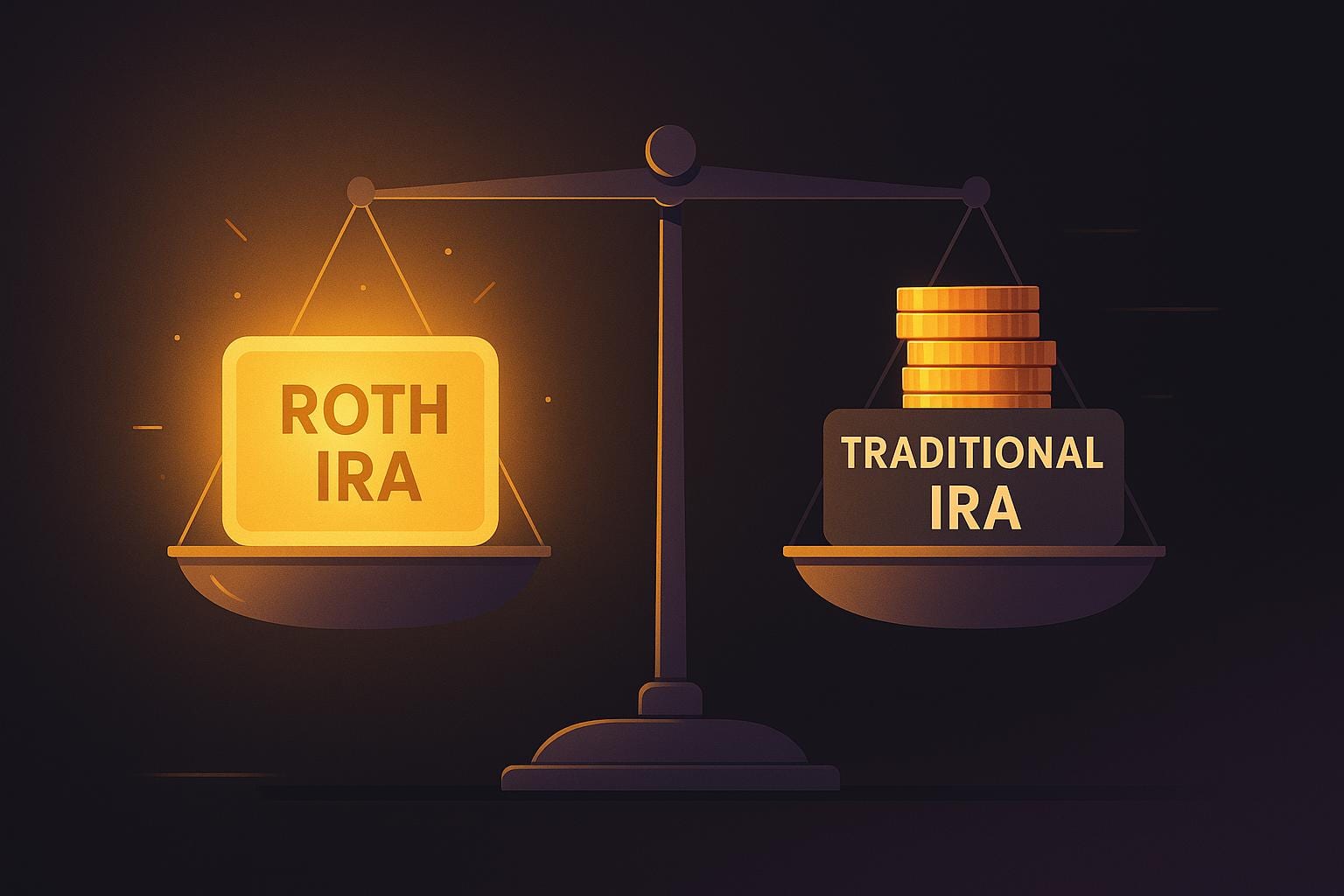
When deciding between a Roth IRA and a Traditional IRA, high earners face a critical tax planning choice. The decision boils down to when you pay taxes - now or later - and how that affects your long-term retirement savings. Here’s the breakdown:
- Roth IRA: Pay taxes now, enjoy tax-free growth, and make tax-free withdrawals in retirement. Ideal if you expect higher tax rates later or want flexibility with no required minimum distributions (RMDs).
- Traditional IRA: Get a tax deduction now, grow investments tax-deferred, and pay taxes on withdrawals in retirement. Best if you expect lower tax rates in retirement.
Key considerations for high earners:
- Income limits restrict direct Roth contributions but can be bypassed with strategies like a backdoor Roth IRA.
- Marginal tax rates and future income expectations are crucial in deciding which IRA aligns with your financial goals.
- Timing matters for Roth IRA conversions - lower-income years or market downturns can reduce the tax impact.
For those with employer-sponsored plans, options like mega backdoor Roth contributions can significantly boost tax-free retirement savings.
Ultimately, the right choice depends on your current tax bracket, expected retirement income, and long-term financial strategy. Balancing both IRA types at different stages of your career can maximize tax efficiency and retirement wealth.
Roth vs Traditional IRA: Which Is Best For Tax Savings?
Income Limits and Contribution Rules for High Earners
High earners face specific income thresholds and contribution rules when planning their IRA strategy. These boundaries dictate which accounts you can utilize and how much you can contribute, making them a critical part of retirement tax planning. Below, we break down the 2025 rules that set the stage for understanding tax treatment and potential strategies.
Roth IRA Income Limits for 2025
The IRS bases Roth IRA income limits on your Modified Adjusted Gross Income (MAGI). For 2025, higher incomes result in phased-out eligibility for contributions.
For 2025, maximum contributions are $7,000 if you're under 50, or $8,000 if you're 50 or older (including the catch-up contribution). If your income falls within the phase-out range, your contribution limit decreases proportionally. For instance, a single filer earning $157,500 might only be eligible to contribute about $3,500 - roughly half the maximum amount.
It's wise to wait until your MAGI is finalized before making contributions to avoid errors. You have until April 15 of the following year to make IRA contributions, so timing them carefully can prevent issues.
If you exceed the contribution limits, you'll face a 6% annual penalty on the excess amount. To fix this, you can withdraw the excess funds and any associated earnings before the tax deadline or recharacterize the contribution to a Traditional IRA.
Traditional IRA Deduction Rules
Anyone can contribute to a Traditional IRA, but whether you can deduct those contributions depends on your income and whether you're covered by a workplace retirement plan. If you don’t have access to an employer-sponsored plan, you can generally deduct your full contribution, regardless of income. However, if you are covered, the deduction phases out based on income.
For 2025, the deduction phases out:
- Between $77,000 and $87,000 for single filers.
- Between $123,000 and $143,000 for married couples filing jointly.
Even if you're above these thresholds, you can still contribute to a Traditional IRA, but the contribution will be non-deductible.
For couples, spousal IRA rules allow a non-working spouse to contribute based on the working spouse's income. In 2025, the deduction for the non-working spouse phases out between $236,000 and $246,000 for joint filers.
Backdoor Roth IRA Method
High earners who exceed Roth IRA income limits can use the backdoor Roth IRA method to sidestep these restrictions. Here's how it works:
- Contribute the maximum - $7,000 (or $8,000 if you're 50 or older) - to a Traditional IRA as a non-deductible contribution.
- Quickly convert the contribution to a Roth IRA, ideally within days or weeks, to minimize taxable gains during the process.
This approach achieves the same result as a direct Roth contribution, allowing your funds to grow tax-free in the Roth account. However, if you have other balances in a Traditional IRA, the pro-rata rule will apply and could impact the taxation of your conversion.
For couples where both spouses have earned income, each can use the backdoor Roth strategy, effectively doubling the contribution to $14,000 (or $16,000 if both are 50 or older). Be sure to file Form 8606 to document non-deductible contributions and conversions.
Next, we’ll dive into how these strategies affect tax treatment across contributions, growth, and withdrawals.
Tax Treatment: Contributions, Growth, and Withdrawals
When it comes to retirement accounts, understanding how taxes apply to contributions, investment growth, and withdrawals is crucial, especially for high earners. Whether you pay taxes now or later can significantly influence your long-term financial strategy. Let’s break down these tax considerations.
How IRA Contributions Are Taxed
The key difference between Roth IRAs and Traditional IRAs lies in when you pay taxes. This decision impacts both your current tax situation and your retirement income.
With a Traditional IRA, contributions may be tax-deductible, depending on your income and eligibility. For example, if you’re in the 32% tax bracket and contribute $7,000, you could save $2,240 on your current tax bill. This immediate tax benefit is especially appealing for high-income earners. By contrast, contributing $7,000 to a Roth IRA would require earning about $10,294 in gross income at the same tax rate.
Roth IRA contributions, on the other hand, are made with after-tax dollars. While this means no immediate tax break, it paves the way for tax-free withdrawals in retirement. For those using backdoor Roth strategies, non-deductible contributions simplify the tax implications during the conversion process.
Tax-Deferred vs. Tax-Free Investment Growth
How your investments grow over time can make or break your retirement savings, and the type of IRA you choose plays a big role.
In a Traditional IRA, your investments grow tax-deferred. This means you won’t owe taxes on dividends, interest, or capital gains while the funds stay in the account. However, withdrawals in retirement are treated as taxable income.
In contrast, Roth IRAs offer tax-free growth. All investment gains accumulate without any tax drag, and when you withdraw funds in retirement, both your contributions and earnings come out completely tax-free.
Here’s an example: If you contribute $7,000 annually and your investments grow at 7% over 20 years, your account could grow to about $306,000. With a Roth IRA, that entire amount would be tax-free. In a Traditional IRA, you’d owe taxes on the full balance when you start withdrawing.
This tax-free growth is particularly advantageous for active investors who frequently rebalance portfolios or trade individual stocks. In a taxable account, such activities could trigger significant tax bills. But inside a Roth IRA, you can adjust your strategy without worrying about immediate tax consequences.
Retirement Withdrawals and Required Distributions
The rules around withdrawals create some of the most notable differences between Traditional and Roth IRAs, especially for high-income retirees.
Traditional IRA withdrawals are taxed as ordinary income in the year you take them. For instance, if you withdraw $50,000 in retirement, that amount gets added to your taxable income, which could push you into a higher tax bracket if you have other income sources.
Roth IRA withdrawals, however, are much more flexible. You can withdraw your contributions at any time without taxes or penalties, since you’ve already paid taxes on that money. To withdraw earnings tax-free, the account must meet two conditions: it must be at least five years old, and you must be 59½ or older, disabled, or deceased.
The Required Minimum Distribution (RMD) rules further differentiate these accounts. Traditional IRAs mandate that you start taking RMDs at age 73 (or earlier, depending on your birth year). These withdrawals are added to your taxable income, and missing an RMD deadline can result in a hefty penalty - 25% of the amount you failed to withdraw. For example, if you were required to withdraw $20,000 and didn’t, you’d face a $5,000 penalty, plus taxes on the withdrawal amount.
Roth IRAs, on the other hand, have no RMD requirements during your lifetime. This allows your investments to grow tax-free indefinitely, making Roth accounts especially appealing for estate planning and leaving tax-free inheritances.
For retirees looking to minimize taxes, Qualified Charitable Distributions (QCDs) from a Traditional IRA offer a smart option. If you’re 70½ or older, you can donate up to $105,000 annually directly to a charity. These donations count toward your RMD but aren’t included in your taxable income, reducing your tax liability while supporting causes you care about.
Understanding these withdrawal rules is essential for managing your retirement income and tax obligations. The flexibility of Roth IRAs and the structured requirements of Traditional IRAs can shape your overall retirement tax strategy, helping you make the most of your savings.
Tax Optimization Strategies for High Earners
When it comes to retirement savings, high earners often face unique hurdles. However, with the right tax strategies, it's possible to maximize retirement wealth while keeping IRS obligations in check.
Roth Conversions and Timing Matters
A Roth conversion involves transferring funds from a Traditional IRA or 401(k) to a Roth IRA. While you’ll pay taxes on the amount you convert in the year you make the move, all future growth in the Roth account becomes tax-free. This approach can be especially useful for high earners who anticipate being in the same or a higher tax bracket during retirement.
The key to a successful Roth conversion lies in timing. For instance, converting funds during a year when your income is temporarily lower - such as between jobs, during a sabbatical, or in the early years of retirement before Social Security kicks in - can help reduce the tax hit. Let’s say you convert $50,000 in a year when you're in the 24% tax bracket; you’ll owe $12,000 in taxes. Compare that to converting the same amount in a 32% tax bracket year, where the tax bill jumps to $16,000.
Market downturns can also create opportunities for conversions. If your Traditional IRA balance drops due to market conditions, converting at the lower value means you’ll pay taxes on a reduced amount, while future growth in the Roth account remains tax-free. Spreading conversions over several years can help you avoid bumping into higher tax brackets. Keep in mind, though, that each conversion has its own five-year waiting period before you can withdraw earnings tax-free.
Next, let’s look at how employer-sponsored plans can further enhance Roth strategies.
Mega Backdoor Roth IRA Strategy
The Mega Backdoor Roth IRA is a powerful method for high earners to contribute more to Roth accounts. This strategy leverages after-tax contributions to employer 401(k) plans, allowing you to exceed the standard contribution limits. For example, after maxing out your standard 401(k) contributions - $23,500 in 2025, or $31,000 if you're 50 or older - you may be able to contribute additional after-tax funds up to the overall plan limit, which is typically $70,000 for 2025 (or $77,500 if you're 50 or older).
Here’s how it works in practice: Imagine you’re 45, earning $300,000 annually, and contributing the maximum $23,500 to your traditional 401(k). If your employer matches $9,000, you could still have room for $37,500 in after-tax contributions (calculated as $70,000 total limit minus $23,500 employee contribution minus $9,000 employer match). These after-tax funds can then be quickly converted to Roth dollars, minimizing any taxable gains.
However, not every employer offers this option. Your 401(k) plan must allow after-tax contributions and either in-service withdrawals or in-plan Roth conversions. Check with your HR department or plan administrator to determine if this strategy is available in your plan.
Now, let’s explore tools that can help high earners manage tax strategies effectively.
Tax Management Tools for Active Investors
For high earners with diverse portfolios, managing tax strategies across multiple accounts can get complicated. This is where technology platforms like Mezzi’s step in to simplify the process.
One area where these tools shine is avoiding wash sales with AI. Under the wash sale rule, you can’t claim a tax loss if you buy the same or a substantially identical security within 30 days before or after selling it. Mezzi’s platform monitors your accounts in real time, identifying potential wash sale risks and suggesting alternative investments that keep your portfolio aligned with your goals.
Additionally, Mezzi offers AI-powered insights to fine-tune tax efficiency. For example, it can recommend rebalancing your portfolio without selling appreciated assets by using new contributions. It can also help you time the realization of gains during lower-income years, reducing your overall tax burden. Other features, like portfolio overlap detection, ensure you avoid unintended concentration risks while placing assets in the most tax-efficient accounts.
Choosing the Right IRA: Decision Framework and Examples
For high earners, selecting the right IRA requires careful consideration of long-term tax strategies and wealth-building objectives.
Key Factors in IRA Selection
When deciding between IRA options, it's crucial to weigh your current tax rate against your anticipated rate in retirement. If you're in a high tax bracket now but expect to be in a lower one later, the immediate tax deduction offered by a Traditional IRA might seem appealing. However, many high earners find themselves in similar - or even higher - tax brackets during retirement. This can be due to required minimum distributions (RMDs), Social Security taxes, or increased Medicare premiums.
Your expected retirement income also plays a big role. High earners often build wealth through various channels, such as 401(k)s, taxable investments, and real estate. In these cases, the tax-free withdrawals offered by a Roth IRA can be a game-changer. Roth IRAs not only provide tax-free growth but also don’t require RMDs during your lifetime, allowing your investments to grow for longer. Additionally, Roth contributions can be withdrawn penalty-free at any time, making them a flexible option for those with unpredictable income streams. For families focused on estate planning, Roth IRAs can offer significant advantages over Traditional IRAs.
These considerations become clearer when examined through real-world scenarios.
Real-World Examples and Decision Models
Take Sarah, a 35-year-old software executive earning $250,000 annually in the 24% tax bracket. She uses a backdoor Roth IRA strategy to secure tax-free growth, anticipating her tax bracket will rise to 32% in the next five years. This approach allows her to leverage tax-free compounding over decades.
Then there's Michael, a 45-year-old investment banker earning $400,000. He maximizes his 401(k) for immediate tax savings while employing a mega backdoor Roth strategy to further grow his tax-free investments.
Finally, consider Jennifer, a 50-year-old physician with $2 million in Traditional IRA accounts. During a lower-income sabbatical, she converted $150,000 to a Roth IRA, reducing her future tax liabilities and taking advantage of her temporarily lower tax rate.
The common thread in these examples is the strategic timing of tax payments - opting to pay taxes at lower current rates to avoid higher rates in the future. This approach can be particularly effective during career transitions or market downturns when income levels or portfolio values temporarily dip.
Using Technology for Better Financial Planning
Executing these strategies efficiently often requires advanced tools, and that's where technology comes in. Platforms like Mezzi simplify the decision-making process by providing a comprehensive view of your financial situation. Instead of juggling spreadsheets and multiple account logins, you can analyze how different IRA strategies impact your overall wealth in real time.
Mezzi’s AI-powered insights identify optimal conversion opportunities by evaluating your income trends, tax bracket projections, and portfolio performance. For instance, if your taxable investments experience losses, the platform can highlight opportunities for tax-loss harvesting across accounts, which could offset income from an IRA conversion and save you thousands in taxes.
The platform also allows you to model various retirement strategies before committing. You can test scenarios like, “What happens if I convert $50,000 annually for five years?” or “How does maximizing Roth contributions today affect my retirement income decades from now?” These simulations account for factors like expected returns, fees, and tax implications, offering a clearer picture of potential long-term outcomes.
For high earners managing multiple accounts - such as retirement plans, taxable investments, and employer-sponsored accounts - Mezzi’s account aggregation feature is invaluable. It provides a unified view of your financial landscape, helping to avoid common pitfalls like wash sales during tax-loss harvesting or poor asset location across account types.
Active investors can also benefit from Mezzi’s X-Ray tool, which identifies hidden portfolio overlaps. For example, if your taxable accounts are heavily invested in growth stocks, you might choose more conservative investments for your Traditional IRA to ensure better diversification as your wealth grows.
Conclusion: Building Wealth Through Smart IRA Decisions
For high earners, deciding between Roth and Traditional IRAs comes down to crafting a strategy that aligns with your long-term financial goals. The right approach can either save or cost you hundreds of thousands of dollars over the course of your retirement. By laying a solid foundation, you can fine-tune your tactics - whether through targeted conversions or well-timed contributions.
Tax optimization isn’t a quick fix - it’s a long-term game. Whether you’re navigating backdoor Roth strategies to bypass income limits, timing Roth conversions during lower-income years, or taking advantage of mega backdoor Roth contributions through your employer’s 401(k), every decision should fit into the bigger picture. The goal is to stay flexible while keeping your overarching strategy on track.
Thanks to advancements in technology, making informed decisions has never been easier. Tools now allow high earners to model various scenarios, monitor wash sale risks across multiple accounts, and access AI-powered insights. These resources not only help you avoid costly mistakes but also enhance your overall strategy, giving you the confidence to act decisively.
For those managing large portfolios, the stakes are even higher. A single misstep - like triggering a wash sale during tax-loss harvesting or missing the ideal window for a conversion - can result in thousands of dollars in unnecessary taxes. Platforms like Mezzi, with its account aggregation and real-time analysis, help you sidestep these pitfalls while uncovering opportunities you might otherwise overlook.
Smart IRA decisions have a compounding effect over time. Tax-free growth from well-executed Roth strategies and timely Traditional IRA deductions can significantly boost your wealth. By staying informed about tax law changes and leveraging the right tools, high earners can build retirement portfolios that grow efficiently and offer maximum flexibility when it’s time to withdraw.
Ultimately, your IRA strategy should evolve alongside your income and goals. With clear options and effective tools, you can make timely conversions and strategic contributions that maximize your retirement benefits and set you up for long-term success.
FAQs
What is the backdoor Roth IRA strategy, and how can high earners use it to boost their retirement savings?
The backdoor Roth IRA strategy offers high-income earners a clever way to sidestep income limits and tap into the perks of a Roth IRA. Here’s how it works: you make a nondeductible contribution to a traditional IRA, then convert that amount into a Roth IRA. This approach allows you to benefit from tax-free growth and tax-free withdrawals in retirement.
To make this strategy work smoothly, it’s important to complete the conversion quickly. Delaying could lead to taxable earnings on any growth that occurs before the conversion. Another key consideration is the pro-rata rule, which could affect the taxes you owe if you have other pre-tax IRA balances. With careful planning and attention to these details, high earners can boost their retirement savings while keeping taxes in check.
What tax factors should high earners consider when choosing between a Roth IRA and a Traditional IRA?
For individuals with higher incomes, deciding between a Roth IRA and a Traditional IRA often hinges on when taxes are paid and the impact of income limits. With a Traditional IRA, contributions might be tax-deductible, but this perk gradually phases out as income increases, particularly if you’re part of an employer-sponsored retirement plan. Keep in mind, though, that any withdrawals during retirement will be taxed as ordinary income.
Roth IRA contributions work differently. They’re made with after-tax dollars, so there’s no upfront tax break. The upside? Qualified withdrawals in retirement are completely tax-free, which can be especially appealing if you anticipate being in a higher tax bracket down the road. For high-income earners who exceed Roth IRA income limits, the backdoor Roth IRA strategy offers a way to still enjoy its benefits.
Ultimately, the choice boils down to comparing your current tax rate with what you expect it to be in retirement and assessing how best to leverage tax-advantaged growth opportunities.
How do changes in income and market conditions impact the best time for Roth conversions for high earners?
Income changes and market trends significantly influence the best timing for Roth conversions, particularly for those in higher tax brackets. Converting during a market slump can be advantageous because lower asset values mean a reduced taxable amount, potentially setting the stage for more tax-free growth in the future.
Likewise, choosing to convert in years when your income is lower can help lessen the tax burden. By syncing your conversions with market downturns or years of reduced income, you can take advantage of tax savings and work toward building greater wealth over the long term.
Related Blog Posts
- Roth IRA Contribution Timing for High Earners
- How Income Affects IRA Deductions for Couples
- What is a mega backdoor roth?
- What is backdoor roth conversion?
The backdoor Roth IRA strategy offers high-income earners a clever way to sidestep income limits and tap into the perks of a Roth IRA. Here’s how it works: you make a nondeductible contribution to a traditional IRA, then convert that amount into a Roth IRA. This approach allows you to benefit from tax-free growth and tax-free withdrawals in retirement.
To make this strategy work smoothly, it’s important to complete the conversion quickly. Delaying could lead to taxable earnings on any growth that occurs before the conversion. Another key consideration is the pro-rata rule, which could affect the taxes you owe if you have other pre-tax IRA balances. With careful planning and attention to these details, high earners can boost their retirement savings while keeping taxes in check.
For individuals with higher incomes, deciding between a Roth IRA and a Traditional IRA often hinges on when taxes are paid and the impact of income limits. With a Traditional IRA, contributions might be tax-deductible, but this perk gradually phases out as income increases, particularly if you’re part of an employer-sponsored retirement plan. Keep in mind, though, that any withdrawals during retirement will be taxed as ordinary income.
Roth IRA contributions work differently. They’re made with after-tax dollars, so there’s no upfront tax break. The upside? Qualified withdrawals in retirement are completely tax-free, which can be especially appealing if you anticipate being in a higher tax bracket down the road. For high-income earners who exceed Roth IRA income limits, the backdoor Roth IRA strategy offers a way to still enjoy its benefits.
Ultimately, the choice boils down to comparing your current tax rate with what you expect it to be in retirement and assessing how best to leverage tax-advantaged growth opportunities.
Income changes and market trends significantly influence the best timing for Roth conversions, particularly for those in higher tax brackets. Converting during a market slump can be advantageous because lower asset values mean a reduced taxable amount, potentially setting the stage for more tax-free growth in the future.
Likewise, choosing to convert in years when your income is lower can help lessen the tax burden. By syncing your conversions with market downturns or years of reduced income, you can take advantage of tax savings and work toward building greater wealth over the long term.