
Restricted Stock Units (RSUs) are a popular form of employee compensation, especially in tech and public companies. They represent a promise to give you company shares after meeting specific conditions, such as staying employed for a certain time. Unlike stock options, RSUs don’t require upfront payment - they vest automatically based on a schedule.
Key Points About RSUs:
- Vesting: RSUs convert into shares over time, often using a "cliff" or "graded" schedule. For example, 25% may vest after the first year, with the rest vesting quarterly over the next three years.
- Taxes: When RSUs vest, their value is treated as ordinary income and taxed accordingly. Selling the shares later may trigger additional capital gains taxes.
- Risk Management: Holding too much company stock can increase financial risk. Diversifying your portfolio may help reduce exposure.
- Sell or Hold Decision: Selling vested shares immediately can simplify taxes and reduce risk, while holding them may offer long-term growth potential but adds volatility.
RSUs can be a valuable component of your financial plan, but they come with tax obligations and risks. Understanding how they work - grant, vesting, and taxation - may help you make informed decisions about managing them.
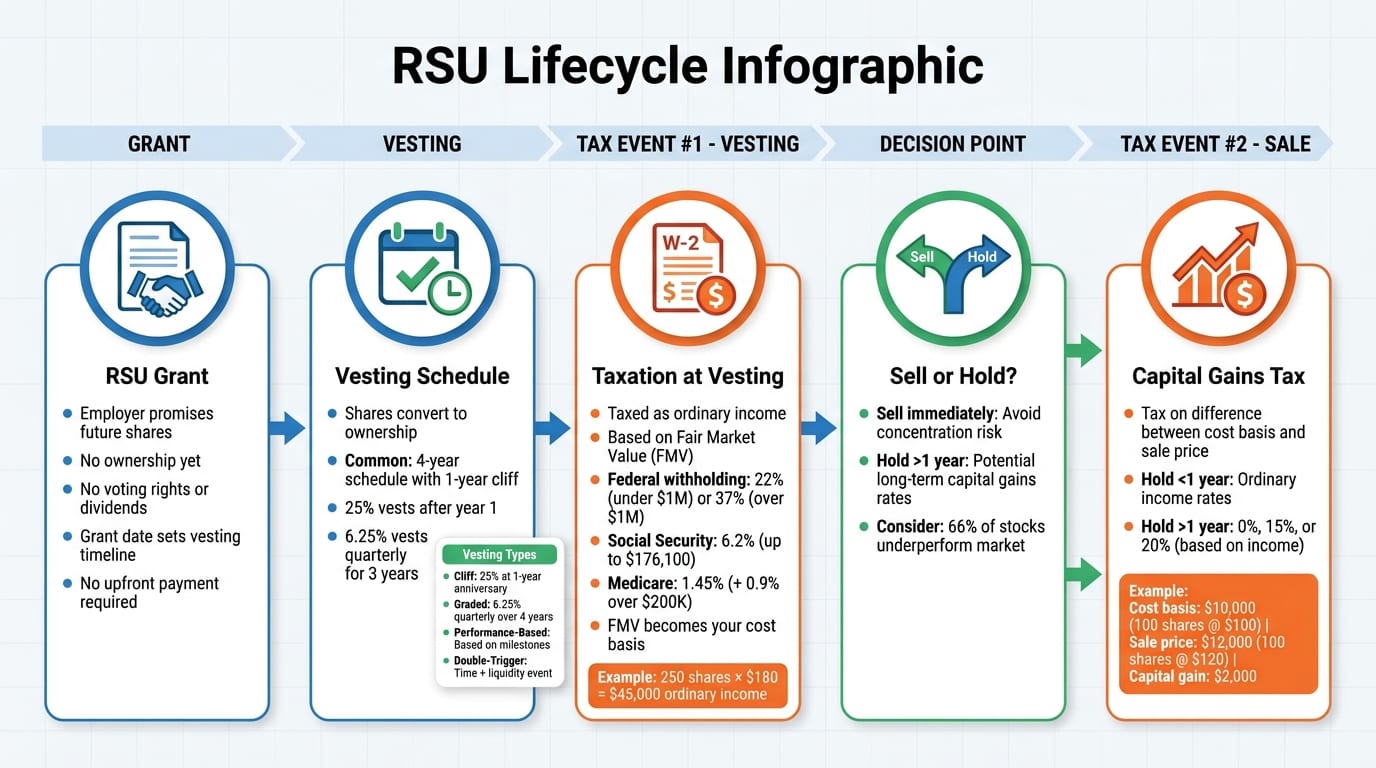
RSUs: Hold or Sell? The Right Strategy
How RSUs Work: Grant, Vesting, and Ownership
Understanding how RSUs (Restricted Stock Units) progress from being awarded to full ownership can help you grasp the key milestones and tax implications. From the moment your employer grants RSUs to when you officially own shares, each stage plays a role in shaping your rights and obligations.
The RSU Grant Process
When your employer grants you RSUs, they’re essentially making a promise rather than handing over shares.
"Think of it as an 'IOU,' which states that as long as you remain with our company, you will earn the right to own Y shares after X time has passed." - Daniel Zajac, CFP, EA
The grant date is the official starting point of this agreement and sets the timeline for your vesting schedule.
At this stage, you don’t actually own the shares. This means you can’t vote, sell, or collect dividends from them. Instead, your grant agreement outlines the number of shares you may eventually receive and the conditions you need to meet. The "grant-date value" shown in your offer letter - calculated by multiplying the stock price by the number of RSUs - is simply an estimate of the potential value at that moment. It’s not a guarantee of what the shares will be worth in the future.
One advantage of RSUs is that you don’t need to purchase them upfront. They automatically convert into shares once you meet the vesting conditions.
Vesting Schedules Explained
Once RSUs are granted, the vesting schedule determines when they convert into actual shares. Vesting is the process that turns the RSU promise into ownership. In the tech industry, it’s common to see a four-year vesting schedule with a one-year cliff. Under this structure, 25% of your RSUs vest after the first year, and the remaining 75% vest gradually, often in quarterly installments of about 6.25% over the next three years.
Performance-based vesting introduces uncertainty since ownership depends on meeting specific goals, such as hitting revenue targets or launching a product. Double-trigger vesting, often seen in private startups, adds another layer. It requires meeting both a time-based condition and a liquidity event, like an IPO or acquisition, before you gain ownership.
When your RSUs vest, you gain full ownership of the shares, but it’s also the point at which tax obligations begin. Being aware of these timelines can help you plan your financial strategy, mitigate risks tied to concentrated stock holdings, and decide whether to hold or sell your shares.
Tax Implications of RSUs
RSUs (Restricted Stock Units) come with two primary tax events: the vesting date and the sale of the shares. Knowing how these events affect your taxes can help you manage your compensation more effectively.
Taxation at Vesting
When your RSUs vest, the IRS treats the fair market value (FMV) of the shares on that day as ordinary income. This means the value of the shares is included in your W-2 and subject to federal, state, local, and FICA taxes (Social Security and Medicare). For example, if 250 shares vest at $180 each, you’ll report $45,000 as ordinary income. This FMV also serves as your cost basis for calculating future capital gains or losses.
"RSUs are taxed as ordinary income on the vesting date, based on the fair market value (FMV) of shares at that specific moment, regardless of whether you sell the shares immediately or hold them indefinitely." - VestingStrategy Editorial Team
Capital Gains Tax on Sale
Selling your RSU shares triggers the second tax event: capital gains tax. This tax applies to the difference in value between the vesting date (your cost basis) and the sale date. If you sell the shares within one year of vesting, any gain is taxed at your ordinary income rate. However, if you hold the shares for more than one year, you may qualify for long-term capital gains rates of 0%, 15%, or 20%, depending on your income.
For instance, imagine 100 vested shares with a cost basis of $10,000 (valued at $100 per share). If those shares are sold at $120 per share, you realize a capital gain of $20 per share, or $2,000 total. The tax rate on this gain depends on whether you held the shares for less than or more than a year after vesting.
It’s important to verify your Form 1099-B cost basis against Form 8949 to avoid paying taxes twice on the same income. Proper withholding and estimated tax payments can also help you manage your tax liability.
Tax Withholding and Estimated Payments
When RSUs vest, employers are required to withhold taxes. For supplemental wages, federal withholding is 22% for amounts under $1 million and 37% for amounts above. However, if your actual marginal tax rate is higher - such as 32% or 37% - this withholding may not cover your full tax liability, leaving you with a potential shortfall.
"The 22% withholding rate is often insufficient for high earners, requiring proactive tax planning." - VestingStrategy Editorial Team
For example, if you’re a single filer in the 32% tax bracket and have $80,000 in RSU income, the 22% withholding would result in $17,600 being withheld. However, your actual tax liability would be $25,600, creating an $8,000 gap before accounting for state taxes and FICA.
To avoid penalties for underpayment, you might consider adjusting your Form W-4 to increase payroll withholding or making quarterly estimated tax payments using Form 1040-ES. The IRS safe harbor rules require you to pay at least 90% of your current year’s tax liability or 100% of the prior year’s liability (110% if your adjusted gross income exceeded $150,000) to avoid penalties.
Strategies for Managing RSUs
When your RSUs (Restricted Stock Units) vest, you face a key decision: should you sell immediately or hold onto the shares for potential growth? The best approach depends on your financial goals, risk tolerance, and how much of your portfolio is already tied up in company stock.
Sell-to-Cover vs. Holding Shares
A sell-to-cover option allows your employer to sell just enough shares at vesting to cover taxes, leaving you with the remaining shares. This avoids any immediate cash outlay, but the default 22% federal withholding might not fully cover your tax liability, especially for high earners. This could result in holding more company stock than planned.
Alternatively, a same-day sale involves selling all vested shares immediately. This approach simplifies things: you avoid concentration risk and sidestep decisions about future capital gains taxes. Since RSUs are taxed as ordinary income at vesting, selling right away doesn’t add extra tax burden.
If you hold onto the shares for over a year, any gains may qualify for lower long-term capital gains tax rates (0%, 15%, or 20%). However, this strategy only makes sense if you’re confident your company’s stock will perform better than a diversified portfolio. Historically, this is a gamble - between January 1987 and March 2025, 66% of individual stocks in the Russell 3000 index underperformed the market, and nearly 40% lost money despite the market’s overall growth of over 4,000%.
"If I had the after-tax value of these vested RSUs in cash today, would I buy this company's stock?" - OnePoint BFG Wealth Partners
If your answer to this question is "no", selling may be the better choice.
Here’s a quick comparison of selling immediately versus holding for over a year:
These decisions play a critical role in managing your overall financial risk and shaping your long-term strategy.
Diversification and Risk Management
Owning too much company stock ties your financial future to a single entity, increasing your exposure. Experts generally suggest keeping no more than 10% to 15% of your net worth in any one stock. For example, with a $500,000 net worth, that means holding no more than $50,000 to $75,000 in company shares. This is especially important in volatile industries like tech, where stocks can lose as much as 40% of their value in a single year.
A disciplined, systematic approach can help remove emotional bias. For instance, you might sell 25% of your vested shares immediately and invest the proceeds in index funds. This creates a repeatable process, reducing concentration risk while still leaving room for potential gains.
To avoid wash sale rules, ensure at least 31 days pass between selling shares at a loss and the next vesting event.
This method complements broader portfolio strategies, which tools like Mezzi can help you manage effectively.
Dividend Rights and Reinvestment
Another factor to consider is how dividends and reinvestments fit into your RSU strategy.
Unlike Restricted Stock Awards (RSAs), RSUs typically don’t include dividends or voting rights until the shares vest. Once vested, the shares act like any other stock, and you’ll receive dividends if your company offers them.
If you’re already heavily invested in company stock, reinvesting dividends into the same stock may increase your concentration risk. Instead, consider directing dividends into a diversified portfolio. For highly appreciated shares held over a year, donating them to a Donor-Advised Fund (DAF) can eliminate capital gains tax, reduce concentration risk, and provide a full fair market value deduction.
Mezzi’s Portfolio X-Ray tool can help you see exactly how much company stock you hold across all accounts, including hidden exposure in ETFs and mutual funds. This insight makes it easier to maintain your target allocation and avoid unintended concentration risk. With tools like these, you can take a more comprehensive approach to managing your RSU exposure.
Using Mezzi to Manage RSUs
Managing RSUs can feel overwhelming, but Mezzi aims to make it easier by offering tools to consolidate accounts, keep track of tax details, and address concentration risks that might otherwise go unnoticed.
RSU Tracking Through Account Aggregation
Mezzi connects all your investment accounts - like 401(k)s, brokerage accounts, Roth IRAs, and taxable accounts - using read-only access through platforms like Plaid and Finicity. This setup lets you view your RSUs alongside all your other investments without needing to transfer accounts or juggle multiple logins. Unlike traditional advisors who may only focus on assets they directly manage, Mezzi provides a broader perspective.
This comprehensive view is especially useful for managing your "rolling vesting ladder" - the ongoing schedule of RSU grants vesting over time. Instead of manually pulling data from various sources like your employer's equity portal, brokerage accounts, and tax records, Mezzi brings everything into one dashboard. This makes it easier to see how much of your net worth is tied to company stock and to keep an eye on your overall exposure. With this consolidated information, Mezzi sets the foundation for more effective tax planning.
Tax Optimization for RSUs
Mezzi also helps identify opportunities to manage taxes more effectively, including monitoring the 61-day wash sale window around each vesting date to avoid disallowed capital losses.
For instance, if you’re thinking about selling company stock at a loss to offset gains elsewhere, Mezzi can flag potential wash sale risks tied to upcoming vesting dates. It also looks for ways to align RSU sales with tax-loss harvesting opportunities across your portfolio, potentially reducing your overall tax burden. Additionally, for high earners, the default 22% federal withholding on RSUs may not be enough. Mezzi can estimate whether you should set aside an additional 15% to 25% in cash reserves to cover your actual tax liability.
Portfolio X-Ray for RSU Overlap
Mezzi’s Portfolio X-Ray tool takes things a step further by highlighting overlap exposure in your investments. It identifies cases where RSU shares overlap with other holdings, such as index funds. For example, if your index fund includes your employer’s stock, you might unintentionally increase your concentration risk and pay duplicate management fees for exposure you already have through your RSUs.
The tool calculates how much a single stock represents across your entire portfolio, factoring in all aggregated accounts. For example, if you hold $75,000 in company RSUs and another $25,000 in your 401(k)’s S&P 500 fund, your total exposure to that stock is $100,000. This might push you beyond safe diversification limits. With this insight, you can decide whether to sell vested shares or adjust other investments to better align with your risk preferences.
Conclusion: Getting the Most from Your RSUs
RSUs may only provide value if your company's stock price performs well, and managing them effectively requires understanding two key tax events: vesting and sale. When your shares vest, you'll likely owe ordinary income tax based on their fair market value at that time. Later, when you sell those shares, you'll also face capital gains tax. Keep in mind, though, that the amount withheld at vesting may not fully cover your tax liability, so making proactive adjustments - like updating your W-4 or making quarterly tax payments - could help avoid surprises.
Another challenge to watch for is concentration risk. Depending heavily on one company for both your paycheck and a significant portion of your portfolio can leave you exposed. If the company struggles, both your income and investments may be affected. Many financial professionals suggest keeping employer stock to no more than 10%–15% of your overall portfolio to reduce this risk.
Be mindful of potential wash sale issues, too. Selling RSU shares at a loss within 30 days before or after buying identical shares (including through vesting) could disallow your ability to claim the deduction.
To navigate these complexities, Mezzi offers tools designed to simplify RSU management. By consolidating all your accounts into one platform, it helps you monitor wash sale risks, spot overlapping exposures between your RSUs and other investments, and evaluate how much cash you might need to cover taxes. Instead of juggling multiple grant tranches, vesting schedules, and cost basis across various systems, Mezzi provides a clear, comprehensive view. This can help you make informed decisions about when to sell, how to diversify, and where there might be opportunities for tax savings.
FAQs
What happens to my unvested RSUs if I leave my company?
If you leave your company before your RSUs (Restricted Stock Units) vest, you’ll typically lose the unvested shares. In other words, you won’t gain ownership of those shares or benefit from their value. It’s important to check your company's RSU policy to understand the specific terms and conditions.
How do I avoid underpaying taxes when my RSUs vest?
When your RSUs vest, the fair market value (FMV) at that time is treated as ordinary income for tax purposes. To avoid underpaying taxes, it’s important to plan for the tax liability. The default withholding rate is 22%, but this might not fully cover the amount owed, especially if your marginal tax rate is higher.
Here are a few steps you might consider:
- Set aside additional funds to cover any tax shortfall.
- Make estimated tax payments during the year to stay on track.
- Adjust your withholding to better align with your actual tax rate.
It’s also a good idea to consult with a tax professional to navigate your specific situation and avoid any unexpected tax bills.
When does holding RSU shares longer actually make sense?
Holding RSU shares for a longer period might align with tax planning strategies and could offer the chance to benefit from capital gains tax rates. By carefully timing sales after vesting, you may be able to optimize after-tax returns. It's important to evaluate your financial objectives and tax circumstances to decide what works best for your situation.
Disclosures:
- This content is for informational purposes only and does not constitute investment advice or a recommendation to buy or sell any security.
- Past performance is not indicative of future results. No guarantee of future performance or outcomes is implied.
Related Blog Posts
- 5 Ways to Donate Equity Compensation Tax-Efficiently
- Equity Compensation in High-Tax States: Key Tax Rules
- How can I analyze my ESPP and RSU vesting schedules and past sales?
- Concentrated stock position monitoring
If you leave your company before your RSUs (Restricted Stock Units) vest, you’ll typically lose the unvested shares. In other words, you won’t gain ownership of those shares or benefit from their value. It’s important to check your company's RSU policy to understand the specific terms and conditions.
When your RSUs vest, the fair market value (FMV) at that time is treated as ordinary income for tax purposes. To avoid underpaying taxes, it’s important to plan for the tax liability. The default withholding rate is 22%, but this might not fully cover the amount owed, especially if your marginal tax rate is higher.
Here are a few steps you might consider:
- Set aside additional funds to cover any tax shortfall.
- Make estimated tax payments during the year to stay on track.
- Adjust your withholding to better align with your actual tax rate.
It’s also a good idea to consult with a tax professional to navigate your specific situation and avoid any unexpected tax bills.
Holding RSU shares for a longer period might align with tax planning strategies and could offer the chance to benefit from capital gains tax rates. By carefully timing sales after vesting, you may be able to optimize after-tax returns. It's important to evaluate your financial objectives and tax circumstances to decide what works best for your situation.