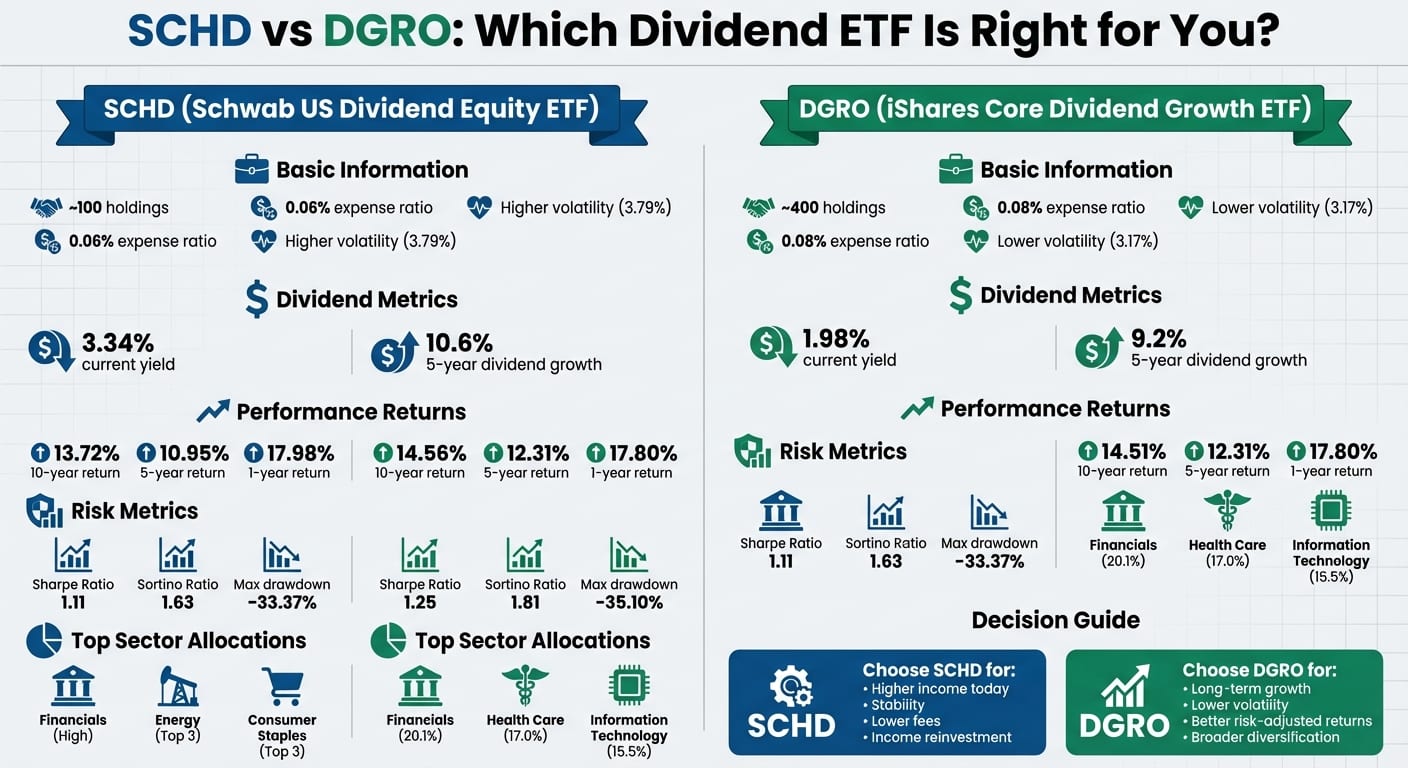
If you're deciding between SCHD and DGRO for long-term investing, here’s the key takeaway:
- SCHD (Schwab US Dividend Equity ETF) focuses on high-yield, reliable dividend-paying U.S. companies. It offers a higher current yield (3.34%) and a lower expense ratio (0.06%), making it ideal for investors seeking income stability and reinvestment opportunities.
- DGRO (iShares Core Dividend Growth ETF) emphasizes companies with consistent dividend growth (5+ years of increases) and broader diversification (400+ holdings). It has a lower yield (1.98%) but slightly stronger 10-year returns (14.56%) and lower volatility, favoring growth-oriented investors.
Quick Comparison
| Feature | SCHD | DGRO |
|---|---|---|
| Expense Ratio | 0.06% | 0.08% |
| Dividend Yield | 3.34% | 1.98% |
| Holdings | ~100 | ~400 |
| 5-Year Dividend Growth Rate | 10.6% | 9.2% |
| 10-Year Annualized Return | 13.72% | 14.56% |
| Sector Focus | Energy, Consumer Staples | Technology, Financials |
| Volatility | Higher | Lower |
Choose SCHD if you prioritize higher income today and stability. Choose DGRO if you're aiming for long-term growth with lower risk.
SCHD vs DGRO ETF Comparison: Key Metrics and Performance Data
Key Metrics Comparison
Expense Ratios and Dividend Yields
When it comes to costs, both ETFs are among the most affordable in their category. SCHD charges an annual expense ratio of 0.06%, while DGRO's is slightly higher at 0.08%. To put that into perspective, investing $10,000 in SCHD costs just $6 per year, compared to $8 with DGRO. Over 30 years, these small differences add up: SCHD's total fees would be $1,663.61, while DGRO's would reach $2,212.13 - a savings of $548.52 by opting for SCHD.
"Fees are one of the biggest killers of portfolio growth. The difference between a 2% fee and a 0.04% fee over 30 years can result in your portfolio having half the total value!"
The dividend yield difference is striking. SCHD offers a trailing 12-month yield of 3.31% to 3.34%, compared to DGRO's 1.96% to 1.98%. That’s approximately 1.35 percentage points more in immediate cash flow with SCHD. For investors reinvesting dividends or relying on them for income, this gap can make a noticeable impact.
| Metric | SCHD | DGRO |
|---|---|---|
| Expense Ratio | 0.06% | 0.08% |
| Dividend Yield (TTM) | 3.31%–3.34% | 1.96%–1.98% |
| Number of Holdings | ~100 | ~400 |
Next, let’s explore how dividend growth and compounding set these ETFs apart.
Dividend Growth Rates and Compounding
Dividend growth plays a key role in long-term compounding, and here’s where SCHD shines again. Despite DGRO’s branding around "dividend growth", SCHD boasts a higher 5-year dividend growth rate of 10.6%, compared to DGRO’s 9.2%. This means SCHD not only starts with a higher yield but has also been increasing its payouts at a faster pace.
That said, DGRO’s broader portfolio of approximately 400 holdings - compared to SCHD’s 100 - provides more exposure to growth-oriented sectors like technology. This diversification has contributed to DGRO’s 10-year annualized return of 14.56%, slightly outpacing SCHD’s 13.72%. The added capital appreciation from DGRO’s growth-focused companies has been a key factor in boosting total returns.
sbb-itb-e429e5c
Historical Performance and Returns
Performance Across Different Timeframes
Looking at the numbers, DGRO has outpaced SCHD in total returns over longer periods. Over the last decade, DGRO delivered an annual return of 14.56%, while SCHD trailed slightly at 13.72%. A similar edge appears in the 5-year performance: DGRO posted 12.31%, compared to SCHD's 10.95%.
When it comes to 1-year returns, the two ETFs are neck and neck. DGRO's range of 17.10% to 17.80% is comparable to SCHD's 16.86% to 17.98%. However, the 2026 year-to-date (YTD) results tell a different story. SCHD surged ahead with gains of 14.10% to 15.39%, while DGRO lagged behind at 4.99% to 6.64%.
The difference in sector exposure explains much of this performance divergence. DGRO's higher allocation to tech giants like Apple and Microsoft has fueled its long-term growth during tech-driven market cycles. On the other hand, SCHD's focus on financials and value-oriented sectors gave it an edge during downturns, such as in 2022, when it limited losses to 3.26%, compared to DGRO's steeper decline of 7.91%.
Performance is only part of the story - volatility and risk metrics also play a key role in evaluating these ETFs.
Volatility and Risk
For investors aiming to grow wealth steadily, understanding risk is just as important as chasing returns. While DGRO has delivered stronger long-term performance, it does so with less volatility. DGRO's overall volatility is 3.17%, lower than SCHD's 3.79%. Even on a shorter timeframe, DGRO's one-month volatility of 2.86% is calmer compared to SCHD's 3.67%.
This difference stems from DGRO's broader diversification. With over 400 holdings versus SCHD's 100, DGRO spreads its risk across a wider range of companies. This diversification also contributes to its better risk-adjusted returns, reflected in a Sharpe Ratio of 1.25 and a Sortino Ratio of 1.81, both higher than SCHD's 1.11 and 1.63, respectively.
However, SCHD has shown resilience during severe market downturns. For instance, during the March 2020 COVID-19 crash, SCHD's maximum drawdown was 33.37%, slightly better than DGRO's 35.10%.
DGRO vs SCHD: $100k in → Which ETF Is better?
Investment Strategies and Holdings
Each ETF's strategy plays a crucial role in defining its potential for long-term growth, complementing the performance and risk metrics previously discussed.
SCHD: Dividend Stability and High Yield
SCHD follows the Dow Jones U.S. Dividend 100 Index, focusing on companies with strong dividend histories and high yields. To be included, companies must demonstrate a 10-year streak of consecutive dividend payments, ensuring only established dividend payers are selected.
The fund's portfolio is relatively concentrated, holding about 100 stocks, with the top 10 positions accounting for roughly 40% of the total. As of February 2026, major holdings include Lockheed Martin (4.67%), Texas Instruments (4.29%), Chevron (4.26%), Bristol-Myers Squibb (4.23%), and ConocoPhillips (4.15%). These are mature companies known for consistently returning capital to shareholders.
SCHD uses a selection process that evaluates factors like cash flow relative to debt, return on equity, dividend yield, and five-year dividend growth rates. This results in a trailing twelve-month yield of 3.31%. The fund rebalances quarterly to maintain high standards and primarily focuses on sectors such as Energy, Consumer Staples, and Health Care.
DGRO, on the other hand, adopts a broader and more growth-focused approach.
DGRO: Emphasizing Dividend Growth and Total Return
While SCHD prioritizes yield stability with a concentrated portfolio, DGRO opts for greater diversification to capture growth opportunities. It tracks the Morningstar US Dividend Growth Index, targeting companies with at least five consecutive years of dividend growth. To avoid unsustainable payouts, it excludes the top 10% of highest-yielding stocks.
DGRO offers a wider spread of investments, holding over 400 stocks, with its top 10 positions making up about 26% of the portfolio. As of February 2026, leading holdings include Exxon Mobil (3.67%), Johnson & Johnson (3.24%), Apple (2.70%), JPMorgan Chase (2.69%), and Philip Morris International (2.49%). The inclusion of tech leaders like Microsoft highlights its focus on companies with strong growth potential, even if their current yields are lower.
Instead of weighting by market cap, DGRO uses dividend dollars, favoring companies with robust dividend programs. Its sector allocation leans toward growth-oriented industries, with Information Technology representing approximately 17.9% and Financials around 20.5%. With a yield of 1.96% and an annual rebalancing schedule, DGRO prioritizes long-term total returns over immediate income.
"DGRO is more of a dividend growth ETF, while SCHD is more of a high-yield dividend ETF." - Steve Cummings, Founder, The Frugal Expat
These contrasting strategies influence each fund's sector exposure and risk profile, offering unique opportunities for investors.
Sector Allocations and Risk Profiles
Sector Weightings and Growth Focus
When comparing SCHD and DGRO, their sector allocations highlight distinct approaches to dividend investing. SCHD leans into defensive, high-yield sectors like Energy, Consumer Staples, and Health Care, favoring companies that deliver strong current income streams. On the other hand, DGRO takes a growth-oriented stance, allocating more heavily to sectors such as Information Technology and Financials. As of August 2025, DGRO allocated approximately 15.5% to tech and 20.1% to financials, reflecting its focus on growth opportunities.
| Sector | SCHD Focus | DGRO Weight |
|---|---|---|
| Financials | High | 20.1% |
| Health Care | Top 3 | 17.0% |
| Information Technology | Lower | 15.5% |
| Consumer Staples | Top 3 | 12.9% |
| Industrials | High | 12.5% |
| Energy | Top 3 | 6.0% |
Both funds show strong exposure to Financials and Health Care, but DGRO distinguishes itself with a notable allocation to technology, including major players like Apple (2.7%) and Microsoft (2.3%). These companies prioritize growth over immediate dividend yields. In contrast, SCHD favors more traditional dividend payers in sectors like Energy and Consumer Staples, offering steady income streams ideal for reinvestment. These differences in sector weightings directly influence the risk and growth profiles of each ETF.
Risk and Diversification
The sector strategies of SCHD and DGRO play a big role in shaping their risk profiles, but portfolio construction further amplifies these differences. SCHD holds a concentrated portfolio of about 100 companies, with its top 10 positions making up nearly 40% of total assets. This approach increases exposure to company-specific risks but aligns with its focus on high-yield dividend payers. DGRO, by contrast, diversifies across more than 400 holdings, with its top 10 accounting for only 20% to 26% of the portfolio. This broader diversification helps cushion the fund against the performance swings of individual companies.
SCHD's focus on defensive sectors has historically provided better protection during market downturns. For example, its maximum drawdown during a correction was -33.37%, slightly better than DGRO's -35.10%. However, SCHD's heavier allocation to Financials and Utilities makes it more sensitive to interest rate changes. Meanwhile, DGRO's tilt toward technology introduces exposure to sector-specific volatility but positions it to benefit during growth-driven market rallies. Despite these differences, the two ETFs share a high correlation of 0.94, meaning their performance often moves in tandem, even with their contrasting sector focuses.
Which ETF for Long-Term Compounding?
After analyzing the key metrics, historical performance, and strategies, it’s time to decide which ETF aligns with your long-term compounding goals. SCHD offers a higher current yield (around 3.34%–3.9%), while DGRO has slightly outpaced it in 10-year annualized returns (14.56% vs. 13.72%). Your choice boils down to priorities: opt for SCHD if immediate income is your focus, or DGRO if long-term growth is your goal.
SCHD: For Income Stability and Reinvestment
If your priority is stable income and reinvesting dividends, SCHD stands out. It holds a concentrated portfolio of about 100 high-quality dividend-paying companies, each boasting a 10-year streak of dividend payments. Its higher yield provides more dollars per distribution, boosting your ability to reinvest and accelerate compounding. Plus, with a low expense ratio of just 0.06%, more of your money works for you. SCHD is particularly suitable for those nearing retirement or investors who value consistent income from sectors like Financials, Consumer Staples, and Energy.
DGRO: For Growth and Total Returns
For those focused on building wealth over the long term, DGRO shines. Its portfolio includes over 400 companies emphasizing consistent dividend growth, with a tilt toward growth sectors like Information Technology. This approach delivers strong risk-adjusted returns (Sharpe Ratio of 1.25), even though the current yield is lower. If you're willing to forgo higher immediate income in favor of long-term capital appreciation and growing dividends, DGRO could deliver better total returns over decades.
Using Mezzi to Optimize Your Choice

Mezzi's X-Ray feature can help you identify hidden overlaps in your portfolio, especially in holdings like AbbVie, Home Depot, and Merck. This is particularly useful for avoiding over-concentration in sectors such as Health Care.
Tax implications also play a role. SCHD’s higher yield may lead to more taxable income, making it a better fit for tax-advantaged accounts. On the other hand, DGRO’s growth-oriented strategy can defer taxes, which may be advantageous in taxable accounts. Mezzi’s tax tools can help you navigate these decisions, ensuring you avoid missteps like wash sales and keep more of your returns. These insights allow you to refine your dividend strategy so it aligns seamlessly with your financial objectives.
FAQs
Can I hold both SCHD and DGRO together?
Yes, it’s absolutely possible to hold both SCHD and DGRO in your portfolio. While these two funds are closely correlated, pairing them can still provide some level of diversification. This approach can be particularly useful for long-term investors who are focused on a dividend growth strategy and the power of compounding over time.
Which is better in a taxable account vs an IRA/401(k)?
SCHD tends to work well in taxable accounts thanks to its higher dividend yield, which hovers around 3.80%. The key advantage here is the favorable tax treatment of qualified dividends, as these are taxed at lower rates compared to ordinary income.
On the other hand, DGRO offers a lower yield of approximately 2.02% and focuses more on long-term growth. This makes it a better fit for tax-advantaged accounts like IRAs or 401(k)s, where dividends and growth can compound over time without triggering annual tax liabilities.
How often do SCHD and DGRO rebalance, and why does it matter?
SCHD and DGRO both rebalance their portfolios on a quarterly basis to stay in sync with their respective indices and investment strategies. These regular adjustments help the ETFs ensure precise index tracking, manage risks appropriately, and respond to shifts in the market. The timing of rebalancing plays a crucial role in influencing the ETFs’ performance and their ability to meet long-term objectives.
Table of Contents
Book Free Consultation
Walk through Mezzi with our team, review your current situation, and ask any questions you may have.