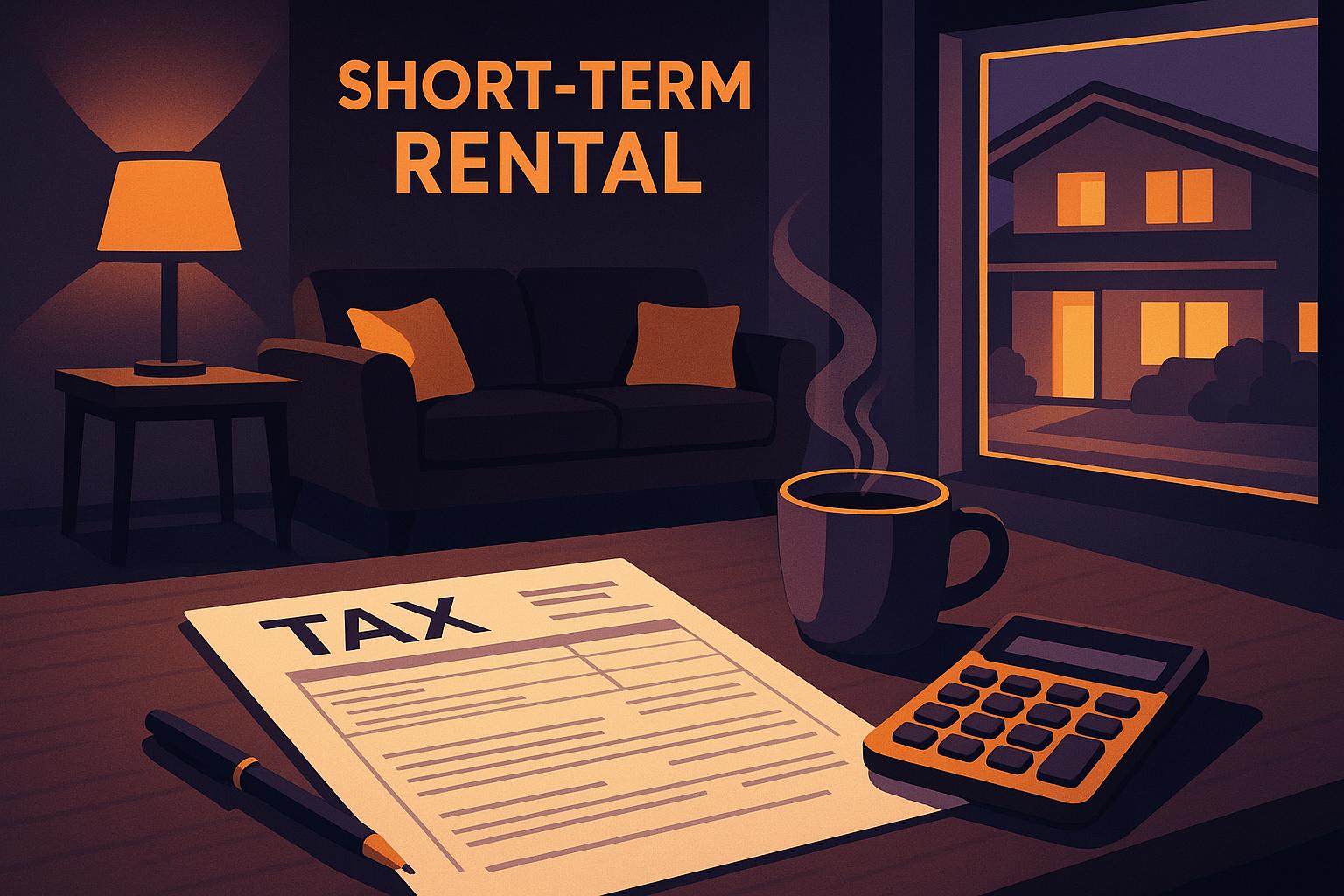
Short-term rentals can generate strong income, but taxes play a big role in determining your actual profits. Here's what you need to know:
- Higher Income, Higher Taxes: Short-term rentals often earn more than long-term rentals, but they may also face higher taxes, especially if services like housekeeping or meals are provided.
- Tax Deductions: You can deduct expenses like mortgage interest, property taxes, repairs, utilities, and depreciation to reduce taxable income.
- Passive Loss Rules: If your income is below $100,000, you may deduct up to $25,000 in rental losses. However, personal use of the property can limit deductions.
- Advanced Strategies: Spending 100+ hours managing your property could allow you to offset rental losses against other income. Cost segregation studies can also accelerate depreciation for big upfront savings.
- Compliance is Key: Report all income, stay on top of local permits, and keep detailed records to avoid penalties or audits. Additionally, consider capital gains tax strategies when planning your eventual exit.
- Audit Risks: Large losses, excessive deductions, or mixed personal and rental use can trigger IRS scrutiny.
How Do Rental Property Deductions Work on My Tax Return? | CountyOffice News
Tax Benefits for Short-Term Rental Owners
Smart tax planning can significantly improve the return on investment (ROI) for short-term rental owners by reducing tax liabilities and taking full advantage of available deductions. Let's dive into how these tax benefits work and the strategies you can use.
Tax-Deductible Expenses
The IRS allows short-term rental owners to deduct a variety of expenses tied to their rental properties. One of the largest deductions is mortgage interest. For example, if you have a $2,000 monthly mortgage payment, with $1,500 going toward interest, you could claim $18,000 in annual interest deductions.
Property taxes are another fully deductible expense. In states with high property taxes, such as New Jersey or New York, annual property taxes for a typical rental property often range between $15,000 and $25,000, making this a substantial deduction.
Depreciation is also a major tax-saving tool. The IRS allows property owners to depreciate their rental property over 27.5 years. For a $400,000 property (excluding land value), this means an annual depreciation deduction of approximately $14,545 - even if the property appreciates in market value.
Additional deductible expenses include:
- Repairs and maintenance
- Utilities
- Property insurance
- Cleaning services
- Property management fees
- Marketing costs
- Furnishing expenses
These deductions can add up quickly, reducing your taxable income. But understanding how IRS rules on passive losses and personal use limits apply is equally important.
Passive Loss Rules and Personal Use Limits
The IRS has specific guidelines for handling rental losses, particularly when the activity is classified as "passive."
If you actively participate in managing your rental - such as by screening guests, handling bookings, or coordinating repairs - you may deduct up to $25,000 in rental losses against other income, provided your adjusted gross income (AGI) is $100,000 or less. However, this deduction phases out as your AGI approaches $150,000.
Personal use limits also play a role in determining your deductions. If you use your rental property for personal purposes for more than 14 days per year or for more than 10% of the total days it is rented (whichever is greater), the IRS considers it a personal residence. In this case, you can only deduct expenses up to the amount of rental income generated. Any excess expenses can be carried forward to future tax years.
Once you’ve mastered these basics, there are advanced strategies that can help you unlock additional tax benefits.
Advanced Tax Strategies
If you can demonstrate material participation in your short-term rental activities, you may qualify for even greater tax advantages. This typically requires spending more than 100 hours per year on rental-related tasks. Meeting this threshold allows you to apply rental losses to offset other types of income, such as wages, bypassing the usual passive loss limitations.
Another advanced strategy involves cost segregation studies, which can accelerate depreciation benefits. Instead of depreciating your entire property over 27.5 years, a cost segregation analysis breaks down the property into components - such as furniture, appliances, fixtures, and land improvements - that can be depreciated over shorter timeframes (typically 5, 7, or 15 years). This can lead to significant upfront tax savings.
Both strategies require thorough documentation and, often, the help of a tax professional to ensure compliance with IRS regulations. But when done correctly, these approaches can have a meaningful impact on your overall tax strategy.
Tax Compliance Requirements and Common Mistakes
Staying on top of tax compliance is key to protecting your rental income and avoiding unnecessary fines. It also ensures you can take full advantage of legitimate deductions. For short-term rental owners, navigating federal, state, and local tax obligations can be tricky, and underestimating these requirements often leads to costly penalties or missed deductions.
IRS Reporting and State/Local Obligations
The IRS requires you to report all rental income, whether or not you receive a 1099 form from booking platforms. This includes income from direct bookings. A common misconception is that income below a certain threshold doesn’t need to be reported. However, even if a platform only issues a 1099 for earnings above a specific amount, you’re still responsible for reporting every dollar you make.
Typically, most short-term rental income goes on Schedule E(Supplemental Income and Loss). But if you offer additional services - like daily housekeeping, meals, or concierge assistance - the IRS might classify your operation as a business instead of a rental. In that case, you'll need to file Schedule C instead.
State and local tax rules add another layer of complexity. Many areas require you to obtain licenses or permits before renting out your property. For instance, some cities mandate registration or licensing, and there may be restrictions on how many days you can rent out a property that isn’t your primary residence. Furthermore, occupancy taxes vary widely depending on location. While booking platforms often handle the collection and remittance of these taxes, you’re ultimately responsible for ensuring everything is paid correctly and on time. Missing registration deadlines or filings could result in fines.
Record-Keeping Requirements
Good record-keeping is the backbone of tax compliance. Aim to maintain income and expense records for at least three years. If your property has significant depreciation claims, hold onto records for the entire time you own the property, plus an additional three years after selling it.
For income, save documents like booking confirmations, payment receipts, bank deposit records, and any correspondence verifying rental dates. Don’t rely solely on platform reports - download and archive monthly statements as a backup.
When it comes to expenses, keep receipts, invoices, and proof of payment for every deduction. This includes repair bills, cleaning service invoices, utility statements, insurance policies, and property management agreements. If certain expenses, like utilities, are partly for personal use, maintain logs showing the portion used for business purposes.
Tracking your property’s occupancy is equally important. Use a calendar to document rental days, personal use days, and vacant periods. This helps clarify whether passive loss rules apply and ensures personal use doesn’t limit your deductions.
For vehicle-related deductions, keep detailed mileage logs that include the date, purpose, and miles driven. Before calculating your deduction, check the IRS’s current standard mileage rate for the tax year.
Finally, using separate accounts for your rental property can streamline record-keeping and make tax season less stressful.
Poor documentation not only puts deductions at risk but also increases your exposure during an audit.
Penalties for Non-Compliance
Failing to comply with tax rules can eat into your rental profits. If you don’t report income accurately, you could face accuracy-related penalties, which usually involve a percentage of the underpaid tax plus interest that accrues from the original due date of your return.
If an audit reveals that you can’t substantiate a deduction, the IRS may disallow it, leading to additional taxes and penalties. Late filings can also rack up penalties if you miss the tax return deadline or fail to pay the full amount owed. Additionally, if your rental income results in a significant tax liability that isn’t covered through withholding or quarterly payments, you may face penalties for underpayment of estimated taxes.
Local penalties can be just as steep. Some municipalities impose daily fines or per-violation fees if you operate without proper permits or registrations.
Since interest on unpaid taxes compounds daily - and IRS rates can change over time - addressing compliance issues promptly is essential to keeping extra costs to a minimum.
Tax Risks and Audit Red Flags
Understanding the triggers that catch the IRS’s attention can help you refine your tax strategy and protect your return on investment (ROI). Short-term rental properties often face added scrutiny due to their mix of personal and business use. An audit in this area could result in disallowed deductions, additional taxes, and penalties - any of which could significantly impact your profits.
What Triggers IRS Audits
The IRS employs computerized systems to flag tax returns that deviate from standard patterns. Here are some common red flags:
- Disproportionate losses: Reporting unusually large or consistent losses compared to your income may raise questions about whether your rental activity is truly profit-driven.
- Excessive deductions: Claiming expenses that far exceed your rental income can appear suspicious.
- Unreported income: Booking platforms now report earnings directly to the IRS, so any mismatch between their reports and your tax return could draw attention.
- Mixed personal and business use: Combining personal and business use of a property makes it harder to justify certain deductions.
- Round numbers on returns: Reporting expenses in clean, round figures looks unusual since actual costs rarely land on exact amounts.
These red flags can often lead to a deeper review of how your rental income is classified, which can have significant tax consequences.
When Rental Income Becomes Business Income
The way the IRS classifies your income - either as rental or business income - has major tax implications of short-term vs. long-term rentals. Several factors influence this determination:
- Substantial services: Offering daily housekeeping, meals, or concierge services can shift your activity from passive rental income to active business income.
- Service mix and rental duration: Short-term stays paired with a high level of services may be treated as business income.
- Owner involvement: If you’re heavily involved in managing bookings, maintenance, or guest services, the IRS may reclassify your property as a business.
If your rental activity is classified as a business, you’ll likely need to report income on a different tax schedule and could become subject to additional taxes, such as self-employment tax. This reclassification also impacts how passive activity losses are handled, potentially limiting your deductions.
Beyond the tax implications, this shift can increase the risk of penalties, as outlined below.
How Non-Compliance Affects Your Profits
Failing to comply with tax regulations can erode your profits in several ways:
- Back taxes and interest: If an audit uncovers unreported income or disallowed deductions, you may owe back taxes along with interest, which can add up quickly.
- Penalties and lost deductions: Inaccurate reporting or poor record-keeping can lead to penalties and the permanent loss of valid deductions.
- Professional and time costs: Dealing with an audit often requires hiring tax professionals and dedicating significant time to gathering records and responding to IRS inquiries.
- Future scrutiny: Being audited once can increase the likelihood of future examinations, adding to your compliance challenges.
- State and local tax issues: Federal audit findings can sometimes trigger additional reviews by state or local tax authorities, further complicating your tax situation.
These risks can quickly turn a seemingly profitable property into a financial headache. That’s why meticulous tax planning and record-keeping are essential from the very beginning.
Tax Optimization Strategies That Work
Once you've tackled tax compliance and addressed risk factors, it's time to focus on strategies that can boost your after-tax returns. Thoughtful tax planning can make a big difference in the profitability of your short-term rental, but it requires careful preparation and the right tools to execute effectively.
Maximizing Deductions and Depreciation
Building on the tax advantages discussed earlier, fine-tuning your approach to deductions and depreciation can further improve your return on investment.
Timing expenses strategically can reduce your tax burden. For example, if you anticipate higher rental income next year, consider accelerating deductible expenses into the current year. This might involve prepaying property management fees, scheduling significant repairs before December 31st, or buying furniture and equipment sooner than initially planned.
Depreciation is one of the most effective tools available to you. For short-term rental properties, you can depreciate the structure over 27.5 years. However, items like furniture, appliances, and decorations often qualify for faster depreciation. Under Section 179 or bonus depreciation rules, you may be able to deduct the full cost of certain personal property in the year it's placed in service, subject to specific limits.
Cost segregation studies can further accelerate depreciation. By reclassifying components of your property, you can depreciate items like carpeting, window treatments, decorative lighting, and certain structural features over shorter periods - such as 5, 7, or 15 years instead of the standard 27.5 years.
If you use part of your primary residence for managing your rental business, you may qualify for home office deductions. This includes space used for tasks like bookkeeping, guest communications, or storing rental supplies. The simplified method allows a deduction of $5 per square foot (up to 300 square feet), while the actual expense method may yield larger deductions for those who qualify.
Using Technology for Tax Optimization
Technology has transformed tax planning into a more precise, data-driven process. Modern platforms now provide tools that were once accessible only through costly financial advisors.
One example is Mezzi's platform, which uses AI-driven insights to identify tax-saving opportunities across your portfolio. For short-term rental owners with investment portfolios, the platform's ability to prevent wash sales across multiple accounts is particularly useful. This feature ensures you don’t inadvertently trigger wash sale rules when reallocating investments to fund property improvements or expansions.
Real-time expense tracking eliminates the chaos of tax season. Instead of scrambling to organize receipts and bank statements, Mezzi's platform tracks deductible expenses as they happen. Its account aggregation feature provides a comprehensive view of your rental income, expenses, and related investments, enabling smarter tax strategies.
The platform’s X-Ray feature highlights hidden risks in your portfolio that could impact your tax planning. For instance, if your rental property is in an area dominated by real estate investment trusts (REITs), the tool might reveal an unexpected concentration of real estate exposure across your accounts, prompting you to diversify.
AI-powered categorization and tracking streamline the process. These systems automatically sort expenses, flag potential deductions, and alert you to missing documentation, saving time and reducing errors. By combining these tools with professional advice, you can create a strong foundation for effective tax planning.
Combining Professional Advice with AI Tools
The combination of professional expertise and AI-driven insights can maximize benefits while minimizing risks. Tax professionals bring a deep understanding of regulations, audit defense experience, and strategic planning capabilities that technology alone can't fully replicate.
AI tools excel at analyzing large volumes of data and spotting patterns. Mezzi’s platform, for example, processes your entire financial picture to uncover opportunities that might go unnoticed in traditional advisor relationships focused on basic tax preparation or investment management.
This hybrid approach is especially valuable for complex situations involving multiple properties, business entities, or sizable investment portfolios. While the AI platform continuously monitors for opportunities and flags potential issues, your tax professional provides guidance on entity selection, timing strategies, and compliance requirements.
The cost advantage is significant. Mezzi’s Advisory, priced at $39/month or $399/year, offers real-time optimization and insights at a fraction of the cost of traditional advisors, who typically charge 1% to 2% of assets under management each year. Over a 30-year period, this could translate into saving over $1 million in fees.
AI platforms complement traditional consultations. While the platform tracks deductions, monitors wash sale risks, and identifies optimization opportunities in real time, periodic consultations with your tax advisor focus on strategic decisions and ensuring compliance.
Documentation and audit readiness are strengthened through this partnership. AI systems maintain detailed, organized records that tax professionals can review and validate quickly. In the event of IRS inquiries, the professional relationship adds credibility and expertise to your case.
Conclusion: Balancing Tax Benefits and Risks
Short-term rental investments come with appealing tax advantages, but turning those into real profitability requires a solid grasp of short-term rental taxes and a strategic approach to deductions. Done correctly, strategies like deductible expenses and accelerated depreciation can significantly reduce taxable income and boost cash flow. However, these perks come with the responsibility of meeting detailed compliance requirements and maintaining accurate records.
Tax planning works best when it's proactive, not reactive. By planning throughout the year, you can avoid missing out on deductions and reduce the likelihood of triggering an audit. The most successful short-term rental owners treat tax planning as an ongoing effort - tracking expenses as they occur and staying informed about regulatory updates.
Today’s technology is making this process easier than ever. Tools like Mezzi use AI to simplify tax planning by identifying opportunities to save - whether it’s catching potential wash sales or automatically tracking deductible expenses. These platforms streamline the process, making it easier to optimize your taxes without the headache of manual calculations.
Combining these tech solutions with professional advice can be a game-changer. By doing so, you can avoid unnecessary costs, like the high fees that can add up to over $1 million over a few decades, and focus on building wealth.
Managing risk is just as important as maximizing benefits. Knowing what might trigger an IRS audit, keeping thorough documentation, and recognizing when your rental activities shift into business territory can safeguard your returns. The goal isn’t to eliminate all risks but to make informed choices that align with your financial goals and comfort with risk.
Ultimately, success lies in blending smart deduction strategies with careful compliance. Using modern tools alongside expert guidance allows you to capture tax advantages, stay compliant, and secure your long-term financial objectives.
FAQs
What determines if my short-term rental is considered a business for tax purposes?
In the U.S., the IRS determines whether your short-term rental is considered a business by looking at factors such as your intent to make a profit, how actively and regularly you manage the property, and the services you offer to guests. If you spend more than 500 hours a year on rental-related activities or provide extensive services - like cleaning or concierge support - it’s more likely to be classified as a business.
When your rental is treated as a business, you could unlock extra tax perks. These might include deductions for home office expenses, start-up costs, and equipment depreciation. Passive investors typically don’t qualify for these benefits, so it’s crucial to evaluate your level of involvement. If you’re unsure, consulting a tax professional can help clarify your situation.
How can I maximize tax deductions for my short-term rental property?
To make the most of tax deductions for your short-term rental property in the US, start by maintaining thorough records of every expense tied to the property. Some expenses you can typically deduct include mortgage interest, property taxes, cleaning services, repairs, and supplies. If you hire a professional property management company, those fees may also qualify as deductible.
Another strategy to explore is cost segregation, which allows you to speed up depreciation on certain parts of the property. This can help lower your taxable income faster. Additionally, knowing the 14-day rule - which lets you exclude rental income from taxes if the property is rented out for 14 days or fewer in a year - can work to your advantage.
Classifying your rental activity as a business might unlock even more deductions. To ensure you're following the rules and making the most of these opportunities, it's a smart move to consult with a tax professional who can guide you through the process.
What records should I keep to stay compliant and avoid penalties during a tax audit for my short-term rental?
To stay on the right side of tax regulations and steer clear of penalties during a tax audit, it's crucial to maintain thorough and well-organized records of your short-term rental activities. Be sure to track everything: income received, receipts, invoices, bank statements, lease agreements, and expense documentation.
Arrange these records by date and category to simplify the process of verifying expenses and supporting deductions if you're audited. Opt for digital copies whenever possible - they're easier to access and provide a reliable backup. Consistent record-keeping not only reduces stress but also helps you avoid costly errors.
Mezzi is free to get started. Choose Advisory for unlimited advice and advanced features at $39/month or $399/year. Concierge includes the same, plus hands-on support, at $99/month or $999/year.