If you're looking to invest in the S&P 500 with a small account, SPYM (formerly SPLG), VOO, and IVV are top ETF options. They all track the same index, but their costs and accessibility differ. Here's the key takeaway:
- SPYM (formerly SPLG): Lowest expense ratio at 0.02% and a share price of $80.20, making it the most budget-friendly for small accounts.
- VOO: Expense ratio of 0.03% with high liquidity and a share price of $636.35. Fractional shares are available through many brokers.
- IVV: Also has a 0.03% expense ratio, excellent tax efficiency, and a share price of $684.76. Fractional shares are widely supported.
Conclusion: For small accounts, SPYM is the most cost-effective due to its low expense ratio and affordable share price. VOO and IVV are great alternatives with similar performance but higher share prices.
Quick Comparison
SPYM's lower fees and share price make it ideal for those starting small, but all three ETFs provide strong long-term growth potential.
SPLG: SPDR Portfolio S&P 500 ETF
Features and Specifications
SPLG - now known as SPYM - has been tracking the S&P 500 since its launch on November 8, 2005, and currently manages an impressive $97.33 billion in assets. The fund holds around 503 securities, with its top positions including NVIDIA (7.38%), Apple (7.07%), and Microsoft (6.25%). Technology dominates the portfolio at 35.29%, followed by financial services at 12.79%.
The fund's expense ratio is just 0.02%, meaning you'd pay only $2 annually for every $10,000 invested. It also offers a dividend yield of approximately 1.13% and maintains a low turnover rate of 3%. As of February 2026, SPYM's share price is around $80.20, and it has delivered a strong annualized return of 16.84% over the past five years.
The combination of a low share price and minimal costs making SPYM a potentially attractive option for investors working with smaller budgets.
Why SPLG Works for Small Accounts
SPYM's affordability may be beneficial for investors with limited funds. For example, with $500, you can purchase about 7 shares of SPYM, while the same amount wouldn’t cover a single share of alternatives like VOO (around $626.89) or IVV (around $684.76).
"Today, $500 won't quite buy you a full-priced S&P 500 index fund, but you can get 7 SPDR Portfolio shares with that budget." – Anders Bylund, Analyst, Finviz/The Motley Fool
Its 0.02% expense ratio - the lowest among major S&P 500 ETFs - further enhances its appeal. As part of State Street's "SPDR Portfolio" lineup, SPYM is designed for long-term retail investors and doesn’t require a minimum investment. This may make it a suitable option for those looking to build their portfolios gradually and cost-effectively.
VOO: Vanguard S&P 500 ETF
Features and Specifications
VOO, launched on September 7, 2010, is one of the largest ETFs, managing about $1.5 trillion in net assets as of December 2025. It holds 504 stocks, covering roughly 80% of the total U.S. stock market capitalization.
With an expense ratio of just 0.03%, you’ll pay only $3 annually for every $10,000 invested. As of January 31, 2026, VOO offers a 30-day SEC yield of 1.08% and maintains a low turnover rate of 2.3%. As of February 11, 2026, its shares are priced at approximately $636.35.
A standout feature of VOO is its connection to Vanguard’s unique ownership model. Vanguard is owned by its funds, which are in turn owned by their investors. This structure eliminates the pressure to generate profits for external shareholders, allowing Vanguard to focus on passing cost savings directly to investors.
"Vanguard is owned by its funds, which are owned by their investors. There's no outside shareholders demanding profits, so Vanguard can pass all economies of scale to investors as lower fees." – Money Globe
Why VOO Works for Small Accounts
VOO is accessible to investors of all sizes, thanks to its $1.00 minimum investment. Many brokerages also allow fractional share purchases, meaning you can get started with even less than the current share price.
Its expense ratio of 0.03% is far below the industry average of 0.73%. While SPLG slightly undercuts it at 0.02%, VOO’s high liquidity and trading volume may help provide smooth transactions with minimal bid-ask spreads.
Vanguard’s commitment to low costs isn’t just a selling point - it’s a fundamental part of the company’s approach. The average expense ratio across Vanguard ETFs is 0.05%, significantly lower than the industry average of 0.22%. For long-term investors, especially those with smaller portfolios, this cost efficiency allows more of your investment to grow over time instead of being reduced by fees. These features may make VOO a contender when compared to other ETFs like SPLG and IVV in terms of long-term affordability and performance.
IVV: iShares Core S&P 500 ETF
Features and Specifications
IVV, launched on May 15, 2000, is the oldest ETF in this comparison, with over two decades of performance history. It manages an impressive $749 billion across 503 holdings, demonstrating its longevity in the market.
The fund charges a low expense ratio of 0.03% - just $3 for every $10,000 invested. It also reports a 12-month trailing yield of 1.16%, maintains a turnover rate of only 3%, and was priced at $684.76 as of February 13, 2026. As an open-end fund, IVV reinvests dividends immediately, which helps reduce cash drag and keeps its tracking error to just 0.02% compared to the S&P 500 Total Return Index. Its consistency and performance have earned it a "Gold" Medalist Rating from Morningstar as of January 28, 2026.
Why IVV Works for Small Accounts
IVV's features make it an excellent option for investors with smaller portfolios. Its high liquidity - averaging about 8 million shares traded daily - and tight bid-ask spreads of just 0.01% help minimize hidden costs, even for small trades.
The fund also features tax efficiency. By using in-kind creation and redemption processes, it avoids triggering capital gains distributions, which is especially beneficial for investors in taxable accounts. Additionally, many brokerages now offer commission-free trading on iShares products, making IVV accessible through certain platforms. Platforms like Fidelity and Schwab make it easy to invest without extra fees.
Worried about the high share price? Most brokerages allow fractional share purchases, so you can start investing with any amount you have. This flexibility, combined with its strong track record and institutional-grade exposure, may make IVV a suitable option for gradually building wealth over time.
SPLG vs VOO vs IVV: Side-by-Side Comparison
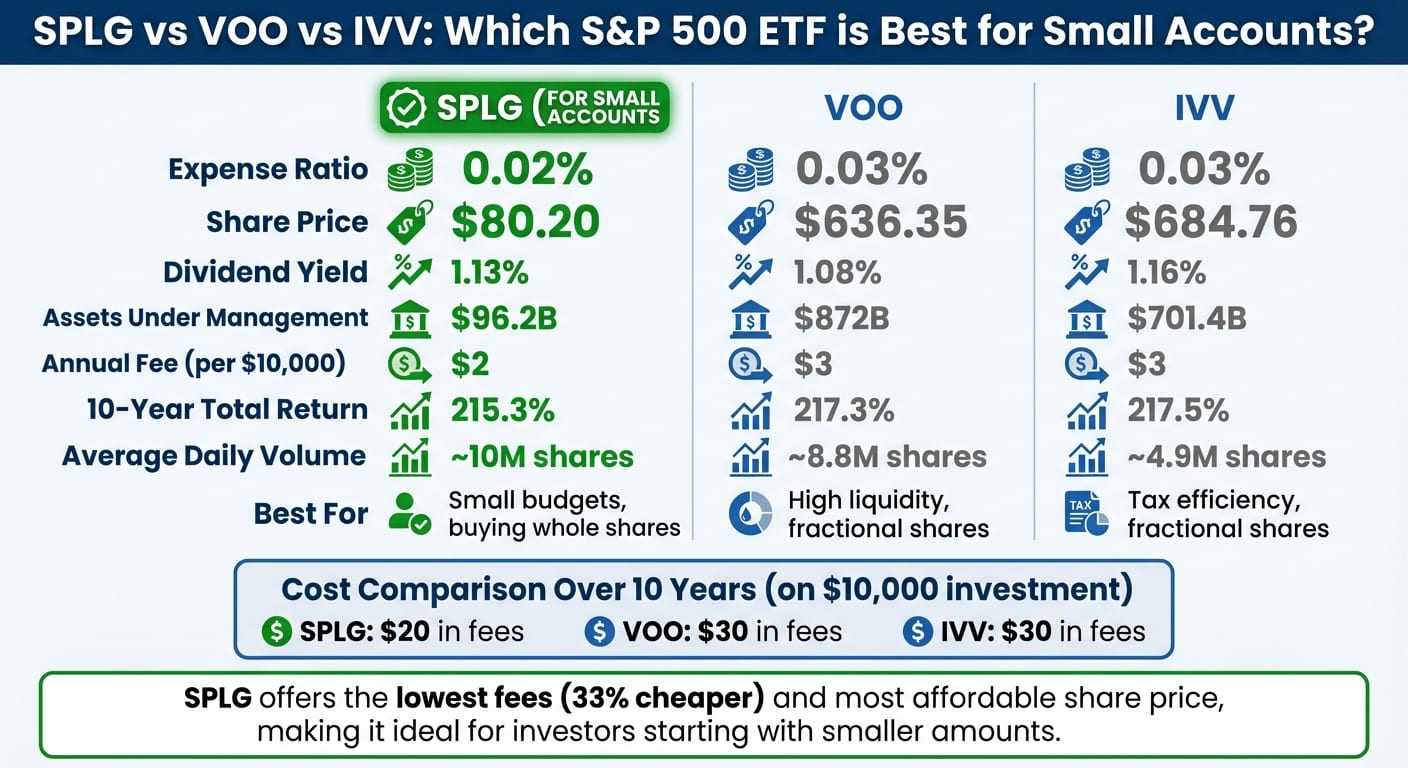
Comparison Table
All three ETFs are designed to track the S&P 500, but small differences can make a big impact for investors with smaller accounts.
SPLG features a lower expense ratio of 0.02%, which is about 33% less than VOO and IVV, both of which charge 0.03%. All three ETFs demonstrate strong tracking accuracy, deviating by just 0.02% to 0.04% from the S&P 500 Total Return Index. In terms of assets, VOO leads with $872 billion under management, followed by IVV at $701.4 billion, while SPLG manages $96.2 billion.
Now, let’s break down how these small fee differences can add up over time.
How Fees Impact Small Accounts Over Time
Even minor differences in fees can significantly affect returns when compounded over decades. For a $10,000 investment, SPLG costs $2 annually, while VOO and IVV cost $3. Over a 10-year period, SPLG accumulates $20 in fees, compared to $30 for VOO and IVV - a $10 difference that grows over time with compounding.
For example, assuming a 10% annual return, a $10,000 investment would grow to approximately $174,494 after 30 years. With SPLG's lower 0.02% expense ratio, investors keep slightly more of their earnings compared to the 0.03% charged by VOO and IVV. On the other hand, older ETFs like SPY, which carries a much higher fee of 0.0945%, would cost around $94.50 over 10 years on the same $10,000 investment.
For smaller accounts, the 0.01% fee difference translates to about $1 per year on a $10,000 investment. While fees are worth considering, the most important factor is starting to invest and staying consistent over the long term.
The Best S&P 500 ETF for Small Accounts
Final Recommendation
After evaluating fees and accessibility, SPLG (now rebranded as SPYM) stands out as the best option for small accounts. With an expense ratio of just 0.02%, SPLG is roughly 33% cheaper than the 0.03% charged by both VOO and IVV. While a $1 annual difference might seem minor, it can grow significantly over time due to compounding.
SPLG also has a clear advantage in share price. Trading at around $80 per share, it allows investors to buy multiple shares, which is particularly useful when brokers don’t offer fractional shares. Compare this to VOO and IVV, which trade at approximately $634 and $684 per share, respectively.
Performance-wise, all three ETFs track the same S&P 500 index and deliver nearly identical results. Over a 10-year period, their total returns differ by less than 2.2%. Since they each hold the same 500+ companies, the deciding factor becomes cost. SPLG provides the same market exposure at a lower price, which may make it an efficient option for building wealth over the long term. This aligns with earlier findings, reinforcing SPLG's position as a possible choice for investors with smaller budgets.
Use Mezzi to manage your SPLG investments and help manage your tax planning.
Voo vs Ivv vs Splg || Which Is Better?
FAQs
Is SPYM really the same ETF as SPLG?
SPYM and SPLG refer to the same ETF. In November 2025, SPLG was renamed to SPYM, but the underlying fund itself stayed the same. The change is purely in the ticker symbol, with no impact on the investment's structure or holdings.
Do fractional shares make VOO or IVV just as good for small accounts?
Yes, fractional shares make VOO and IVV accessible to investors with smaller accounts. Thanks to dollar-based investing, you can purchase fractions of these ETFs, meaning you don’t have to buy full shares to gain exposure. This approach allows individuals with limited funds to include VOO and IVV in their portfolios. While SPLG may also work with fractional investing, VOO and IVV stand out as strong choices for smaller investors due to their availability on many fractional share platforms.
Which ETF is best for a taxable account?
VOO is sometimes regarded as a possible option for taxable accounts due to its expense ratio and tax efficiency features when compared to IVV and SPLG. These qualities make it an economical choice for investors looking to reduce tax burdens while optimizing their returns.
Related Blog Posts
- SPY vs VOO: fees, liquidity, dividend treatment, and tracking differences.
- VOO vs IVV: why might an investor choose one over the other?
- SWPPX (Schwab S&P 500 Index) vs SPY in a Schwab account: which fits a long-term taxable investor?
- SPY vs VOO vs IVV - Best S&P 500 ETF for liquidity and tracking
SPYM and SPLG refer to the same ETF. In November 2025, SPLG was renamed to SPYM, but the underlying fund itself stayed the same. The change is purely in the ticker symbol, with no impact on the investment's structure or holdings.
Yes, fractional shares make VOO and IVV accessible to investors with smaller accounts. Thanks to dollar-based investing, you can purchase fractions of these ETFs, meaning you don’t have to buy full shares to gain exposure. This approach allows individuals with limited funds to include VOO and IVV in their portfolios. While SPLG may also work with fractional investing, VOO and IVV stand out as strong choices for smaller investors due to their availability on many fractional share platforms.
VOO is sometimes regarded as a possible option for taxable accounts due to its expense ratio and tax efficiency features when compared to IVV and SPLG. These qualities make it an economical choice for investors looking to reduce tax burdens while optimizing their returns.