
Tax-loss harvesting helps you reduce your tax bill by selling investments at a loss to offset gains or ordinary income. The IRS allows you to deduct up to $3,000 annually from ordinary income, with excess losses carried forward. Tools like Mezzi use AI to simplify this process by:
- Scanning your portfolio for unrealized losses in real time.
- Suggesting replacement investments to avoid the wash-sale rule.
- Aggregating data across multiple accounts for a complete view.
For example, if you’re in the 24% tax bracket, harvesting a $3,000 loss could save you $720 in taxes. Automated tax loss harvesting tools make this process faster and more accurate, potentially increasing after-tax returns by 1–2%. By automating loss detection, compliance, and replacement recommendations, these platforms allow you to focus on long-term financial growth while minimizing tax liabilities.
Tax-Loss Harvesting Explained
How Tax-Loss Harvesting Works
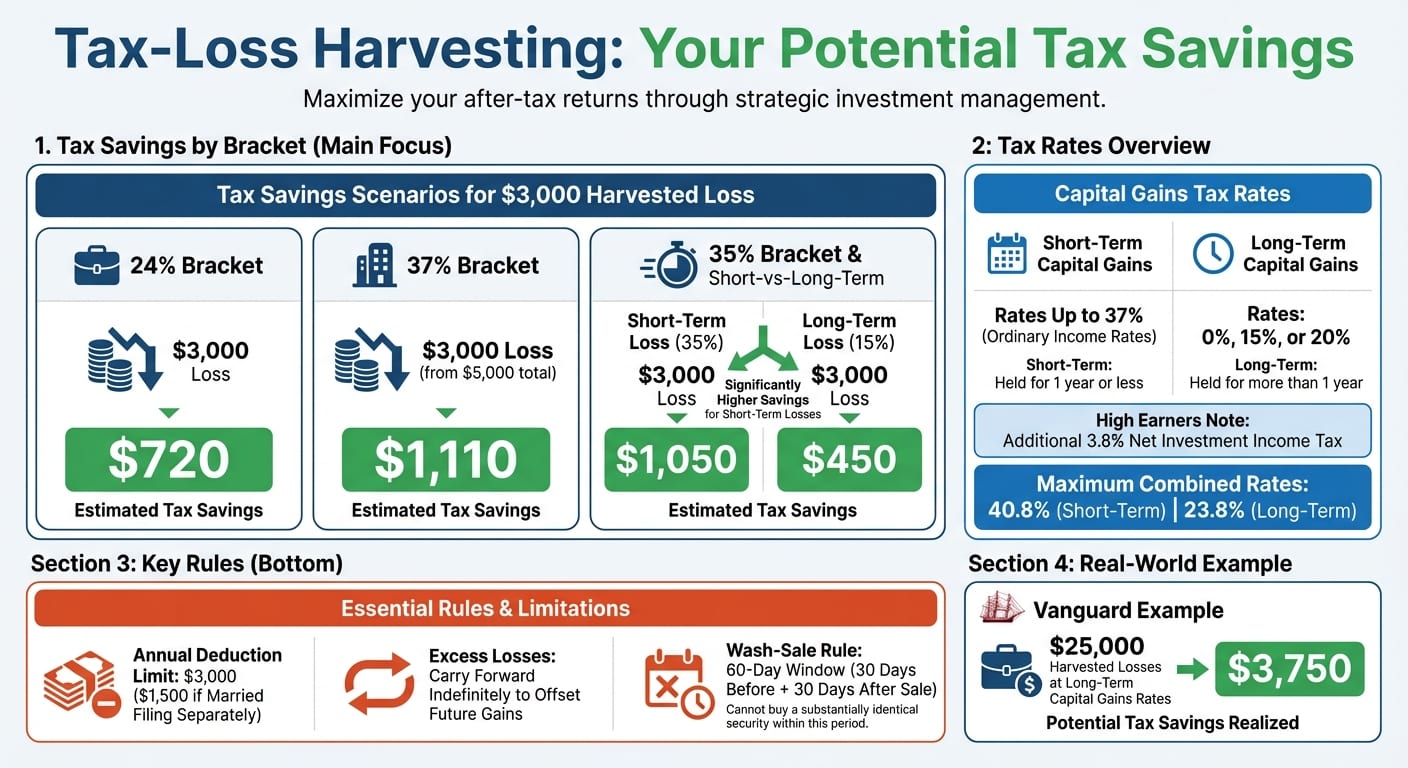
Tax-loss harvesting involves selling investments that have declined in value to offset gains from profitable investments. If your losses exceed your gains, you can deduct up to $3,000 ($1,500 if married filing separately) from ordinary income and carry any remaining losses forward indefinitely.
The tax savings depend on the type of gains you’re offsetting. Short-term losses reduce gains taxed at rates as high as 37%, while long-term losses offset gains taxed at 0%, 15%, or 20%. For high earners, the 3.8% Net Investment Income Tax may apply, meaning short-term gains could face a combined tax rate of up to 40.8%, with long-term gains taxed as high as 23.8%.
Tax-loss harvesting applies to investments like individual stocks, bonds, mutual funds, and ETFs held in taxable brokerage accounts. However, it doesn’t apply to tax-deferred accounts like IRAs, 401(k)s, or 529 plans because losses in these accounts cannot be deducted. These principles form the backbone of AI-driven tax strategies designed to help you save more.
Tax Savings from Harvesting Losses
The main advantage is reducing your tax bill. For instance, an investor in the 37% tax bracket who offsets $3,000 of ordinary income with a $5,000 loss could save $1,110 in taxes that year. This approach allows for reinvestment while creating potential tax benefits.
Focusing on short-term losses can amplify savings, as they offset gains taxed at higher ordinary income rates. Using the specific identification method - selling shares with the highest cost basis instead of averaging costs - can further increase your realized losses. Tools like Mezzi make this process easier by automatically identifying the best shares to sell based on these strategies.
"Tax-loss harvesting is very episodic; when it's there, we look to take advantage. We put those additional losses into what we consider to be a 'tax savings account.'"
Grasping these savings concepts is key to using technology effectively for tax-loss harvesting.
The Wash-Sale Rule Explained
The IRS enforces a wash-sale rule, which prevents you from claiming a loss if you buy a "substantially identical" security within 30 days before or after the sale. This creates a 60-day window during which the loss is disallowed. The rule extends to all accounts owned by you or your spouse, including IRAs.
To avoid triggering a wash sale while staying invested, you can replace the sold security with a similar - but not identical - investment. For example, you could sell a tech stock and reinvest in a technology sector ETF.
"The purpose of tax-loss harvesting is not to pick losing stocks. It is simply to potentially help investors benefit from naturally occurring market volatility and dispersion in stock returns."
Tracking these rules manually can be overwhelming, especially across multiple accounts. AI tools for navigating wash sale rules simplify this process and ensure all trades settle by December 31 to count for the current tax year. Staying compliant is critical for maintaining an effective, technology-assisted tax-loss harvesting strategy.
Why AI Tools Make Tax-Loss Harvesting Easier
Tax-loss harvesting manually can feel like a full-time job. It means juggling spreadsheets, tracking cost basis, calculating unrealized losses, and keeping an eye on wash-sale windows - all while trying to time the market dips. This process often eats up 10–20 hours each quarter and still risks missing 15–25% of potential losses, especially in portfolios spread across multiple accounts. That’s where AI tools like Mezzi come in, simplifying the process by automating loss detection and managing risks.
Year-Round Portfolio Monitoring
One of Mezzi’s standout features is its ability to monitor your portfolio daily, flagging losses of 5–10% as they happen. For example, it doesn’t just identify loss opportunities; it also recommends replacement securities that comply with wash-sale rules. This proactive approach lets you harvest losses throughout the year, offsetting quarterly gains for immediate tax benefits. Vanguard highlights the advantages of this strategy, noting that capturing losses during the year can result in tax savings, depending on your specific circumstances.
Tracking Across Multiple Accounts
Dealing with multiple accounts manually can be overwhelming, especially when trying to avoid wash-sale violations. Mezzi solves this by securely aggregating data from all your accounts using Plaid’s API connections. The result? A single dashboard that shows your total harvestable losses - say, $50,000 across all accounts - in one place. This centralized view is critical since the wash-sale rule applies across all accounts, including those held by a spouse. For instance, Mezzi might flag a scenario where an S&P 500 ETF was purchased in a spouse’s account within the 30-day window and suggest a compliant alternative, like a total market ETF with a 99% correlation but a different ticker. Some users report identifying additional losses using Mezzi’s data aggregation capabilities.
Faster Execution with AI Guidance
In fast-moving markets, timing is everything. Mezzi sends real-time alerts regarding potential loss harvesting opportunities, allowing for timely decision-making. This guidance helps you identify opportunities as they arise.
What to Look for in Tax-Loss Harvesting Tools
When it comes to tax-loss harvesting tools, not all are created equal. The right tool can help you identify potential tax savings, while a basic portfolio tracker may not provide the same capabilities. To make the most of your investments, focus on three key features that set advanced tools apart from simple spreadsheets.
Real-Time Loss Detection
A top-tier tool should monitor your portfolio daily, identifying losses as they occur. For example, Mezzi tracks individual tax lots with precision, pinpointing securities trading below their cost basis and notifying you when it's time to act. It breaks down unrealized losses for each position, highlighting whether they're short-term or long-term - an essential distinction since tax rates vary based on timing. Imagine holding 100 shares of a tech ETF bought at $50 per share, now trading at $45. A good tool would flag this $500 loss and prioritize it based on its tax-saving potential. Beyond detection, the tool should also address compliance concerns to ensure smooth execution.
Wash-Sale Risk Alerts
To maximize your tax benefits, the tool must help you avoid wash sales - situations where a loss deduction is disallowed because you repurchase the same or a similar security within 30 days. Mezzi, for instance, monitors wash sale rules across all connected accounts. If you sell an industrial sector ETF at a loss, the tool will immediately alert you if you try to repurchase it - or a nearly identical ETF - within the restricted window. Without this level of monitoring, you could accidentally invalidate your tax deductions.
Replacement Security Recommendations
Effective tools go beyond loss detection and risk alerts by offering suggestions for compliant replacement securities. This ensures you maintain your portfolio's allocation while staying within IRS guidelines. Mezzi, for example, recommends alternatives that match the original security's risk profile and sector exposure without being "substantially identical." If you sell a broad U.S. stock index fund, it might suggest a comparable index fund from another provider, allowing you to pursue tax benefits while maintaining your investment strategy. The tool should also explain why each replacement makes sense, giving you confidence that your portfolio remains aligned with your goals.
How to Use AI Tools for Tax-Loss Harvesting
Mezzi makes tax-loss harvesting with AI simple with its advanced monitoring and alert system. Here's how to get started: connect your accounts, set your preferences, and take action based on the platform's recommendations.
Connect Your Accounts
The first step is linking your investment accounts. Mezzi securely connects to brokers like Vanguard, Fidelity, and Schwab using read-only access. With multi-factor authentication and 256-bit encryption, it ensures your data stays safe while allowing the platform to view your holdings (but not execute trades).
Even though tax-loss harvesting applies only to taxable accounts, linking all your accounts helps Mezzi monitor for potential wash-sale risks across your entire portfolio.
Set Your Harvesting Preferences
Once your accounts are connected, you can set a minimum loss threshold - for instance, $1,000 or 5% below the cost basis - to identify opportunities that fit your financial goals. If you're in a higher tax bracket, such as 35%, focusing on short-term losses can be especially useful. These losses offset ordinary income, which is taxed at higher rates. For example, a $3,000 short-term loss could save you $1,050 in taxes, compared to $450 for a long-term loss taxed at 15%.
Mezzi’s AI reviews your portfolio daily, using your selected thresholds to spot positions trading below their cost basis. It also calculates potential tax savings and presents these findings on your dashboard for easy review.
Act on Recommendations and Track Compliance
When Mezzi flags an opportunity, it provides details like the loss amount, replacement suggestions, and estimated tax savings. You can then execute the trade directly through your brokerage, as Mezzi offers guidance but doesn’t handle trades on your behalf.
After completing the sale, Mezzi monitors the 30-day wash-sale window to ensure compliance. If there’s a risk of repurchasing a disallowed security, the platform will alert you. For instance, if you sell an energy sector ETF at a loss, Mezzi might suggest a similar but not identical replacement to maintain your portfolio's balance. It also notifies you when it’s safe to buy back the original security, ensuring your tax deduction remains intact.
Calculating Tax Savings and Long-Term Impact
AI's ability to monitor portfolios in real time takes tax-loss harvesting to the next level, making your portfolio more efficient. Mezzi’s dashboard doesn’t just track opportunities; it calculates potential tax savings for every harvesting scenario, providing estimates of potential tax savings before making a trade.
Measuring Your Tax Savings
Tax savings start with how you apply harvested losses. Realized losses offset capital gains dollar-for-dollar - short-term losses first reduce short-term gains, while long-term losses reduce long-term gains.
Here’s an example: If you’re in the 24% federal tax bracket, a $3,000 deduction could mean $720 in immediate tax savings. And any unused losses? They carry forward indefinitely, continuing to lower your taxable income in future years.
Take David, an engineer in the 24% tax bracket. In March 2026, he harvested a $6,000 loss. He used $3,000 of that loss to reduce his 2026 taxable income, saving $720 in federal taxes. The remaining $3,000 carried forward to 2027, earning him another $720 in tax savings.
Mezzi simplifies this process by tracking your portfolio down to the individual tax lots - specific shares purchased at different times. Even if your overall position is profitable, Mezzi identifies losses within those lots. Plus, it monitors the transition of positions from short-term to long-term status, which can cut tax rates nearly in half.
These immediate benefits are just the beginning - they also set the stage for understanding the long-term advantages of tax alpha.
What Is Tax Alpha?
Tax alpha goes beyond short-term savings, focusing on how tax-loss harvesting boosts your long-term after-tax returns. Automated tools like Mezzi amplify these returns by harvesting losses daily. For investors in the 24% tax bracket or higher, the efficiency gained may help offset management fees, depending on individual circumstances.
Mezzi’s daily monitoring ensures you don’t miss opportunities. Unlike the typical December rush, the platform identifies loss-harvesting "windows" as they appear, even before markets bounce back.
Conclusion
With the AI-driven strategy outlined earlier, tax-loss harvesting becomes simpler and more accessible. Tools like Mezzi analyze your portfolio in real time, identifying unrealized losses in individual tax lots - even when the broader position seems profitable. These insights may help identify tax savings opportunities.
Mezzi offers guidance intended to support informed decision-making, without charging a typical 1% advisor fee. It monitors wash-sale risks across all your accounts, suggests replacement securities to preserve your asset allocation, and estimates potential tax savings before you take action. This efficient process not only provides immediate tax benefits but also enhances long-term returns by lowering cost bases and improving compounding.
Unlike traditional advisors who only focus on the assets they manage, Mezzi connects to all your accounts - whether it's a 401(k), brokerage, Roth IRA, or taxable account - through secure, read-only access. It uncovers opportunities across your entire financial landscape, giving you actionable recommendations while you remain in full control. This aims to support tax-efficient strategies while allowing you to maintain control and manage costs.
FAQs
When should I harvest a loss versus waiting?
When your investments lose value, you might consider selling to "harvest" the loss. Why? It can help offset capital gains or lower your taxable income - but timing is key. If the loss occurs within the current tax year, acting quickly could make sense. On the other hand, if you believe market conditions will improve or want to save that loss for future tax strategies, holding off might be the smarter move.
How can I avoid wash sales across all my accounts?
To steer clear of wash sales across all your accounts, consider using automated tools like Mezzi. These tools use AI to keep an eye on your trades in real-time, identifying potential wash sale violations as they happen. They can also suggest alternative investments to help you maintain market exposure without breaking the IRS wash sale rule. By using such tools, you can streamline portfolio management and minimize the chances of accidental violations, even when managing multiple accounts.
Does tax-loss harvesting change my cost basis or future taxes?
Tax-loss harvesting doesn’t change your original cost basis. What it does is let you use investment losses to offset taxable income or capital gains, which might lower your tax bill. This approach can make your portfolio more tax-efficient while leaving your initial investment records intact.
Related Blog Posts
- AI Tools for Tax-Loss Harvesting in Portfolios
- AI Tools for Navigating Wash Sale Rules
- How AI Optimizes Tax-Loss Harvesting
- Tax-Loss Harvesting: Best Seasons for Maximum Savings
When your investments lose value, you might consider selling to "harvest" the loss. Why? It can help offset capital gains or lower your taxable income - but timing is key. If the loss occurs within the current tax year, acting quickly could make sense. On the other hand, if you believe market conditions will improve or want to save that loss for future tax strategies, holding off might be the smarter move.
To steer clear of wash sales across all your accounts, consider using automated tools like Mezzi. These tools use AI to keep an eye on your trades in real-time, identifying potential wash sale violations as they happen. They can also suggest alternative investments to help you maintain market exposure without breaking the IRS wash sale rule. By using such tools, you can streamline portfolio management and minimize the chances of accidental violations, even when managing multiple accounts.
Tax-loss harvesting doesn’t change your original cost basis. What it does is let you use investment losses to offset taxable income or capital gains, which might lower your tax bill. This approach can make your portfolio more tax-efficient while leaving your initial investment records intact.