From bitcoin to bonds: the ETFs to harvest right now
In this week's The Boost, we cover the ETF tax-loss harvesting opportunities hiding in plain sight right now.
Tax-loss harvesting is one of the easiest ways to reduce your tax bill without changing your investment strategy. The idea is simple: if an ETF you own is trading below what you paid for it, you sell it, book the loss for tax purposes, and immediately buy a similar (but not identical) ETF to maintain your exposure. The loss offsets gains or ordinary income on your tax return, and your portfolio stays invested.
Even though the S&P 500 is up roughly 5% this year, several of the most widely held ETFs in America are negative. And anyone who bought them in January, February, or March is now underwater.
This is the cleanest tax-loss harvesting setup of the year — because swapping one ETF for a similar (but not identical) ETF lets you book the loss without changing your portfolio’s exposure.
Here are the specific opportunities, what to swap into, and the trade-offs you need to think through before you trade.
The ETFs worth looking at right now
These are widely held, the losses are meaningful, and clean replacement options exist. All performance as of May 1, 2026.
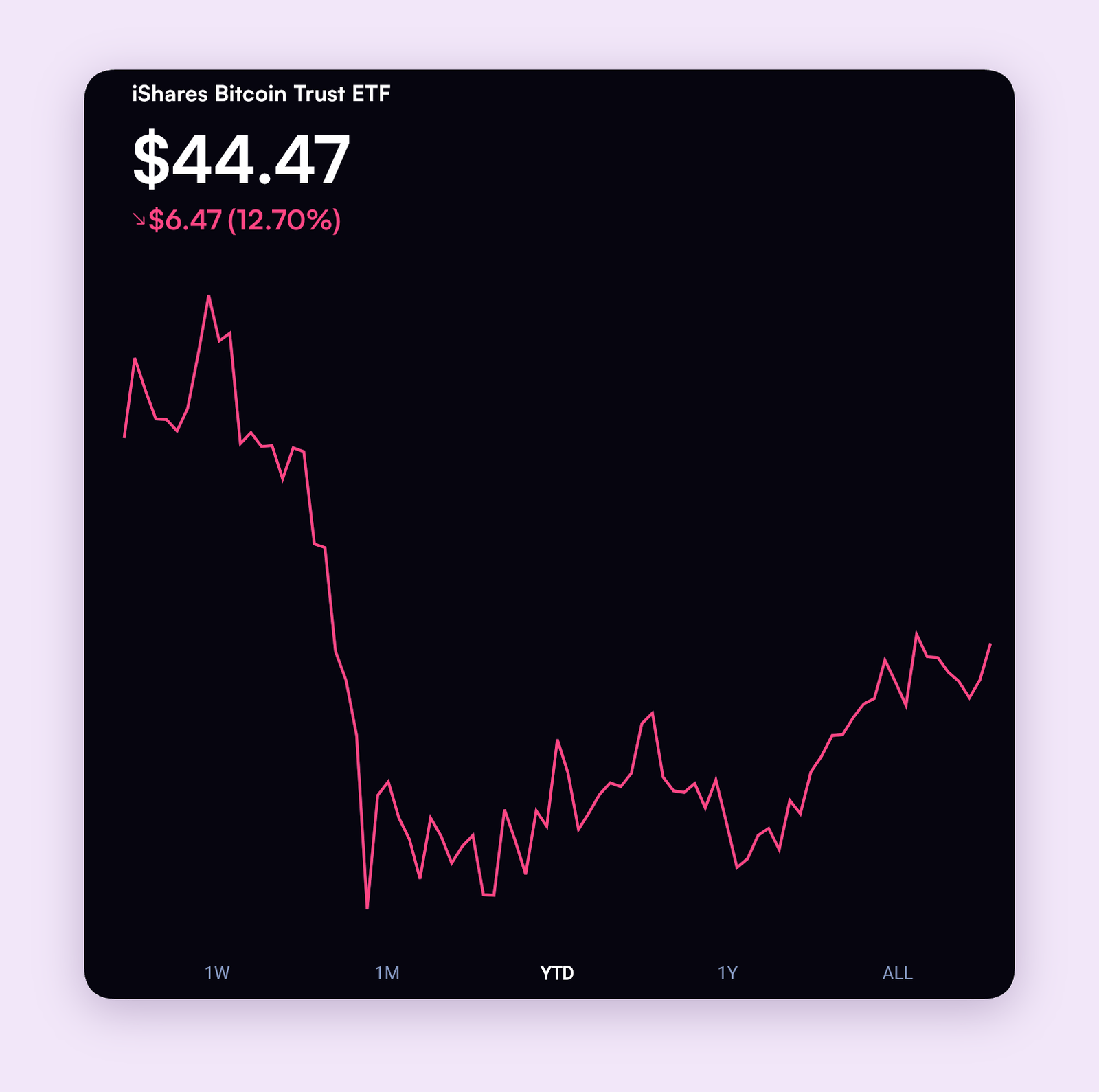
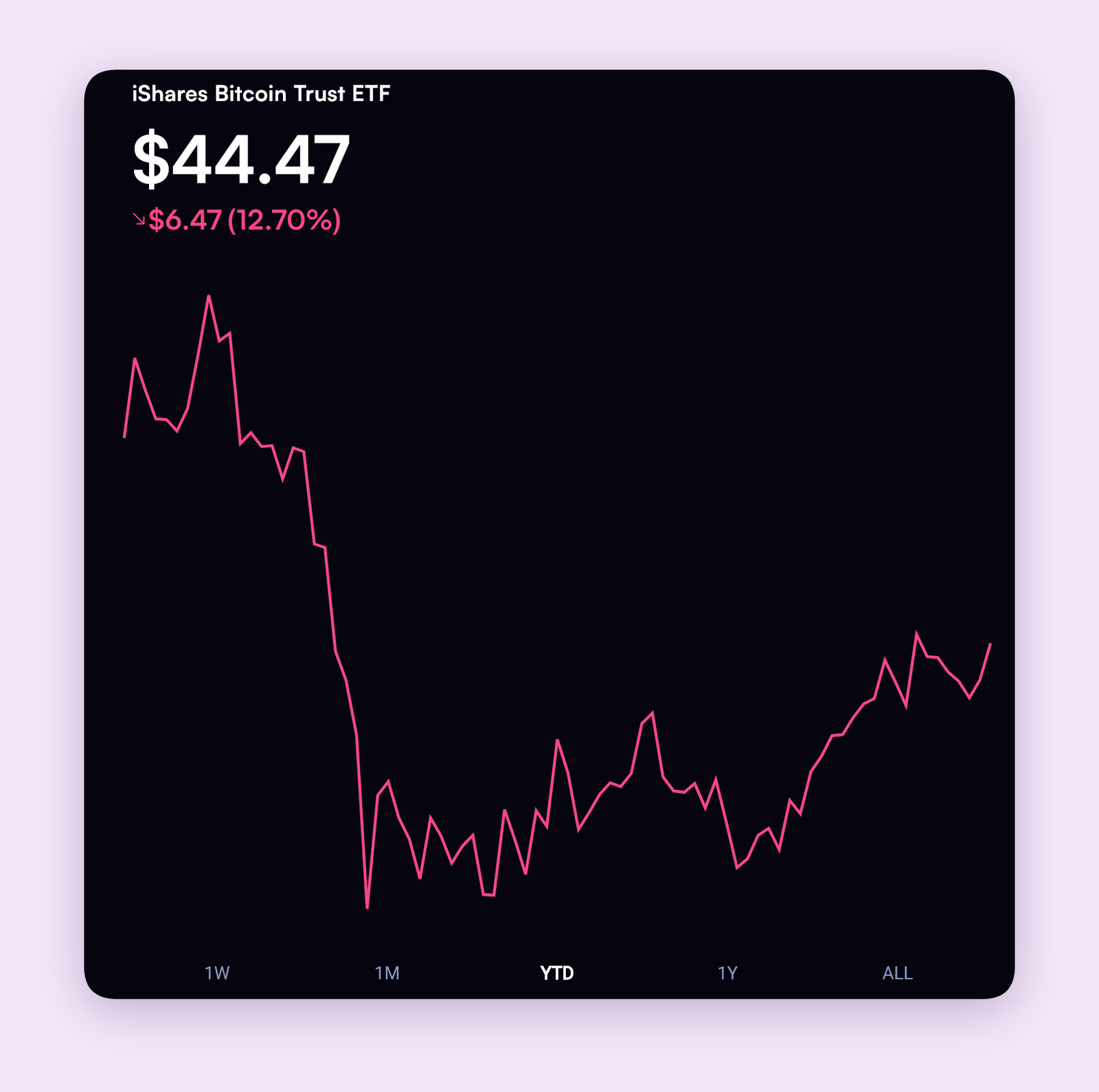
iShares Bitcoin Trust (IBIT) — down ~13% this year
Anyone who bought IBIT in early-to-mid January 2026 — when bitcoin rallied to ~$97,000 and IBIT pushed into the mid-$50s — is now down 17–22%. Even buyers from January 1 (around $51) are sitting on a 12–13% loss. This is the single biggest harvesting opportunity on this list.
Health Care Select Sector SPDR (XLV) — down ~5.8% this year
Healthcare has been one of the worst-performing S&P 500 sectors this year. If you bought XLV anytime in Q1 to overweight defensive exposure, you’re underwater.
Financial Select Sector SPDR (XLF) — down ~4.0% this year
Financials sold off on rate uncertainty. Q1 buyers are sitting on losses.
iShares 20+ Year Treasury Bond ETF (TLT) — down ~0.75% this year
If you bought long-term Treasury bond ETFs in early 2026 expecting rate cuts, you're in the red. The percentage loss looks small, but the real opportunity here is swapping into a dramatically cheaper fund. The -0.75% figure is total return (with distributions). Price-only return is closer to -2.5%, and price is what determines your harvestable loss.
iShares Core US Aggregate Bond (AGG) and Vanguard Total Bond Market (BND) — price returns down ~1% this year
A note on bond ETFs: their total returns look near-flat this year because monthly distributions mask the share-price decline. For tax-loss harvesting, what matters is the share price vs. what you paid — and that's negative. The losses here are small in percentage terms, but these are huge positions for many investors. A $500K BND position with a 1% price decline is a $5,000 harvestable loss — and at a 37% effective rate, that's $1,850 in tax savings from one trade.
The replacement playbook
For each underwater ETF, here's the recommended swap and what to think about before pulling the trigger.
Bitcoin: IBIT (0.25%) → FBTC (0.25%), BITB (0.20%), or BTC (0.15%) All are spot bitcoin ETFs from different companies. FBTC (Fidelity) matches IBIT's fee. BITB (Bitwise) is 0.05% cheaper. BTC (Grayscale Mini) is 0.10% cheaper — the lowest-cost option. The IRS hasn't ruled on whether spot Bitcoin ETFs from different sponsors count as the same investment for wash sale purposes, but the widely accepted view is that funds from different companies don't trigger a wash sale. If you're conservative, sit out 31 days before buying back instead.
Healthcare: XLV (0.08%) → VHT (0.09%) Essentially the same annual cost. VHT is broader (~400 holdings vs. XLV's ~60). Different index, different sponsor. Clean swap.
Financials: XLF (0.08%) → VFH (0.09%) Essentially the same annual cost. VFH is broader than XLF. Different index, different sponsor — clean swap.
Treasury bonds: TLT (0.15%) → VGLT (0.03%) This is the easiest swap on the list. VGLT is 0.12% cheaper per year — on a $100K position, you could save $120/year in fees forever. You might never want to go back to TLT.
Aggregate bonds: BND (0.03%) ↔ AGG / SCHZ / SPAB (all 0.03%) Identical expense ratios, different sponsors, slightly different construction. A widely used tax-loss harvesting swap. Of the three, SCHZ and SPAB are built a bit differently from BND than AGG is, if you want to err on the conservative side.
This isn't just an ETF strategy
Everything above focuses on ETFs because the swaps are clean. But if you own individual stocks that are underwater, those losses are harvestable too.
The challenge is finding a replacement. When you sell XLV, you can buy VHT. When you sell an individual stock, you need a company in the same industry with similar characteristics — close enough to maintain exposure, different enough to avoid a wash sale. That's harder to do systematically, and it's where most people either leave money on the table or give up entirely.
If you're sitting on losses in individual stock positions, don't ignore them just because the swap is less obvious.
The wash sale traps that break this
Automatic dividend reinvestment. Bond ETFs pay monthly distributions. If you sell BND at a loss in your taxable account and your IRA still owns BND, the IRA's monthly distribution will auto-reinvest into more BND shares — triggering a wash sale. Fix: Turn off automatic dividend reinvestment across ALL accounts during your tax-loss harvesting window.
The 401(k) bond-fund overlap (gray area). If you sell BND in your taxable account and your 401(k) bond fund or target-date fund buys substantially similar bond securities within 30 days, some practitioners view this as a potential wash sale risk. The IRS has never formally extended wash sale rules to 401(k)s, and a target-date fund is its own security (not BND), so most tax pros treat this as low-risk. But if you want to be airtight, check your 401(k) rebalance schedule before harvesting.
How can Mezzi help?
Tax-loss harvesting sounds simple in a newsletter and gets messy fast in a real portfolio — especially across multiple accounts, with monthly bond distributions, IRAs, and spouses' accounts in the mix.
That's exactly what Mezzi is built for. Specifically, use Mezzi to:
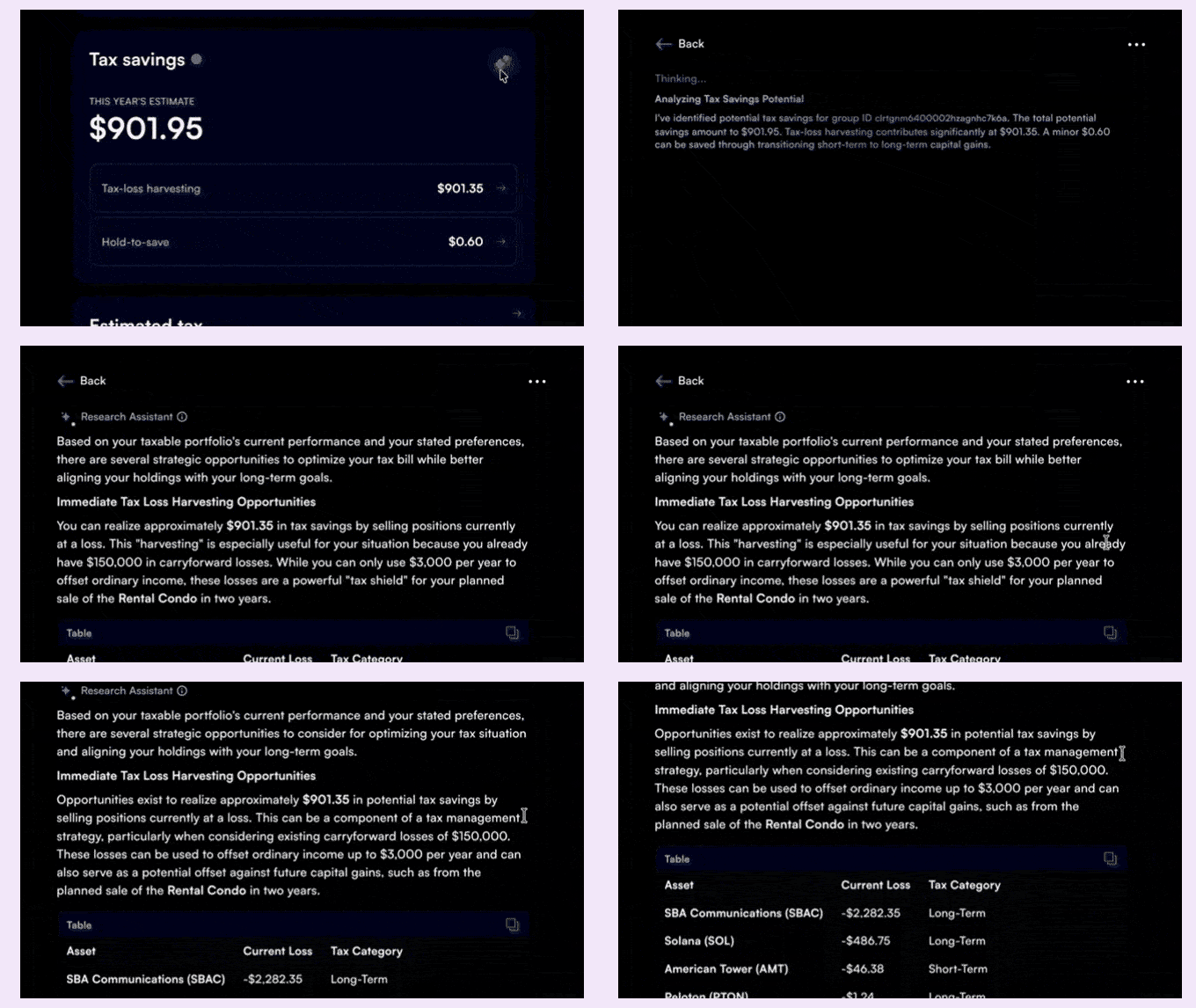
Surface tax-loss harvesting opportunities across every connected taxable account, not just one
Flag wash-sale risks across your taxable accounts, IRAs, and your spouse's accounts before you trade — including the dividend reinvestment and rebalance traps above
Suggest replacement ETFs that maintain your exposure without crossing wash sale rules
Track losses on individual stock positions, where the swap is less obvious and most investors leave money on the table
Coordinate harvesting decisions with your broader tax picture — gains, income, and carry forwards — so you're harvesting where it actually matters
The opportunities above don't last forever. Markets recover, prices climb back, and the harvestable loss disappears with them.
IMPORTANT DISCLOSURES
This content is for informational purposes only and does not constitute investment advice or a recommendation to buy or sell any security.
Past performance is not indicative of future results. No guarantee of future performance or outcomes is implied.
Savings and performance examples are hypothetical and for illustrative purposes only. Actual results will vary based on individual circumstances, portfolio composition, market conditions, and fees.