One cost you can see coming
Whether you're 35 and building up your 401(k) or 63 and drawing down from your IRAs, planning for retirement is confusing.
One reason: until you're close, most people don't think about what Medicare will cost, or the taxes that come with funding retirement. They tend to arrive right when retirement comes into focus, and nobody likes a bill they didn't see coming.
Today we want to help you minimize surprises and stay ahead of it.
The short version:
- A couple's Medicare premiums start near $5,800 a year and rise with income, up to about $19,700, for the same coverage. It's called IRMAA.
- What lands you there in retirement is mostly your required withdrawals, so the size of your pre-tax balance today quietly sets your premium later.
- You can plan around it. A little lean toward Roth now, or conversions in your low-income years, goes a long way. No need to get it perfect, just don't get caught off guard.
What Medicare actually costs
Here's the whole picture, so nothing's hidden. A couple's Part B and Part D premiums start around $5,800 a year and rise with income through IRMAA (your 2024 income sets your 2026 premium):
- Under $218,000: about $5,800
- $218,001–$274,000: about $8,100
- $274,001–$342,000: about $11,600
- $342,001–$410,000: about $15,000
- $410,001–$749,999: about $18,500
- $750,000 and up: about $19,700
These are premiums only. A supplement and out-of-pocket costs are separate.
What leads to higher cost
In retirement, the income that places you on that table is mostly your required withdrawals from 401(k)s and IRAs. RMDs begin at 73 or later depending on your current age and grow over time. For a couple with roughly $60k of Social Security and $50k of annual dividends:
Estimated annual premiums based on total IRA/401(k) size:
- $2M: $5,800 (No surcharge)
- $3M: $8,100 (First tier)
- $6.5M: $15,000 (Multi-tier jump)
A large balance is a good problem to have. It just means a bit of planning so it doesn't quietly raise your premiums later.
If you're still building wealth
You have the most valuable thing here: time. Every pre-tax dollar becomes taxable income later; a Roth dollar never counts toward your Medicare income at all. Leaning a little toward Roth now is one of the easiest levers you have — nothing dramatic required.
If you're near retirement
The years between retiring and 73 (or when required minimum distributions kick in) are usually your lowest-income stretch, a natural window to convert some of your IRA/401(k) balances to Roth. That trims future withdrawals, and future premiums.
You don't have to get it exact. Even rough, steady moves help:
- Do nothing, and a $3M couple's surcharges might run $70k–$120k over a full retirement.
- Convert modestly through the early 60s, and much of that eases off.
Conversions aren't magic. Each one adds income in the year you do it, so they reward spreading across a few years. "I'll convert later" is a fine plan; it's just better as a real one.
Worth a look, no rush:
- Add up your pre-tax balances across every 401(k) and IRA.
- Ask whether they'll drift you into IRMAA territory later.
- If so, a light touch now (Roth contributions, or conversions in low-income years) goes a long way.
Don't stress about this
The point isn't to dodge every dollar or optimize to the decimal. It's to not be caught off guard, and to make a few sensible moves in the years you have. That's very doable, and it's exactly what we're here to help you map out.
How can Mezzi help?
This is complicated stuff. Mezzi is here to simplify it for you.
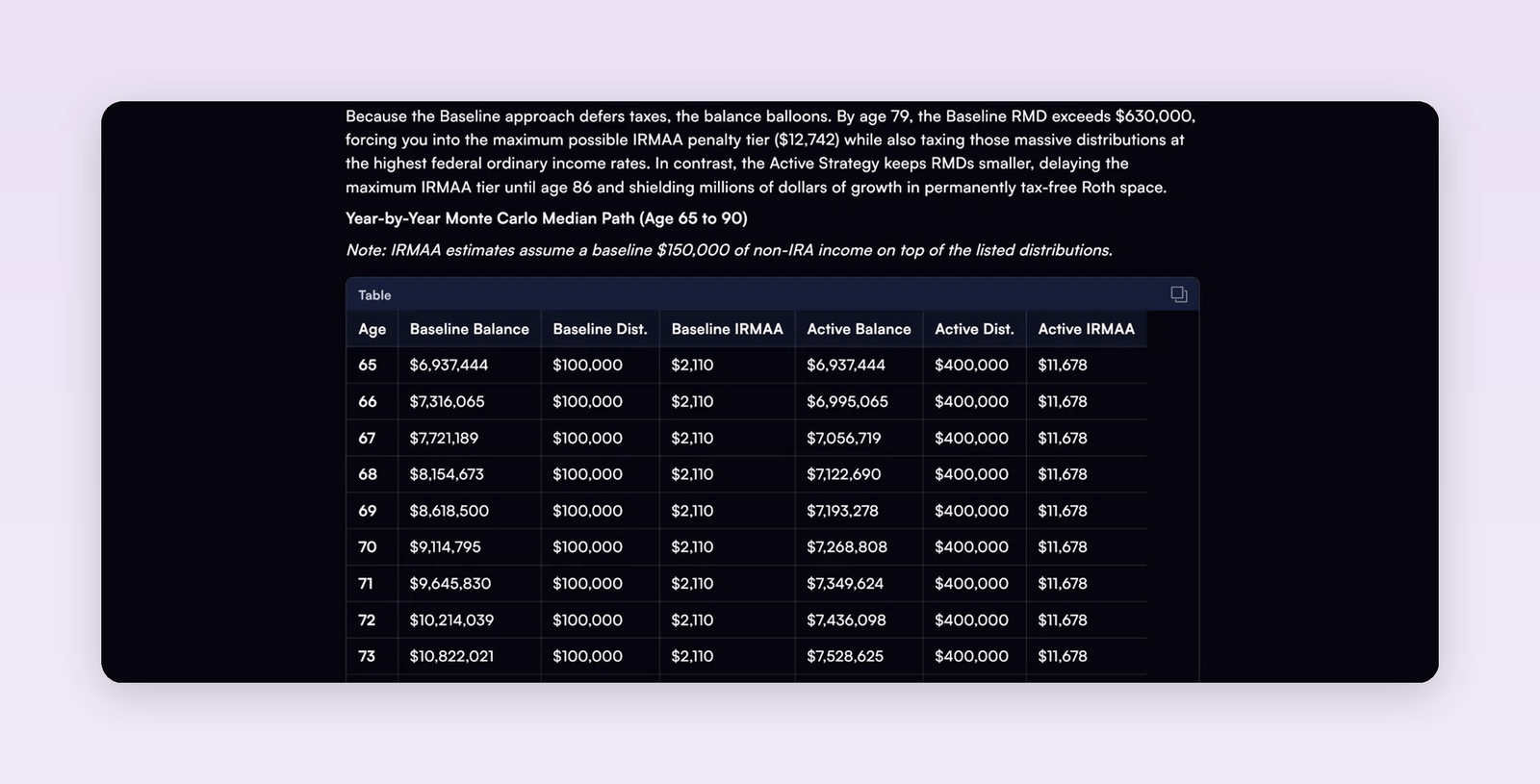
I ran this and learned that it will be better for me to pay nearly $100K in extra IRMAA in the years between 65 and 73!
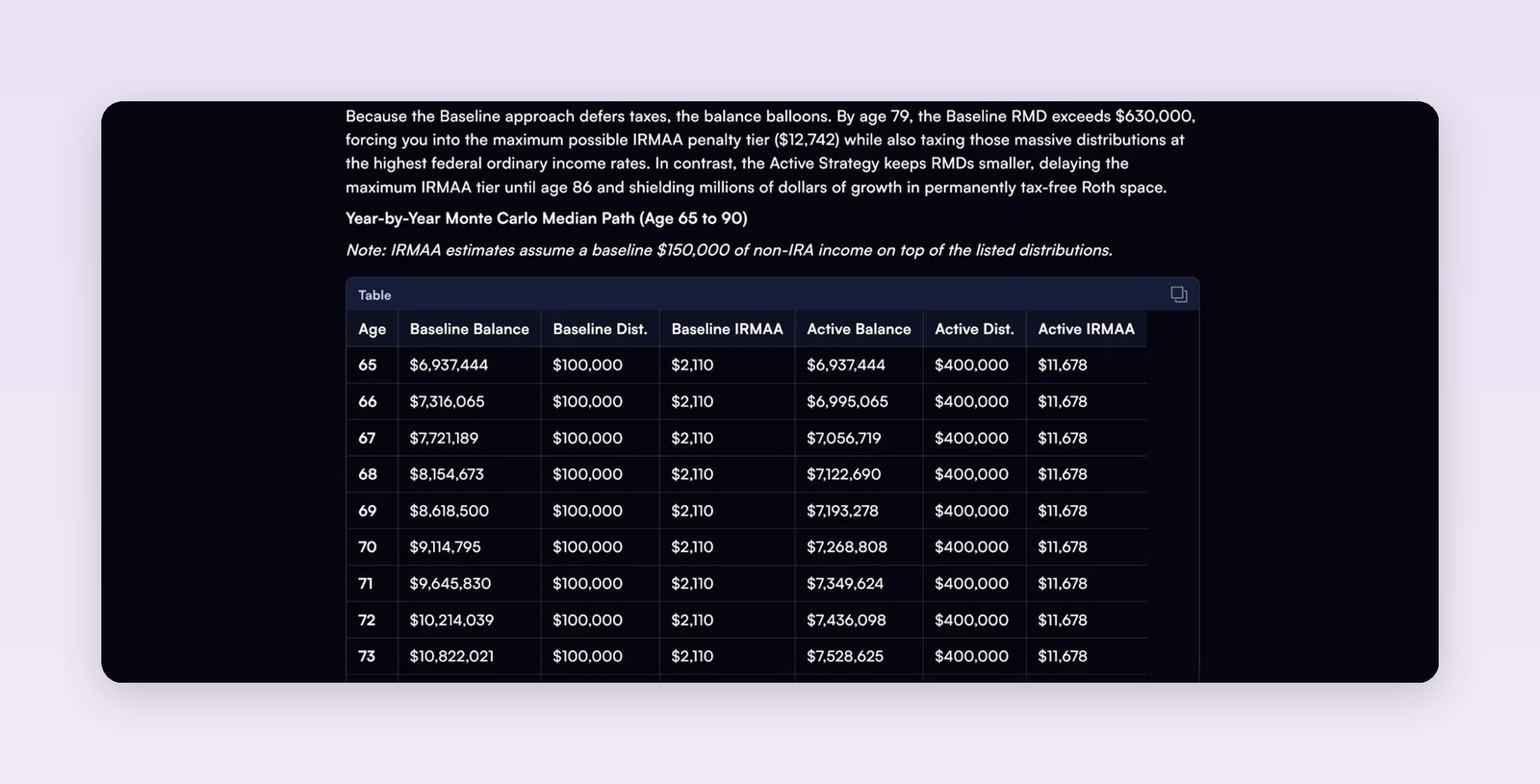
Ask Mezzi to model out the scenarios. Simply copy this prompt into Mezzi:
Please run a year-by-year projection of my pre-tax retirement accounts from my target retirement age through age 90.Model out the tradeoffs between holding funds tax-deferred versus executing strategic Roth conversions.Build a table comparing each scenario. Summarize the lifetime outcomes between paying Medicare surcharges early versus paying higher income taxes on massive RMDs later.
IMPORTANT DISCLOSURES
This content is for informational purposes only and does not constitute investment advice or a recommendation to buy or sell any security.
Past performance is not indicative of future results. No guarantee of future performance or outcomes is implied.
Savings and performance examples are hypothetical and for illustrative purposes only. Actual results will vary based on individual circumstances, portfolio composition, market conditions, and fees.