
Updated September 26, 2026.
A net-worth forecast is useful when it makes your assumptions visible. It should help you see how saving, spending, debt, asset values, and major decisions interact. It cannot tell you exactly what markets, property, or your life will do.
For structured long-term scenarios, consider ProjectionLab or Boldin. For cash-flow forecasting, consider PocketSmith. For a multi-asset balance-sheet projection, examine Kubera's Fast Forward. For forecasting within a household finance workflow, evaluate Monarch Plus. For ongoing guidance connecting those questions to current accounts and personal context, consider Mezzi.
AI is not a requirement for a useful forecast. The important questions are what is modeled, where the inputs came from, and how the result changes when assumptions change.
Method and disclosure: Mezzi publishes this article. We reviewed official product and release documentation on September 26, 2026, alongside our Mezzi application review. We did not measure forecast accuracy or run matched household models. The recommendations identify workflows to evaluate, not products proven to predict future wealth.
Six tools by forecasting job
| Tool | Best reason to evaluate it | What to inspect |
|---|---|---|
| Mezzi | Interpret a financial decision using current accounts and saved context | Available data, stated assumptions, and the specific output needed |
| ProjectionLab | Build and compare long-term financial scenarios | Cash flows, return assumptions, taxes, and scenario differences |
| Boldin | Maintain a retirement-oriented financial plan with AI assistance | Income timing, tax projections, withdrawals, and plan updates |
| PocketSmith | Forecast cash balances from income and spending plans | Recurring budgets, timing, accounts, and forecast horizon |
| Kubera | Project a diverse balance sheet with Fast Forward | Asset assumptions, liabilities, inflation, and valuation dates |
| Monarch Plus | Explore forecasts alongside household finances | Plus-tier scope, inputs, and desktop/mobile availability |
Business-finance products serve a different audience. Fuelfinance, Pigment, Planful, and StackAI describe business-finance or enterprise AI workflows. They should not be presented as ready-made personal net-worth planners without a specific, verified consumer offering. The shortlist below is organized around household decisions.
1. Mezzi: start with the decision and the current picture
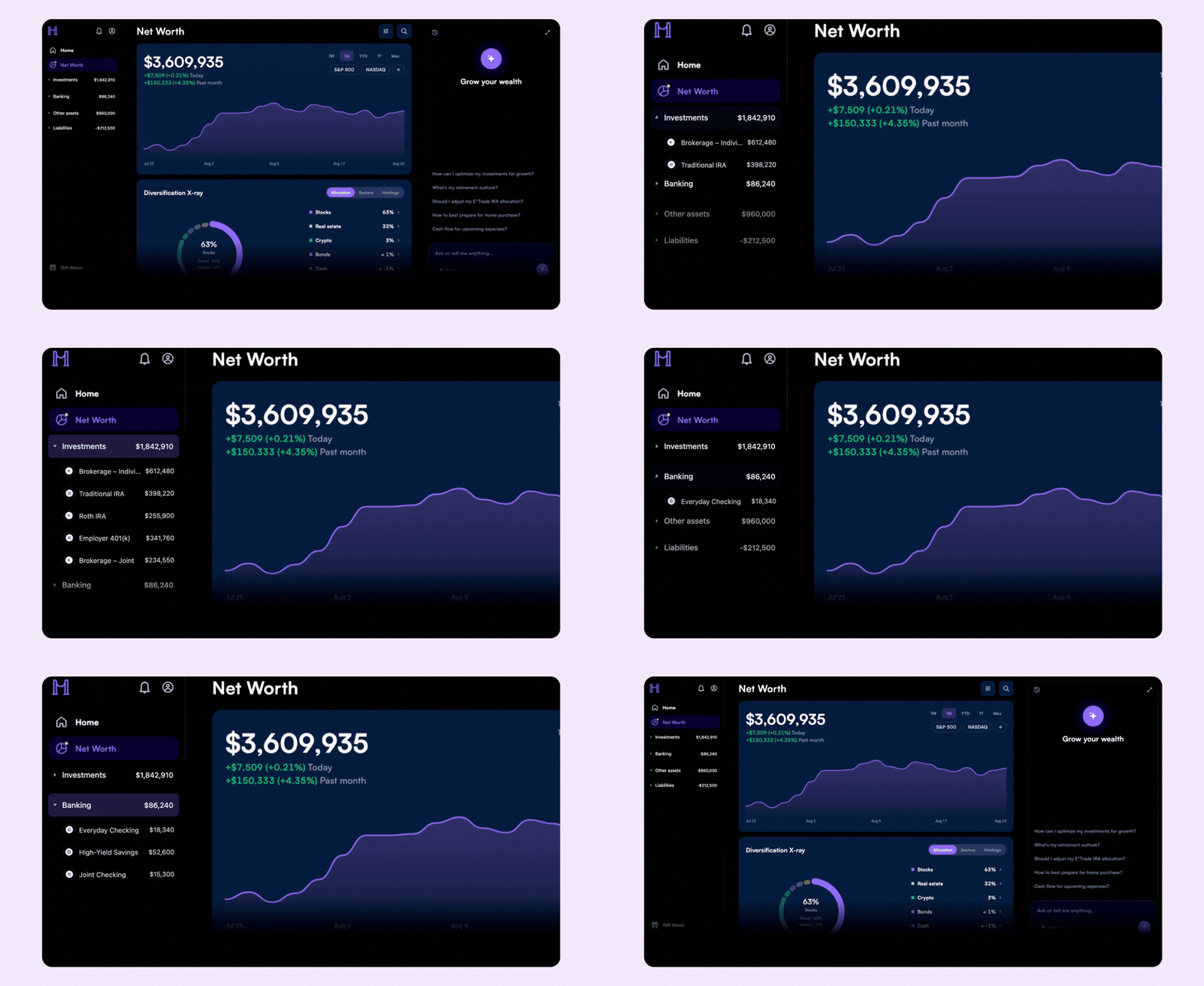
Mezzi can connect investments and banking, include credit cards and other liabilities, and record assets such as real estate. AI Personalization lets you supply goals and preferences that should inform the discussion. This provides a starting point for questions that cross several financial categories.
For example, a household may want to understand how a career break could interact with cash reserves, ongoing debt payments, and investment contributions. A useful first step is to identify what is known, what must be estimated, and which decisions would change the outcome. That is a different task from simply extending last year's net-worth growth into the future.
What to try
Bring one question and ask Mezzi to state the required inputs and assumptions. Specify whether you want a simple calculation, a comparison of alternatives, or a list of information needed for a specialist model. Check that the discussion distinguishes current balances from future estimates.
The account-group update explains the broader financial view. Manual property values need maintenance, and connected data can be incomplete or delayed. A conversation cannot make an unsupported valuation certain.
Cost and boundary
Free offers an entry point; Advisory is $399 annually and Concierge is $999 annually. See current plan details. Mezzi provides guidance and monitoring, not automatic execution. Do not infer a particular forecasting engine or specialist planning output from its ability to discuss a scenario. If you require a structured model with a specific tax treatment or simulation method, inspect that output directly or use an appropriate dedicated planner.
Choose Mezzi when the central need is ongoing interpretation and decision support across your current finances. Choose a modeling specialist when maintaining the model itself is the main job.
2. ProjectionLab: build explicit long-term scenarios
ProjectionLab is designed for financial and retirement planning through visual models. Its plan features include scenario comparisons, cash-flow projections, withdrawal strategies, tax estimation, and simulations, with access depending on the subscription.
The value is the ability to make a set of assumptions concrete. You can examine how a major purchase, a change in work, or a different retirement date affects the path. That is more informative than a single future net-worth number with no explanation of how it was produced.
What to inspect
Build a baseline before trying alternatives. Check whether the income, expenses, tax assumptions, and dates reflect your intended scenario. Then change one variable and look at the effect. If several assumptions change at once, it becomes harder to understand why the result moved.
Simulations and historical tests can expose uncertainty, but they do not establish a known future probability. Their usefulness depends on the method and the inputs. Ask which assumptions matter most and whether an apparently successful plan remains workable under less favorable conditions.
Cost and fit
Basic is free and Premium is $129 annually; Pro is a separate offer for professional users. ProjectionLab is a strong candidate for people who want to build and maintain their own model. It requires engagement with the assumptions. If you mainly need daily spending oversight, a cash-flow tool may be more immediately useful.
3. Boldin: connect a forecast to retirement decisions
Boldin combines a structured financial planner with retirement-oriented analysis and AI assistance. It is relevant when the forecast needs to address income timing, withdrawals, taxes, and long-term spending together.
A household approaching retirement may not need the highest projected ending wealth. It may need to understand whether cash flows cover a particular period and which assumptions make the plan sensitive. A structured retirement workflow can focus attention on those questions.
Current capabilities matter
Boldin's release notes document AI-assisted plan updates, Investments: Today, and Document Vault. These additions mean it should not be reduced to an old static retirement calculator. The plan can incorporate current information and AI-supported interaction, subject to its documented scope and user review.
What to inspect
Compare two scenarios using the same starting facts. Look at the timing of income and withdrawals, not only the final total. If the assistant suggests a plan change, examine what field changes and why. Keep estimated future conditions distinct from confirmed records.
Cost and fit
Basic is free and PlannerPlus is $144 annually. Separate coaching and advisory services have different deliverables and prices. Boldin fits someone who wants detailed retirement planning and is willing to maintain the plan. For broader discussion of its relationship to Mezzi, see Mezzi vs. Boldin.
4. PocketSmith: forecast the cash you may actually have
PocketSmith's forecasting workflow connects planned income and spending with projected account balances. Its calendar documentation explains how budgets contribute to the forecast.
That can be more actionable than a net-worth projection when the immediate problem is timing. A household may be financially sound overall but face a cash shortage before a large payment. A calendar-based view can help expose that issue before it arrives.
What to inspect
Review the dates and amounts of recurring income and bills. Include irregular expenses rather than assuming every month resembles an average month. Then examine how moving a payment date or changing a spending assumption affects the account path.
The resulting forecast is conditional on the budget and starting balances. It should not be presented as an AI prediction of exactly what will happen. Long horizons are especially sensitive to assumptions that may need regular revision.
Cost and fit
PocketSmith's plans display Foundation at $9.99, Flourish at $16.66, and Fortune at $26.66 per month billed annually. Month-to-month prices are $14.95, $24.95, and $39.95. Forecast horizons are ten, 30, and 60 years respectively; the Free plan has a six-month horizon. A longer horizon does not make the distant forecast more certain. Its strength is particularly relevant to people who want to manage cash-flow timing and scenarios. A dedicated retirement or investment model may be necessary for a different planning question.
5. Kubera: project a varied balance sheet
Kubera's Fast Forward lets users model potential changes in net worth. This complements its focus on organizing a diverse set of assets and liabilities.
For someone with public investments, private holdings, and property, the starting balance sheet can be as important as the growth assumptions. A forecast based on incomplete ownership information or stale valuations may be precise-looking but misleading.
What to inspect
Check asset values, valuation dates, ownership shares, and debts before projecting. Separate liquid assets from assets that may take time to sell. If a scenario assumes a sale, consider what would need to happen for the proceeds to become available.
Kubera also documents an inflation rule in Fast Forward. Inspect the distinction between future nominal value and purchasing power. A larger number in the future is not necessarily a proportionately larger standard of living.
Cost and fit
The Essentials and Black guide lists Essentials at $250 annually and Black at $2,500 annually. Black adds ownership tags, nested portfolios, and higher-touch support. Kubera is a candidate when the main task is projecting a broad balance sheet. Do not assume that every balance-sheet scenario includes the same tax and withdrawal model as a retirement-planning specialist.
6. Monarch Plus: forecast within an everyday household workflow
Monarch Plus adds forecasting and deeper financial features to Monarch's household money-management experience. It deserves consideration if you already use budgets, transactions, and goals as the basis for decisions.
The appeal is continuity. Instead of treating a future plan as entirely separate from current spending, a household can explore a decision within the place it already reviews finances. Whether that is sufficient depends on the scenario and the detail required.
What to inspect
Choose one major change, such as a planned purchase or income adjustment, and examine which assumptions the forecast uses. Check the feature's platform availability, since newer Plus capabilities may differ between desktop and mobile. Verify that the data represents the household rather than only one person's connected accounts.
Cost and fit
Monarch's current plans list Core at $99.99 annually and Plus at $199.99 annually before any qualifying promotion. A Core subscription should not be described as including every Plus output. If household financial organization is already your primary workflow, testing the added forecast may be more efficient than immediately buying a separate model. If you require specialist planning assumptions, compare those explicitly.
A simple forecast that shows why assumptions matter
Suppose a hypothetical household begins with $500,000 in net worth and adds $20,000 a year through net saving. Over five years, those additions total $100,000 before investment changes, debt dynamics, taxes, or changes in asset values.
A forecast that shows $600,000 from that simplified arithmetic is not predicting returns. It is showing the consequence of the stated saving assumption. If net saving falls to $10,000 annually, the same simplified five-year total becomes $550,000. The $50,000 difference comes from behavior assumed in the model, not superior forecasting technology.
Real models may need separate treatment for investment returns, loan repayment, property, taxes, and inflation. The example illustrates why the explanation behind the number is essential.
Reconcile debt payments and purchasing power
Before comparing charts, decide whether each figure is in future dollars or today's purchasing power. A hypothetical $600,000 five years from now is about $517,565 in today's dollars at an assumed 3% annual inflation rate: $600,000 ÷ 1.03⁵. That is an illustration, not an inflation forecast. Two charts using different dollar conventions can look inconsistent while describing the same outcome.
Also separate the cash-flow effect of debt payments from their balance-sheet effect. Paying $1,000 of loan principal from cash reduces both cash and debt by $1,000, leaving net worth unchanged before other effects. Interest is different: paying $200 of interest reduces cash without reducing principal. A forecast that counts the principal payment as new wealth while leaving cash unchanged double-counts the improvement.
Use this reconciliation when trying any of the six products: starting assets minus starting liabilities, plus the explicitly modeled changes, should explain the ending balance sheet. Record how manual property values, illiquid holdings, debts, taxes, and withdrawals enter that calculation. A useful model lets you explain the change instead of accepting a larger future number on faith.
Make the forecast useful rather than merely optimistic
Start with a reconciled current picture. Mark estimates and dates. Decide whether the question concerns spendable cash, total net worth, retirement income, or a particular goal. Those are related but different outputs.
Then compare at least a baseline and a less favorable set of assumptions. Investigate which changes have the largest effect. A plan that works only with a particular high return deserves a different level of confidence from one with room for lower returns or higher spending.
Revisit the model when important facts change. A forecast is a working planning tool, not a number to calculate once and defend indefinitely. AI can help explain the changes, but maintaining accurate inputs remains essential.
Frequently asked questions
Can AI accurately predict my future net worth?
No tool can know future market returns, asset values, or life events with certainty. A useful forecast shows conditional outcomes based on inputs and assumptions and helps you understand how those outcomes could change.
What is the difference between cash-flow and net-worth forecasting?
Cash-flow forecasting focuses on money entering and leaving accounts and the resulting balances. Net-worth forecasting considers assets minus liabilities. High projected net worth does not guarantee cash is available when a bill is due.
Why are enterprise planning tools absent from this list?
Business planning and household planning use different inputs, workflows, and responsibilities. A platform's ability to forecast corporate results does not establish a ready-made personal finance service.
Which tool should I try first?
Start with the question. Evaluate ProjectionLab or Boldin for structured long-term scenarios, PocketSmith for cash timing, Kubera for a varied balance sheet, Monarch Plus for household forecasting, and Mezzi for ongoing guidance in the context of current finances.
See how Mezzi groups accounts
Put the assumptions into the conversation. Connect your accounts, explain your goal, and ask Mezzi what needs to be understood before the next decision.
Start with Mezzi FreeThis comparison is published by Mezzi for educational purposes and is not personalized investment, tax, or legal advice. Features, prices, and data availability can change. Investing involves risk, including loss of principal. Examples are illustrative and are not customer results or guarantees.