
Managing finances as a couple can feel overwhelming, especially when accounts are scattered across platforms. This lack of coordination often leads to missed opportunities, redundant investments, and financial disagreements. Here's the good news: by consolidating accounts, setting shared goals, and using tools like Mezzi, you can simplify the process and align your financial strategies.
Key Takeaways:
- Joint accounts help couples build more wealth by promoting shared accountability and long-term planning.
- Consolidation tools like Mezzi provide a complete financial overview, flag risks, and track performance across multiple accounts.
- Regular money meetings foster transparency and ensure both partners stay aligned on financial goals.
- Tax strategies and account roles, when coordinated, can maximize savings and improve long-term returns.
By unifying your financial approach, you can reduce stress, improve communication, and work more effectively toward shared goals.
Should Couples Invest Together or Separately? | The Unhelpful Desk
Set Shared Financial Goals and Ground Rules
Before diving into tracking investments together, it's important to agree on shared financial goals and avoid common pitfalls. Without a unified vision, one partner’s approach could clash with the other’s. For instance, one partner might focus on saving aggressively for early retirement, while the other prioritizes funding a child’s college education. Aligning individual priorities ensures you’re not working against each other. Once goals are clear, map your accounts to these objectives and establish a plan for regular communication.
Define Common Goals
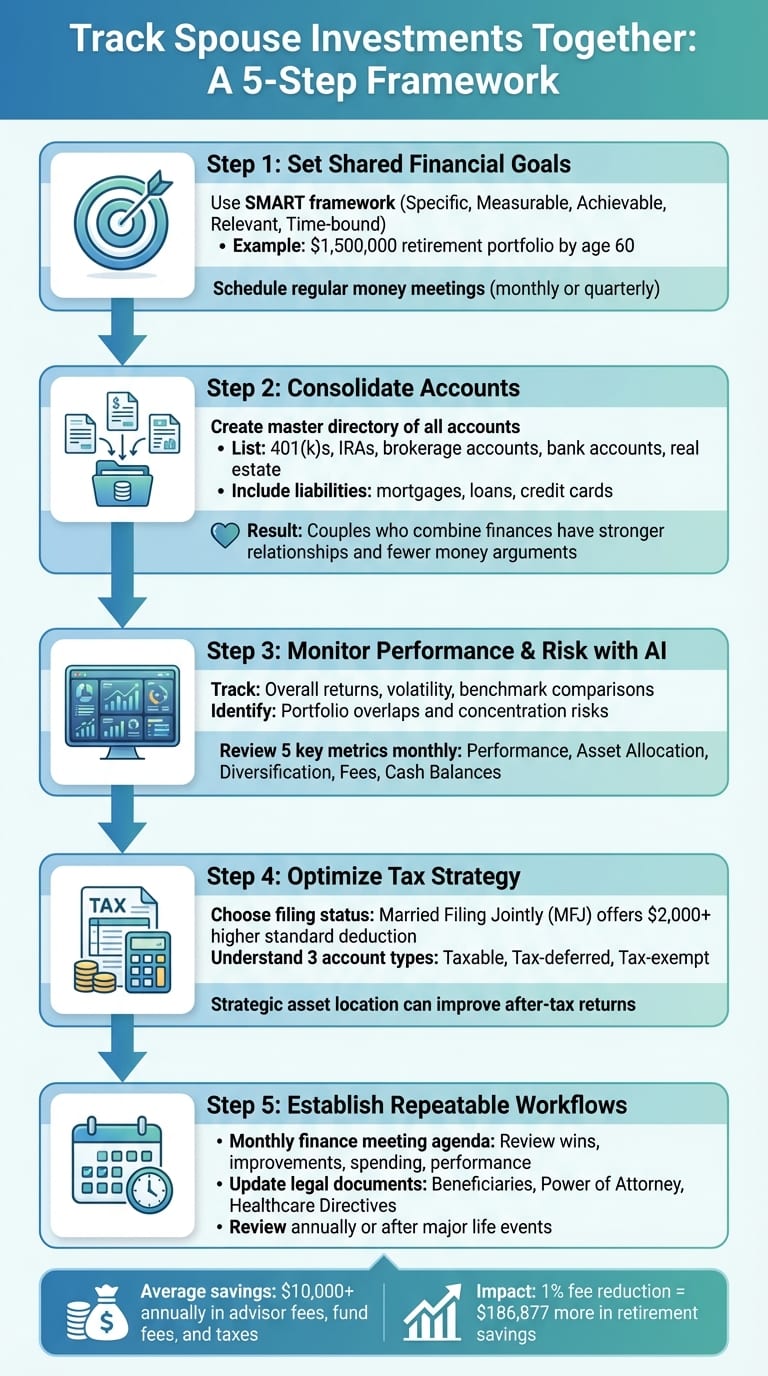
Start with an honest conversation about what matters most financially. Use the SMART framework - Specific, Measurable, Achievable, Relevant, and Time-bound. For example, you might aim to build a $1,500,000 retirement portfolio by age 60 or save $80,000 for a home down payment within three years. Write down individual priorities and identify where they overlap.
Having a clear roadmap is key. If you’re juggling multiple goals, prioritize them strategically. For example:
- Maximize your employer’s 401(k) match.
- Pay off high-interest debt.
- Build an emergency fund.
- Max out tax-advantaged retirement accounts like 401(k)s and IRAs.
- Save for other major expenses.
This step-by-step approach helps you take advantage of available benefits while securing your financial stability.
Map Individual Accounts to Joint Objectives
Once your goals are set, assign specific accounts to each objective. For instance, a 401(k) might be dedicated to retirement savings, while an HSA could double as a healthcare fund and a long-term investment tool. One partner’s IRA might focus on aggressive growth for early retirement, while the other’s brokerage account could serve as a home down payment fund.
Consider using a "yours, mine, ours" account system. Clearly defining which accounts are tied to which goals can reduce confusion and make it easier to track your progress over time.
Establish Communication Guidelines
Transparency is the foundation of any financial partnership, and regular, structured conversations are essential. Schedule money meetings - monthly or quarterly - to review your progress and adjust strategies as needed. Make these meetings enjoyable: grab coffee on a Saturday morning or incorporate them into a date night.
For partners who frequently bring up financial topics, having a set meeting time can consolidate discussions. On the other hand, if one partner tends to avoid money talks, these meetings create a safe space for open dialogue. Use these sessions to review account performance, discuss life changes, and refine your strategies. While it’s natural to have different risk tolerances, the goal is to build understanding and respect for each other’s financial perspectives.
Consolidate Accounts for a Unified Household View
Once you've aligned your financial goals, the next step is to consolidate your accounts to get a clear picture of your household's overall financial health. Many couples find their finances scattered across various institutions - old 401(k)s from previous jobs, individual IRAs, joint brokerage accounts, and multiple bank accounts. Without a unified view, it’s tough to fully understand your financial position or make informed decisions together.
A March 2023 study by the Kelley School of Business at Indiana University, published in the Journal of Consumer Research, revealed that couples who combined their finances experienced stronger relationships, fewer arguments about money, and greater satisfaction with their household finances. While you don’t need to legally merge every account, consolidating them onto a single platform for tracking can create the transparency and shared understanding that strengthens your financial partnership. Start by listing all your accounts for a complete financial snapshot.
Create a Joint Inventory of Accounts
Start with a comprehensive list of all your accounts and liabilities. Morningstar suggests creating a "master directory" - a detailed record of your financial landscape. This should include investments, retirement plans like 401(k)s and 403(b)s (from both current and former employers), individual IRAs, brokerage accounts, bank accounts, real estate holdings, and any funds overseen by a Registered Investment Advisor. Be sure to also include liabilities such as mortgages, car loans, and credit card debt.
Document each account, its purpose, and key contacts. Whether you choose a password-protected digital file or a physical document stored securely, this master directory will serve as a crucial reference point.
Use Mezzi for Account Aggregation
Managing multiple accounts across institutions can quickly become overwhelming. That’s where tools like Mezzi come in. Mezzi connects your U.S. brokerages, banks, and retirement accounts into a single dashboard, giving you a unified view of your household finances. By securely linking accounts through trusted aggregators like Plaid and Finicity, Mezzi simplifies account management. It also unlocks advanced features like identifying portfolio overlaps, tracking performance, and optimizing tax strategies - all from one platform.
Structure Accounts by Ownership and Purpose
Not every account can or should be merged. Accounts like 401(k)s and IRAs are tied to individual ownership and cannot be held jointly. However, non-retirement brokerage accounts can often be set up as joint accounts. Understanding these distinctions is key to organizing your finances effectively.
Consider grouping accounts by ownership (individual or joint), tax type (taxable, tax-deferred, or tax-free), and financial purpose (e.g., retirement, home buying, or emergency savings). For instance, one partner’s Roth IRA might focus on long-term growth for retirement, while a joint brokerage account could be allocated for a down payment on a home. This categorization makes it easier to track progress toward specific goals and ensures both partners understand how each account contributes to the bigger picture.
Even though IRAs cannot be combined into a single joint account, both spouses’ IRAs can still be managed on the same platform for convenience. Once your accounts are categorized and consolidated, you’ll be ready to use tools like AI for performance tracking and strategic planning.
Use AI to Monitor Performance and Risk as a Team
Once your accounts are consolidated, AI can step in to track your household portfolio's performance and spot risks that might otherwise fly under the radar. Traditional methods often rely on manual calculations, which can be time-consuming and prone to error. AI platforms simplify this process by analyzing your entire financial landscape, offering insights that support informed, collaborative decision-making. With this unified view, you can better monitor performance and evaluate risks.
Track Household Investment Performance
Keeping an eye on combined returns, volatility, and progress against benchmarks is crucial to ensure you're on track to meet shared financial goals. AI platforms can process historical data to generate detailed reports, helping you quickly determine whether your retirement savings are growing as planned or if other goals, like a down payment fund, need more attention.
By aggregating data from various accounts like IRAs, brokerage accounts, and 401(k)s, Mezzi offers a comprehensive view of your household's investment progress. This consolidated perspective makes it easier to have meaningful discussions about whether to adjust your strategy, rebalance without selling, or stay the course. Once you've reviewed performance, the next step is to assess your portfolio for hidden risks.
Identify Portfolio Overlaps and Risks
It's not uncommon for couples to unintentionally concentrate their investments in the same stock or sector. For example, if both partners are heavily invested in technology stocks through their retirement plans, it could lead to higher exposure - and risk - than expected. AI leverages advanced algorithms to detect patterns and correlations that might be overlooked manually.
Mezzi’s X-Ray feature is specifically designed to highlight overlapping holdings, concentration risks, and unintended exposures across all your accounts. By analyzing your combined portfolio, it flags areas where you may be overexposed to a particular company, sector, or asset class. This helps ensure proper diversification, a key element of effective risk management.
Review Key Metrics Together
Regularly reviewing your portfolio as a team keeps both partners informed and aligned on financial progress. Consider tracking these key metrics on a monthly basis:
With Mezzi, you gain access to real-time AI-driven prompts and actionable insights, turning what used to be a labor-intensive task into a quick, streamlined process. In just minutes, you and your partner can complete a monthly review and stay on the same page financially.
Optimize Tax Strategy and Account Roles
Once you've assessed performance and risk, the next step is aligning your tax strategy as a couple. Navigating the U.S. tax code can feel overwhelming without the right approach, but smart planning can help you retain more of your returns and ensure each account fulfills its purpose effectively. Understanding your filing status is a key starting point for coordinating tax strategies across joint investments.
Understand Filing and Tax Considerations for Couples
Your tax filing status as of December 31 determines your tax treatment for the entire year. For most couples, Married Filing Jointly (MFJ) is the optimal choice. It offers a higher standard deduction - nearly $2,000 more than filing individually - and unlocks additional tax benefits. For instance, in 2026, the top federal income tax rate of 37% applies to individuals earning $640,600 or more annually, while the threshold for married couples filing jointly rises to $768,700.
However, Married Filing Separately (MFS) may be worth considering in specific situations, such as when one spouse wants to avoid liability for the other's prior debts. Keep in mind, though, that this option often restricts access to certain credits, like the Earned Income Tax Credit.
Selecting the right type of account for each investment is equally important. The three main types of accounts include:
- Taxable accounts: Gains and dividends are taxed annually (e.g., brokerage accounts).
- Tax-deferred accounts: Taxes are delayed until withdrawal (e.g., 401(k)s, traditional IRAs).
- Tax-exempt accounts: Qualified withdrawals are tax-free (e.g., Roth IRAs).
Your current and expected future tax rates, along with your investment timeline, should guide how you utilize these accounts.
Use Mezzi for Tax Optimization
Mezzi's AI tools make tax planning easier by flagging potential wash sales and optimizing your household tax strategy. A wash sale happens when you sell a security at a loss and then repurchase the same - or a substantially identical - security within 30 days before or after the sale. This disallows the loss for tax purposes, which can complicate your strategy. Managing these transactions manually across multiple accounts can be tricky, especially for couples.
By analyzing all household accounts, Mezzi identifies potential wash sales before they occur, helping you preserve tax deductions and take advantage of tax-loss harvesting strategies to reduce your tax burden. Once the tax implications are minimized, you can assign specific roles to each account to further refine your approach.
Designate Account Roles
Integrating tax strategies with clearly defined account roles strengthens your overall investment plan. Strategic asset location - placing the right investments in the appropriate account types - can make a big difference in after-tax returns. For example, tax-inefficient investments like bonds, REITs, or actively managed funds that generate regular income are best held in tax-deferred or tax-exempt accounts. Meanwhile, tax-efficient investments, such as index funds or long-term stocks, are better suited for taxable accounts.
As a couple, assign specific roles to your accounts based on your shared financial goals. For instance:
- Use Roth IRAs for long-term growth, as qualified withdrawals are tax-free.
- Leverage traditional 401(k)s for immediate tax deductions.
- Maintain taxable brokerage accounts for short-term goals or emergency savings.
It’s important to note that individual retirement accounts must still be managed separately, even as you coordinate your broader strategy. By aligning your tax approach with your account roles, you can maximize efficiency and work toward your financial objectives as a team.
Establish Repeatable Workflows and Safeguards
Keeping track of joint investments requires consistent processes and safeguards. With a unified financial view in place, it's important to create workflows that maintain clarity and security. Without regular check-ins and proper systems, even the best-laid plans can stumble during hectic times or unexpected challenges.
Create a Recurring Money Meeting Framework
Set up a monthly finance meeting on the last Friday or Saturday of each month to review your household investments systematically. Use these meetings to stay on top of your financial goals and ensure alignment. Here's a simple structure for your agenda:
- Highlight two financial "wins" from the previous month.
- Identify two areas where improvements are needed.
- Review your biggest spending categories and any unusual expenses.
- Compare the current month's performance with the previous one.
- Set one specific financial goal for the next month.
During these meetings, use tools like Mezzi to access a consolidated view of your household finances. This includes reviewing portfolio performance, tax strategies, and risk management insights.
"Monthly finance meetings are an essential practice for couples aiming to take control of their finances. This collaborative approach not only enhances transparency but also fosters a deeper understanding of each other's financial habits." – Jackie Mitchell
To ease into this routine, start with weekly 15-minute check-ins. These shorter sessions can help you build the habit before transitioning to full monthly reviews. This structure reinforces the transparency you've worked to establish.
Use Mezzi's Family Collaboration Features
Mezzi offers a unified platform where both partners can access the same financial data in real-time. Whether you want to view accounts collectively or individually, Mezzi makes it easy. Its AI-driven insights analyze your entire portfolio, highlighting opportunities like tax-loss harvesting and alerting you to potential wash sales. Additionally, Mezzi's unlimited AI chat feature allows both partners to ask questions, get tailored advice, and understand complex financial scenarios with ease.
Prepare for Emergencies and Contingencies
Beyond regular reviews, it's essential to protect your financial partnership with proactive legal measures. Start by documenting all your assets - both tangible and intangible - along with any liabilities.
Ensure that beneficiaries are correctly designated on all accounts, such as life insurance policies, IRAs, 401(k)s, and certain bank accounts. These designations often override what's stated in a will, allowing assets to transfer directly without going through probate. Don’t forget to name contingent beneficiaries as backups in case your primary choices are unavailable.
Establish Power of Attorney (POA) documents for both financial matters (Durable POA) and healthcare decisions (Medical POA). This ensures that a trusted individual can manage your affairs if one partner becomes incapacitated. Additionally, include Advance Health Care Directives to outline your treatment preferences, making decision-making easier during emergencies.
Make it a habit to review and update these legal documents annually or after major life events - such as the birth of a child, a new job, acquiring significant assets, or changes in tax laws - to keep everything current. Store account details, passwords, and legal documents in a secure, shared location, and communicate clearly with designated executors or trustees about their responsibilities. This preparation can prevent confusion and ensure smoother handling during difficult times.
Conclusion
Combining your investments and financial strategies creates a clear, unified view of your shared wealth. Managing investments together doesn’t have to be complicated or expensive. By setting financial goals as a team, consolidating accounts, and leveraging AI-driven insights, you can take a more effective approach to managing household finances. The foundation of this strategy lies in open communication, understanding the risks and opportunities within your combined portfolio, and optimizing tax loss harvesting when married across all accounts. This streamlined method helps lay the groundwork for long-term financial growth.
Mezzi makes this process easier by offering both partners a complete financial overview. With a unified view of your accounts, you can spot overlaps, adjust your tax strategy, and make informed decisions. Plus, Mezzi’s unlimited AI chat feature allows you to ask questions and receive personalized guidance instantly - no need to schedule meetings or wait for callbacks.
On average, Mezzi members save over $10,000 annually in advisor fees, fund fees, and taxes. Even a small fee reduction of 1% can potentially add Even a small fee reduction of 1% can potentially add $186,877 to your retirement or college savings86,877 to your retirement or college savings.
By using Mezzi’s consolidated insights to build efficient workflows, you create a system that keeps both partners informed and engaged. With safeguards like updated beneficiary designations and power of attorney documents in place, you’re better prepared for everyday decisions and unforeseen events. These strategies not only enhance your portfolio’s performance but also help secure your financial future.
Managing investments as a couple can be simple and effective with the right tools. Mezzi offers the clarity and support you need to grow wealth together - without the hassle or high costs of traditional financial management.
FAQs
What are the best ways for couples to align their financial goals?
Couples can bring their financial goals into sync by fostering open and honest conversations about their individual priorities and long-term dreams. Whether it's saving for a home, planning for retirement, or building an emergency fund, setting shared objectives provides a clear direction to work toward together.
To keep things moving in the right direction, create a joint budget and schedule regular check-ins to review your progress. Leveraging AI-powered tools can make the process smoother by helping track investments, monitor account performance, and fine-tune tax strategies. These tools not only simplify adjustments but also promote transparency, ensuring both partners stay aligned and committed to their financial journey.
How can using tools like Mezzi benefit couples managing their finances together?
Using tools like Mezzi can take the stress out of managing joint finances. By bringing all accounts together in one place, couples can enjoy clearer visibility into their financial landscape, monitor investment performance at a glance, and simplify the budgeting process. This approach minimizes confusion and keeps both partners on the same page when it comes to their financial goals.
Mezzi also encourages stronger goal alignment, enabling couples to focus on shared ambitions, fine-tune tax strategies, and make smarter financial decisions as a team. These features not only simplify day-to-day money management but also help couples work together more effectively toward long-term financial milestones.
How can AI help couples track and manage their investments more effectively?
AI brings a new level of efficiency to how couples manage their investments. By processing vast amounts of financial data, it identifies potential risks and uncovers opportunities that might otherwise go unnoticed. It can simulate market scenarios, spot unusual activity, and predict trends, equipping couples with the insights they need to make smarter decisions to safeguard and grow their wealth.
With real-time updates and tailored recommendations, AI tools help couples stay on track with their financial goals. These tools simplify the process of managing joint investments, making it easier to optimize returns, adjust strategies when needed, and maintain transparency - all while ensuring that both partners stay informed and aligned.
Related Blog Posts
- AI Tools for Smarter Portfolio Diversification
- AI Tools for Family Wealth Consolidation
- Personal finance for couples: How to manage your finances and investments together
- Ultimate Guide to AI Joint Account Budgeting
Couples can bring their financial goals into sync by fostering open and honest conversations about their individual priorities and long-term dreams. Whether it's saving for a home, planning for retirement, or building an emergency fund, setting shared objectives provides a clear direction to work toward together.
To keep things moving in the right direction, create a joint budget and schedule regular check-ins to review your progress. Leveraging AI-powered tools can make the process smoother by helping track investments, monitor account performance, and fine-tune tax strategies. These tools not only simplify adjustments but also promote transparency, ensuring both partners stay aligned and committed to their financial journey.
Using tools like Mezzi can take the stress out of managing joint finances. By bringing all accounts together in one place, couples can enjoy clearer visibility into their financial landscape, monitor investment performance at a glance, and simplify the budgeting process. This approach minimizes confusion and keeps both partners on the same page when it comes to their financial goals.
Mezzi also encourages stronger goal alignment, enabling couples to focus on shared ambitions, fine-tune tax strategies, and make smarter financial decisions as a team. These features not only simplify day-to-day money management but also help couples work together more effectively toward long-term financial milestones.
AI brings a new level of efficiency to how couples manage their investments. By processing vast amounts of financial data, it identifies potential risks and uncovers opportunities that might otherwise go unnoticed. It can simulate market scenarios, spot unusual activity, and predict trends, equipping couples with the insights they need to make smarter decisions to safeguard and grow their wealth.
With real-time updates and tailored recommendations, AI tools help couples stay on track with their financial goals. These tools simplify the process of managing joint investments, making it easier to optimize returns, adjust strategies when needed, and maintain transparency - all while ensuring that both partners stay informed and aligned.