
If most of your investments are tied to U.S. stocks, you might be overexposed to risks specific to one market. While it’s common for American investors to favor domestic stocks, this approach can limit growth opportunities and increase vulnerability to market downturns. Here’s why global diversification matters:
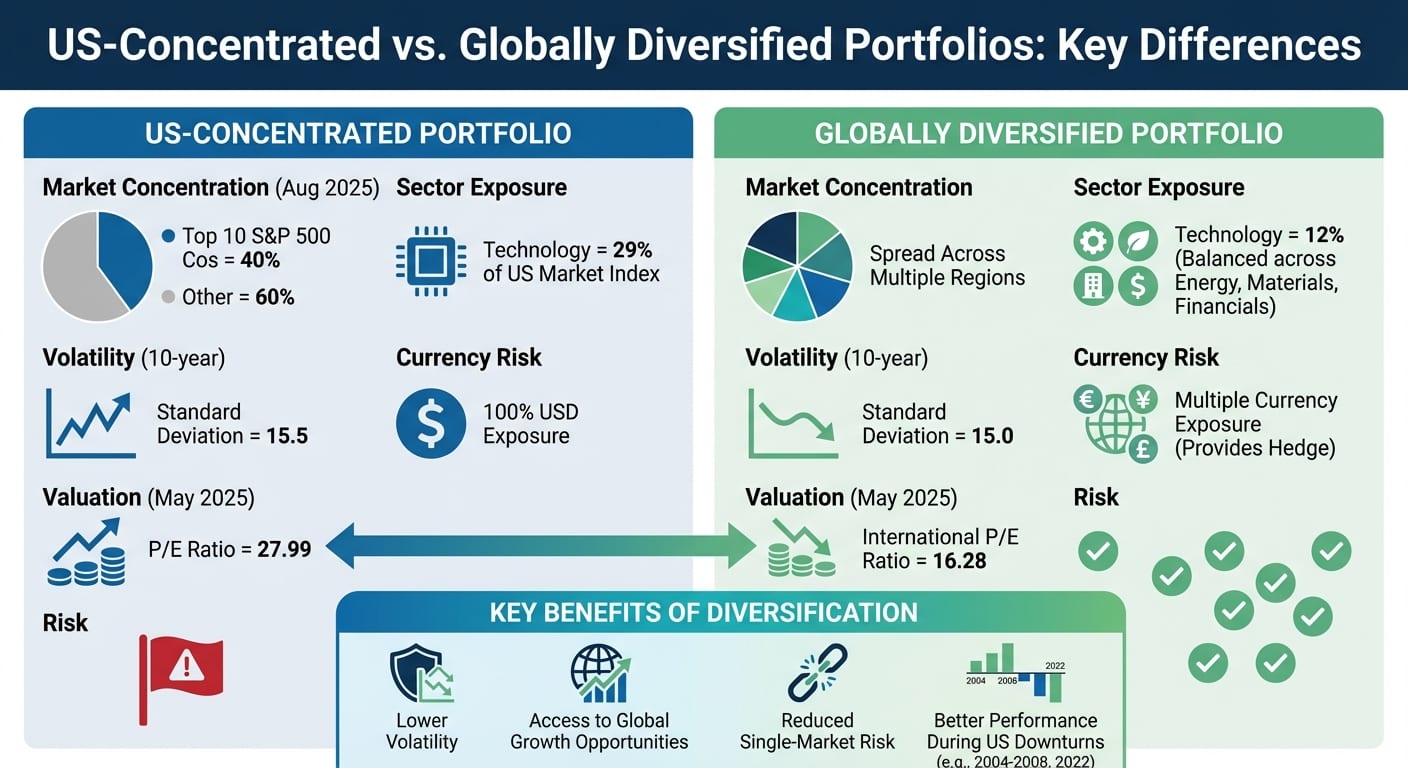
- Heavy U.S. Concentration Risks: The top 10 companies in the S&P 500 make up 40% of its market cap (as of August 2025), creating potential instability if these stocks falter.
- Missed Global Growth: International markets often outperform during specific periods, offering exposure to industries and currencies not tied to the U.S.
- Reduced Volatility: Globally diversified portfolios tend to have slightly lower volatility compared to U.S.-only portfolios.
Using tools like Mezzi’s Portfolio X-Ray can help identify overlaps in U.S. holdings and provide actionable steps to balance your investments globally. By reallocating to international sectors and managing tax-efficient rebalancing carefully, you can reduce risks and position your portfolio for long-term stability.
Why a 100% U.S. Stock Portfolio Feels Safer Than It Is
Risks of a US-Concentrated Portfolio
Relying too heavily on US stocks might seem like a safe bet - until market conditions shift and expose hidden risks.
Missing Growth in Global Markets
Focusing solely on US investments assumes that the American market will always outperform. But this approach limits exposure to other sectors that thrive globally. For instance, technology makes up 29% of the Morningstar US Market Index, compared to just 12% in international markets. This imbalance means less exposure to industries like energy, basic materials, and financials, which dominate global indexes and often excel during different economic cycles.
Looking back, international stocks have outpaced US holdings during certain periods. Between 2004 and 2008, for example, a weaker US dollar led to stronger performance from global markets. Similarly, during the Federal Reserve's aggressive interest-rate hikes in 2022, non-US stocks held up better than their US counterparts. By sticking to US assets, you miss these kinds of opportunities for growth abroad.
Higher Exposure to US-Specific Risks
A US-only portfolio ties your financial well-being to the ups and downs of a single country's economy. As of August 31, 2025, the top 10 companies in the S&P 500 made up 40% of the index's total market capitalization. This level of concentration creates vulnerabilities, especially in sectors like technology, which are prone to sharp corrections.
"Concentration in a few stocks in a portfolio can mean more risk. The same stocks that had significant positive performance in 2023 had experienced losses just the year before - and could fall again in the future." - Addison Schubert, Financial Consultant, American Century Investments
When heavily weighted mega-cap stocks stumble, portfolios lacking diversification feel the impact more acutely. The 2022 bear market highlighted this risk when mega-cap stocks drove the S&P 500's decline, correcting the imbalance between their market cap share and earnings share.
When US-Only Portfolios Underperform
Even when the US market performs well, a concentrated portfolio can still fall short. In September 2025, both the S&P 500 and Nasdaq hit record highs, but only 4.6% of S&P 500 stocks and 3.5% of Nasdaq stocks reached new 52-week highs. This narrow market breadth meant that while the indexes climbed, most individual stocks lagged behind.
Moreover, US-only portfolios have shown higher volatility compared to globally diversified ones. The 10-year standard deviation for the Morningstar US Market Index is 15.5, slightly higher than the 15.0 for global portfolios, indicating more risk without necessarily better returns. Events like the Eastern European equity crisis following Ukraine's invasion in early 2022 further underscore the importance of geographic diversification, as those markets moved independently of US trends.
These examples reveal the potential pitfalls of a US-focused strategy and highlight why diversification across regions could be a smarter move.
Signs Your Portfolio Is Too US-Focused
After understanding the risks of overexposure to US markets, it’s time to examine your portfolio for signs of being overly reliant on US investments. Recognizing these signs is essential to ensure your holdings are balanced and diversified.
High US Equity Allocation
Take a close look at how much of your portfolio is allocated to US equities. Currently, the "Magnificent 7" stocks make up nearly 34% of the S&P 500.
"The US stock market has reached its highest concentration level in more than 50 years, with the top 10 stocks comprising a weighting of 36%." - Bill Pauley, CFA; Kevin Bales, CFA; and Adam Schreiber, CFA
For context, the MSCI World Index - a widely used global benchmark - has about 70% exposure to US markets as of early 2025. A balanced portfolio typically keeps US holdings between 50% and 70%. If your allocation exceeds 70%, you could be overlooking opportunities to diversify geographically.
Overlapping US-Focused Holdings
Owning multiple US-focused funds can lead to unintended redundancy. For instance, holding both an S&P 500 index fund and a tech-focused ETF might result in overconcentration in a few dominant tech stocks. This overlap can dilute the benefits of diversification.
Mezzi’s Portfolio X-Ray tool simplifies this analysis by breaking down your ETFs and mutual funds to reveal overlapping holdings. By linking all your accounts - such as 401(k)s, IRAs, and taxable brokerage accounts - Mezzi helps you spot situations where you might be paying fees for duplicate exposure.
"Fund overlap reduces the benefits of diversification for the investor and may create unseen risks." - Investopedia
This issue becomes even more pronounced when market performance is driven by a small group of stocks. For example, in September 2025, while the S&P 500 and Nasdaq hit record highs, only 4.6% and 3.5% of their respective stocks were trading at new 52-week highs.
Limited International and Currency Exposure
A portfolio focused solely on US assets misses out on the advantages of international diversification and currency exposure. For example, over 30% of the S&P 500 is concentrated in the technology sector, which can heighten risk in a tech-heavy portfolio. Additionally, relying only on USD-denominated assets ties your portfolio’s performance to the strength of the dollar. When the dollar weakens, foreign currency gains can help balance out domestic losses.
Valuation differences between markets also highlight missed opportunities. As of May 30, 2025, the US stock market had a price-to-earnings (P/E) ratio of 27.99, compared to 16.28 for international markets (MSCI EAFE). Without exposure to these lower-valued international markets, you might be paying a premium for US-only holdings.
Mezzi’s analysis tools can compare your portfolio against global benchmarks, identifying areas where adding international and currency diversification could reduce risk and improve long-term performance. Up next, learn how Mezzi's Portfolio X-Ray can help pinpoint these concentration issues.
How Mezzi Analyzes Your Geographic Allocation
If you've noticed an overconcentration in U.S. investments, it's time to dig deeper into your portfolio's geographic distribution. Mezzi's Portfolio X-Ray tool offers a comprehensive breakdown of your exposure across all your accounts, giving you a clearer picture of where your investments are truly concentrated.
Using Mezzi's Portfolio X-Ray for Geographic Analysis
Mezzi securely links your 401(k), IRA, and taxable accounts, bringing everything together in one place. This consolidated view enables a detailed, security-level analysis, examining holdings and share counts to uncover your actual geographic exposure.
"Mezzi's X-Ray feature allowed me to uncover exposure to stocks I didn't realize I had." - Shuping, Founder of Summer AI
The tool organizes your investments into regions like the Americas, Greater Europe, and Greater Asia, including their subregions. It also compares your portfolio against global benchmarks, which is particularly helpful for identifying hidden U.S. concentration in funds that are marketed as "global" but are disproportionately weighted toward U.S. large-cap stocks.
Additionally, the Stock Intersection feature highlights overlapping U.S. or international holdings across different funds, helping you avoid duplicate exposure. Mezzi's AI-powered insights, developed using technology from OpenAI and Google, then provide summaries that tie your geographic exposure directly to your investment strategy.
This structured analysis makes it easier to see how your current allocation measures up on a global scale.
Comparing U.S. vs. Global Allocation
Understanding how your portfolio compares to a balanced global allocation is essential for managing concentration risk. For instance, if nearly 90% of your investments are focused on the Americas with minimal exposure to European or Asian markets, the X-Ray tool will flag this imbalance. It will also show how your allocation differs from a more diversified global strategy that includes significant international representation. This comparison lays the groundwork for personalized recommendations to help you rebalance your portfolio effectively.
Personalized Recommendations for Your Goals
Armed with these insights, Mezzi's AI can fine-tune your investment strategy by aligning your geographic allocation with your specific financial goals. The platform compares your current distribution to a target allocation tailored to your risk profile - whether you're conservative, moderate, or aggressive. For example, someone planning to retire in a decade may require a different international allocation than an investor with a longer time horizon.
"I loved chatting with the AI to make important changes to my portfolio. I haven't found another wealth app like Mezzi." - Tim, CEO, Somnee
Mezzi's AI provides actionable guidance on regional exposure and allocation adjustments, customized to your risk tolerance and objectives. You can ask questions like, "Should I add more exposure to emerging markets?" and receive precise, data-backed answers. Just remember to download the latest quotes and hit "Refresh X-Ray" to ensure your analysis reflects the most up-to-date market values and holdings.
How to Diversify Your Portfolio Globally
After using Mezzi's X-Ray tool to assess your U.S. investment concentration, the next step is to adjust your portfolio for broader global exposure. The idea isn't to cut U.S. investments entirely but to reduce the risks of being overly reliant on one economy.
Adding International and Emerging Market Investments
To balance your portfolio, consider adding international funds, global funds, and emerging market funds. These can help counteract domestic bias and offer exposure to different economic conditions, currencies, and business cycles. Fractional shares can be a great way to fine-tune your position sizes when you’re adding international investments.
Diversifying globally isn’t just about tapping into growth opportunities abroad. It’s also about reducing reliance on U.S. mega-cap stocks, particularly tech giants that dominate many domestic portfolios. This broader approach can protect your investments from being overly affected by U.S.-specific market trends.
Once you’ve chosen your international investments, it’s important to consider the tax implications to keep your portfolio efficient.
Tax-Efficient Rebalancing
Selling appreciated U.S. stocks can lead to taxes of up to 20% on capital gains, plus a 3.8% Net Investment Income Tax (NIIT). Mezzi simplifies this process by identifying the most tax-efficient ways to rebalance your portfolio.
One effective strategy is using tax-advantaged accounts like IRAs or 401(k)s for rebalancing. In these accounts, you can sell U.S. positions and buy international assets without triggering immediate capital gains taxes. For taxable accounts, Mezzi suggests directing new contributions toward underweighted international sectors instead of selling appreciated positions.
If you must sell in a taxable account, spreading the sales over several years can help manage the tax burden. Another option is charitable gifting - donating appreciated U.S. shares directly to a qualified non-profit. This eliminates the capital gains tax while freeing up funds to invest globally.
These strategies, combined with Mezzi’s insights, can help align your portfolio with your long-term goals.
Optimizing Asset Location for Tax Efficiency
After rebalancing, it’s crucial to place your assets in accounts that maximize tax benefits. Mezzi reviews your entire account setup - taxable, tax-deferred, and Roth - to recommend where each asset type fits best.
For taxable accounts, index-based international ETFs are a good choice due to their low turnover and in-kind transfer benefits. On the other hand, some emerging market ETFs might be less tax-efficient because they may need to sell securities for cash redemptions, which can trigger taxable gains.
High-growth international stocks often fit well in Roth IRAs, where qualified distributions are tax-free, allowing for maximum growth. Actively managed global funds, however, are better suited for tax-advantaged accounts like traditional IRAs or 401(k)s, as these accounts shield them from taxes caused by frequent trading and short-term gains.
To take advantage of lower dividend tax rates (0% to 20%), ensure that your international ETF dividends qualify for the favorable rate. This requires holding the fund for at least 60 days before the dividend is issued. Mezzi tracks these holding periods across your accounts, helping you achieve the best tax outcomes for your international investments.
Maintaining Balance with Mezzi's Monitoring
Diversifying globally is just the beginning. Keeping that balance intact as markets fluctuate and regions outperform each other is where the real challenge lies. Without consistent monitoring, portfolios often drift back toward a heavy U.S. concentration.
This is where Mezzi's real-time alerts come into play, helping you stay on track.
Alerts for Rebalancing Opportunities
Mezzi’s monitoring system helps you tap into the "rebalancing premium" - the extra returns you can achieve by systematically rebalancing your portfolio instead of letting it naturally shift toward the highest-performing assets. When certain assets appreciate beyond your target allocation, Mezzi steps in with guidance. It suggests selling overperforming positions and reallocating those funds to underweighted areas. For instance, if your U.S. allocation grows beyond your target, Mezzi provides specific recommendations on which positions to trim and where to redirect funds, ensuring your portfolio maintains balanced geographic exposure.
Avoiding Wash Sales During Diversification
One common mistake during rebalancing is triggering a wash sale during rebalancing. This happens when you sell a security at a loss and then repurchase the same or a very similar investment within a 61-day window (30 days before or after the sale). The IRS disallows the tax loss in such cases, and if the repurchase occurs in a tax-advantaged account like an IRA, the loss is forfeited entirely. Mezzi helps you sidestep this issue by monitoring activity across all your connected accounts. It keeps an eye on potential triggers, such as dividend reinvestment plans or automatic contributions, and notifies you when the 31st day arrives, so you can safely repurchase without losing the tax benefit.
Projecting Long-Term Impact of Diversification
Before making any rebalancing moves, Mezzi's simulation tools let you model the potential long-term effects of adjusting your portfolio’s geographic allocation. For example, you can test shifting 20% of your U.S. holdings into international markets and see how it might influence your retirement timeline. The simulations use data from your actual connected accounts, offering insights far more tailored than generic calculators. This feature empowers you to explore different allocation strategies and make thoughtful decisions about how much international exposure aligns with your financial goals.
Conclusion
Focusing too much on U.S.-based investments can leave your portfolio exposed to unnecessary risks. Over-reliance on U.S. interest rates, tech sector performance, or a handful of mega-cap stocks increases the chance of significant losses and limits opportunities in other regions.
"Having a large position of any one stock in your portfolio is risky. While it has the potential to generate growth over time, it's difficult to manage the risk that can occur with a concentrated individual stock position" - Rob Haworth, Senior Investment Strategy Director at U.S. Bank Asset Management
Global diversification offers a way to spread risk by tapping into different currencies, economic cycles, and growth factors. This approach can reduce overall volatility and create a more stable investment journey.
"A diversified portfolio's returns may not seem as great... the highs may not be as high, but the lows may not be as low. A diversified portfolio can give investors a potentially smoother ride" - Addison Schubert, Financial Consultant
Mezzi’s tools, like Portfolio X-Ray, real-time alerts, and tax-efficient rebalancing, make it easier to manage a globally diversified portfolio. These features help you identify over-concentration in U.S. investments, assess your true geographic exposure, and avoid pitfalls like wash sales. With insights comparable to those of a $10,000/year advisor - without the 1% AUM fee - Mezzi empowers you to make smarter, timely decisions while staying in control of your wealth. It’s a modern way to manage your investments confidently and effectively.
FAQs
How much of my portfolio is 'too much' in U.S. stocks?
Finding the right balance in your investment portfolio depends on your risk tolerance, financial goals, and how you approach diversification. For instance, holding a large portion of U.S. stocks - say 70-80% or more - can leave you more vulnerable to risks from economic slowdowns or specific sector declines. Spreading your investments across different regions, sectors, and asset classes can help reduce these vulnerabilities.
Using tools like Mezzi, you can analyze the geographic distribution of your portfolio and make adjustments that align more closely with your goals and comfort level with risk. This kind of insight can be invaluable for creating a well-rounded strategy.
How do I find hidden overlap across my funds and accounts?
To identify overlapping investments in your portfolio, take a close look at large positions in the same stocks, sectors, or regions across your various accounts. Tools powered by AI, such as Mezzi, can provide a detailed analysis of your portfolio's geographic and asset allocation. By using these insights to rebalance and diversify regularly, you can lower concentration risks and strengthen your overall approach to risk management.
What’s the most tax-efficient way to add international exposure?
Investing in index funds or ETFs is one of the smartest ways to add international exposure to your portfolio while keeping taxes low. These tools offer broad global diversification, making it easier to tap into markets worldwide without overcomplicating your strategy. Plus, they often come with tax advantages, helping you manage liabilities more efficiently.
Disclosures:
- This content is for informational purposes only and does not constitute investment advice or a recommendation to buy or sell any security.
- Past performance is not indicative of future results. No guarantee of future performance or outcomes is implied.
- Registration does not imply a certain level of skill or that the SEC has approved the company or its services.
- Savings and performance examples are hypothetical and for illustrative purposes only. Actual results will vary based on individual circumstances, portfolio composition, market conditions, and fees.
Related Blog Posts
- Ultimate Guide to Geographic Diversification
- What are the risks of having overlapping exposures in my fund investments?
- How can I identify and reduce over-concentration risks in my 401(k) (by issuer, sector, and factor)?
- Concentrated stock position monitoring
Finding the right balance in your investment portfolio depends on your risk tolerance, financial goals, and how you approach diversification. For instance, holding a large portion of U.S. stocks - say 70-80% or more - can leave you more vulnerable to risks from economic slowdowns or specific sector declines. Spreading your investments across different regions, sectors, and asset classes can help reduce these vulnerabilities.
Using tools like Mezzi, you can analyze the geographic distribution of your portfolio and make adjustments that align more closely with your goals and comfort level with risk. This kind of insight can be invaluable for creating a well-rounded strategy.
To identify overlapping investments in your portfolio, take a close look at large positions in the same stocks, sectors, or regions across your various accounts. Tools powered by AI, such as Mezzi, can provide a detailed analysis of your portfolio's geographic and asset allocation. By using these insights to rebalance and diversify regularly, you can lower concentration risks and strengthen your overall approach to risk management.
Investing in index funds or ETFs is one of the smartest ways to add international exposure to your portfolio while keeping taxes low. These tools offer broad global diversification, making it easier to tap into markets worldwide without overcomplicating your strategy. Plus, they often come with tax advantages, helping you manage liabilities more efficiently.