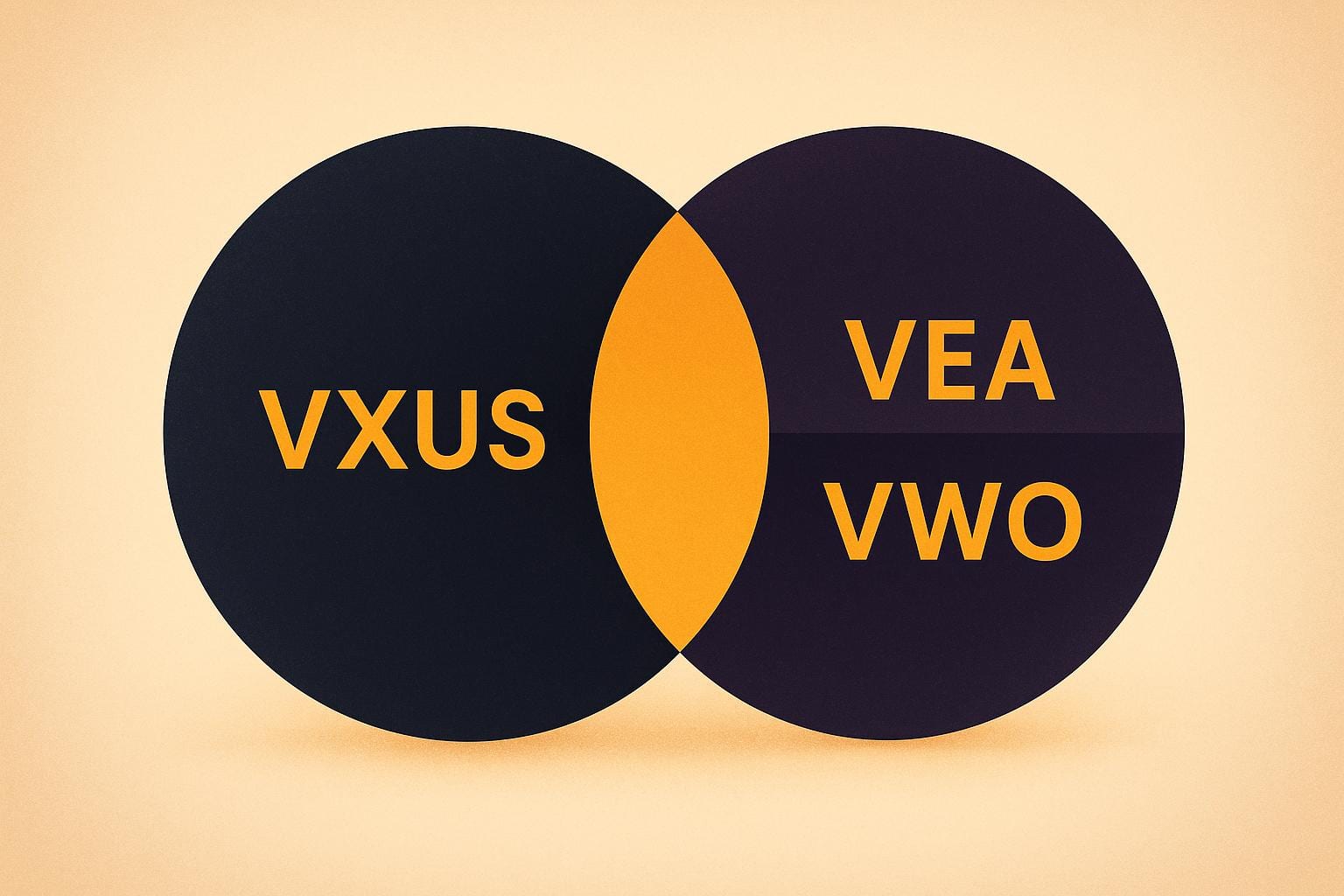
When deciding between VXUS (Vanguard Total International Stock ETF) and a combination of VEA (Vanguard Developed Markets ETF) + VWO (Vanguard Emerging Markets ETF), the key differences boil down to simplicity, cost, and control:
- VXUS is an all-in-one fund with automatic rebalancing, offering 75% exposure to developed markets and 25% to emerging markets. It has a slightly higher expense ratio (0.08%) but requires no ongoing management.
- VEA + VWO allows for customizable allocations between developed and emerging markets, with a lower combined expense ratio (~0.0575%). However, it requires manual rebalancing and more effort to manage.
Key Considerations:
- Cost: VEA + VWO is cheaper by ~$1.25 per $10,000 invested annually.
- Simplicity: VXUS handles rebalancing automatically, saving time and effort.
- Flexibility: VEA + VWO lets you adjust allocations and take advantage of tax-loss harvesting opportunities.
- Performance Tracking: With VEA + VWO, you can see how developed and emerging markets contribute separately to your returns. VXUS blends the two, making it less transparent.
Quick Comparison
Bottom Line: Choose VXUS if you prefer simplicity and a hands-off approach. Opt for VEA + VWO if you value control, lower costs, and tax efficiency, but are willing to invest time in managing your portfolio.
VEA vs. VWO vs. VXUS – Which ETF for International Stocks?
1. VXUS Performance and Characteristics
VXUS offers extensive international market exposure with a built-in allocation of 75% to developed markets and 25% to emerging markets.
Cost Structure and Efficiency
The expense ratio for VXUS stands at 0.07%, translating to about $7 for every $10,000 invested. For comparison, replicating VXUS's allocation by holding 75% in VEA (expense ratio: 0.05%) and 25% in VWO (expense ratio: 0.08%) results in a blended expense ratio of approximately 0.0575%, or $5.75 per $10,000 invested. This means investors could save around $1.25 per $10,000 by managing the two funds separately. However, the simplicity VXUS offers may outweigh these minor cost savings, especially for those with larger portfolios.
Portfolio Management Simplicity
VXUS eliminates the need for AI vs. manual rebalancing by consolidating international exposure into a single fund. It automatically maintains the target allocation, reducing the time and effort required to manage a portfolio.
For investors who prefer a hands-off approach to international diversification, VXUS provides an easy, all-in-one solution. While it comes with a slightly higher expense ratio compared to managing VEA and VWO individually, the convenience it offers can be well worth the modest premium.
2. VEA + VWO Combined Performance
Holding VEA and VWO separately gives investors more precise control over their international exposure. To replicate the composition of VXUS, you'd allocate around 75% to VEA (developed markets) and 25% to VWO (emerging markets). This setup provides a clearer view of the distinct risks and strategies tied to each market type.
Risk and Volatility Characteristics
The combined VEA + VWO portfolio mirrors VXUS in terms of overall volatility, but the two funds behave differently. VEA, focusing on developed markets like Japan, the United Kingdom, and Germany, tends to be more stable. On the other hand, VWO, which tracks emerging markets such as China, Taiwan, and India, experiences more pronounced swings.
This separation helps you pinpoint how much of your portfolio's movement stems from developed versus emerging markets. For instance, during periods of stress in emerging markets, VWO is likely to drop more sharply than VEA. In contrast, VXUS would present a blended performance, potentially masking these underlying patterns.
Rebalancing Requirements and Flexibility
Managing VEA and VWO separately means you'll need to rebalance periodically, but this also gives you the flexibility to tweak your allocations. For example, you might increase your exposure to emerging markets when valuations seem appealing or scale back during times of geopolitical uncertainty. These adjustments can influence both performance outcomes and your tax strategy.
Performance Tracking and Tax Considerations
A two-fund strategy simplifies performance tracking. You can easily identify whether developed or emerging markets are driving your international returns during any given period. This transparency can guide future allocation decisions and improve portfolio analysis.
Additionally, this approach can benefit tax planning. If one fund underperforms the other, you can take advantage of tax-loss harvesting while maintaining your overall international exposure through the other fund.
While this combined strategy offers the same market coverage as VXUS, it provides greater control and visibility. However, it does come with added complexity and the need for ongoing maintenance.
Pros and Cons
Every investment strategy comes with its own set of trade-offs. As outlined earlier, factors like cost, management, and tax implications play a significant role. Here's a quick comparison of these elements:
These points lay the groundwork for exploring how each strategy aligns with various investor preferences.
The Case for VXUS
VXUS stands out for its simplicity and efficiency. With just one purchase, you get automatic rebalancing, ensuring your portfolio maintains its target allocation without any extra effort. This hands-off approach saves time and removes the stress of deciding when or how to adjust allocations.
From a cost standpoint, VXUS charges a single expense ratio of 0.08% annually. This structure minimizes trading costs and simplifies record-keeping, as you'll only need to manage one consolidated tax document instead of juggling multiple statements.
Another advantage of VXUS is its ability to reduce behavioral pitfalls. Many investors struggle with the urge to time the market or make emotional allocation changes. The single-fund strategy eliminates these temptations by maintaining consistent, professional management. However, while VXUS emphasizes convenience, a two-fund approach offers more control and tax efficiency.
The Case for VEA + VWO
Opting for separate funds - VEA and VWO - offers greater flexibility and potential tax benefits. You can tailor your allocation between developed and emerging markets, adjusting based on market trends, valuations, or your evolving risk tolerance. This adaptability is particularly useful when one market segment significantly outperforms or underperforms the other.
Another key advantage is automated tax-loss harvesting. With two separate funds, you can strategically sell underperforming assets to offset taxable gains, which can lead to substantial tax savings over time - especially for investors in higher tax brackets.
Transparency is another benefit of this approach. With separate funds, it's easy to see whether returns are being driven by developed markets like Europe and Japan or emerging markets like China and India. This clarity can help you make informed decisions about future allocations and portfolio adjustments.
Hidden Costs and Considerations
While both strategies have their strengths, each also comes with hidden costs. For instance, managing VEA and VWO might seem cost-effective due to their lower individual expense ratios. However, this approach requires ongoing rebalancing, which can lead to transaction fees, bid-ask spreads, and taxable events - costs that VXUS handles internally.
Rebalancing two funds also demands time and effort. You'll need to monitor performance, maintain your target allocations, and make periodic adjustments. For investors who prefer a hands-off, "set-it-and-forget-it" approach, this added complexity may not be appealing.
In contrast, VXUS simplifies these tasks by handling all rebalancing internally without creating taxable distributions for shareholders. This convenience can be a significant advantage for those who value ease of management.
Both strategies offer excellent international diversification, but they cater to different types of investors. Whether you prioritize simplicity or control, understanding these nuances can help you make the choice that best aligns with your investment goals and engagement level.
Conclusion
Deciding between VXUS and the VEA + VWO combination ultimately comes down to your personal investment style. VXUS offers a simple, all-in-one solution, while VEA + VWO provides more control and potential tax advantages. Both approaches deliver broad international diversification but cater to different investor needs.
The choice highlights a key trade-off: ease of management versus active allocation. If you prefer a hands-off approach, VXUS might be the better fit. It handles rebalancing automatically, saving you time, though it comes with a slightly higher expense ratio. On the other hand, if you enjoy fine-tuning your portfolio, the VEA + VWO combination offers lower costs and greater flexibility, particularly for tax management and loss harvesting.
Time commitment is another crucial factor. If you’re willing to monitor and rebalance your holdings, VEA + VWO can offer more opportunities for tax-efficient ETF investing and adjustments. However, if you prefer a set-it-and-forget-it approach, VXUS delivers comparable long-term results with far less effort.
Both strategies have their strengths in terms of diversification, expenses, and control. For most investors, the performance differences over the long term are relatively small. Your decision ultimately reflects what you value more: the convenience of an all-in-one fund or the ability to actively manage and optimize your portfolio.
FAQs
What are the benefits of VXUS’s automatic rebalancing compared to manually rebalancing VEA and VWO?
VXUS takes care of rebalancing automatically, ensuring the portfolio stays aligned with the intended mix of developed and emerging markets. Investors don’t need to lift a finger, which can save time, cut down on potential mistakes, and make managing a portfolio much easier.
On the other hand, if you hold VEA and VWO separately, you’re responsible for manual rebalancing. This means you’ll need to periodically adjust the allocation between the two funds to keep things on track. Not only is this more time-consuming, but it can also lead to extra transaction costs. With its built-in automation, VXUS offers a smoother, low-maintenance way to achieve broad international market exposure.
What tax considerations should I keep in mind when choosing between VXUS and a combination of VEA + VWO, and how can I optimize for tax efficiency?
When weighing VXUS against a combination of VEA and VWO, tax considerations largely focus on dividend taxation and the foreign tax credit. VEA, which targets developed markets, generally produces a higher proportion of qualified dividends. These dividends may be taxed at a lower rate, depending on your income bracket. VXUS, on the other hand, covers both developed and emerging markets, often resulting in a smaller share of qualified dividends.
For better tax efficiency, holding international ETFs like VEA in a taxable account can be advantageous. This allows you to utilize the foreign tax credit, which offsets taxes paid to foreign governments. Meanwhile, VWO, with its smaller percentage of qualified dividends, might be a better fit for tax-advantaged accounts like a Roth IRA. If you’re close to income thresholds that affect subsidies - such as those tied to the Affordable Care Act (ACA) - it’s also worth considering how foreign taxes paid could impact your taxable income calculations.
Why might an investor choose VEA and VWO over VXUS, even with the added effort?
Investors may choose VEA and VWO over VXUS to have more control over how their portfolio is split between developed and emerging markets. This approach offers the flexibility to adjust weightings in a way that better matches individual investment goals or market perspectives.
By managing VEA and VWO separately, investors can also fine-tune rebalancing efforts. This can help improve diversification or aim for better returns. While this strategy demands more time and effort, it’s an attractive option for those who prefer a hands-on, personalized approach to investing.
Related Blog Posts
- What are the benefits of including VTSA in my portfolio
- SPY vs VOO: fees, liquidity, dividend treatment, and tracking differences.
- FXAIX vs VOO: Which to Buy (2026).
- How do VPU and XLU compare on dividend yield, dividend growth, fees, and sector concentration?
VXUS takes care of rebalancing automatically, ensuring the portfolio stays aligned with the intended mix of developed and emerging markets. Investors don’t need to lift a finger, which can save time, cut down on potential mistakes, and make managing a portfolio much easier.
On the other hand, if you hold VEA and VWO separately, you’re responsible for manual rebalancing. This means you’ll need to periodically adjust the allocation between the two funds to keep things on track. Not only is this more time-consuming, but it can also lead to extra transaction costs. With its built-in automation, VXUS offers a smoother, low-maintenance way to achieve broad international market exposure.
When weighing VXUS against a combination of VEA and VWO, tax considerations largely focus on dividend taxation and the foreign tax credit. VEA, which targets developed markets, generally produces a higher proportion of qualified dividends. These dividends may be taxed at a lower rate, depending on your income bracket. VXUS, on the other hand, covers both developed and emerging markets, often resulting in a smaller share of qualified dividends.
For better tax efficiency, holding international ETFs like VEA in a taxable account can be advantageous. This allows you to utilize the foreign tax credit, which offsets taxes paid to foreign governments. Meanwhile, VWO, with its smaller percentage of qualified dividends, might be a better fit for tax-advantaged accounts like a Roth IRA. If you’re close to income thresholds that affect subsidies - such as those tied to the Affordable Care Act (ACA) - it’s also worth considering how foreign taxes paid could impact your taxable income calculations.
Investors may choose VEA and VWO over VXUS to have more control over how their portfolio is split between developed and emerging markets. This approach offers the flexibility to adjust weightings in a way that better matches individual investment goals or market perspectives.
By managing VEA and VWO separately, investors can also fine-tune rebalancing efforts. This can help improve diversification or aim for better returns. While this strategy demands more time and effort, it’s an attractive option for those who prefer a hands-on, personalized approach to investing.