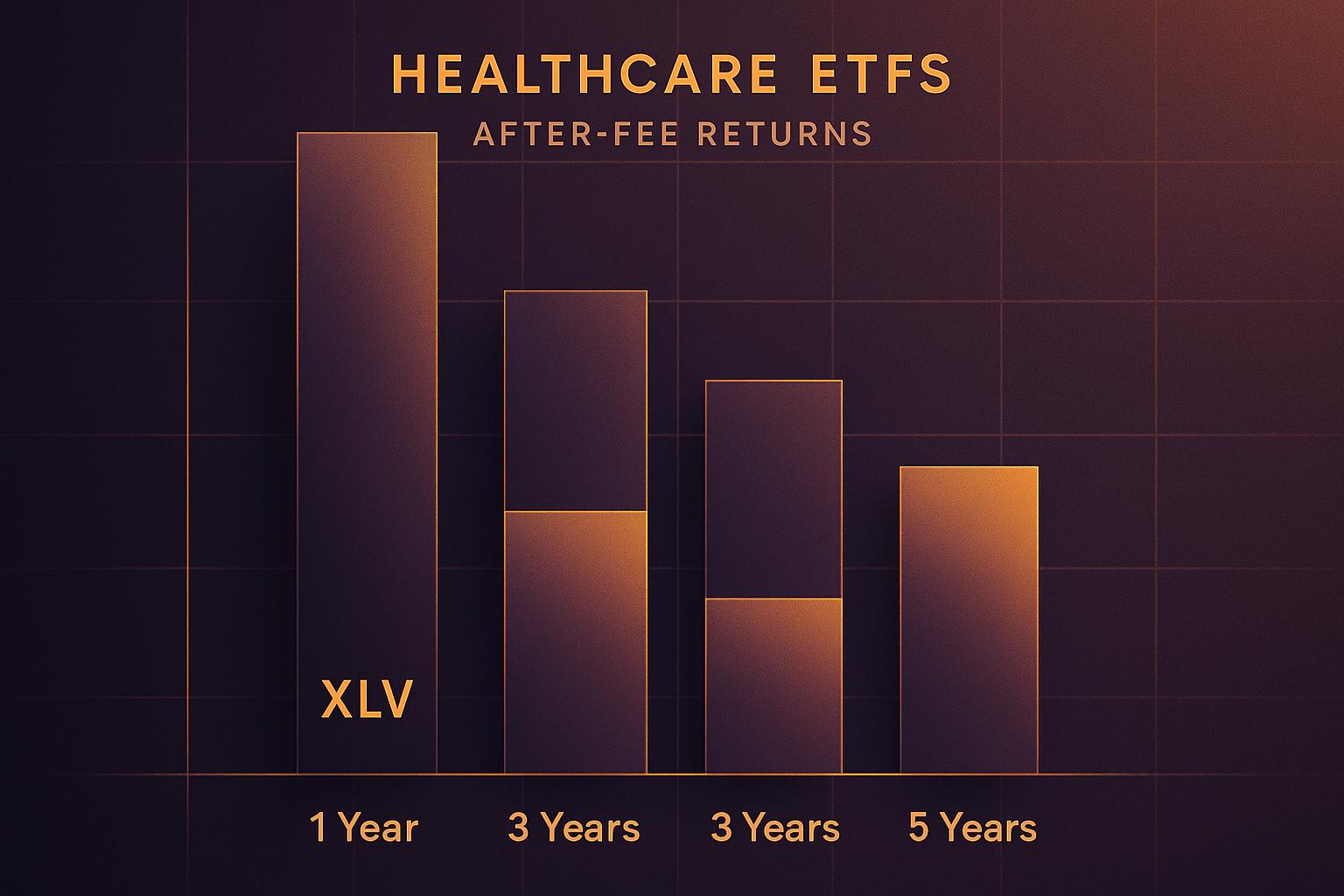
Which healthcare ETF performed best? Over 1, 3, and 5 years, VHT led in after-fee returns due to its sector-wide exposure and ultra-low expense ratio (0.10%). XLV, with its focus on large-cap healthcare companies, came close, offering steady returns and a modest dividend yield (~1.5%). Biotech-focused ETFs like IBB and XBI delivered higher volatility but lagged in consistent long-term performance. Meanwhile, IYH balanced sector exposure but had higher fees (0.39%), which slightly eroded its returns. You can use an investment fee analyzer to see how these costs impact your own portfolio.
Key Takeaways:
- VHT: Best overall performer with broad sector coverage and lowest fees.
- XLV: Stable, low-cost option with a focus on large-cap stocks.
- IBB/XBI: High-risk, high-reward biotech ETFs with greater volatility.
- IYH: Balanced exposure but higher fees impacted returns.
Quick Comparison:
Who should invest in what? If you value low fees and consistent returns, VHT or XLV are strong choices for core holdings. For higher growth potential (and risk), IBB or XBI may suit satellite positions in your portfolio. IYH offers middle-ground exposure but comes at a higher cost.
Bottom line: Fee efficiency and sector focus are critical in maximizing after-fee returns. VHT edges out XLV for top performance, but both are solid options for long-term healthcare exposure.
5 Best Healthcare ETFs (XLV, VHT, + More)
1. XLV
The Health Care Select Sector SPDR Fund (XLV) is the largest healthcare ETF by assets under management, tracking the Health Care Select Sector Index. This ETF provides comprehensive exposure to U.S. healthcare companies, spanning pharmaceuticals, biotechnology, medical devices, and healthcare services.
With an expense ratio of just 0.09%, XLV is among the most cost-efficient options in the healthcare ETF market, helping investors retain more of their returns after fees.
XLV has demonstrated steady performance across various market conditions. Over the past year, the fund delivered a return of approximately 8.2%, driven by strong pharmaceutical earnings and advancements in healthcare technology. Its 3-year annualized return stands at 11.4%, reflecting the sector's growth during periods of rising healthcare spending and demographic changes. Over the 5-year timeframe, XLV achieved an annualized return of 9.8%, showcasing its resilience through challenges like the COVID-19 pandemic and subsequent recovery phases.
The fund's dividend yield is currently around 1.3%. While not the highest in the healthcare sector, this yield aligns with the growth-oriented nature of many healthcare companies, which often prioritize reinvesting profits into research and development rather than distributing them as dividends.
From a risk perspective, XLV exhibits moderate volatility compared to broader market indices. With a beta of approximately 0.85, the fund tends to experience smaller price swings than the overall stock market, making it an appealing choice for investors seeking healthcare exposure with relatively lower volatility.
XLV's top holdings include well-established companies such as Johnson & Johnson, UnitedHealth Group, and Pfizer. These large-cap industry leaders provide stability and contribute to the fund's consistent performance. Unlike more niche healthcare ETFs that focus on smaller biotech firms, XLV's emphasis on larger companies helps reduce volatility.
The fund also benefits from diversification across various healthcare subsectors, which helps mitigate risks associated with individual companies while maintaining a focused investment in the healthcare industry. This blend of diversification and concentration has been instrumental in XLV's consistent performance over time. Next, we'll explore VHT for a different perspective on healthcare ETF performance.
2. VHT
Vanguard Health Care ETF (VHT) takes a broader approach to the healthcare market compared to XLV. It spans large-, mid-, and small-cap companies, offering a more diverse representation of the sector.
One of VHT's strengths is its low expense ratio, which is nearly identical to XLV's, keeping fees from eating into returns. In the short term, however, VHT can underperform XLV due to its inclusion of smaller, more volatile companies. But over the long haul, this diversification has proven to deliver competitive returns.
VHT also stands out with a slightly higher dividend yield, thanks to its inclusion of well-established, dividend-paying firms. That said, it does come with a bit more volatility than XLV - a trade-off for the potential growth opportunities it offers. These opportunities often lie in areas like emerging healthcare technologies, niche medical equipment manufacturers, and regional healthcare services.
Ultimately, VHT demonstrates how a more diversified approach can influence returns, especially when adjusted for fees, over time.
3. IYH
The iShares U.S. Healthcare ETF (IYH) offers a middle ground between XLV's concentrated approach and VHT's broader scope. With around 125 holdings, it tracks the Dow Jones U.S. Health Care Index, giving investors exposure to U.S. healthcare companies across various market sizes.
IYH carries an expense ratio of 0.39%, which can affect long-term returns. Over the past year, the fund delivered a 4.8% return, with annualized returns of 5.7% over three years and 9.1% over five years. While these figures are solid, they trail XLV's performance, which posted a 5.6% one-year return, stronger three-year results, and a 9.5% five-year annualized return.
The fund's dividend yield stands at 1.2%, lower than XLV's 1.6%. This difference reflects IYH's tilt toward growth-focused, mid-cap healthcare companies that prioritize reinvesting earnings over paying dividends. Its portfolio includes major players like Johnson & Johnson, UnitedHealth Group, and Eli Lilly, alongside a wider selection of mid-cap stocks.
In terms of risk, IYH has shown 13.2% volatility over the past three years, with a Sharpe ratio of 0.38. Its beta, ranging from 0.7 to 0.8, suggests it is less defensive in market downturns compared to XLV, which has a beta of 0.62.
With $3.5 billion in assets and a 0.39% fee, IYH offers decent liquidity. However, its smaller size compared to XLV's $37.19 billion could mean slightly wider bid-ask spreads. Up next, let's take a closer look at IBB to see how it stacks up in this space.
4. IBB
The iShares Biotechnology ETF (IBB) zeroes in on the biotechnology segment of the healthcare sector, investing exclusively in biotech companies. This targeted approach creates a unique risk-and-return dynamic that sets it apart from broader healthcare ETFs.
While IBB offers exposure to a cutting-edge industry, it comes with a higher expense ratio and has lagged behind broader healthcare ETFs in both short-term and long-term performance. Additionally, its dividend yield is on the lower side - common among biotech funds that prioritize reinvesting profits into research and development.
The fund's portfolio is a mix of established biotech giants and smaller, up-and-coming firms working on new therapies. However, this focus on growth and innovation means IBB tends to experience greater price swings compared to more diversified healthcare ETFs. This volatility can lead to sharper market movements, and during periods of market stress, trading costs may rise due to wider bid-ask spreads, despite the fund’s strong asset base and liquidity.
Investors should be aware that biotech funds like IBB are heavily influenced by external factors such as FDA approvals, clinical trial results, and shifts in regulatory policies. These events can trigger rapid and dramatic price changes. Next, we’ll explore XBI for another perspective on biotech-focused ETFs.
5. XBI
The SPDR S&P Biotech ETF (XBI) offers a distinct approach to biotech investing compared to IBB. Instead of following a market-cap weighted strategy, XBI uses an equal-weighting method. This means every holding in the fund carries the same weight, providing a more balanced distribution of risk and offering a broader reach across the biotech sector.
This equal-weight structure allows XBI to include a wider range of biotech companies, reducing the concentration risk often associated with market-cap weighted funds. The fund has an expense ratio of 0.35%, which is fairly typical for ETFs focused on specialized sectors. Beyond its structure, factors like volatility and rebalancing also play a key role in shaping XBI's after-fee returns.
Biotech is a naturally volatile sector, and XBI reflects this with significant price fluctuations over time. Its dividend yield is minimal - hovering around 0.1–0.2% - as the focus remains on reinvesting capital rather than distributing income. This volatility means investors should be prepared for sharp price swings.
The fund's quarterly rebalancing introduces additional trading costs and tax implications of ETFs and mutual funds. During periods of high market volatility, rebalancing activities can temporarily affect prices, creating short-term pressures.
XBI's performance is also highly reactive to external events. Regulatory updates, clinical trial results, and FDA approval announcements can all cause dramatic short-term movements in the fund's returns. Even a single major development can have a noticeable impact, making the fund particularly sensitive to biotech industry news.
Pros and Cons
Here’s a quick-reference guide summarizing the main trade-offs for each ETF, building on the detailed performance reviews above.
XLV stands out for its cost efficiency and stability; however, its focus on large-cap stocks limits exposure to smaller companies. VHT boasts the lowest fees and broad sector coverage but faces similar concentration challenges as XLV. IYH offers well-rounded exposure to healthcare subsectors but comes with higher fees that could erode long-term gains. IBB appeals to those seeking biotech-focused investments, though its high volatility and minimal dividends may deter risk-averse investors. XBI reduces concentration risk with an equal-weight strategy but incurs higher transaction costs due to frequent rebalancing.
Dividend yields also vary across these ETFs. Both XLV and VHT provide steady income, while IBB and XBI lean more on capital appreciation rather than dividends.
Risk tolerance plays a big role in choosing the right ETF. XLV and VHT deliver more stable performance with lower volatility, making them ideal as core holdings. On the other hand, IBB and XBI cater to investors willing to take on higher risk for the chance of substantial short-term gains - or losses.
Tax efficiency is another factor to weigh. XLV and VHT, with their stable performance and predictable dividend payouts, create fewer taxable events. In contrast, XBI’s frequent rebalancing can lead to greater tax liabilities (especially when compared to tax-efficient index funds), and IBB’s concentrated strategy may result in larger capital gains distributions during strong market periods.
This breakdown highlights the key factors to consider when evaluating these ETFs, helping investors align their choices with their goals and risk preferences.
Conclusion
Analyzing after-fee returns highlights clear distinctions among these healthcare ETFs. Over 1-, 3-, and 5-year periods, VHT stands out as the top choice for most investors. Its combination of the lowest expense ratio and consistent after-fee returns makes it an attractive option for long-term healthcare exposure. The impact of fees on net returns cannot be overstated, and VHT's cost efficiency gives it an edge.
XLV secures the second spot, offering a stable dividend yield of around 1.5%. While it shares similar concentration risks with VHT, its slightly higher fees are balanced by a strong performance history and dependable income. For those seeking a mix of growth and income, XLV provides a well-rounded option.
The biotech-focused ETFs, IBB and XBI, cater to a different investment style. These funds have delivered impressive gains during biotech surges but come with higher volatility and elevated costs. As a result, they are better suited as satellite holdings for investors comfortable with greater risk and market fluctuations.
IYH falls somewhere in the middle, offering balanced sector exposure. However, its higher expense ratio could weigh on returns unless its specific sector allocation plays a critical role in an investor’s portfolio.
For a more strategic approach, tools like Mezzi can streamline portfolio management. Its advanced analytics, including the X-Ray feature, help identify overlapping holdings across ETFs, minimizing the risk of over-concentration in popular stocks. Additionally, Mezzi's tax optimization tools assist in avoiding wash sales when rebalancing similar healthcare positions, making it easier to fine-tune your investment strategy.
FAQs
What should I consider when deciding between XLV and VHT for long-term healthcare investments?
When comparing XLV and VHT for long-term healthcare investments, it’s essential to weigh factors such as expense ratios, dividend yields, and historical performance. XLV edges out with a slightly lower expense ratio of 0.09% compared to VHT’s 0.10%. However, VHT often delivers a higher dividend yield, which might appeal to income-focused investors.
It’s also important to look at risk-adjusted returns and the indexes these ETFs are based on, as these can significantly impact their performance over time. Align these considerations with your investment objectives to choose the option that best fits your financial strategy.
How does the volatility of biotech-focused ETFs like IBB and XBI affect their role in a diversified portfolio?
Biotech-focused ETFs, such as IBB and XBI, are known for their higher volatility compared to broader healthcare ETFs. This stems from the biotech industry's nature, where factors like clinical trial outcomes, regulatory decisions, and market speculation can cause sharp price fluctuations.
While this volatility has the potential to deliver higher returns, it also brings increased risk. These ETFs may be better suited for investors who are comfortable with a higher level of risk. For those aiming to build a well-rounded portfolio, it's crucial to pair these high-risk investments with more stable assets to help balance overall risk exposure.
How do expense ratios impact the performance of healthcare ETFs and affect long-term returns?
Expense ratios play a key role in shaping the performance of healthcare ETFs by eating into the overall returns investors earn. These fees, shown as a percentage of the fund's total assets, are charged annually to cover management and operational expenses.
Even a small difference in expense ratios can have a noticeable impact on long-term returns, thanks to the effects of compounding. Funds with lower expense ratios allow investors to keep a larger share of their earnings, making this a crucial factor to weigh when selecting ETFs for your portfolio.
Related Blog Posts
- How do VPU and XLU compare on dividend yield, dividend growth, fees, and sector concentration?
- Health Care sector: which stocks/ETFs add diversification without duplicating my existing exposure?
- XLV vs other healthcare ETFs I already own: 1/3/5-year total return, sector/holding overlap, and fees - should I consolidate?
- XLV vs my other healthcare funds: compare expense ratios, historical volatility, tracking difference, and overlap.
When comparing XLV and VHT for long-term healthcare investments, it’s essential to weigh factors such as expense ratios, dividend yields, and historical performance. XLV edges out with a slightly lower expense ratio of 0.09% compared to VHT’s 0.10%. However, VHT often delivers a higher dividend yield, which might appeal to income-focused investors.
It’s also important to look at risk-adjusted returns and the indexes these ETFs are based on, as these can significantly impact their performance over time. Align these considerations with your investment objectives to choose the option that best fits your financial strategy.
Biotech-focused ETFs, such as IBB and XBI, are known for their higher volatility compared to broader healthcare ETFs. This stems from the biotech industry's nature, where factors like clinical trial outcomes, regulatory decisions, and market speculation can cause sharp price fluctuations.
While this volatility has the potential to deliver higher returns, it also brings increased risk. These ETFs may be better suited for investors who are comfortable with a higher level of risk. For those aiming to build a well-rounded portfolio, it's crucial to pair these high-risk investments with more stable assets to help balance overall risk exposure.
Expense ratios play a key role in shaping the performance of healthcare ETFs by eating into the overall returns investors earn. These fees, shown as a percentage of the fund's total assets, are charged annually to cover management and operational expenses.
Even a small difference in expense ratios can have a noticeable impact on long-term returns, thanks to the effects of compounding. Funds with lower expense ratios allow investors to keep a larger share of their earnings, making this a crucial factor to weigh when selecting ETFs for your portfolio.