
Paying a 1% fee for financial advice can be costly, but is it justified?
Here’s the deal: advisors charging 1% of your portfolio’s value annually might seem reasonable at first, but additional costs (like product fees) often push the total closer to 1.65%. For a $1M portfolio, that’s $16,500 a year. Over decades, these fees can erode hundreds of thousands of dollars from your wealth.
On the flip side, advisors can add value through services like tax planning, behavioral coaching, and portfolio management - potentially boosting returns by 1.8% to 5.1% annually, according to studies. This might make the cost worthwhile for those with complex financial needs.
Mezzi is free to get started. Choose Advisory for unlimited advice and advanced features at $39/month or $399/year. Concierge includes the same, plus hands-on support, at $99/month or $999/year. Mezzi’s model appeals to self-directed investors looking to cut costs and grow wealth faster.
The choice boils down to this: Do you need hands-on, personalized advice for complex finances? Or are you comfortable using AI-driven investment apps to manage your portfolio and save on fees?
1. Traditional 1% AUM Financial Advisors
Cost and Fees
The 1% fee based on assets under management (AUM) has long been the go-to standard in the financial advisory world, mainly because it’s straightforward and easy to understand. But here’s the catch: the range of services included in that fee can vary - a lot. Stoy Hall, CFP® and founder of Black Mammoth, puts it this way:
That 1% fee should buy you a full suite of financial planning services. Investment management should be the floor, not the ceiling.
Some advisors stick to just basic investment management, which might leave you feeling like you're paying too much if they’re not offering more comprehensive financial planning. This inconsistency in service levels makes it worth digging deeper into what you’re actually getting - especially when it comes to areas like tax optimization.
Tax Optimization
Linking tax planning with investment strategies is often a key part of what traditional advisors bring to the table, particularly for high-net-worth clients. If your financial situation is complex - think multiple businesses, real estate investments, or detailed estate planning - advisors often step in with advanced tax strategies that can lead to real savings. Independent investors can also use a tax planning checklist to identify similar opportunities. As one client of Fuchs Financial shared:
Ben knows the tax laws and invests to optimize our retirement funds.
This hands-on approach to tax planning is one of the ways traditional advisors aim to deliver value. But tax strategies are just one piece of the puzzle; portfolio management is another area where they claim to shine.
Portfolio Performance and Oversight
One of the core services offered by traditional financial advisors is active portfolio management. This includes regular monitoring, rebalancing, and performance reporting. They also keep a close eye on tax implications, adjusting asset allocations to align with changing market conditions using tax-efficient rebalancing strategies. The idea is that this proactive oversight helps clients avoid costly mistakes - like emotional decision-making - or simply fills the gap for those who lack the time or expertise to manage their investments effectively.
Long-Term Wealth Impact
While the 1% fee may seem manageable at first glance, it can significantly impact your portfolio’s growth over time. According to an SEC study, an account charged a 1% annual fee would be worth $30,000 less after 20 years compared to one with a 0.25% fee. For a $2 million portfolio earning 7% annually, that 1% fee could mean over $375,000 in lost wealth after 10 years - and more than $566,000 over 30 years.
And as your portfolio grows, so does the dollar amount of the fee. For example, a $2 million portfolio charged a 1% fee incurs $20,000 annually. But if that portfolio doubles to $4 million and the advisor reduces the rate to 0.8%, you’re still paying $32,000 - a 40% increase in fees, even with the lower percentage. Whether this cost is worth it depends on the depth and quality of the services your advisor provides.
Up next, we’ll dive into AI-driven wealth management as an alternative to traditional advisors.
2. Mezzi AI-Driven Wealth Management
Cost and Fees
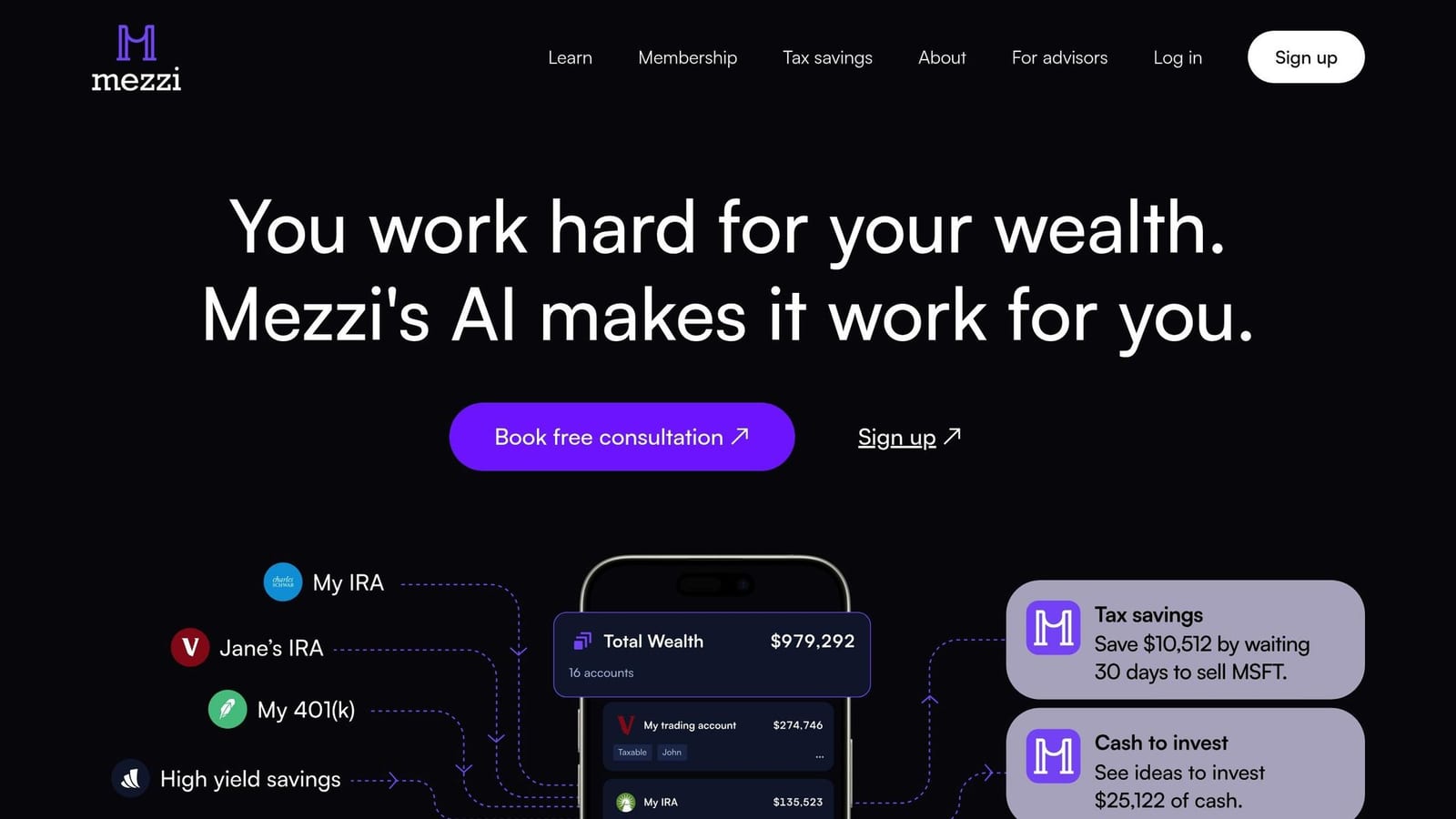
Mezzi takes a straightforward approach to pricing with its flat annual fee model. The Advisory is priced at $39/month or $399/year, while the Concierge costs $99/month or $999/year. The latter includes perks like unlimited AI coaching calls and priority phone support. This predictable pricing remains steady no matter how much your portfolio grows, offering a transparent alternative to traditional fee structures. Next, let's dive into how Mezzi handles tax efficiency.
Tax Optimization
One standout feature of Mezzi's platform is its focus on minimizing tax burdens. It actively monitors your accounts to avoid wash sales, which can trigger unnecessary taxable events. Additionally, the platform provides real-time AI-driven prompts to help you spot opportunities to reduce taxes, keeping more of your money working for you.
Portfolio Performance and Oversight
Mezzi's AI-driven tools ensure continuous monitoring of your portfolio, delivering detailed insights to help you make informed decisions. The X-Ray feature uncovers hidden risks, such as overlapping investments, and helps manage potential exposures. Meanwhile, the Financial Calculator offers a comprehensive view of your retirement savings by factoring in details like your current portfolio value, projected contributions, estimated returns, and asset manager fees. These tools also provide real-time performance updates and risk analysis, giving you everything you need to guide your investments effectively.
Long-Term Wealth Impact
By sticking to a flat fee structure, Mezzi allows you to keep more of your capital invested, which can amplify the benefits of compounding over time. Unlike traditional advisors whose fees tend to grow with your portfolio, Mezzi’s price does not increase with portfolio size, so more of your money can remain invested. With features like unlimited AI-driven financial guidance - and the added benefit of unlimited coaching calls for Concierge members - Mezzi offers a streamlined, cost-effective solution for self-directed investors aiming to fine-tune their financial strategies and grow their wealth efficiently.
Are 1% Financial Advisor Fees Worth It? The REAL Impact on Retirement
Pros and Cons
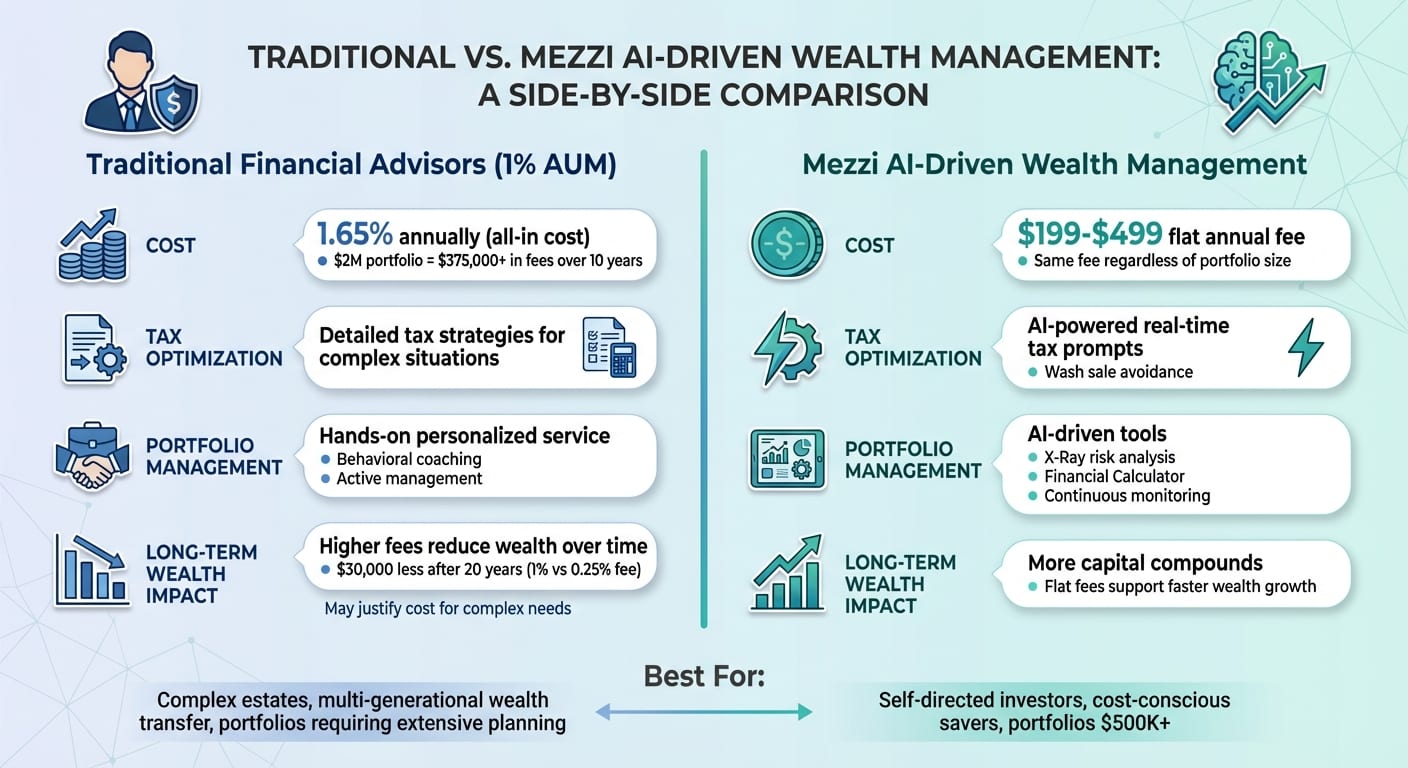
The table below highlights the key differences between traditional financial advisors and Mezzi's AI-powered wealth management, helping you weigh the trade-offs more effectively.
CategoryTraditional Financial Advisors (1% AUM)Mezzi AI‐Driven Wealth ManagementCostAverage all-in cost is 1.65% annually. For a $2M portfolio growing at 7%, fees can exceed $375,000 over 10 years.Flat fees: $39/month or $399/year for Advisory or $99/month or $999/year for Concierge, which includes unlimited coaching calls. Fees stay the same regardless of portfolio size.Tax OptimizationOffers detailed tax strategies that can lead to significant annual savings, especially for complex financial situations.Uses AI to provide real-time prompts for avoiding wash sales and identifying tax-saving opportunities, though it doesn’t offer tailored advice for complex cases.Portfolio ManagementProvides hands-on, personalized service with behavioral coaching to counteract panic selling and active management incorporating tax and risk strategies.Features tools like X-Ray to uncover hidden risks and a Financial Calculator for projecting retirement savings. AI continuously monitors performance and provides updates.Long-Term Wealth ImpactHigher fees can reduce wealth significantly over time. For example, a 1% annual fee compared to 0.25% can result in $30,000 less after 20 years. However, comprehensive services may justify the cost for clients with complex needs.Flat fees allow more capital to compound, avoiding the drag of a 1% AUM fee. This structure supports faster wealth growth for self-directed investors.
Traditional advisors excel in providing tailored, hands-on services, which may benefit those with intricate financial needs. On the other hand, Mezzi’s flat-fee model and AI-driven tools focus on cost efficiency, making it an attractive option for investors aiming to maximize long-term growth while managing expenses.
Conclusion
For investors navigating intricate financial situations - like complex estate strategies or transferring wealth across generations - a 1% AUM fee might make sense due to the extensive planning and personalized advice traditional advisors offer.
However, for self-directed, cost-conscious investors, the math paints a different picture. According to an SEC study, the difference between a 1% fee and a 0.25% fee could shrink wealth by $30,000 over 20 years. When total costs approach 1.65%, even small fee differences can significantly chip away at returns.
This is where an alternative model stands out. Mezzi’s flat-fee approach - starting at $39/month or $399/year - offers a practical solution. It’s perfect for investors who prefer making their own decisions but still value AI-driven tools for tax optimization, risk analysis, and performance tracking. With lower fees, you can keep more of your money invested and let it grow over time.
So, what’s your priority? Do you need comprehensive estate and tax planning, or are you focused on maximizing investment efficiency? Is your portfolio size (typically over $500,000) better suited to a predictable flat fee? And are you comfortable leveraging AI-powered insights? Your answers will guide you toward the approach that aligns best with your financial goals and ensures your investments remain on track.
FAQs
Is paying a 1% AUM fee to a financial advisor worth it in the long run?
While a 1% Assets Under Management (AUM) fee might appear modest, its long-term effect on your wealth can be far-reaching, particularly if you have a larger portfolio. Over the years, these fees can eat into your returns through compounding, potentially slowing the growth of your investments.
Many financial advisors defend this fee by highlighting services like tax strategies, portfolio management, and tailored financial planning. However, it’s worth asking yourself: does the value they deliver justify the cost? For some investors, more affordable options, such as AI-powered tools, can provide similar outcomes without the recurring 1% charge. By carefully evaluating your financial goals and exploring available options, you can make a smarter, more informed choice about how to manage your investments.
What are the advantages of using AI-powered platforms for managing your portfolio?
AI-powered platforms offer a range of benefits that make portfolio management more efficient and precise. By automating tasks like asset allocation, risk analysis, and trade execution, they take care of time-consuming processes, freeing you up to focus on other priorities. These platforms rely on advanced algorithms to analyze data and make informed decisions, which can lead to better investment outcomes.
What’s more, these tools respond to market changes in real time, delivering personalized insights and strategies aligned with your financial objectives. They minimize the risk of human error, streamline operations, and provide a more cost-effective option compared to traditional financial advisors - all while maintaining a high degree of accuracy and reliability.
When is paying a 1% AUM fee to a financial advisor worth it?
Paying a 1% Assets Under Management (AUM) fee to a financial advisor can make sense if their services go beyond just managing your investments. This could mean offering personalized financial planning, tax strategies, retirement planning, or helping you navigate tricky financial decisions.
The key is determining whether their expertise and services match your financial goals. Do they bring value that justifies the cost? For many, the peace of mind and customized advice from a trusted advisor can outweigh the fee - especially if they help you achieve better financial results over time.