
**Selling a rental or other investment property may trigger federal capital gains tax of 15% to 20% plus depreciation recapture of up to 25%.** This article’s short answer: both a 1031 exchange and a DST used within a 1031 exchange may defer those taxes, but the tradeoff usually comes down to control vs. passivity.
Here’s the plain-English version:
- A 1031 exchange may fit people who want to buy and run the next property themselves.
- A DST may fit people who want a more hands-off setup and may need a fast replacement option.
- Both paths use the same 1031 tax rules.
- Both still follow the 45-day identification and 180-day closing deadlines.
- A Qualified Intermediary usually must hold the sale proceeds.
- A DST may also help with debt replacement because trust-level financing is often already in place.
- The tradeoff with a DST may include less control, lower liquidity, accreditation rules, and fees.
- Direct ownership may offer more control over leasing, financing, improvements, and sale timing.
If I strip it down even more, the choice often looks like this:
If I want control, I may lean toward a direct 1031 exchange. If I want less landlord work, I may lean toward a DST.
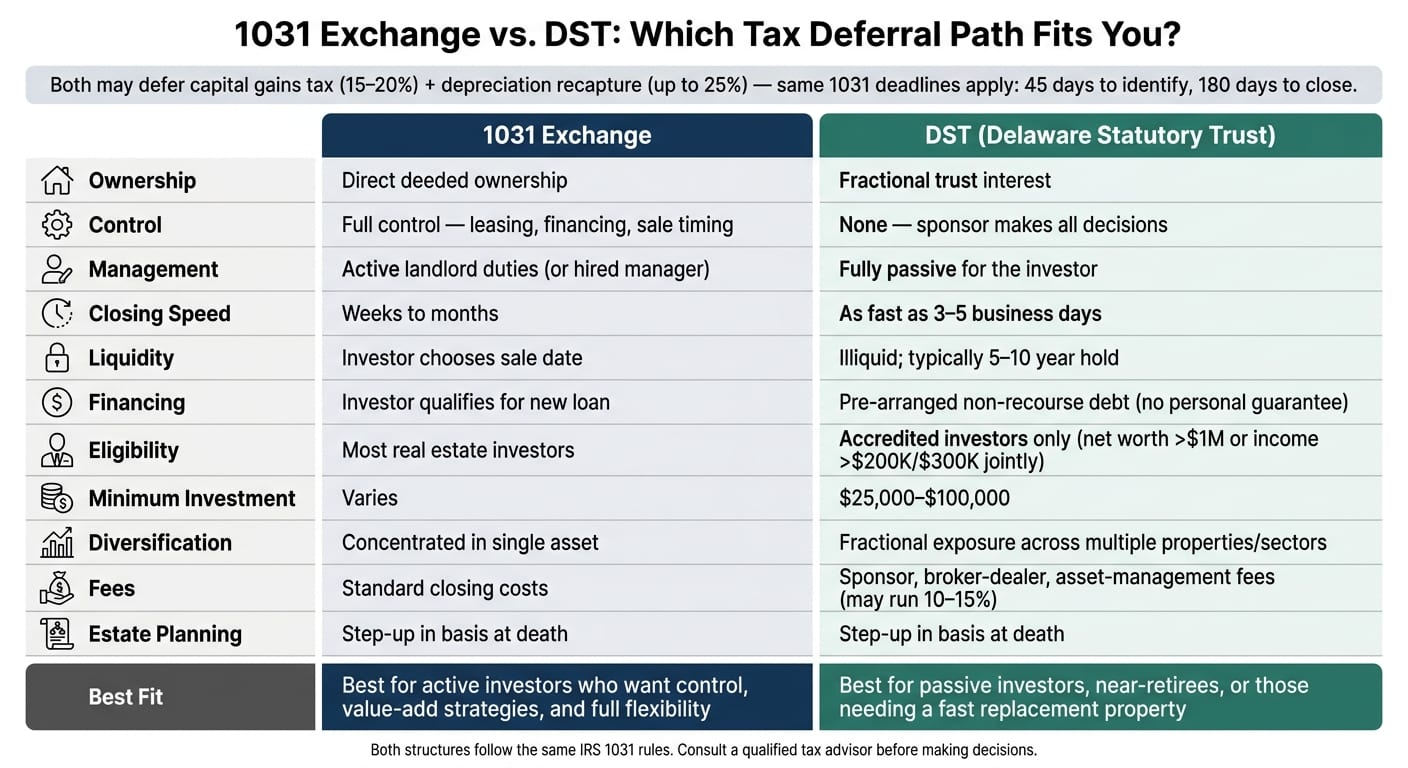
Quick Comparison
That’s the core of the article: same tax goal, very different ownership experience.
How each structure works
1031 exchange rules and deadlines
A 1031 exchange runs on a strict timeline. The sale proceeds need to go to a Qualified Intermediary (QI), not to you. If you receive the funds at any point, the exchange may be disqualified, and the tax bill may become due right away.
From the closing date of your sale, two hard deadlines begin. You have 45 calendar days to identify possible replacement properties in writing to your QI, and 180 calendar days to close on one of them, or by the due date of your tax return, whichever comes first. To fully defer tax, you may need to replace both the equity and debt from the sold property. Any leftover cash or debt shortfall - boot - may be taxable.
During the 45-day identification window, two common rules usually come up:
- The Three-Property Rule lets you identify up to three properties, no matter their value.
- The 200% Rule lets you identify more than three, as long as their combined fair market value does not go above 200% of the property you sold.
A DST addresses the same tax issue, but without asking the investor to find, finance, and manage a replacement property.
DST structure, ownership, and operating limits
A DST uses the same 1031 framework, but it shifts property management and financing to a sponsor.
A DST is a Delaware trust that holds income-producing real estate. Investors buy beneficial interests, and the IRS treats those interests as real-property interests for 1031 purposes under Revenue Ruling 2004-86.
The sponsor handles property operations, leasing, and financing decisions. Investors may receive distributions and depreciation pass-throughs, but the sponsor controls the day-to-day operation. One practical upside is that leveraged DSTs come with pre-arranged, non-recourse debt. That means an investor’s share of the debt may count toward the 1031 debt-replacement requirement without the investor personally qualifying for a new loan.
To remain 1031-eligible, DSTs need to follow strict IRS operating limits, often called the "seven deadly sins." These rules include no new capital contributions after the offering closes, no new borrowing or loan renegotiation, no reinvesting sale proceeds, no major structural improvements, limited ability to enter new leases or renegotiate current ones, no holding excess cash beyond reserves, and no active business operations. Those limits are part of what keeps the DST passive and supports its tax treatment.
Which investors each option typically fits
A direct 1031 exchange may fit investors who want full control over property selection, financing, and exit timing, and who are comfortable making active decisions about tenants, leases, and capital improvements. It may work best when you have time to identify and review replacement properties before the 45-day clock runs out, and when you may qualify for new financing on your own.
A DST may fit investors who want passive income without landlord duties, or who need to close on replacement property fast. Because a DST is already set up and the property is already acquired, it may close in as little as 3 to 5 business days. That timing may make DSTs a common backup option when a direct property deal falls apart near the end of the 45-day window.
DSTs may also appeal to investors who want to spread equity across multiple property types or sectors instead of concentrating in a single asset. One eligibility point matters here: DST interests are sold as securities, so investors generally need to be accredited. That usually means a net worth above $1 million, excluding a primary residence, or annual income above $200,000 ($300,000 jointly) for the past two years. Minimum investments often range from $25,000 to $100,000.
The next section compares the tradeoffs directly.
Understanding the Pros and Cons of DST 1031 Exchanges
1031 exchange vs. DST: Side-by-side comparison
Because both structures may defer the same tax, the choice may come down to control, speed, and workload. The tax treatment may be similar. The tradeoff may lie in how much say you want to keep and how much day-to-day involvement you may be willing to take on.
Control, management, and liquidity
The biggest difference may be who makes the decisions after closing.
With a direct 1031 exchange, you hold the deed. You choose the tenant, set the lease terms, decide when to refinance, and pick the exit date. That level of control may also mean the work stays with you.
A DST turns that model on its head. You own a beneficial interest, not a deed, and the sponsor handles the property. The structure stays passive because investors do not run operations. For some people, that may feel like a relief. For others, it may feel like giving up too much of the steering wheel.
Liquidity is where the split may feel the sharpest. A direct property owner may list and sell when the timing looks right. A DST investor waits for the sponsor to start an exit, often after a 5- to 10-year hold. Between purchase and sale, there may be little to no functional secondary market.
Deadlines, eligibility, and fees
Speed may matter most when the clock is ticking on a replacement property. A direct purchase usually involves due diligence, financing, and negotiation, which may take weeks or months. A DST offering is already put together and may close in 3 to 5 business days. That may be one reason some investors use a DST as a backup replacement property.
Eligibility may be another clear dividing line. Direct 1031 exchanges are open to most real estate investors. DST interests are securities, so access is generally limited to accredited investors.
Costs may differ too. Direct ownership often comes with standard closing costs. DSTs may also include sponsor, broker-dealer, and asset-management fees.
Risk, diversification, and estate planning
A direct 1031 exchange may place your equity in one property. If that asset underperforms or needs major capital work, the effect may fall on that single holding. A DST may let investors spread equity across multiple properties, sectors such as industrial or medical office, and different geographies.
That said, DSTs come with their own set of tradeoffs. Sponsor risk matters because investors have no operating control, so the sponsor's history and financial strength may carry more weight. Leverage risk matters too. DSTs use pre-arranged debt, and investors cannot renegotiate that debt if conditions change.
Both structures receive a step-up in basis at death. DST interests may also be easier to divide among heirs.
Which structure fits your situation
The comparison above may help you line up each structure with your goals, your timeline, and how much hands-on work you want.
When a 1031 exchange is usually the better fit
A direct 1031 exchange may make more sense if you want control over the replacement property, the financing, and the timing of your exit.
When a DST is usually the better fit
A DST may fit investors who want tax deferral without active property management. If you may be nearing retirement or looking for passive income, a DST may offer professional management and access to larger, more diversified properties.
It may also work as a fallback when the 45-day deadline is getting tight. Since DST offerings are already assembled and may close in 3 to 5 business days, naming one as a backup may give you some breathing room if your main deal falls apart. The tradeoff may be less control and less liquidity, and DST fees may run 10%–15%.
Hypothetical investor scenarios
These examples show how control, timing, and management burden may shape the choice.
Scenario 1: The burned-out landlord approaching retirement
A 62-year-old physician sells a property and has no interest in finding or managing another rental. She moves her proceeds into two DSTs - one focused on multifamily, the other on industrial - and meets her debt-replacement requirement through the pre-arranged, non-recourse financing already in place at the trust level.
Scenario 2: The tech employee with a concentrated gain and no management appetite
A 45-year-old software engineer inherited a commercial property and wants no part of active ownership. A direct 1031 exchange may mean qualifying for a new loan, finding a replacement property under deadline pressure, and taking on active management. Because he is accredited, a DST may give him a tax-deferral path without active ownership.
Scenario 3: The active operator who wants full control
A 50-year-old real estate investor sells a stabilized retail strip center and wants to move into a renovation-heavy multifamily property he has already identified. He plans to renovate units, push rents, and refinance in three years to pull out equity. A DST may not work here because it cannot raise new capital, renegotiate loans, or make major structural improvements once the offering has closed. A direct 1031 exchange may be the better fit. He closes on the replacement property, carries out his business plan, and keeps full flexibility over when to exit. That may be the main 1031 advantage: the flexibility stays with the investor.
Conclusion: Pick the tax deferral path that fits your goals
Both a direct 1031 exchange and a DST may defer capital gains tax, but they tend to fit different goals.
A direct exchange may appeal to people who want more control, more flexibility, and room to carry out value-add plans on their own timeline. A DST may appeal to people who prefer a more hands-off setup, access to institutional-quality assets, and a faster close when time may be tight.
Neither path is automatically better. The better fit may depend on your timeline, how much day-to-day management you want, and your longer-term plan. That may include retirement income, estate planning, and portfolio allocation.
That’s where the bigger picture comes in. A tax move on its own may not tell you much. It may make more sense when viewed as part of your broader financial plan.
Mezzi is designed to help you see how either path may fit into that broader picture. You keep control of your accounts while getting a clearer view of how the choice may line up with your overall plan. The best tax deferral path may be the one that fits your goals, not just your gain.
FAQs
Can I put part of my exchange into a DST and part into direct property?
Yes. You may split a 1031 exchange between direct property and a Delaware Statutory Trust (DST), as long as you meet all exchange rules, including the 45-day identification window and 180-day closing deadline.
This hybrid approach may combine direct ownership and control with passive income and diversification through one or more DSTs. Your Qualified Intermediary must handle the full transaction to preserve tax deferral.
What happens if you miss your 1031 exchange deadlines?
Missing a 1031 exchange deadline may disqualify the entire transaction and may trigger immediate capital gains tax liability.
You must identify replacement properties within 45 days of selling your relinquished property and close on at least one by day 180. These deadlines are generally treated as absolute.
Some investors use Delaware Statutory Trusts as a backup because they may be identified and closed within a few business days.
How do I compare DST fees to direct ownership costs?
Look past the simple annual price tag. With direct ownership, you may avoid sponsor-level fees, but you still pay for property management directly, often around 4% to 10% of rent, plus maintenance, repairs, and loan administration.
DSTs roll several fees into the structure. Those may include sponsor charges for acquisition, asset management, and disposition, such as 1% to 3% upfront and 0.75% to 1.5% annually.
The better comparison may be net returns after fees weighed against the value of passive management. For some investors, that trade-off may feel worth it. For others, direct control may matter more.
Disclosures:
- This content is for informational purposes only and does not constitute investment advice or a recommendation to buy or sell any security.
- Past performance is not indicative of future results. No guarantee of future performance or outcomes is implied.
- Savings and performance examples are hypothetical and for illustrative purposes only. Actual results will vary based on individual circumstances, portfolio composition, market conditions, and fees.
Related Blog Posts
- Tax Deferral Strategies Beyond 1031 Exchanges
- Capital Gains Tax Strategies For Real Estate Investors
- Tax Implications of Short-Term vs. Long-Term Rentals
- Opportunity Zone Investing: Tax Deferral and Step-Up in Basis
Yes. You may split a 1031 exchange between direct property and a Delaware Statutory Trust (DST), as long as you meet all exchange rules, including the 45-day identification window and 180-day closing deadline.
This hybrid approach may combine direct ownership and control with passive income and diversification through one or more DSTs. Your Qualified Intermediary must handle the full transaction to preserve tax deferral.
Missing a 1031 exchange deadline may disqualify the entire transaction and may trigger immediate capital gains tax liability.
You must identify replacement properties within 45 days of selling your relinquished property and close on at least one by day 180. These deadlines are generally treated as absolute.
Some investors use Delaware Statutory Trusts as a backup because they may be identified and closed within a few business days.
Look past the simple annual price tag. With direct ownership, you may avoid sponsor-level fees, but you still pay for property management directly, often around 4% to 10% of rent, plus maintenance, repairs, and loan administration.
DSTs roll several fees into the structure. Those may include sponsor charges for acquisition, asset management, and disposition, such as 1% to 3% upfront and 0.75% to 1.5% annually.
The better comparison may be net returns after fees weighed against the value of passive management. For some investors, that trade-off may feel worth it. For others, direct control may matter more.