
Most people underestimate how much 401k fees hurt their retirement savings. Even small fees - like a 1% difference - can cost you hundreds of thousands of dollars over time. Here’s the problem: fees are often hidden in your investment portfolio, and many plans offer limited or expensive investment options.
Key takeaways:
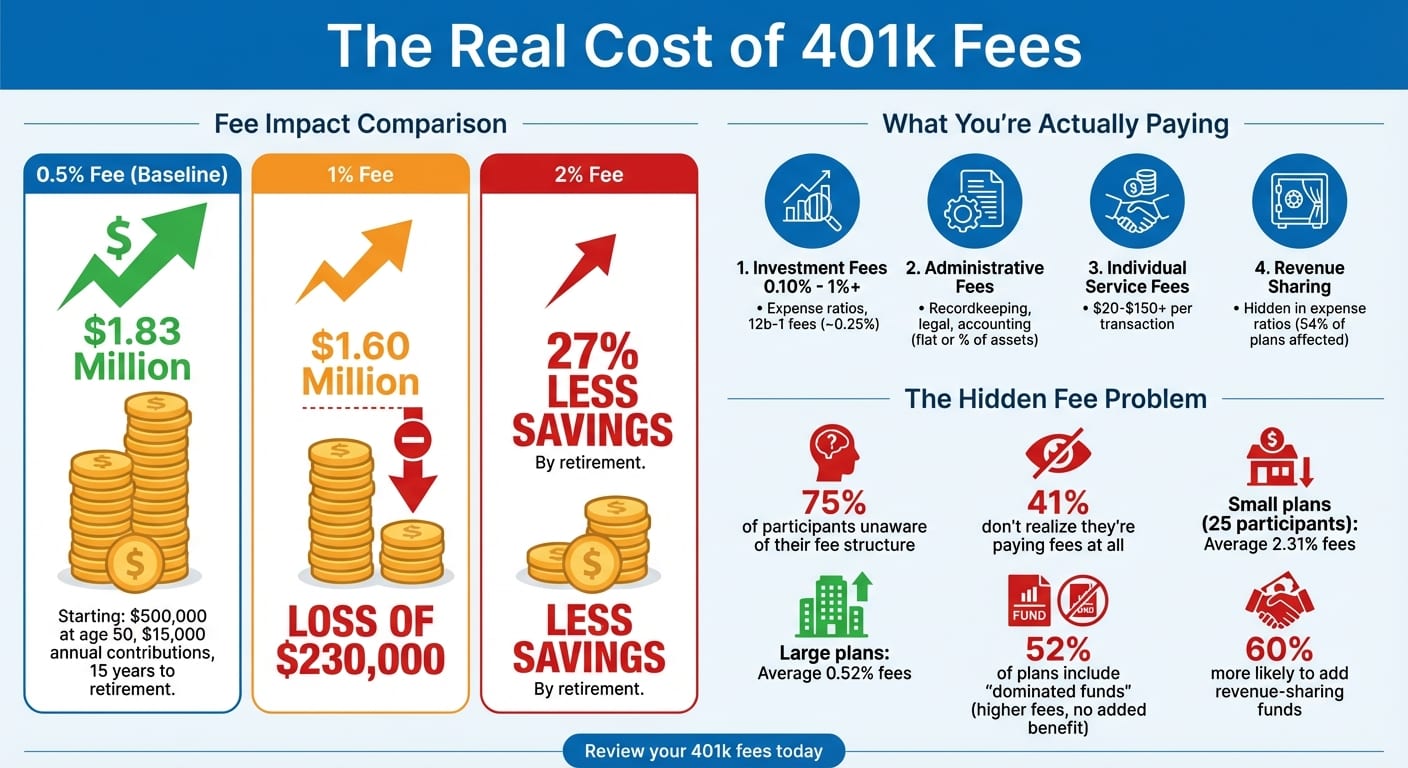
- Fees quietly reduce your savings: A 2% fee could leave you with 27% less by retirement compared to a 0.5% fee.
- Most people don’t know what they’re paying: 75% of participants are unaware of their fee structure.
- Limited fund choices hurt returns: Many plans include high-cost, underperforming funds due to conflicts of interest.
- Smaller plans charge more: Fees in small 401k plans can reach 2.31%, compared to 0.52% for larger plans.
To protect your savings:
- Review your plan’s fee disclosure documents.
- Opt for low-cost index funds when possible.
- Consider rolling over old 401k accounts into an IRA for better options.
- Use tools like Mezzi to analyze and reduce hidden costs.
Hidden Fees That Reduce Your 401k Returns
Common 401k Fees You're Paying
When it comes to your 401k, fees can quietly chip away at your returns. These fees generally fall into three categories: investment fees, administrative fees, and individual service fees. The most deceptive of these are investment fees, as they’re deducted directly from your returns, making them hard to spot.
Investment fees include expense ratios, which cover the cost of managing a fund, and 12b-1 fees, which are typically around 0.25% annually and go toward marketing and distribution. The cost of these fees depends on the type of fund you’re invested in. For example, index funds are generally cheaper, often costing less than 0.10%. In contrast, actively managed funds - especially those focused on areas like emerging markets or international stocks - can charge more than 1%. Michael Murray, president of Peabody Wealth Advisors, points out that "the higher fees are on actively managed mutual funds, especially areas where research is more expensive–emerging markets, international, and sector funds".
Administrative fees cover services like recordkeeping, legal work, accounting, and trustee oversight. Some employers absorb these costs, but many pass them on to employees. These fees can either be a flat dollar amount or a percentage of your assets, with asset-based fees being particularly concerning.
Another hidden cost comes from revenue-sharing arrangements. In these cases, fund providers pay part of their fees to the plan's record-keeper or administrator. A study of the 1,000 largest 401k plans revealed that 54% included at least one fund with revenue-sharing agreements.
The impact of these fees is more than just the immediate cost. Over time, they reduce not only your savings but also the potential growth and compounding gains. As the U.S. Department of Labor explains, "The cumulative effect of fees and expenses can substantially reduce the growth of your retirement savings".
Understanding these categories is key to spotting hidden fees in your 401k plan.
How to Find and Understand Hidden Fees
Now that you know the types of fees, it’s time to uncover them in your own plan.
Start by looking at your 404(a) Disclosure, also known as the Participant Fee Disclosure. This document, which the Department of Labor requires plans to provide annually, outlines both plan-level and investment-level fees. If you haven’t received it or can’t find it, reach out to your HR department or plan administrator.
Next, review the fund prospectus for details on expense ratios and hidden charges like sales loads. Pay close attention to 12b-1 fees, which are often buried within the expense ratio.
It’s also helpful to compare your plan’s expense ratios to industry benchmarks. For instance, large companies often offer plans with total fees below 0.5%, while smaller businesses may charge between 1.5% and 2%. In 2022, the average participant paid 0.52%, but smaller plans - those with as few as 25 participants and $250,000 in assets - faced average investment expenses of 1.37%.
Check your quarterly statements for individual service fees, and if anything is unclear, request a complete fee summary from your plan administrator. Be sure to ask about "all-in" costs, including indirect compensation like revenue sharing.
If you find the documents confusing, you’re not alone. Roughly 40% of participants don’t fully understand the fee information they receive, and 41% don’t even realize they’re paying fees. Justin Pritchard, a Certified Financial Planner at Approach Financial Planning, cautions that disclosure documents often fail to clearly outline all recordkeeping and administrative fees.
Limited Investment Options and Their Impact
The Problem with Limited Fund Choices
Many people assume their 401k plans offer a wide range of investment options, but the reality is often quite different. On average, a 401k plan provides around 22 choices, and about 40% of these are tied to the plan's own record-keeper. This setup creates a potential conflict of interest, as the same entity acts as both trustee and fund manager. While they’re supposed to choose the best options for participants, they have an incentive to promote their own products. Research highlights this bias: administrators remove only 13.7% of their own underperforming funds each year, compared to 25.5% of underperforming funds from external providers.
As Dan Kadlec puts it:
"This bias brings more poorly performing funds onto the menu... poorly performing funds tend to remain sub-par. That proves to be a long-term drag on participant returns".
Revenue-sharing arrangements further muddy the waters. Over half of 401k plans include at least one fund with such arrangements, and these funds are 60% more likely to be added, even when they don’t deliver better returns. Clemens Sialm, a finance professor at the University of Texas at Austin, cautions:
"The result is that you might be paying more than you realize for weaker returns".
Additionally, 52% of plans include "dominated funds" - ones with higher fees but no added retirement income diversification benefits. Regulations don't help much either. Employers are only required to offer three investment options to meet legal standards, which often leads to a bare-minimum selection rather than a thoughtfully curated menu.
This combination of limited choices, biased fund inclusion, and higher costs creates a significant hurdle for your 401k's growth potential.
How Poor Fund Choices Affect Your Retirement Savings
The impact of limited investment options goes beyond inconvenience - it directly affects your retirement savings. Hidden fees and restricted choices in the average 401k plan add up to an extra cost of 0.78% annually compared to low-cost index funds. While 0.78% might not sound like much, it compounds over time, significantly reducing your retirement nest egg.
Let’s break it down: imagine someone starts with $500,000 at age 50, contributing $15,000 a year. With a 1% annual fee, their account might grow to $1.60 million by age 65. But without that fee, the balance could reach $1.83 million - an extra $230,000 in savings. Even reducing fees by just 0.5% for someone contributing $10,000 annually over 20 years could save them around $10,000.
Younger workers face even greater challenges. In 16% of analyzed plans, fees are so high they effectively cancel out the tax benefits of a 401k. Smaller plans, particularly those with 50 participants and $500,000 in assets, often have total costs as high as 2.31%, compared to an average of 0.85%.
High-cost menus also encourage poor investment habits. Many participants spread their money across all available options without fully understanding them, leading to underperforming portfolios by default. This behavior, combined with the drag of hidden fees, underscores the importance of having access to better fund options. Without them, your retirement savings could fall far short of their potential.
Using Technology to Optimize Your 401k
How Mezzi Helps Identify Hidden Costs
401k fee structures can be incredibly confusing, leaving many employees unaware of how much they're actually paying. Over time, these fees can seriously cut into your savings, as they compound and reduce the growth of your retirement funds.
This is where AI-powered tools like Mezzi come in. Mezzi’s X-Ray feature shines a light on hidden fees and overlapping stock exposures that are often buried in dense policy documents. By scanning your fund options, it provides automated comparisons, pointing out lower-cost, higher-performing alternatives. Essentially, it helps you avoid funds that quietly drain your returns.
Here’s a striking statistic: a 2025 study revealed that over 54% of 401k plans included at least one investment fund that shared revenue with the plan's record-keeper. These revenue-sharing funds are 60% more likely to appear on a plan’s menu - even if they don’t offer better returns. Mezzi helps you uncover these potential conflicts of interest, empowering you to make smarter, more informed choices for your retirement.
But Mezzi doesn’t stop at identifying fees. It also offers proactive tools to help you fine-tune your overall retirement strategy.
Using Mezzi for Better 401k Management
Mezzi goes beyond just highlighting issues - it helps you understand the long-term impact of your financial decisions. Its Financial Calculator takes into account portfolio value, annual contributions, expected returns, and asset manager fees. For example, it can show the difference between paying a 0.75% fee and a 1.50% fee, giving you a clear picture of how fees affect your retirement timeline.
Consider this: saving just 1% in fees could add $186,877 to your retirement savings over time. On a $1 million portfolio, effective tax strategies through Mezzi might add $10,000 to $20,000 in annual wealth. The platform also helps you optimize your returns with features like tax-loss harvesting, wash sale tracking, and balancing contributions between Roth and Traditional accounts - strategies that could increase annual returns by 1% to 2%.
What’s more, Mezzi’s chat-based interface delivers advanced financial planning without the hefty 1% advisor fee. Over 30 years, that could mean saving over $1 million in fees. As Tim, the CEO of Somnee, shared:
"I loved chatting with the AI to make important changes to my portfolio. I haven't found another wealth app like Mezzi".
Practical Steps to Minimize Fees and Maximize Growth
Consolidating Accounts for Lower Costs
If you have multiple 401(k) accounts from previous jobs, you're probably paying duplicate fees, which can quietly chip away at your retirement savings. Combining these accounts into a single IRA can help you eliminate those redundant costs while giving you access to a broader selection of low-cost investment options.
Here’s an example: A 1% fee might not seem like much, but over 40 years, it could drain over $120,000 from your retirement savings on a $500 monthly contribution earning a 7% return. Many brokerages now offer no-fee IRAs, where the only expenses are the funds' expense ratios - typically much lower than the layered fees you’ll find in many 401(k) plans. By consolidating, you simplify account management and can more easily stick to your target asset allocation and tax strategies.
Once your accounts are merged, the next step is to select funds that keep your costs as low as possible.
Choosing Low-Cost Funds and Target-Date Options
Low-cost index funds are a smart choice, with expense ratios ranging from 0.10% to 0.5%. These funds are far cheaper than actively managed funds, which often charge over 1%. Over time, the difference is staggering: A plan with a 1.5% annual fee could leave you with about 17% less in retirement savings after 20 years compared to one charging only 0.5%.
Take a close look at your plan’s fee disclosure to identify funds with the lowest expense ratios. Institutional share classes and collective investment trusts (CITs) often come with reduced fees and may be available through large employers. If your plan’s fees are higher than 1.5%, it might make sense to contribute just enough to get your employer match, then put additional savings into a low-cost IRA.
Keeping fees low is crucial, but pairing this with smart tax strategies can take your growth even further.
Using Tax Optimization for Greater Savings
Tax inefficiencies can quietly eat into your returns. For instance, a wash sale - selling a security at a loss and then buying the same or a similar security within 30 days - can disqualify your tax deduction. This can dampen your long-term growth. Just as minimizing fees boosts your portfolio, avoiding tax missteps helps you keep more of your returns.
Mezzi’s tax optimization tools can help by avoiding wash sale violations across all your accounts and alerting you before you make a costly mistake. By staying proactive, you ensure more of your money stays invested and working for you, instead of unintentionally increasing your tax bill. This small effort can make a big difference in preserving your portfolio’s growth over time.
Are Hidden 401k Fees Taking Your Money?
Conclusion
Hidden fees, limited investment options, and outdated plans can quietly chip away at your retirement savings. With 401(k) fees averaging 0.52% in 2022 - and smaller plans reaching as high as 2.31% - the long-term impact on your nest egg can be significant.
But you’re not powerless. Start by taking a closer look at your fee disclosure documents. These will reveal exactly what you’re paying. From there, consider switching to low-cost index funds, which can help you save a substantial amount over time. If your 401(k) plan offers limited or pricey options, contribute just enough to secure your employer match, then allocate additional savings to a lower-cost IRA.
Mezzi simplifies this process by exposing hidden fees and pointing you toward lower-cost investment options. Instead of wading through dense disclosure documents, you can quickly identify costly funds and protect your savings.
"Being aware of these fees is the first step to making your 401(k) plan more profitable." - Investopedia
Take charge of your retirement. Review your plan, seek out cost-effective options, and let Mezzi’s AI-driven insights help you make the most of every dollar. Your future self will thank you.
FAQs
Which 401(k) fees matter most?
The fees that can most affect your 401(k) are investment fees, including expense ratios, and less obvious charges like revenue sharing and 12b-1 fees. These expenses chip away at your investment returns over time, so understanding and reducing them is key to maximizing long-term growth.
How can I calculate my plan’s total “all-in” fee?
To figure out the total fees for your 401(k), start by checking your plan’s fee disclosures, such as the 404a-5 document. Look for key components like the expense ratios of the funds you’ve chosen, administrative fees, and any less obvious charges, like trading fees or revenue sharing. Add these together to get a clear picture of your plan’s overall costs. This breakdown can help you evaluate whether your fees align with industry benchmarks and ensure you’re making the most of your retirement savings.
When does rolling a 401(k) into an IRA make sense?
Rolling over a 401(k) into an IRA might be a good move if your current 401(k) comes with high fees, limited investment options, or underwhelming performance. IRAs typically offer access to a broader range of investments and funds with lower costs, which could help boost your long-term growth potential. That said, keep an eye on possible rollover costs, such as administrative fees or expense ratios. It’s a good idea to weigh these factors carefully or talk to a financial advisor to make sure this decision fits your retirement goals.
Related Blog Posts
- Impact of Fees on Long-Term Investment Growth
- 401(k) Fees: How to Identify Hidden Costs
- Discover wich accounts are losing the most to fees and poor investment choices
- Finding hidden fees in investment portfolios
The fees that can most affect your 401(k) are investment fees, including expense ratios, and less obvious charges like revenue sharing and 12b-1 fees. These expenses chip away at your investment returns over time, so understanding and reducing them is key to maximizing long-term growth.
To figure out the total fees for your 401(k), start by checking your plan’s fee disclosures, such as the 404a-5 document. Look for key components like the expense ratios of the funds you’ve chosen, administrative fees, and any less obvious charges, like trading fees or revenue sharing. Add these together to get a clear picture of your plan’s overall costs. This breakdown can help you evaluate whether your fees align with industry benchmarks and ensure you’re making the most of your retirement savings.
Rolling over a 401(k) into an IRA might be a good move if your current 401(k) comes with high fees, limited investment options, or underwhelming performance. IRAs typically offer access to a broader range of investments and funds with lower costs, which could help boost your long-term growth potential. That said, keep an eye on possible rollover costs, such as administrative fees or expense ratios. It’s a good idea to weigh these factors carefully or talk to a financial advisor to make sure this decision fits your retirement goals.