If you earn too much to contribute directly to a Roth IRA, a Backdoor Roth IRA is a legal workaround. It’s a two-step process: you make a nondeductible contribution to a Traditional IRA and then convert it to a Roth IRA. This allows high-income earners to access tax-free growth and withdrawals in retirement, even if they exceed income limits by understanding the Roth vs. Traditional IRA tax implications.
In 2026, you can contribute up to $7,500 annually (or $8,600 if you're 50+). However, understanding the pro-rata rule, filing IRS Form 8606, and avoiding common mistakes like over-contributing or delaying conversion is essential to avoid tax issues.
Key Takeaways:
- Income limits: Direct Roth IRA contributions are barred for single filers earning $168,001+ and married couples earning $252,001+.
- Pro-rata rule: Pre-tax IRA balances impact how much of your conversion is taxable.
- Form 8606: This tracks your after-tax contributions and ensures proper tax reporting.
Backdoor Roth IRA 2026: Complete Tutorial (Step By Step)
2026 Contribution and Income Limits
Before diving into a backdoor Roth IRA strategy, make sure the 2026 income thresholds and contribution limits align with your financial plan. These limits, updated annually by the IRS to account for inflation, play a key role in determining whether you need the backdoor approach or can directly contribute to a Roth IRA.
Roth IRA Income Phase-Out Ranges
Your Modified Adjusted Gross Income (MAGI) determines whether you're eligible to contribute directly to a Roth IRA. To find your MAGI, start with your Adjusted Gross Income (AGI) from your tax return and add back certain deductions, such as student loan interest or foreign earned income exclusions.
Here are the 2026 phase-out ranges, based on filing status:
If your MAGI falls within the phase-out range, you can still make a partial direct contribution using an IRS formula. However, if your MAGI exceeds the upper limit - $168,000 for single filers or $252,000 for married couples filing jointly - you won’t qualify for direct contributions and will need to consider the backdoor Roth IRA method.
Once you've reviewed your income eligibility, the next step is understanding the contribution limits for 2026.
Annual IRA Contribution Limits
For 2026, the standard IRA contribution limit is $7,500 for individuals under 50, reflecting a $500 increase from 2025. For those aged 50 and older, an additional $1,100 catch-up contribution is allowed, raising the total limit to $8,600.
These limits apply to the combined contributions across Traditional and Roth IRAs. For example, if you contribute $3,000 to a Traditional IRA, you can only allocate $4,500 to a Roth IRA (if you're under 50). The deadline to make your 2026 contributions is April 15, 2027.
Be cautious not to exceed these limits. Over-contributions can result in a 6% IRS penalty unless the excess and any associated earnings are withdrawn before the tax filing deadline.
How to Execute a Backdoor Roth IRA: 5 Steps
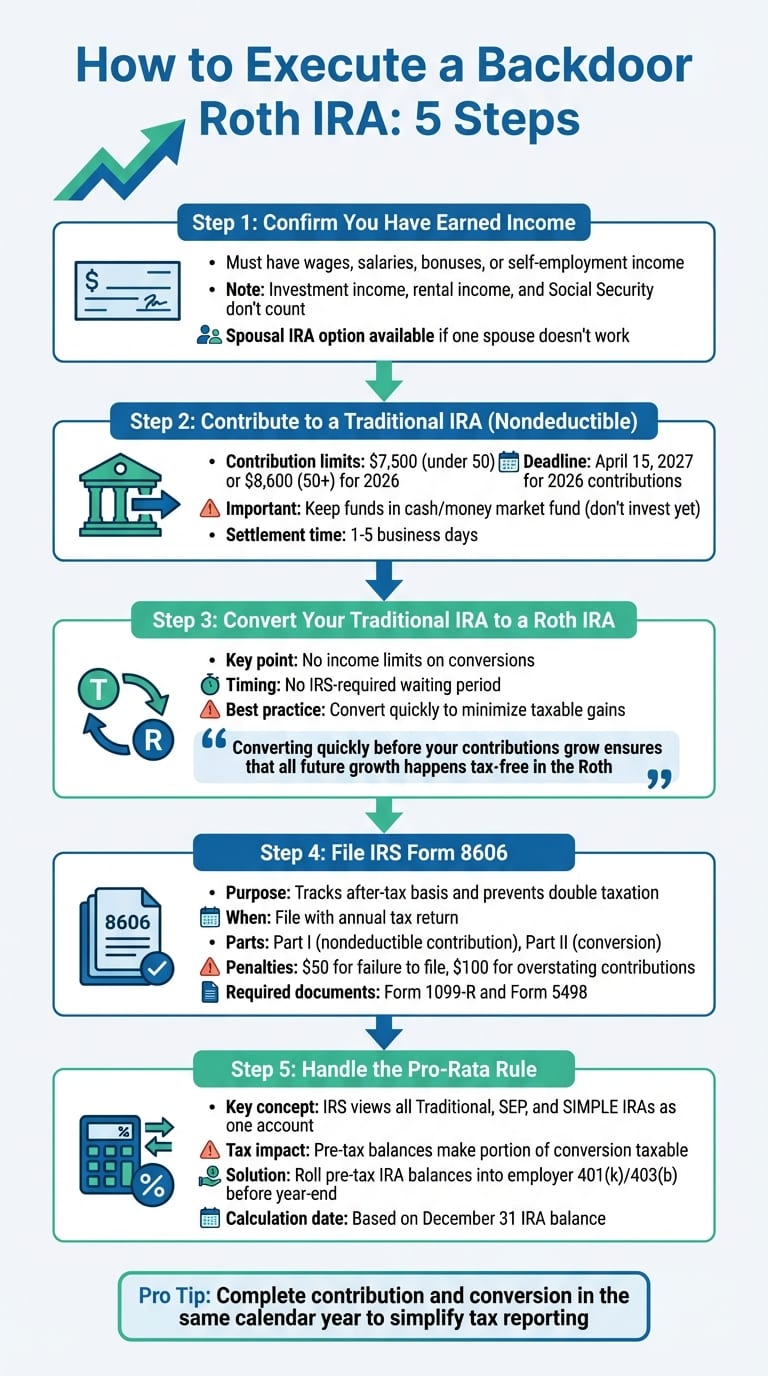
If your income surpasses the limits for direct Roth IRA contributions, you can still take advantage of the benefits using a backdoor strategy. Here’s a step-by-step guide to converting nondeductible contributions into tax-free Roth funds.
Step 1: Confirm You Have Earned Income
Start by ensuring you have enough earned income to cover your contribution. This includes wages, salaries, bonuses, or self-employment earnings - essentially, money you make from working. Keep in mind that investment income, rental income, or Social Security payments don’t count. Your earned income must match or exceed the amount you plan to contribute. If you’re married and one spouse doesn’t work, the working spouse’s income can support a spousal IRA contribution, enabling both of you to use the backdoor Roth strategy.
Step 2: Contribute to a Traditional IRA (Nondeductible)
Next, open a Traditional IRA with a brokerage like Fidelity, Vanguard, or Schwab. Transfer funds from your bank account up to the annual limit - $7,500 for 2026 if you’re under 50, or $8,600 if you’re 50 or older. Since your income exceeds the tax deduction thresholds, these are considered nondeductible contributions, meaning you’re contributing after-tax dollars.
Make sure to allocate the contribution to the correct tax year. For 2026, you have until April 15, 2027, to complete this step. Keep the funds in a cash or money market settlement fund instead of investing them right away - this avoids generating taxable gains before conversion. Most brokerages require 1–5 business days for funds to settle before you can proceed with the next step.
Step 3: Convert Your Traditional IRA to a Roth IRA
Once your contribution has settled, initiate the conversion to a Roth IRA. If you don’t already have a Roth IRA, open one at the same brokerage to streamline the process. One feature of this strategy is that the conversion itself has no income limits, making it accessible to high earners.
"Converting quickly before your contributions grow means that future growth in the Roth can be tax-free, potentially maximizing your long-term tax savings." - Investopedia
The IRS does not require a waiting period between making a contribution and converting it. Acting promptly limits any taxable investment gains in the Traditional IRA, ensuring the conversion remains as tax-efficient as possible.
Step 4: File IRS Form 8606
You’ll need to file Form 8606 to document the nondeductible contribution and the conversion. This form tracks your "basis" - the after-tax dollars you contributed - and ensures the IRS knows you’ve already paid taxes on those funds. Without it, the IRS might mistakenly treat the entire conversion as taxable, leading to double taxation.
File Form 8606 along with your annual tax return. Part I records your nondeductible contribution, while Part II reports the conversion. You’ll need Form 1099-R from your brokerage (detailing the distribution) and Form 5498 (confirming the contribution) to complete it accurately. Missing this step could result in penalties: $50 for failing to file and $100 for overstating nondeductible contributions. Keep copies of all Form 8606 filings to prevent future tax issues.
Finally, you’ll need to address the pro-rata rule.
Step 5: Handle the Pro-Rata Rule
The pro-rata rule is where things can get tricky. The IRS views all your Traditional, SEP, and SIMPLE IRAs as a single account when calculating taxes on conversions. If you have pre-tax balances in these accounts at the end of the year, a portion of your conversion will be taxable - regardless of whether you’re converting nondeductible contributions.
For example, if your nondeductible contribution makes up 25% of your total IRA balance, only 25% of the conversion will be tax-free. To avoid this, consider rolling any pre-tax IRA balances into your current employer’s 401(k) or 403(b) plan before year-end. This strategy removes those funds from the pro-rata calculation, allowing your backdoor Roth conversion to potentially be tax-free.
Tax Rules You Need to Know
Understanding how the IRS taxes your Roth IRA conversion is crucial to avoid unexpected costs. Two main factors influence your tax liability: the pro-rata rule and the timing of your conversion.
How the Pro-Rata Rule Works
The pro-rata rule plays a key role in determining how much of your conversion will be taxed.
The IRS views all your Traditional, SEP, and SIMPLE IRAs as one combined account. When you convert funds to a Roth IRA, the taxable portion is calculated based on the ratio of pre-tax to after-tax contributions across all your IRAs.
The pro-rata rule says that all IRAs are treated as one IRA. This means that any funds converted to Roth will be taxed proportionally according to the amount of pre-tax and after-tax funds subject to the conversion.
Willis Johnson & Associates
The taxable amount hinges on your total IRA balance as of December 31 of the conversion year - not the date you actually convert. For example, if you contribute $7,500 in after-tax dollars but have $94,000 in a pre-tax rollover IRA, about 94% of the conversion amount will be taxable. This rule often surprises investors - nearly 40% are unaware of it, leading to unexpectedly high tax bills.
When to Convert and Tax Consequences
The IRS does not enforce a waiting period between making a nondeductible contribution and converting it to a Roth IRA. To reduce taxable gains, convert as soon as your funds settle - usually within 1 to 3 business days. Keep the contributions in cash or a money market fund until the conversion is complete. For instance, if your $7,500 grows to $7,600 before conversion, the additional $100 will be taxable.
It’s also wise to avoid tax withholding during the conversion process, as withholding reduces the amount transferred to your Roth IRA.
Whenever possible, contribute and convert in the same calendar year to simplify tax reporting and minimize the risk of unintended taxable growth.
Carson McLean, CFP, Founder of Altruist Wealth Management
4 Common Mistakes to Avoid
These mistakes can lead to unexpected tax bills or even IRS penalties - but the good news is they’re completely preventable with the right planning. Knowing these common pitfalls can help you successfully navigate a backdoor Roth IRA strategy.
Ignoring the Pro-Rata Rule
If you have pre-tax funds in Traditional, SEP, or SIMPLE IRAs, the IRS requires you to convert a proportional mix of pre-tax and after-tax money. You can’t simply choose to convert only the after-tax dollars.
Here’s an example: One taxpayer ended up with nearly all of their converted funds being taxable due to pre-tax balances, resulting in an unexpectedly high tax bill.
To avoid this, you might roll your pre-tax IRA funds into an employer-sponsored 401(k) or 403(b) before starting the conversion process. Just double-check that your employer’s plan allows rollovers from IRAs.
Waiting Too Long to Convert
Delaying the conversion means more taxable growth. While your original nondeductible contribution itself isn’t taxed, any earnings on that money are taxed as ordinary income.
Waiting too long can create issues as well. Any earnings that happen before the conversion takes place are taxable.
Michael Kitces, Nerd's Eye View
To minimize taxable gains, convert your funds as soon as they settle - usually the next business day. This approach also simplifies filing IRS Form 8606. During this short period, consider keeping your contribution in a money market fund or cash equivalent to avoid unnecessary growth.
Contributing Too Much or Miscalculating MAGI
Contributing more than the 2026 limit of $7,500 ($8,600 if you’re 50 or older) will result in IRS penalties. Additionally, incorrectly calculating your Modified Adjusted Gross Income (MAGI) could lead to costly mistakes. For instance, making a direct Roth IRA contribution when you’re not eligible triggers an excess contribution penalty.
Perhaps the biggest mistake is not doing your Roth IRA through the backdoor when your income was so high that you had to.
Jim Dahle, Founder, The White Coat Investor
To calculate MAGI correctly, start with your Adjusted Gross Income (AGI) from Form 1040 and add back items like traditional IRA deductions, student loan interest, and foreign earned income exclusions. If your income is near the phase-out range ($153,000–$168,000 for single filers or $242,000–$252,000 for married couples filing jointly in 2026), the backdoor method is often the safer bet.
Forgetting to File Form 8606
Form 8606 is essential for tracking your after-tax basis when you make a nondeductible contribution or complete a conversion. If you skip this form, the IRS may treat the entire conversion as taxable income, wiping out any tax advantage.
Failing to file can result in a $50 penalty, and overstating your nondeductible contributions could lead to a $100 penalty. If you mistakenly claimed a deduction for a contribution that should have been nondeductible, you’ll need to amend your return using Form 1040X to fix the error.
Getting the Most from Your Backdoor Roth IRA
To potentially benefit from your backdoor Roth IRA, it's crucial to follow IRS rules carefully, convert funds promptly, and ensure your pre-tax IRA balances are zero by the end of the year. The process is straightforward: contribute nondeductible funds to a Traditional IRA, then convert them to a Roth IRA. However, success hinges on understanding key details like the pro-rata rule, filing IRS Form 8606, and confirming that your Traditional IRA balance is zero by December 31.
Ms. Client, whereas your tax preparer is focused almost exclusively on last year, one of my jobs is to keep you ahead of the IRS for decades.
Michael Henley, Financial Advisor
If you have existing pre-tax IRA balances, consider transferring those funds into an employer-sponsored retirement plan. This step can help increase the tax efficiency of your conversion. Additionally, convert your contribution as soon as possible to reduce the risk of taxable gains. Keeping the funds in a money market account during this time can also help avoid unexpected gains from market fluctuations. These strategies help you potentially increase tax benefits while staying compliant with IRS requirements.
Keeping accurate records is essential to safeguard your tax advantages. Be sure to document every transaction and retain key forms, including your filed Form 8606, any Form 1099-R from the conversion, Form 5498 confirming the contribution, and December 31 statements for all IRA accounts. These records are your proof of the after-tax basis and protect you from double taxation down the road.
For high earners, the long-term benefits can be significant. For example, contributing $7,500 annually over 20 years with a 10% growth rate could result in approximately $430,000 in tax-free account value. Key considerations? Consistency, meticulous record-keeping, and strict adherence to IRS rules.
FAQs
Do I owe taxes on a backdoor Roth conversion?
Yes, taxes might be due on a backdoor Roth conversion if your traditional IRA includes pre-tax funds. When you convert, the IRS considers it a taxable event, so any pre-tax contributions or earnings in the account will be subject to income tax. It's a good idea to review your IRA balances carefully and refer to IRS guidelines to prevent surprises during tax season.
How do I avoid the pro-rata rule?
When executing a Backdoor Roth IRA, it's crucial to minimize or eliminate existing traditional IRA assets to steer clear of the pro-rata rule. One effective strategy is rolling over your current IRA balances into a 401(k) or another employer-sponsored plan. This approach may help you avoid proportional taxation on conversions and may make it easier to comply with IRS guidelines.
Can I do a backdoor Roth if I already have IRA money?
Yes, you can still execute a backdoor Roth IRA even if you already have funds in an IRA. The process involves making a contribution to a traditional IRA and then converting that amount into a Roth IRA. However, be aware that any existing IRA balances can impact the tax consequences of this conversion. Proper planning is essential to manage potential tax liabilities and avoid surprises.
Related Blog Posts
- Roth IRA Contribution Timing for High Earners
- What is a mega backdoor roth?
- What is backdoor roth conversion?
- Can I contribute to a Roth IRA if I’ve already contributed to a Traditional IRA (including backdoor options)?
Yes, taxes might be due on a backdoor Roth conversion if your traditional IRA includes pre-tax funds. When you convert, the IRS considers it a taxable event, so any pre-tax contributions or earnings in the account will be subject to income tax. It's a good idea to review your IRA balances carefully and refer to IRS guidelines to prevent surprises during tax season.
When executing a Backdoor Roth IRA, it's crucial to minimize or eliminate existing traditional IRA assets to steer clear of the pro-rata rule. One effective strategy is rolling over your current IRA balances into a 401(k) or another employer-sponsored plan. This approach may help you avoid proportional taxation on conversions and may make it easier to comply with IRS guidelines.
Yes, you can still execute a backdoor Roth IRA even if you already have funds in an IRA. The process involves making a contribution to a traditional IRA and then converting that amount into a Roth IRA. However, be aware that any existing IRA balances can impact the tax consequences of this conversion. Proper planning is essential to manage potential tax liabilities and avoid surprises.