
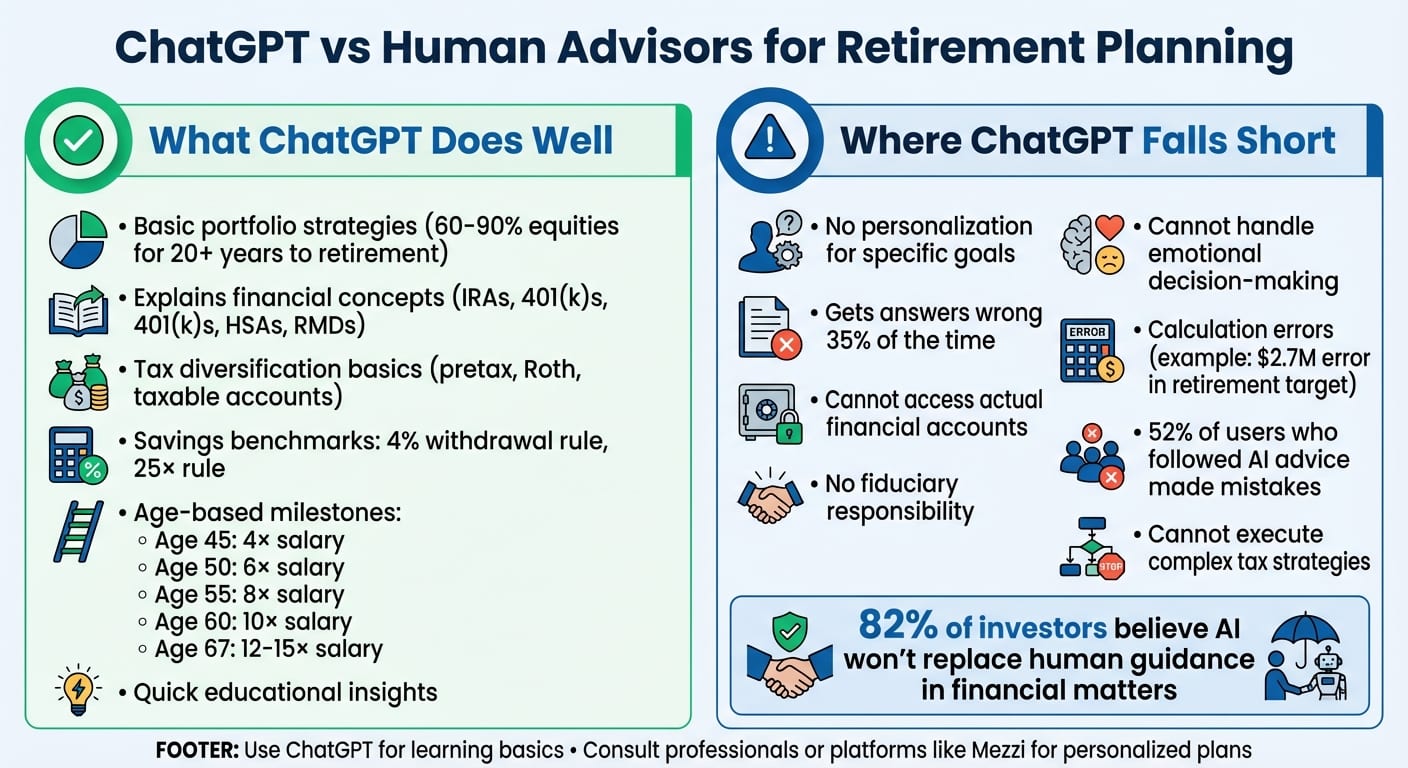
ChatGPT can provide quick, general retirement advice by simplifying complex terms, offering basic savings strategies, and explaining concepts like retirement tax strategies and market impacts. It’s a great starting point for understanding financial principles. However, it lacks the ability to personalize advice, handle intricate tax strategies, or account for emotional decision-making during market volatility. Errors in calculations and generic assumptions can lead to flawed guidance. While tools like ChatGPT are helpful for learning, they can’t replace the expertise of a human advisor or platforms with full financial visibility like Mezzi. Use ChatGPT for basic insights, but consult professionals for tailored plans.
What ChatGPT Does Well for Retirement Planning
Basic Portfolio Strategies and Financial Principles
ChatGPT is particularly good at breaking down complex investment ideas into plain language. For instance, if you're more than 20 years away from retirement, it might suggest a growth-focused portfolio with 60% to 90% in equities. As you get closer to retirement, it recommends gradually shifting to a more balanced allocation. This advice aligns with long-standing principles many financial advisors use.
The tool also simplifies financial concepts like IRAs, 401(k)s, HSAs, and RMDs. It reinforces smart habits, such as taking advantage of employer matching contributions and automating savings. Additionally, it explains how market downturns or unexpected expenses can impact long-term plans. These foundational strategies set the stage for more advanced planning, like managing taxes effectively.
Tax Optimization Basics
ChatGPT builds on these foundational strategies by offering clear guidance on tax-efficient savings. It emphasizes the importance of tax diversification - spreading your savings across pretax 401(k)s, Roth IRAs, and taxable brokerage accounts. This approach gives you flexibility to manage tax brackets in retirement. It also explains when a Roth conversion might be advantageous, such as during lower-income years before Social Security kicks in.
Here’s a quote from ChatGPT, as shared by Laura Beck:
Try to diversify tax exposure... Having different types of accounts gives you more options for withdrawals and managing taxes in retirement.
ChatGPT
The tool also highlights potential tax challenges, like Required Minimum Distributions (RMDs) starting at age 73, which can push you into a higher tax bracket if not planned for. It explains the triple-tax advantage of Health Savings Accounts (HSAs): deductible contributions, tax-free growth, and tax-free withdrawals for medical expenses. While it doesn’t replace personalized advice, ChatGPT provides a strong framework for understanding these key principles.
Retirement Savings Rules and Estimates
ChatGPT simplifies well-established savings benchmarks, like the 4% withdrawal rule and the 25× rule. For example, if you need $50,000 annually in retirement, it suggests targeting $1.25 million in savings. It also incorporates age-based savings milestones to help you gauge your progress:
For those on track, it recommends saving 15% to 25% of your gross income. However, if you’re starting later, it suggests increasing that rate to over 35%. ChatGPT also factors in inflation, often assuming a 3% annual rate, to help you understand how your purchasing power could change over time. While these calculations are based on general assumptions, they provide a helpful starting point for evaluating your progress and making adjustments as needed.
Can ChatGPT Plan Your Retirement?: Generative AI and Financial Advice
Where ChatGPT Falls Short in Retirement Planning
ChatGPT can provide broad strategies for retirement planning, but it often misses the finer details that make each financial journey unique.
Missing Personalization and Specific Goal-Setting
ChatGPT struggles to account for the intricate details of your financial life. Whether you're planning to leave an inheritance, budgeting for healthcare costs, or aiming to retire early for travel, it can't fully tailor its advice to your goals. Instead, it relies on generic assumptions that might not fit your situation. In fact, 82% of investors believe AI won't replace human guidance in financial matters. Adding to this, AI tools like ChatGPT aren't bound by fiduciary responsibilities, meaning they aren't legally required to prioritize your best interests. These gaps highlight its limitations in handling complex financial strategies.
Complex Tax Strategies and Execution Gaps
When it comes to tax strategies, ChatGPT can explain basic concepts like Roth conversions or retirement income diversification. However, it falls short in crafting and executing plans tailored to your specific financial picture. Take the example of Eric Franklin, CFP and managing principal at Prospero Wealth, who reviewed a ChatGPT-generated retirement plan in March 2026. The plan, designed for a 40-year-old earning $125,000, used the outdated 4% rule and set a retirement goal of $2.5 million. After accounting for inflation, the correct target should have been $5.2 million - a glaring $2.7 million error.
The math is literally wrong... I was a little bit appalled, that the simple task… it's literally not even calculating the contribution strategy to get close to what it's trying to achieve.
Eric Franklin, CFP and Managing Principal, Prospero Wealth
Mistakes like these can lead to missed opportunities or inefficient tax planning. Beyond technical errors, ChatGPT also falters when it comes to addressing the emotional side of financial decisions.
Emotional Decision-Making During Market Volatility
Market volatility can test even the most seasoned investors. ChatGPT, however, lacks the empathy and judgment needed to guide you through emotional challenges. Fifty-two percent of Americans who acted on AI-generated financial advice later reported making mistakes. Human advisors, on the other hand, provide accountability and emotional support during tough times, helping you stay focused on your long-term goals instead of reacting impulsively.
ChatGPT can be a great tool for explaining retirement concepts... but it's not the whole toolbox. It can't anticipate human behavior, emotion, or life's curveballs.
Stephan Shipe, CFP and Founder, Scholar Financial Advising
Retirement planning isn’t just about numbers - it’s about aligning your finances with your values, legacy, and purpose. These deeply personal elements require the nuanced judgment and empathy that only a human advisor can provide.
Why Generic Advice Based on User Inputs Isn't Enough
ChatGPT provides retirement advice based solely on the data you enter. This means the quality of its guidance depends entirely on the accuracy and completeness of what you input. Without a full picture of your financial situation, the AI relies on assumptions, which can lead to advice that doesn't align with your reality.
The Problem with Hypothetical Data
Because ChatGPT lacks "know your client" capabilities, it rarely questions vague or incomplete inputs, often resulting in generic advice. In fact, studies show that ChatGPT gets personal finance questions wrong 35% of the time.
One review pointed out how the AI's hypothetical calculations could leave users far short of their actual retirement needs, highlighting the risks of relying on estimated figures. Since AI tools depend on pattern recognition rather than true understanding, they often apply generic data from their training sets to your specific situation. This approach can fail to account for key factors like your age, income, or goals.
For example, entering identical financial data produced different retirement estimates when the location was changed from New Jersey to Mississippi. This inconsistency underscores the danger of relying on generalized advice.
The Benefit of Complete Financial Visibility
The core limitation of ChatGPT is its inability to access your full financial picture. It doesn't know the details of your portfolio, your current tax obligations, or how fees affect your investments - unless you manually provide that information.
This is where tools like Mezzi come in. By connecting securely to all your accounts, such as 401(k)s, brokerage accounts, Roth IRAs, and taxable accounts, Mezzi provides a real-time, comprehensive snapshot of your finances. With this complete visibility, it can deliver advice based on actual balances, tax liabilities, and portfolio performance. Instead of relying on hypothetical data, Mezzi offers personalized, accurate plans tailored to your unique financial situation.
When You Need Specialized Tools or Human Advisors
ChatGPT can provide general guidance, but it falls short when it comes to accessing your actual financial data or implementing specific strategies. For serious retirement planning, tools with a full financial perspective and expert insights are essential. This is where platforms like Mezzi step in, offering a level of detail and functionality that ChatGPT simply cannot match.
Account Aggregation for Better Retirement Insights
One major limitation of ChatGPT is that it doesn’t know what assets you own. It has no visibility into your 401(k) balance, overlapping ETF holdings, or potential tax inefficiencies. Luke Harder, a Certified Financial Planner at Claro Advisors, puts it clearly:
"It doesn't know your full financial picture: your portfolio composition, tax situation, or how you personally handle market volatility".
While ChatGPT can offer broad advice, Mezzi takes things further by securely aggregating all your financial accounts. Using read-only access, it connects to everything - 401(k)s, brokerage accounts, Roth IRAs, taxable accounts, and more. This unified view helps uncover issues that generic AI tools simply miss, like duplicate holdings, risks tied to wash sales during tax-loss harvesting, or improper asset placement that leads to unnecessary taxes. With this level of detail, Mezzi identifies opportunities that might otherwise cost you thousands in advisory fees - sometimes exceeding $10,000 annually. Having a complete financial snapshot enables you to tackle more intricate challenges with confidence.
When to Move Beyond AI
Certain retirement scenarios require more than just algorithms and pattern recognition. For example, managing complex tax strategies - such as timing Roth conversions to stay within Medicare premium brackets or handling required minimum distributions across multiple inherited IRAs - demands human expertise and critical thinking.
Because ChatGPT cannot execute trades or synchronize advice across multiple accounts, there’s often a gap between guidance and action. Mezzi addresses this by offering fiduciary-level insights tailored to your actual portfolio. It doesn’t just stop at advice - it guides you through actionable steps. For instance, it can alert you when the 30-day wash sale window has passed, so you can confidently rebuy securities after tax-loss harvesting. This hands-on approach ensures you’re not left navigating complex financial decisions alone.
How to Use ChatGPT Safely for Retirement Planning
ChatGPT can be a helpful resource for understanding retirement planning concepts, but its effectiveness depends on how you interact with it. Clear, detailed prompts and careful handling of your financial information are key to using it safely.
Effective Prompts for Better Results
The quality of ChatGPT's answers often hinges on how specific your questions are. For instance, instead of asking something broad like, "How much money do I need to retire?" try framing a detailed query such as:
"Act as a retirement planner and estimate how long $850,000 might last if I retire at 65, spend $5,000 a month, get $2,000 in Social Security, and earn a 5% investment return."
John Rampton, CEO of Due, shared an example where he used ChatGPT to explore a retirement strategy. By asking for a "5-year Roth conversion strategy starting at age 63" for a couple retiring in 2026 with $1.2 million in a 60/40 portfolio, he demonstrated how specific prompts can lead to actionable insights, such as ways to lower future Required Minimum Distributions (RMDs).
Don’t stop at a single question - treat ChatGPT like an ongoing conversation. Follow up on broad responses with clarifying questions to refine the advice and make it more relevant to your scenario.
Once you’ve mastered crafting clear prompts, the next step is protecting your personal data.
Protecting Your Financial Data
When using ChatGPT, make sure to safeguard your financial details. Avoid sharing sensitive information like Social Security numbers, bank account details, or exact balances. Instead, use general figures - like "$500,000 in savings" instead of "$523,467" - and refer to account types generically (e.g., "traditional IRA" or "taxable brokerage account") without naming specific institutions.
It’s important to remember that ChatGPT is not a licensed fiduciary. While it can provide general guidance, it doesn’t adhere to the same regulatory standards or confidentiality protections as a human financial advisor.
Recognizing When You Need Professional Help
While ChatGPT can provide helpful insights, it’s not a substitute for a professional advisor. It lacks the ability to analyze your full financial picture or handle complex scenarios like tax strategies, inherited IRAs, or Roth vs. Traditional IRA tax implications.
For situations requiring a deeper understanding, tools like Mezzi can securely aggregate all your financial accounts and offer tailored advice that generic AI tools cannot. Use ChatGPT as an educational tool or starting point, but always consult a professional or a platform with full visibility into your accounts before making significant financial decisions.
Conclusion: Balancing AI and Human Expertise
Combining AI with professional expertise is a smart way to approach retirement planning. Tools like ChatGPT are excellent for providing a basic understanding and running quick "what-if" scenarios. But it’s important to remember their limitations. ChatGPT doesn’t have fiduciary responsibility, can’t access your actual financial accounts, and may occasionally provide inaccurate information. In fact, a Morgan Stanley survey revealed that 82% of investors believe AI will never fully replace human guidance.
The real risk comes from overestimating AI’s capabilities. Gary Smith, Senior Fellow at the Walter Bradley Center for Natural and Artificial Intelligence, highlights this concern:
"The real danger today is not that computers are smarter than us. Rather, it is that we think computers are smarter than us and consequently trust them to make decisions they should not be trusted to make".
AI-generated advice, while helpful for general insights, can’t account for personal factors like your tax situation, health, or emotional responses to market downturns. For critical retirement decisions, you need a solution that offers complete financial clarity.
That’s where Mezzi comes in. Unlike ChatGPT, Mezzi provides SEC-registered fiduciary insights, offering a level of detail AI can’t match. It evaluates your entire financial picture, flags tax-saving opportunities, identifies wash sale risks across accounts, and suggests rebalancing strategies tailored to your actual portfolio. This isn’t generic advice - it’s actionable guidance based on your real data. Plus, unlike traditional advisors who only see the assets they manage, Mezzi has full visibility across your financial accounts, all without charging the usual 1% AUM fee.
AI is a great starting point for learning and exploring broad concepts, but when it comes to decisions that impact your long-term financial security, it’s essential to rely on professionals and tools that are legally obligated to act in your best interest. The key is knowing when to use AI and when to trust human expertise.
FAQs
What should I double-check before trusting ChatGPT’s retirement math?
Always double-check ChatGPT's calculations and assumptions, especially when it comes to areas like investment returns or inflation rates. Its recommendations depend entirely on the data you provide and may not fully account for the details of your personal financial situation. Make sure its suggestions align with your unique financial goals, as it cannot provide the depth of personalized advice a professional would offer.
What details should I include in a prompt to get a useful retirement estimate?
To calculate a meaningful retirement estimate, it’s important to provide specific details. These include your current income, monthly expenses, existing savings, desired retirement age, expected investment returns, estimated inflation rate, and projected healthcare costs. The more accurate and detailed the information, the better the AI can tailor its insights to your situation.
When do I need Mezzi or a human advisor instead of AI?
When your financial goals demand tailored advice, empathy, or current knowledge of policies, you'll find Mezzi or a human advisor indispensable. AI tools like ChatGPT are great for general guidance, but they fall short when it comes to addressing the finer details of your unique situation. For intricate financial planning and decisions, the expertise and understanding of a human professional often make all the difference.
Related Blog Posts
- AI Tools for Tax-Efficient Retirement Planning
- AI Tools for Retirement Withdrawal Planning
- Best AI tools to help you answer the question "How much money do I need to retire?"
- AI Tools for Optimizing Retirement Savings Rates
Always double-check ChatGPT's calculations and assumptions, especially when it comes to areas like investment returns or inflation rates. Its recommendations depend entirely on the data you provide and may not fully account for the details of your personal financial situation. Make sure its suggestions align with your unique financial goals, as it cannot provide the depth of personalized advice a professional would offer.
To calculate a meaningful retirement estimate, it’s important to provide specific details. These include your current income, monthly expenses, existing savings, desired retirement age, expected investment returns, estimated inflation rate, and projected healthcare costs. The more accurate and detailed the information, the better the AI can tailor its insights to your situation.
When your financial goals demand tailored advice, empathy, or current knowledge of policies, you'll find Mezzi or a human advisor indispensable. AI tools like ChatGPT are great for general guidance, but they fall short when it comes to addressing the finer details of your unique situation. For intricate financial planning and decisions, the expertise and understanding of a human professional often make all the difference.