
A collectible car may hold value over time, but it may also bring high costs, slow sales, and tax drag. In the data cited, classic cars returned 5.6% a year nominal and 3.4% real from 1998 to 2017, before the full weight of storage, insurance, maintenance, and selling friction.
Here’s the short version:
- Ferrari may offer more upside in top-tier models, but prices may swing more and service bills may be steep.
- Porsche may draw a broader buyer pool, with more usable cars and lower ownership friction.
- Other blue-chip classics like the Mercedes-Benz 300 SL may sit in between: strong collector interest, but a thinner market.
- Net results may depend less on the badge alone and more on rarity, originality, records, condition, and sale venue.
- U.S. owners may also face auction fees, months-long exit timelines, and a federal collectibles tax rate up to 28%, with some cases reaching 40.8% when NIIT applies.
If I were to boil the whole piece down to one line, it would be this: ***a collectible car may work better as a small, high-risk side holding than as a core investment.***
The Ultimate Guide To Classic Car Investing With Peter Klutt
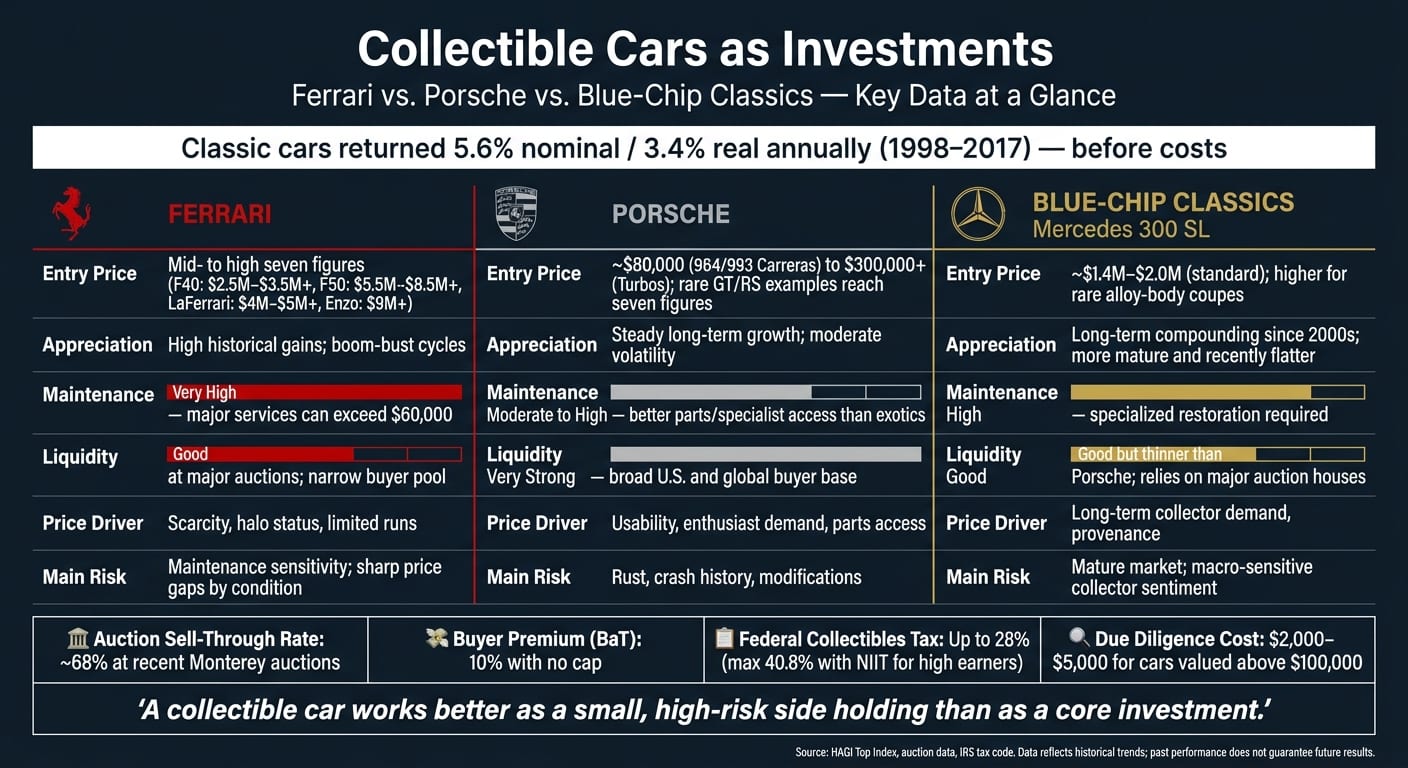
Quick comparison
The main takeaway may be simple: if the car would still make sense to own without price gains, then it may fit better. If not, the risk may be higher than it first appears.
How collectible cars work as an asset class
Collectible-car prices may depend more on collector demand, rarity, condition, originality, and documentation than on cash flow. That makes this market feel very different from stocks, bonds, or rental property. In many cases, the value gap between two cars that look similar on paper may come down to brand strength, rarity, condition, and provenance.
There’s also a liquidity issue. Selling at full value may take time, so fast exits may be hard. A car may be worth one number in theory and another number in the timeframe a seller actually has.
Return potential, volatility, and why timing matters
Classic-car returns may be strong in some periods, but the market may also be cyclical. The HAGI Top Index tracks benchmark models, and Ferrari and Porsche sub-indexes often move differently from the broader market. Put simply: Ferrari and Porsche may not move in lockstep with the rest of the classic-car space, which means model selection may matter just as much as market timing.
Auction results may also make returns look better than what an owner actually receives. Auction commissions, transport, detailing, storage, and the time it may take to find a buyer willing to pay market price may all reduce what a seller actually pockets. So the headline sale price may tell only part of the story.
That’s why the sharper question may not be, “Did the market go up?” It may be: which Ferrari and Porsche models have the strongest collector demand?
Why allocation size matters more than enthusiasm
Classic-car prices may make the most sense as gross prices. Fees, transport, storage, and sale delays may reduce net gains. Enthusiasm may get someone into the market, but position size may shape the outcome more than excitement does.
From there, the next step may be checking whether a specific car’s history and carrying costs justify its asking price.
What drives appreciation in Ferrari, Porsche, and other classics
Not every classic car goes up in value. The ones that do usually share a small set of traits that show up again and again.
Brand strength, rarity, and model desirability
These traits matter because collector demand doesn't flow evenly across every brand or every model. Ferrari and Porsche tend to draw steady interest for a reason. Both brands have long motorsport histories, famous designs, and enthusiast groups that stay active through different market cycles. That steady demand may create a more reliable buyer base, which may matter a lot when it's time to sell.
But even within those brands, the pecking order matters. Ferrari and Porsche both have clear internal ladders: standard production cars, special editions, track-focused variants, and homologation models built to satisfy racing rules. Cars near the top of that ladder often trade at higher prices. A homologation car like a Porsche 911 Carrera RS or a limited-production Ferrari blends rarity with motorsport relevance, and that mix may push prices well above a standard production car from the same period.
Originality, condition, and documentation
Collectors tend to pay for correctness, not just a shiny presentation. Originality - matching-numbers drivetrain components, factory-correct paint and trim, and original options - usually draws a premium over cars that have been changed, even when the changed car looks newer or cleaner.
A documented 1988 Ferrari 328 GTS with Ferrari Classiche certification may trade far above a similar car without full records. Maintenance history matters for the same reason. Deferred service on a high-value Ferrari or Porsche may become expensive in a hurry, so a full paper trail showing regular servicing, major interval work, and specialist inspections may lower buyer concern and support pricing. Missing records don't just create uncertainty - they often show up as a discount.
Provenance, liquidity, and sale venue
Provenance sits on top of originality. A car with documented ties to a notable owner, a major race result, or a factory-built special may command a premium over an otherwise similar car. But the key word is documented. Clear chain-of-ownership records, period photographs, and verifiable race history are what tend to support a provenance premium.
The same factors may also shape how fast a car sells and how much discount the seller may need to accept.
Where a car sells may shape the outcome too. Auctions offer price discovery and broad reach, but fees, volatility, and missed reserves may reduce net proceeds - recent Monterey auctions saw sell-through rates fall to around 68%. Specialist dealers offer vetting and convenience, but they usually build in a retail spread. Private sales may produce better net economics for both sides, though they often move more slowly and leave little public evidence of fair market value.
These drivers don't show up in exactly the same way across Ferrari, Porsche, and other blue-chip models.
Ferrari, Porsche, and blue-chip classics: model-level investment patterns
Those value drivers don’t show up the same way across every marque. They vary by model, and that may shape both upside and exit risk.
Ferrari: halo cars, limited runs, and maintenance sensitivity
Ferrari’s collector leaders cluster around vintage 250/275 cars and modern top-tier models such as the F40, F50, Enzo, and LaFerrari. The F40 has risen from about $399,000 new to roughly $2.8 million to $2.9 million today.
What separates record-setting results from average ones may come down to maintenance sensitivity and quality spread. Major services can exceed $60,000, and deferred work may weaken buyer confidence fast. Non-original body panels, aftermarket seats, or undocumented engine work tend to create auction discounts. In this part of the market, complete records and factory-correct specs may support prices, while gaps may be punished hard.
Porsche leans on almost the opposite strength: a broader buyer base tied to drivability, parts access, and lower ownership friction.
Porsche: air-cooled 911s, GT cars, and usable demand
Porsche’s collector market is broader and more liquid than Ferrari’s because many cars are usable, serviceable, and backed by a deep U.S. network for parts and specialists. Air-cooled 911s built their case around driving feel and parts access. That usability may widen demand and may reduce turnover friction.
The main risks are pretty familiar:
- Rust
- Crash history
- Modifications
Non-factory wide-body kits or engine tuning typically push values below original-spec cars, while well-documented, unmodified examples consistently attract the broadest buyer pools.
That same pattern shows up in other blue-chip classics, where condition and provenance may matter just as much as the badge.
Other established classics with long-term collector demand
The Mercedes-Benz 300 SL Gullwing and Roadster remain blue-chip classics, with long-term appreciation and a thinner buyer base than Porsche. The segment is more mature now and more sensitive to collector sentiment than it was a decade ago.
Mixing segments may reduce dependence on any single collector trend. The table works as a quick screen: Ferrari is scarcity-led, Porsche is usability-led, and the 300 SL sits somewhere in the middle.
How to evaluate a car, estimate true costs, and decide if it fits your portfolio
Once you narrow the model, the next step is figuring out whether the specific car - its history, condition, and carrying costs - may justify the asking price.
Due diligence before you treat a car like an asset
The purchase price may be just the beginning. Before you negotiate, verify that the VIN matches the title, chassis tags, and major components - especially on Ferraris and air-cooled Porsches, where originality and records may shift pricing in a big way. Then pull the build sheet or factory records to confirm the car’s original configuration, options, and color. Numbers-matching cars may command a premium, but that premium may hold up only when the paperwork backs it up.
A pre-purchase inspection from an independent marque specialist may also be worth the time. A thorough PPI usually covers rust, underbody condition, paint-meter readings, compression, chassis integrity, and overall condition grading. For cars valued above $100,000, diligence costs of $2,000 to $5,000 - including the PPI, title and lien search, paint-meter work, and documentation review - may be worth the spend. What looks like a bargain on paper may stop looking cheap once missing records, correction work, or restoration costs are added in.
A simple rule: start with completed sales, then adjust for condition, originality, provenance, and venue fees. That process may help separate a blue-chip model from an overhyped example.
The real economics: storage, insurance, taxes, and resale friction
After the purchase checks, the ownership math matters too. Carrying costs and exit fees may shape whether any price appreciation survives the hold period.
Collector-car insurance usually relies on agreed-value coverage rather than depreciation-based coverage. Annual premiums may range from about $300 to $600 for average classics and $1,000 to $3,000+ for premium or high-value examples, depending on storage conditions, usage, and driver profile.
Selling has friction as well. Bring a Trailer charges buyers a 10% premium with no cap, while seller commissions are often negotiated between 0% and 15%.
Taxes may take a larger bite than some buyers expect. In the U.S., collectible gains held for more than one year may face a maximum 28% federal long-term capital gains rate - above the 0%/15%/20% rates that apply to most securities for many taxpayers. High earners may also owe the 3.8% net investment income tax, which may push total federal exposure to as much as 40.8% in some situations. That’s why recordkeeping may matter more than people think. Purchase contracts, restoration invoices, shipping receipts, and storage costs may all help document cost basis and may reduce taxable gain where the law allows.
Using Mezzi to stress-test a collectible car purchase before you commit
The last step is testing the purchase against your broader balance sheet, not just the car market.
Before committing, it may make sense to test how the purchase affects liquidity, concentration, and retirement timing. Mezzi connects your accounts - 401(k), IRA, brokerage, and taxable - through read-only access and may help model whether a large illiquid purchase changes retirement flexibility or weakens liquidity. Because Mezzi looks across your full portfolio, not just the assets at one institution, it may surface concentration risk and tax issues that a single-account view may miss. You may also ask specific questions and get answers tied to your actual account data rather than generic assumptions.
The table below lays out the main tradeoffs:
The core rules still apply regardless of model or marque: buy quality, verify everything, assume costs may run higher than planned, and treat collectible cars as a controlled satellite allocation - not as a substitute for a diversified investment strategy.
FAQs
How much should I allocate to collectible cars?
There’s no one-size-fits-all allocation for collectible cars. In high-net-worth portfolios, about 6% may go to alternatives for diversification, but collectibles are often a smaller, more specialized part of that mix.
Because collectible cars are illiquid and come with their own risks, they may make more sense as satellite investments around a core portfolio, rather than the main engine of growth. Factors like your emergency fund, time horizon, and comfort with limited liquidity may shape how some people think about that tradeoff.
Which matters more: the model or the specific car?
Usually, the specific car may matter more than the model itself.
The model may set a baseline for buyer interest and appreciation potential, but an individual car’s value may depend a lot on its provenance, maintenance history, originality, condition, and documentation. That’s why two versions of the same model may sell for very different prices.
What costs most often reduce real returns?
Real returns on collectible car investments may often be reduced by holding and maintenance costs. The purchase price is only part of the picture. Owners may also need to account for insurance, secure storage, and regular maintenance if they want to protect the car’s condition and value.
Resale risk and possible tax costs may also reduce net gains. Because of that, some owners focus closely on recurring expenses over the time they hold the car.
Disclosures:
- This content is for informational purposes only and does not constitute investment advice or a recommendation to buy or sell any security.
- Past performance is not indicative of future results. No guarantee of future performance or outcomes is implied.
- Savings and performance examples are hypothetical and for illustrative purposes only. Actual results will vary based on individual circumstances, portfolio composition, market conditions, and fees.
Related Blog Posts
- How can I optimize savings to buy a car without liquidating investments (timeline, account source, and APY targets)?
- The Complete Guide to Alternative Investments including farmland, art, pre-ipo, and private credit
- Fractional Jet Ownership: Costs, Benefits, and Tax Considerations
- Investing in Collectibles: Watches, Wine, and Rare Goods
There’s no one-size-fits-all allocation for collectible cars. In high-net-worth portfolios, about 6% may go to alternatives for diversification, but collectibles are often a smaller, more specialized part of that mix.
Because collectible cars are illiquid and come with their own risks, they may make more sense as satellite investments around a core portfolio, rather than the main engine of growth. Factors like your emergency fund, time horizon, and comfort with limited liquidity may shape how some people think about that tradeoff.
Usually, the specific car may matter more than the model itself.
The model may set a baseline for buyer interest and appreciation potential, but an individual car’s value may depend a lot on its provenance, maintenance history, originality, condition, and documentation. That’s why two versions of the same model may sell for very different prices.
Real returns on collectible car investments may often be reduced by holding and maintenance costs. The purchase price is only part of the picture. Owners may also need to account for insurance, secure storage, and regular maintenance if they want to protect the car’s condition and value.
Resale risk and possible tax costs may also reduce net gains. Because of that, some owners focus closely on recurring expenses over the time they hold the car.