
When you leave a job, leaving your 401(k) behind might seem harmless, but it can gradually reduce your retirement savings over time. Here’s what you need to know:
- Fees Add Up: Once you leave your job, you’re responsible for administrative fees your employer used to cover. Even a small monthly fee, like $4.55, can cost you thousands over decades.
- Limited Investment Options: Old 401(k) plans often restrict your investment choices, which may result in higher-cost funds that could reduce your returns.
- Risk of Forced Distributions: If your balance is under $7,000, your employer can force you out of the plan, leading to potential tax penalties or fees.
- Tracking Challenges: Forgotten accounts are common, with an estimated 31.9 million unclaimed 401(k)s holding $2.1 trillion in assets as of 2025. Neglecting these accounts can cost you in missed savings and outdated investments.
Solution: Rolling over your 401(k) into an IRA gives you more control, lower fees, and access to better investment options. Tools like Mezzi can help identify hidden fees, simplify rollovers, and optimize your retirement savings.
Key Takeaway: Don’t let old 401(k)s gradually reduce your future savings. Taking action now may help you avoid unnecessary costs and support your retirement goals.
Hidden 401(k) Fees: How They're Costing You THOUSANDS! 😠
The Financial Drawbacks of Keeping a 401(k) in a Former Employer's Plan
When you leave a job, your 401(k) doesn't just sit there unaffected. The financial dynamics of your retirement savings can shift in ways that might hurt your long-term goals. Beyond hidden fees, there are several key reasons why sticking with your old employer's plan could cost you.
Higher Account Maintenance Fees
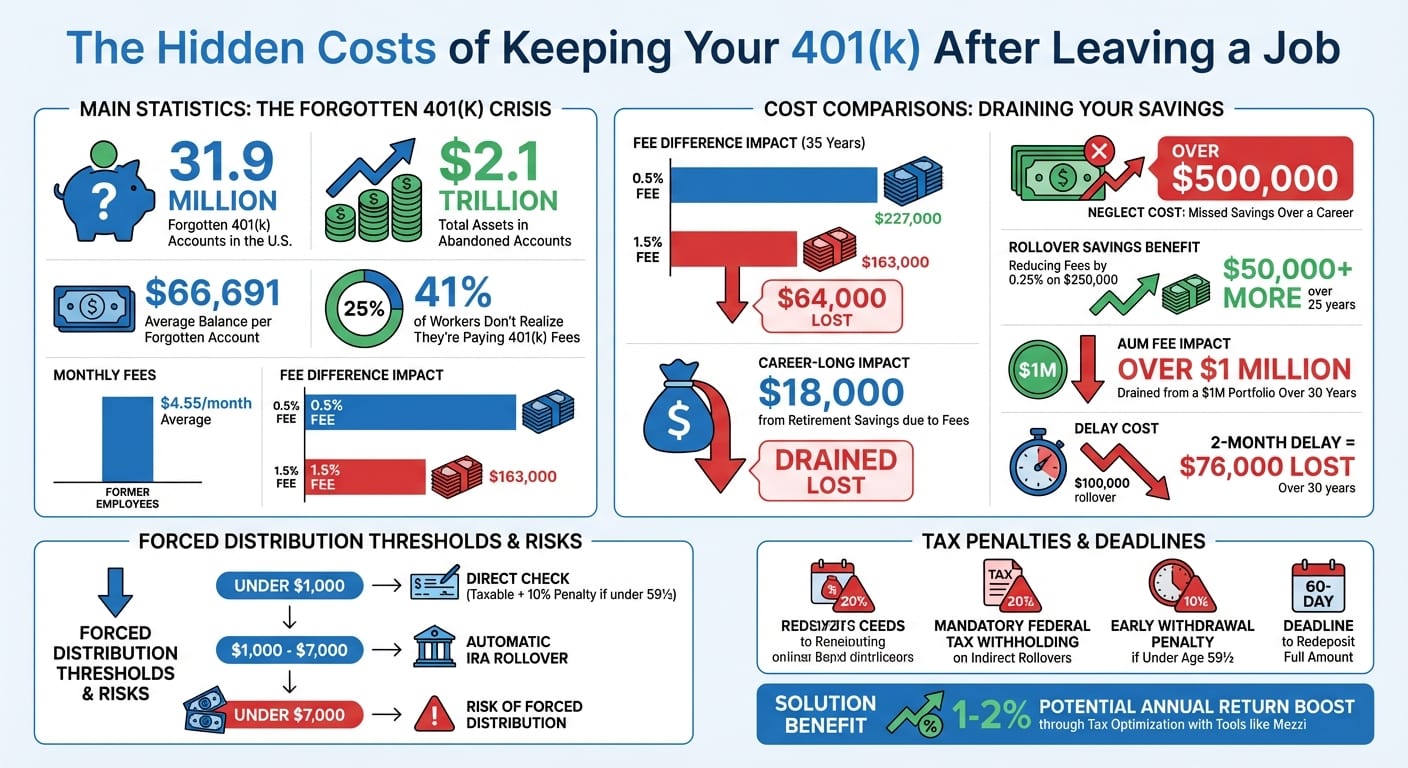
While you're employed, your company typically covers various administrative costs like recordkeeping, accounting, and trustee services. But once you leave, those fees become your responsibility. According to a May 2023 analysis by PensionBee, keeping a 401(k) with a former employer can cost an average of $4.55 per month in fees. Over the course of a career, these recurring charges, combined with the impact of lost compound growth, could drain roughly $18,000 from your retirement savings. PensionBee CEO Romi Savova put it bluntly:
"High fees may shrink rather than grow savings, in some cases, depleting them to $0".
Limited Investment Options and Higher Expense Ratios
Old 401(k) plans often limit you to a small selection of investment options, unlike IRAs, which allow access to a wider range of low-cost funds and ETFs. This restriction may result in higher-cost retail share classes of mutual funds, especially if your former employer's plan is small and lacks the leverage to negotiate lower institutional rates. Even a seemingly small difference in fees can have a significant impact. For example, a 1% fee difference (e.g., 0.5% versus 1.5%) could reduce your retirement savings by 28% over 35 years.
Let’s break it down: if you start with $25,000 earning 7% annually, a 0.5% fee would grow your balance to about $227,000. But with a 1.5% fee, you'd end up with just $163,000 - a stark $64,000 difference.
On top of that, when you leave a job, you can't add new contributions to your old 401(k). This means you lose the chance to inject fresh capital and benefit from dollar-cost averaging. Combined with limited investment choices, these factors may hinder your ability to grow your savings.
Tax Penalties from Forced Distributions
Another major risk is the possibility of forced distributions, which can lead to tax penalties and lost growth potential. If your balance drops below $7,000, your former employer may require you to move the funds, triggering costly consequences:
- Balances Under $1,000: The plan might send you a check directly. This counts as a taxable distribution, and if you're under 59½, you'll also face a 10% early withdrawal penalty.
- Balances Between $1,000 and $7,000: The plan may roll your funds into an IRA automatically.
Things get even trickier if you're handling an indirect rollover. In this case, the plan withholds 20% for federal taxes. To avoid taxes and penalties, you must deposit the full original amount - including the withheld portion - into a new qualified account within 60 days. Miss that window, and you'll face additional tax liabilities.
These financial drawbacks - higher fees, limited investment options, and potential tax penalties - can significantly erode your retirement savings if you're not careful.
Tracking Challenges and the Cost of Dormant 401(k)s
Mismanaging multiple 401(k) accounts can throw a wrench into your retirement plans. As of July 2025, there are an estimated 31.9 million forgotten 401(k) accounts in the U.S., collectively holding about $2.1 trillion - roughly 25% of total 401(k) assets. The average balance in these accounts? Around $66,691. This scattered approach makes managing retirement funds a lot harder than it needs to be.
The problem is partly rooted in how often Americans change jobs - on average, 12 times over a career. Each job switch often leaves behind a new 401(k) account with its own custodian, investment choices, and fees. Over time, this fragmentation creates a tangled web that's tough to manage and easy to overlook.
Adding to the chaos, many people fail to update their contact details with former plan administrators. A change in address or email can mean missing critical updates about fee changes, plan modifications, or even forced distributions. Shockingly, 41% of workers don’t even realize they’re paying 401(k) fees. Gil Baumgarten, Founder and CEO of Segment Wealth Management, highlights this issue:
Ultimately, it can't really be lost. Every one of these companies has a responsibility to provide statements.
Dormant accounts face another major pitfall: outdated asset allocation. Without regular monitoring and rebalancing, the investment mix can drift away from what suits your age and risk tolerance. This misalignment can negatively affect returns. Over a career, neglecting these accounts could result in significant missed savings. That’s a staggering loss, especially when you consider the importance of compound growth in building wealth.
The issue is only growing. Between 2021 and 2023, the number of abandoned accounts surged by 20%. Anqi Chen, Associate Director of Savings and Household Finance at the Center for Retirement Research, puts it plainly:
If the employee isn't paying attention, the higher fees can slowly erode away at the savings.
The costs of neglecting these accounts - both in fees and lost growth - are far too high to ignore.
Solutions: How to Optimize Your Retirement Savings with Rollovers
Rolling Over to an IRA for Lower Fees and More Control
Transferring your old 401(k) into an IRA can lead to significant savings and give you greater control over your investments. The process is simple: open an IRA with a provider that offers low-cost investment options, then request a direct rollover from your old plan administrator. This ensures the funds move directly between custodians, avoiding taxes or penalties.
IRAs provide access to thousands of investment options - like stocks, bonds, and ETFs - compared to the limited choices in many employer-sponsored 401(k) plans. Most major brokerages charge $0 for incoming rollovers and account maintenance fees. Even small fee reductions can add up over time. For instance, cutting fees by just 0.25% on a $250,000 balance may increase your retirement savings by more than $50,000 over 25 years, assuming a 7% annual return.
Opting for a direct rollover is key to avoiding a mandatory 20% federal tax withholding and the 60-day deadline to redeposit the full amount. Once you've set up your rollover, tools like Mezzi’s AI-driven X-Ray feature can help uncover hidden costs in your accounts.
Using Mezzi to Find Hidden Costs and Optimize Rollovers
Mezzi simplifies the process of consolidating retirement accounts with its AI-powered tools. The platform’s X-Ray feature scans your linked accounts to identify hidden fees and overlapping investments. By securely aggregating data from your 401(k)s, IRAs, and brokerage accounts through services like Plaid and Finicity, Mezzi provides a clear, unified view of your finances. This makes it easy to pinpoint which accounts are burdened with the highest administrative fees.
Additionally, Mezzi helps enhance tax efficiency during rollovers by identifying opportunities for tax-loss harvesting and rebalancing, which may potentially increase annual returns by 1% to 2%.
"Most people benefit from consolidating retirement accounts to obtain control and to make sure they don't leave their savings behind, where they could be lost or extinguished by fees".
Romi Savova, CEO of PensionBee, underscores the importance of taking action with this insight.
Calculating Long-Term Savings with Mezzi's Financial Calculator
Mezzi also offers a Financial Calculator to help you understand how fees affect your retirement savings over time. By entering details like your current portfolio value, projected annual contributions, expected returns, and asset manager fees, you can see the true long-term impact of these costs. For example, Assets Under Management (AUM) fees can reduce a $1 million portfolio by over $1 million in fees over 30 years.
This tool doesn’t just rely on simple compound interest calculations - it factors in the cumulative drag of fees over decades. With this clarity, you can prioritize which accounts to consolidate or roll over first, ensuring you minimize unnecessary costs and maximize your retirement potential.
Conclusion: Take Control of Your Retirement Savings Today
Hidden fees, limited investment options, and forced distributions can quietly chip away at your retirement savings. Keeping a 401(k) after leaving a job might seem convenient, but it often comes at a cost - higher fees, fewer choices, and missed growth opportunities.
Opting for a direct rollover to an IRA can change the game. It gives you access to a wider range of investments, cuts out administrative fees, and helps you avoid the 20% mandatory federal tax withholding. Acting quickly is crucial. For instance, delaying the rollover of a $100,000 balance for just two months may result in missed potential returns over 30 years.
This is where Mezzi can make a big difference. Its AI tools are designed to uncover hidden fees, highlight tax-saving opportunities, and show the long-term impact of your financial decisions. Features like the X-Ray tool help you spot overlapping investments and concentration risks, while the Financial Calculator demonstrates how fees can eat into your savings over time. On top of that, optimize your tax-advantaged accounts strategies offered by Mezzi may potentially increase your annual returns by 1% to 2%.
You don’t need expensive advisors or complicated spreadsheets to take control of your retirement savings. With the right tools and a proactive mindset, you can reduce costs, work toward growing your investments, and pursue the retirement you’ve been working toward. Start today - consolidate your accounts and take charge of your financial future.
FAQs
When should I keep my old 401(k) instead of rolling it over?
If your old 401(k) plan permits it, you might consider leaving your funds there. This option could make sense if the plan offers low fees, strong investment choices, and helps you avoid triggering immediate taxes or penalties. Take the time to assess these elements closely to ensure the plan supports your financial goals and long-term retirement strategy.
What’s the safest way to do a rollover and avoid taxes?
The best way to steer clear of taxes during a rollover is by opting for a direct rollover. This method ensures that the funds move straight from your 401(k) provider to an IRA or another qualified plan without passing through your hands. By skipping direct distribution to yourself, you avoid the risk of the amount becoming taxable. Make sure to double-check with your provider to confirm that the transfer process is handled properly.
How do I find and track old 401(k) accounts I forgot about?
To track down forgotten 401(k) accounts, start by checking old pay stubs or tax returns for any mentions of retirement contributions. Reaching out to the HR departments of your former employers is another effective step, as they can provide details about any accounts you might have left behind. Additionally, federal databases and account aggregation tools can assist in identifying and consolidating these accounts. With billions of dollars in unclaimed retirement savings out there, taking the time to locate and combine these funds can help you cut down on fees and make the most of your investment growth potential.
Related Blog Posts
- Avoid 401(k) Rollover Penalties: Key Rules
- 401(k) Fees: How to Identify Hidden Costs
- Consolidating Accounts for Tax-Efficient Retirement
- Why Your 401k Fund Options Are Costing You More Than You Think
If your old 401(k) plan permits it, you might consider leaving your funds there. This option could make sense if the plan offers low fees, strong investment choices, and helps you avoid triggering immediate taxes or penalties. Take the time to assess these elements closely to ensure the plan supports your financial goals and long-term retirement strategy.
The best way to steer clear of taxes during a rollover is by opting for a direct rollover. This method ensures that the funds move straight from your 401(k) provider to an IRA or another qualified plan without passing through your hands. By skipping direct distribution to yourself, you avoid the risk of the amount becoming taxable. Make sure to double-check with your provider to confirm that the transfer process is handled properly.
To track down forgotten 401(k) accounts, start by checking old pay stubs or tax returns for any mentions of retirement contributions. Reaching out to the HR departments of your former employers is another effective step, as they can provide details about any accounts you might have left behind. Additionally, federal databases and account aggregation tools can assist in identifying and consolidating these accounts. With billions of dollars in unclaimed retirement savings out there, taking the time to locate and combine these funds can help you cut down on fees and make the most of your investment growth potential.