
An ISO exercise may create a tax bill before you sell a single share. That usually happens when the spread between your strike price and the stock’s value at exercise gets pulled into AMT income if you still hold the shares on December 31.
Here’s the short version:
- Regular federal tax may treat an ISO exercise-and-hold as non-taxable at exercise.
- AMT may treat the spread as income on paper.
- A larger exercise may mean a larger AMT bill, even if you received $0 in sale proceeds.
- In 2026, high earners may lose part of the AMT exemption as income rises, which may make large exercises more expensive.
- The main levers people may look at are:
when they exercise,
- how many shares they exercise,
- and whether they hold or sell in the same year.
A simple way to think about it: some employees may try to fit an exercise inside four limits at once - tax, cash, holding period, and stock concentration.
A quick example from the article makes the risk easy to see. If your strike price is $10 and the stock is worth $40, your spread may be $30 per share. On 5,000 shares, that may mean $150,000 of AMT income without any cash from a sale.
ISOs Explained: Exercise timing, AMT, and the "Tax Trap"
Quick comparison
If I were framing the article in one sentence, it would be this: the “right” ISO exercise size may be the smallest amount that may fit your AMT room, cash reserve, and comfort with holding more employer stock.
Why ISO exercises can trigger AMT
ISO exercises may trigger AMT because the same exercise may be handled one way under regular tax and another way under AMT. That gap may change your tax result even if you haven't sold a single share. So the size of the exercise may matter just as much as the spread.
The bargain element: how an exercise and hold still creates tax
When you exercise an ISO and hold the shares, the bargain element - the gap between your strike price and the stock's fair market value (FMV) on the day you exercise - may be added to your AMT income in the year of exercise, even if you haven't sold a single share.
Here's the part that throws people off: you may end up with taxable income on paper without getting any cash.
For example, if your strike price is $10 and the stock is trading at $40 on your exercise date, the spread is $30 per share. Exercise 5,000 shares and hold them, and you've added $150,000 of AMT income on paper, with no cash received. The next question is how much AMT that spread may create at different share counts.
Regular tax vs. AMT treatment for ISOs
The table below shows where the two systems split:
Sell before the one-year and two-year holding periods, and the gain may become a disqualifying disposition taxed as ordinary income.
Once you know how regular tax and AMT split apart, you may be in a better position to estimate how many shares fit inside your tax budget.
How to estimate your AMT exposure before you exercise
Before you exercise, you may estimate your AMT exposure with five inputs. Start with the spread from the prior section.
The 5 inputs that drive your AMT estimate
In 2026, the AMT exemption starts phasing out at $500,000 of income for single filers and $1,000,000 for joint filers. Added spread may face a marginal AMT rate of 42%.
With those inputs, you may test how many shares fit inside your room before AMT starts.
Scenario table: exercising 1,000 vs. 3,000 vs. 5,000 shares
The table below shows how exercise size may change AMT and cash outlay. All figures are hypothetical and based on 2026 federal tax rules.
Hypothetical 2026 scenario: Single filer, $250,000 salary, $5 strike price, $30 FMV ($25 spread per share)
Figures are hypothetical and U.S.-specific. Actual results may depend on your full income picture, deductions, and state tax rules. Some states, including California, have their own AMT calculations that may need to be modeled separately.[[2]](https://blog.rally.tax/p/iso-exercise-strategy-how-to-calculate-your-amt-crossover-point)\[*\[7\]*\](https://vantagedigital.dev/blog-amt-iso-exercise)
Larger exercises may increase both AMT and concentration risk. The point isn't only to estimate tax. It's also to look at a share count you may be able to afford.
That estimate may show whether exercising all at once makes sense, or whether splitting the order may make more sense.
Why a year-end tax projection changes how many shares to exercise
Bonuses, RSU vests, and capital gains may change your room before AMT starts late in the year. A late-year projection may show how many shares you may exercise without pushing into AMT.
Some people use that crossover point to size an exercise. If the estimate comes in too high, timing and partial exercises may be the next levers to look at.
Exercise strategies that can reduce AMT
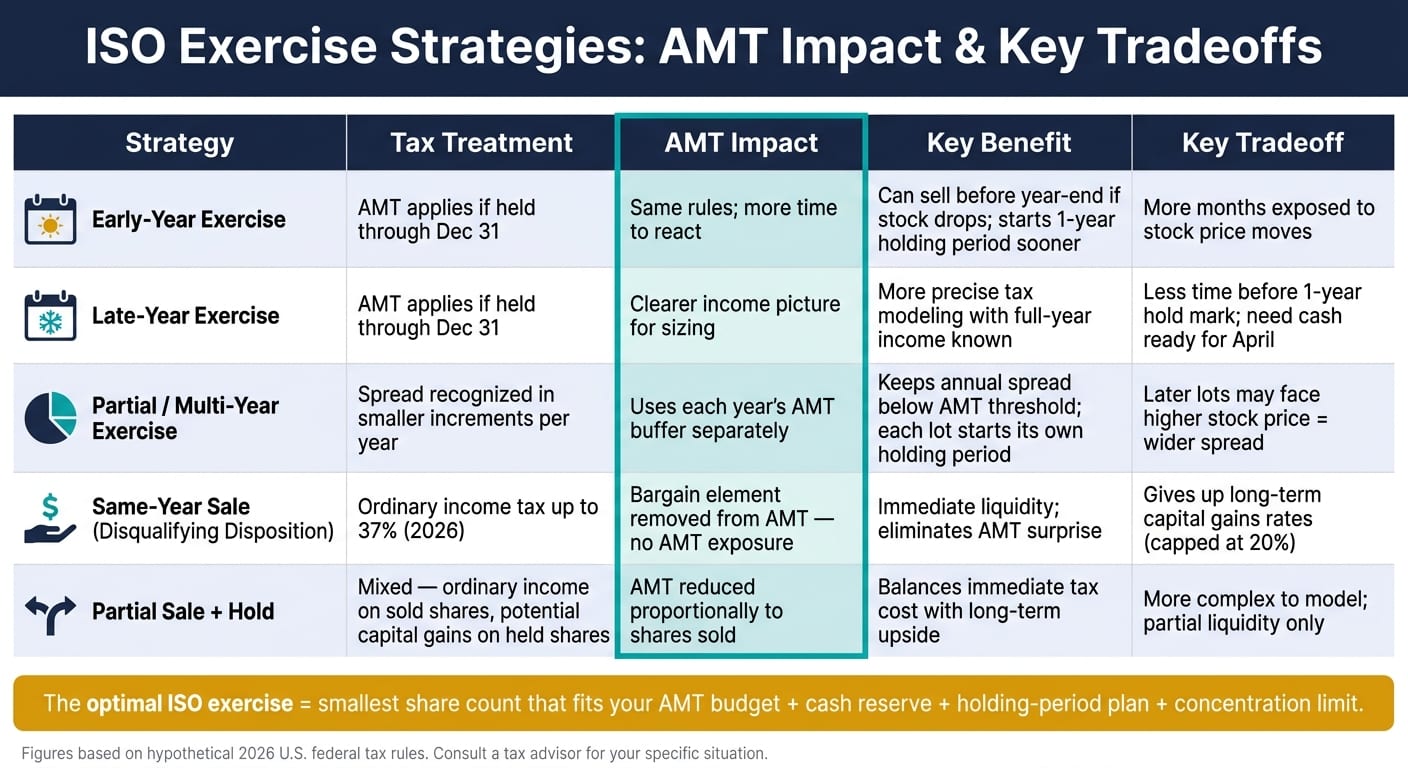
Once you know your AMT exposure, three levers may help keep the tax bill smaller.
Early-year vs. late-year exercise: timing tradeoffs
Exercising in January or February may give you more room to react if things change. If the stock drops, you may have time to sell before year-end and avoid paying AMT on value you never end up realizing. You also start the one-year holding period earlier, which may let you sell the following January and still have cash in hand before the April tax bill comes due.
Late-year exercises may fit better when your tax picture is mostly set. By November or December, you may know much more about your year-end income, which may make it easier to size the exercise with more precision. The tradeoff is simple: you have less time left on the one-year holding period, and you may need cash ready for the April tax bill.
Early-year exercises may give you more time to react. Late-year exercises may give you more certainty on tax exposure.
If timing alone may not solve the problem, lowering the share count may be the next lever.
Partial exercises and spreading the tax hit across multiple years
If a full exercise would push you past your AMT limit, some people split it across tax years to use each year's AMT buffer separately. This may be the cleanest way to stay inside your AMT budget without dropping the exercise plan. Spreading exercises across tax years may lower the amount recognized in any one year, and each lot starts its own one-year holding period, which may build toward long-term capital gains treatment over time.
There is a catch. If the stock price rises before you exercise later lots, the spread per share may be wider, and fewer shares may fit under the AMT threshold.
If holding the shares still creates too much AMT, selling some or all of them in the same year may cut the spread out of the calculation.
Same-year sale, disqualifying disposition, and reducing the AMT spread
A same-year sale removes the bargain element from AMT. The tradeoff is that you may owe ordinary income tax on the spread right away - up to 37% in 2026 - instead of potentially paying AMT now and long-term capital gains rates later. A same-year sale may trade some upside for a smaller tax surprise and immediate liquidity.
There may be a middle path too: sell part of the grant in the same year and hold the rest. That may reduce AMT in proportion to the shares sold while keeping some long-term upside on the shares you continue to hold.
After timing and sale structure, the next decision may be how much exercise fits your cash and concentration limits.
Choosing the right exercise amount for your cash flow and portfolio
Cash planning: exercise cost, tax reserve, and cash buffer
If the tax math looks workable, cash flow may be the next limit. A tax approach only goes so far if you may not have the cash to fund the exercise in the first place. Before landing on a share count, map out three separate cash needs.
- The exercise cost - the amount to buy the shares outright (exercise price × number of shares)
- A tax reserve for the AMT bill that may arrive the following April
- A cash buffer in case the stock drops before you may be able to sell
That third bucket matters more than it may seem. A stock drop may leave you owing AMT on value you no longer have.
Plan for all three before choosing a share count. If the total may put pressure on your liquidity, a smaller exercise may make more sense. A smaller exercise that you may fully fund may be better than a larger one that leaves you short on cash in April.
When concentration risk should override tax optimization
Even a tax-efficient exercise may still be too large if employer stock already makes up a big share of your portfolio.
Holding ISOs for one year to qualify for long-term capital gains rates - capped at 20% in 2026 versus up to 37% for ordinary income - may look appealing on paper. But that math may shift if your employer stock already represents a large part of your net worth. The longer you hold, the more your financial outcome may be tied to one company's performance.
Tax optimization and concentration risk may pull in opposite directions. A staged approach - exercising part of the grant each year - may reduce concentration while keeping each year's spread smaller. If your employer stock already dominates your portfolio across all accounts, the right exercise amount may be smaller than the tax math alone suggests. In some cases, it may also mean accepting a disqualifying disposition to reduce exposure now.
Doing nothing may still leave you concentrated in employer stock.
Conclusion: A simple framework for avoiding AMT surprises
Use the smallest exercise size that fits your AMT budget, cash reserve, holding-period plan, and concentration limit.
FAQs
How do I know how many ISO shares I can exercise without triggering AMT?
Find your AMT crossover point: the maximum spread (fair market value minus strike price) you may create before your tentative minimum tax exceeds your regular tax.
A common way to estimate it is to calculate the gap between your regular tax and your pre-exercise tentative minimum tax, then divide that amount by the AMT rate, which may be 26% or 28% in many cases.
Because this figure may depend on income, deductions, and filing status, it may make sense to model it with care or consult a tax professional.
What happens if I exercise ISOs and the stock price falls before I sell?
If you exercise Incentive Stock Options (ISOs) and the stock price falls before you sell, you may still owe Alternative Minimum Tax (AMT) based on the higher value at exercise.
AMT is based on the spread between the fair market value and your strike price. That means you may owe tax on paper gains that no longer exist if the stock drops afterward.
Should I exercise early in the year or wait until year-end?
It may depend on your liquidity and tax-planning goals. Some people prefer to exercise early in the year because it may give them more time to monitor their tax situation before December 31.
If you exercise early, you may have more time to see whether you may trigger AMT. If needed, some people choose to sell before year-end with the goal of avoiding it. Exercising early may also start the one-year holding period for long-term capital gains sooner.Disclosures:
- This content is for informational purposes only and does not constitute investment advice or a recommendation to buy or sell any security.
- Tax laws and rates are subject to change. Individual tax situations vary; consult a qualified tax advisor for personalized advice.
- Past performance is not indicative of future results. No guarantee of future performance or outcomes is implied.
Related Blog Posts
- NSO and ISO Tax Timing Strategies
- ISO vs NSO: What’s the Difference?
- Pre-IPO stock: how to track value before a liquidity event
- Different Types of Equity Compensation: RSUs, ISOs, NSOs, ESPP
Find your AMT crossover point: the maximum spread (fair market value minus strike price) you may create before your tentative minimum tax exceeds your regular tax.
A common way to estimate it is to calculate the gap between your regular tax and your pre-exercise tentative minimum tax, then divide that amount by the AMT rate, which may be 26% or 28% in many cases.
Because this figure may depend on income, deductions, and filing status, it may make sense to model it with care or consult a tax professional.
If you exercise Incentive Stock Options (ISOs) and the stock price falls before you sell, you may still owe Alternative Minimum Tax (AMT) based on the higher value at exercise.
AMT is based on the spread between the fair market value and your strike price. That means you may owe tax on paper gains that no longer exist if the stock drops afterward.
It may depend on your liquidity and tax-planning goals. Some people prefer to exercise early in the year because it may give them more time to monitor their tax situation before December 31.
If you exercise early, you may have more time to see whether you may trigger AMT. If needed, some people choose to sell before year-end with the goal of avoiding it. Exercising early may also start the one-year holding period for long-term capital gains sooner.Disclosures:
- This content is for informational purposes only and does not constitute investment advice or a recommendation to buy or sell any security.
- Tax laws and rates are subject to change. Individual tax situations vary; consult a qualified tax advisor for personalized advice.
- Past performance is not indicative of future results. No guarantee of future performance or outcomes is implied.