
Not sure whether to invest your HSA or use it for medical bills? Here’s the bottom line:
- Invest if you can afford to cover medical costs out-of-pocket and want to grow your savings tax-free for retirement.
- Spend now if you have high medical expenses, limited cash reserves, or want to avoid debt.
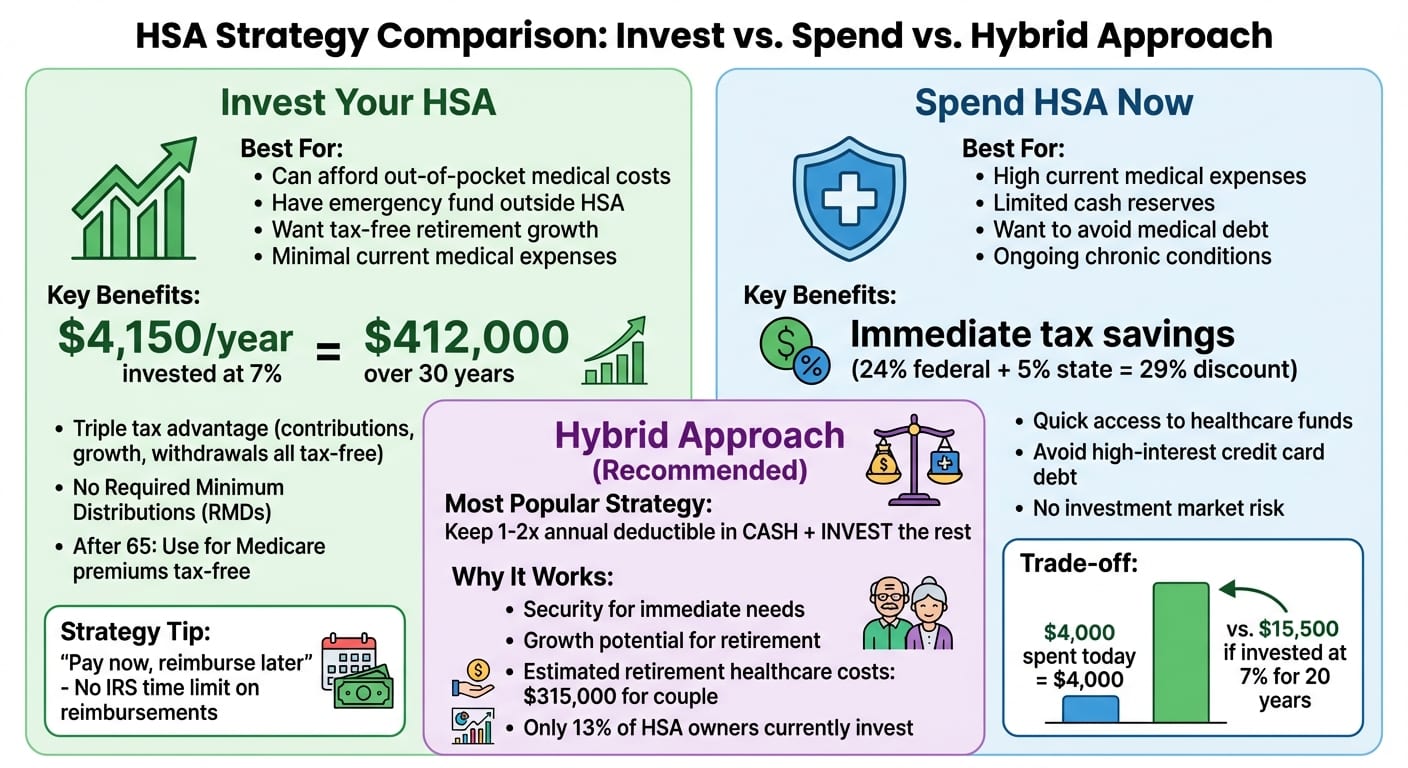
Health Savings Accounts (HSAs) are powerful tools with unmatched tax benefits - contributions, growth, and withdrawals for qualified expenses are all tax-free. But only 13% of HSA owners invest their funds, missing out on long-term growth. For example, $4,000 invested at a 7% return over 20 years grows to $15,500, compared to $4,000 spent today.
A hybrid approach works best for most: Keep 1-2 times your annual deductible in cash for immediate needs and invest the rest for the future. This balances security with growth potential, helping you prepare for significant retirement healthcare costs (estimated at $315,000 for a 65-year-old couple).
Ultimately, your decision depends on your current finances, medical expenses, and retirement goals. Below, we’ll explore how HSAs work, their tax advantages, and strategies to optimize your savings.
The Supercharged HSA Strategy 91% of People Miss - Health Savings Account
How HSAs Work and Why They Matter
A Health Savings Account (HSA) is a tax-advantaged account specifically for individuals enrolled in a High-Deductible Health Plan (HDHP). The account is entirely yours, meaning it stays with you even if you change jobs or switch health insurance plans. For 2026, the contribution limits are $4,400 for individual coverage and $8,750 for family coverage. If you're 55 or older, you can add an extra $1,000 as a catch-up contribution.
What sets HSAs apart from other savings accounts is their flexibility. There's no "use it or lose it" rule - your balance rolls over year after year. Once your account reaches your provider's minimum balance, you can even invest the funds in options like stocks, ETFs, or mutual funds, allowing for potential long-term growth. As of June 30, 2025, there were about 40 million HSAs holding an estimated $159 billion. This versatility makes HSAs a powerful tool, whether you choose to spend the funds on current healthcare needs or save them for future expenses.
Triple Tax Benefits Explained
The HSA offers a rare combination of tax advantages, often referred to as the "triple tax benefit." Here's how it works:
- Contributions lower your taxable income.
- Earnings grow tax-free.
- Withdrawals for qualified medical expenses are also tax-free, regardless of your age.
To put this into perspective, if you're in the 22% federal tax bracket, you could save almost 30% in total taxes (including FICA) on every dollar you contribute through payroll deductions.
Unlike Roth IRAs, which don't offer an upfront tax deduction, or Traditional IRAs and 401(k)s, which tax withdrawals, HSAs vs. 401(k)s and IRAs show that HSAs provide the best of both worlds - tax-free contributions and tax-free withdrawals for eligible healthcare expenses.
What Counts as Qualified Medical Expenses
HSA funds can be used for a wide range of healthcare costs. These include everyday expenses like doctor visits, prescriptions, dental care, and vision care, as well as unexpected costs like emergency room visits. Thanks to the CARES Act of 2020, over-the-counter medications and menstrual care products are also eligible.
Additionally, HSAs can cover COBRA premiums and Medicare premiums (Parts B and D). However, they generally cannot be used for private health insurance premiums or Medigap policies.
Using Your HSA in Retirement
HSAs become even more versatile after age 65. At that point, the 20% penalty for non-medical withdrawals no longer applies, allowing you to use the funds for any purpose, though non-medical withdrawals will be taxed as ordinary income - similar to a Traditional IRA. Withdrawals for medical expenses, however, remain completely tax-free, and unlike Traditional IRAs, HSAs have no Required Minimum Distributions (RMDs).
Once you enroll in Medicare (usually at age 65), you can no longer contribute to your HSA. However, the funds already in your account can still be used tax-free for qualified medical expenses. Given that a single 65-year-old retiring in 2025 may need an estimated $172,500 for healthcare costs, an HSA can play a crucial role in your retirement planning. This makes it a powerful tool for both immediate healthcare needs and long-term financial security.
Using HSA Funds for Current Medical Costs
Why Spending HSA Funds Now Makes Sense
Using your HSA to cover medical expenses today comes with immediate tax perks. Every dollar spent from your HSA is pre-tax money, effectively giving you a discount on healthcare costs. For instance, if you're in the 24% federal tax bracket and pay 5% in state taxes, a $4,000 HSA contribution could save you $1,160 in taxes right away.
Beyond the tax savings, having cash in your HSA means you have quick access to funds for medical expenses. Whether it’s for doctor visits, prescriptions, or high-deductible costs, your HSA allows you to manage these without touching your regular savings or emergency fund. This is especially useful for ongoing expenses like dental work, therapy, or vision care - essentially, your HSA becomes a dedicated account for healthcare costs.
Another key benefit is avoiding high-interest debt. Unexpected medical bills can often lead people to rely on credit cards or even loans. With an HSA, you can sidestep these costly options. Christine Benz, Director of Personal Finance and Retirement Planning at Morningstar, emphasizes this point:
"A tax-free HSA withdrawal beats other forms of emergency funding, such as credit cards, home equity lines of credit, or 401(k) loans".
Many employers also contribute to HSAs, giving you extra funds to use right away for out-of-pocket expenses. By the end of 2023, around $77 billion in HSA assets were held in cash or savings accounts, specifically earmarked for immediate medical costs.
However, choosing to spend your HSA funds now does come at a cost - namely, giving up the chance for long-term, tax-free growth.
What You Give Up by Not Investing
While spending HSA funds immediately offers quick benefits, it comes at the expense of long-term growth potential. By using these funds right away, you lose out on years of tax-advantaged compounding. For example, if you invest $4,150 annually and earn a 7% return, your HSA could grow to roughly $412,000 over 30 years.
Despite this potential, only 13% of HSA owners currently invest their funds, with most treating the account as a short-term spending tool. This approach means missing out on the HSA's triple tax advantage, which includes tax-free contributions, growth, and withdrawals for qualified expenses. In comparison, taxable brokerage accounts lose about 33% of their growth over 30 years to taxes on dividends and capital gains - something an HSA avoids entirely.
Investing HSA Funds for Future Growth
If you're looking to maximize your retirement savings while balancing immediate healthcare expenses, investing your HSA could be a game-changer. It’s a strategy that combines tax advantages with long-term growth potential.
Why Investing HSA Funds Pays Off
An HSA offers a rare opportunity: decades of tax-free growth. Unlike taxable brokerage accounts, where dividends and capital gains are taxed annually, your HSA earnings grow without any tax drag. Over time, this difference can be massive.
Here’s an example: A 30-year-old investing $4,150 annually in an HSA could accumulate more than $400,000 tax-free by retirement, assuming a 7% annual return. In contrast, the same contributions in a taxable account might grow to just $306,000 after taxes. That’s a substantial advantage for the HSA.
Once you turn 65, your HSA becomes even more versatile. You can use the funds tax-free for Medicare premiums (Parts B and D) and other out-of-pocket medical expenses. For non-medical withdrawals, it functions similarly to a Traditional IRA - withdrawals are taxed as ordinary income but without penalties. Certified Financial Planner Dan Galli describes it as:
"The plan is to go into retirement with a six-figure HSA... this is the holy grail of retirement planning".
Another savvy approach is the "pay now, reimburse later" strategy. By paying current medical expenses out-of-pocket and letting your HSA balance grow, you can later reimburse yourself tax-free - no matter how much time has passed. This allows your investments to compound for as long as possible.
While the potential for growth is undeniable, it’s not without risks.
Risks of Investing Your HSA
Like any investment, putting your HSA funds into the market comes with risks. Market volatility is a key concern. If the market takes a downturn right when you need funds for a medical emergency, you could be forced to sell investments at a loss. Plus, selling assets often takes a few days, which could delay access to cash when you need it most.
To mitigate these risks, it’s crucial to maintain a cash buffer. Given the high deductibles of HSA-eligible health plans, experts suggest keeping one to two times your annual deductible in cash within your HSA. This ensures you’re prepared for immediate medical expenses without having to liquidate investments at the wrong time.
It’s also worth noting the penalties for non-qualified withdrawals. If you withdraw funds for non-medical expenses before age 65, you’ll face a 20% tax penalty on top of ordinary income taxes. Additionally, investment fees can chip away at your long-term returns, so it’s important to choose low-cost investment options.
How to Choose the Right HSA Strategy
Choosing how to manage your Health Savings Account (HSA) depends on your specific needs and circumstances. Whether you focus on spending or investing, the right approach should align with your healthcare needs, financial situation, and retirement plans. Let’s break it down.
Assess Your Medical Expense Patterns
Start by looking at your healthcare spending over the past year. This includes out-of-pocket costs for doctor visits, prescriptions, dental, and vision care. This review gives you a clear picture of how much cash you might need to keep accessible.
If your medical expenses are minimal and predictable - like an annual check-up and the occasional prescription - you could consider investing a larger share of your HSA funds. On the other hand, if you or your family have ongoing medical needs or are managing a chronic condition, keeping a larger cash reserve is a smarter move. A good rule of thumb is to maintain cash equal to your deductible, with those facing frequent expenses leaning toward the higher end of that range.
Your spending habits not only cover your immediate needs but also guide how much risk you can afford to take when investing for the future.
Consider Your Age and Retirement Timeline
Your age and how close you are to retirement are key factors in shaping your HSA strategy. If you're in your 20s or 30s, you have time on your side. Long-term investing can maximize growth, so you might consider keeping just enough cash to cover one year's deductible and investing the rest - especially if you already have a separate emergency fund.
As you enter your 40s and 50s, healthcare costs tend to rise. At this stage, it’s wise to keep a larger portion of your HSA in cash to cover growing medical expenses. After age 55, you can contribute an additional $1,000 annually as a catch-up. Around this time, it’s a good idea to hold two to three years’ worth of anticipated medical costs in cash to prepare for the transition to Medicare at 65.
Don’t forget to revisit your investment approach regularly to ensure it balances your immediate needs with long-term goals.
Balance Liquidity and Growth
Finding the right balance between liquidity and growth is critical. Keep enough cash for short-term needs, but let the rest of your funds grow through investments. Many HSA providers offer an auto-sweep feature that automatically moves excess cash into investments, helping you maintain liquidity while benefiting from potential long-term gains.
If you have a solid emergency fund outside your HSA, consider the "shoebox strategy." This involves paying for medical expenses out-of-pocket while leaving your HSA fully invested. Save your receipts digitally - thermal paper receipts can fade - and reimburse yourself tax-free later, even years down the line. However, if your financial situation is tighter, maintaining a larger cash reserve is essential to avoid selling investments during a market downturn.
Optimizing Your HSA with Mezzi
Once you’ve decided to balance liquidity and growth within your HSA, the next step is fine-tuning your strategy. That’s where smart technology steps in. Mezzi simplifies HSA management by giving you a complete view of your finances. By connecting all your accounts - HSA, 401(k), Roth IRA, and brokerage - through read-only access, Mezzi provides a unified snapshot of your wealth. This allows you to take advantage of your HSA’s benefits with a proactive approach that addresses both immediate expenses and long-term financial growth.
How Mezzi Helps You Manage Your HSA
Mezzi supports a "pay now, reimburse later" strategy by tracking unreimbursed medical expenses in real time. Thanks to the IRS’s lack of a time limit on HSA reimbursements, you can pay for medical costs out of pocket while letting your HSA investments grow tax-free for years - or even decades.
The platform also scans your portfolio to identify overlapping investments across your HSA and other accounts, helping you avoid unnecessary duplicate fees. It notifies you when excess cash in your HSA could be better utilized through investments. On top of that, Mezzi highlights tax-efficient investment opportunities and guides asset allocation, positioning your HSA as a powerful retirement tool with unbeatable tax advantages. This seamless setup ensures you receive tailored advice that evolves alongside your financial situation.
Get Personalized Advice When You Need It
With AI-driven insights, Mezzi delivers tailored HSA advice based on your financial accounts. Whether you’re wondering at 1 a.m. if it’s time to invest your HSA surplus or keep it in cash, Mezzi provides recommendations in just minutes. The platform also keeps an eye on your portfolio, sending alerts for tax-efficient rebalancing opportunities.
Mezzi provides insights any time I need them.
Mike, Product Manager
As an SEC-registered fiduciary, Mezzi offers professional financial advice without the traditional 1% AUM fee - which could add up to over $1,000,000 in fees over 30 years. For those managing wealth across multiple accounts, Mezzi’s combination of clear visibility and on-demand guidance makes optimizing your HSA simpler and far less daunting.
Building Your Personal HSA Plan
Creating an HSA plan tailored to your needs requires a close look at your finances, health needs, and retirement goals. Start by figuring out your cash target. A good starting point is to review last year's medical expenses and estimate any upcoming costs. Aim to keep enough cash in your HSA to cover at least your annual deductible, then consider investing any extra funds.
Your age and financial situation play a big role here. If you're in your 20s or 30s, have a steady income, and an emergency fund, it might make sense to pay for medical bills out-of-pocket. Why? This allows your HSA to grow tax-free over time. Here's a perk: the IRS doesn’t set a time limit for reimbursements. So, a $3,000 medical expense today could grow tax-free for decades before you decide to reimburse yourself. On the other hand, if you're nearing retirement or have limited savings, keeping more cash in your HSA might be smarter. That way, you don’t have to sell investments during a market downturn.
Another tip: set a spending threshold, like a percentage of your income, to decide when to tap into your HSA. This helps preserve your account for major medical expenses instead of using it for smaller, less critical costs. As Curtis Pope, CFP® at Northstar, explains:
"This triple tax advantage is magical. By taking money out of the account, you sacrifice the opportunity for decades of tax-free growth compounding".
Once you’ve nailed down a strategy, technology can make managing your HSA easier. If you’re using the "pay now, reimburse later" approach, scan all medical receipts and EOBs (Explanation of Benefits) right away to keep your records in order. Tools like Mezzi can simplify this even further by tracking unreimbursed medical expenses in real time and offering a clear view of how your HSA fits into your overall financial goals.
FAQs
How much cash should I keep in my HSA before investing?
The amount of cash you should keep in your HSA largely depends on your anticipated medical expenses and how much liquidity you might need. Many experts suggest maintaining a buffer of two to three years’ worth of routine medical costs. This approach helps ensure you can handle ongoing expenses without needing to sell investments during market downturns. After setting aside this safety net, you can invest the remaining funds to take advantage of long-term, tax-advantaged growth opportunities.
Can I reimburse myself later if I pay medical bills out of pocket now?
The IRS permits tax-free reimbursements for qualified medical expenses as long as they were incurred after your HSA was established. There’s no expiration date on when you can reimburse yourself. Just hold onto your receipts, and you can claim those expenses months - or even decades - later, as long as they qualify under the guidelines.
What happens to my HSA when I turn 65 or enroll in Medicare?
When you reach 65 or sign up for Medicare, contributing to your HSA comes to an end. However, the good news is you can still use the funds tax-free for qualified medical expenses, such as Medicare premiums. If you're still working and decide to delay Medicare enrollment, you can continue contributing as long as you remain on your employer's health plan.
Disclosures:
- This content is for informational purposes only and does not constitute investment advice or a recommendation to buy or sell any security.
- Past performance is not indicative of future results. No guarantee of future performance or outcomes is implied.
- Savings and performance examples are hypothetical and for illustrative purposes only. Actual results will vary based on individual circumstances, portfolio composition, market conditions, and fees.
- Registration does not imply a certain level of skill or that the SEC has approved the company or its services.
Related Blog Posts
- HSA vs. 401(k) and IRA: Key Differences
- How can I optimize my tax-advantaged accounts for better long-term growth?
- We use dividends from our HSA to pay healthcare costs - does this approach optimize taxes and cash flow?
- I Maxed My 401(k). What Should I Save In Next?
The amount of cash you should keep in your HSA largely depends on your anticipated medical expenses and how much liquidity you might need. Many experts suggest maintaining a buffer of two to three years’ worth of routine medical costs. This approach helps ensure you can handle ongoing expenses without needing to sell investments during market downturns. After setting aside this safety net, you can invest the remaining funds to take advantage of long-term, tax-advantaged growth opportunities.
The IRS permits tax-free reimbursements for qualified medical expenses as long as they were incurred after your HSA was established. There’s no expiration date on when you can reimburse yourself. Just hold onto your receipts, and you can claim those expenses months - or even decades - later, as long as they qualify under the guidelines.
When you reach 65 or sign up for Medicare, contributing to your HSA comes to an end. However, the good news is you can still use the funds tax-free for qualified medical expenses, such as Medicare premiums. If you're still working and decide to delay Medicare enrollment, you can continue contributing as long as you remain on your employer's health plan.