
If you're over 50 and behind on retirement savings, don't panic - it's not too late to make progress. Catch-up contributions allow you to save beyond standard IRS limits, helping to close the gap in your retirement planning. Many savers also find consolidating retirement accounts helps simplify this process. Here’s what you need to know:
- 401(k) catch-up contributions: In 2025, those 50+ can contribute up to $31,000, and if you're 60–63, the limit rises to $34,750.
- IRA Catch-Up Contributions: Add $1,000 to the standard limit, totaling $8,000 in 2025 ($8,100 in 2026).
- SIMPLE IRA Plans: Extra contributions of $3,500 for those 50+ in 2025, increasing to $4,000 in 2026.
- New Roth Rule (2026): High earners ($150,000+ in 2025 wages) must direct catch-up contributions to Roth accounts.
2026 401K Changes Explained: New Limits, Super Catch Up, and the New Roth Rule
Catch-Up Contribution Rules and Limits
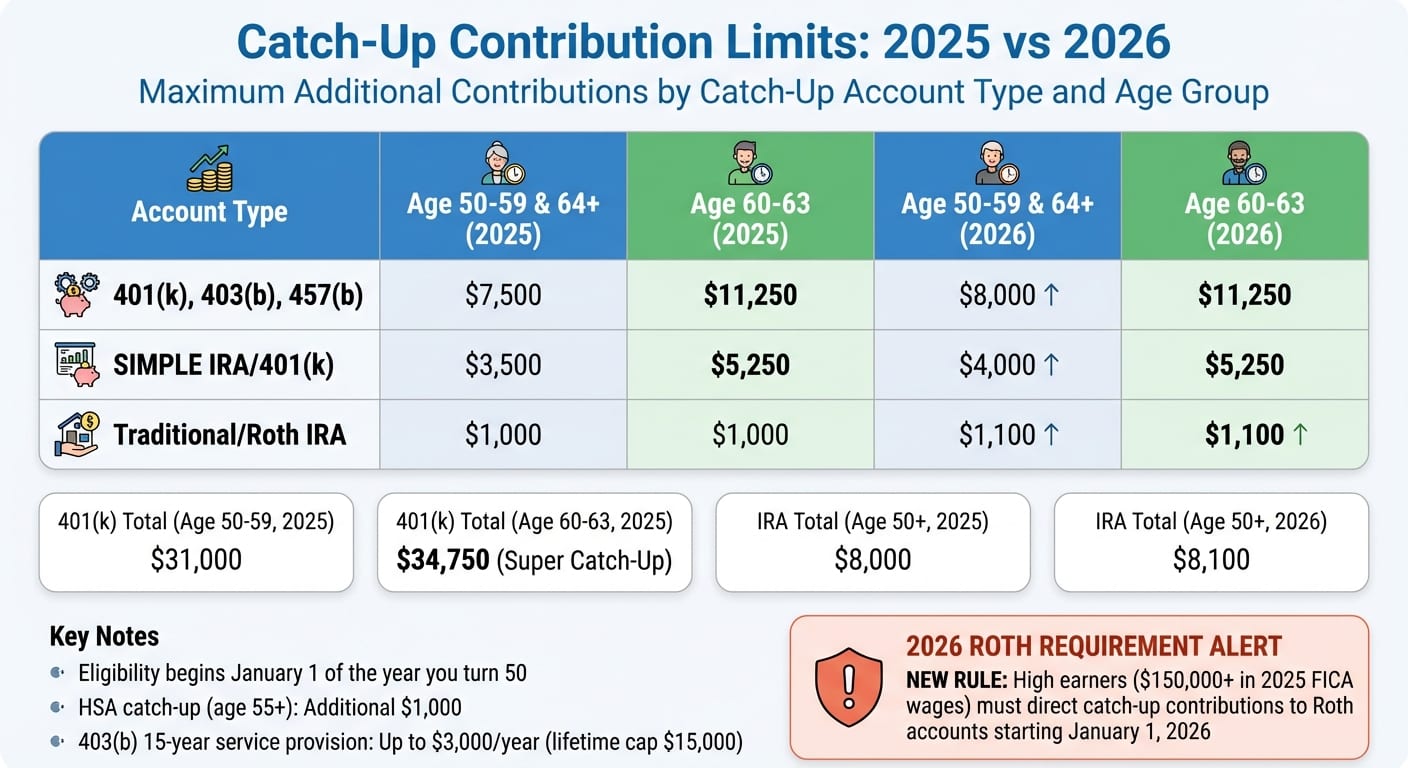
Once you hit 50, you can take advantage of catch-up contributions to boost your retirement savings using tax-efficient planning tools beyond the usual IRS limits. The IRS allows you to start making these contributions as of January 1 in the year you turn 50 - even if your birthday falls later in the year - giving you a head start on saving.
These contributions apply to a variety of retirement accounts, including 401(k), 403(b), governmental 457(b), SARSEP, SIMPLE 401(k), and SIMPLE IRA plans. Thanks to the SECURE 2.0 Act, there's also a "super catch-up" provision for individuals aged 60 to 63, offering higher limits during those critical pre-retirement years. Here's a closer look at the rules for major account types.
Starting in 2026, if you earn more than $150,000 in FICA wages in 2025, you'll need to direct your catch-up contributions to Roth accounts - paying taxes upfront for tax-free withdrawals later. If your earnings are below that threshold, you can still choose between traditional and Roth options.
"Catch-up contributions allow investors age 50+ to save beyond standard IRS limits, making them one of the most powerful tools for accelerating retirement savings." - Hayden Adams, Charles Schwab
401(k) Catch-Up Limits for 2025 and 2026
In 2025, the maximum catch-up contribution for a 401(k) will bring your total contribution to $31,000. By 2026, the standard catch-up amount increases to $8,000, allowing a total contribution of $32,000. For those aged 60 to 63, the super catch-up limit is $11,250, raising the total possible contribution to $34,750 in both years. These limits also apply to 403(b) and governmental 457(b) plans.
IRA Catch-Up Contribution Rules
Although IRA catch-up limits are smaller, they still provide a helpful boost. In 2025, the standard IRA contribution limit is $7,000. If you're 50 or older, you can add $1,000, bringing your total to $8,000. In 2026, the catch-up amount rises to $1,100, making the total $8,100.
These limits apply to both traditional and Roth IRAs, and you can split your contributions between the two as long as your combined total doesn’t exceed the limit. Unlike 401(k) plans, IRAs don’t offer a super catch-up provision - the catch-up contribution remains the same once you turn 50.
If you have both a 401(k) and an IRA, you can maximize catch-up contributions for both accounts. For example, in 2025, someone aged 50–59 could contribute $31,000 to a 401(k) and $8,000 to an IRA, for a combined total of $39,000. Next, let’s explore catch-up options for SIMPLE IRA and 403(b) plans.
403(b) and SIMPLE IRA Catch-Up Options
SIMPLE IRA plans have lower catch-up limits compared to 401(k) plans. In 2025, individuals 50 and older can contribute an additional $3,500, while those aged 60–63 can contribute $5,250. By 2026, these amounts increase to $4,000 and $5,250, respectively.
Source: Compiled from NerdWallet and Charles Schwab.
403(b) plans also offer a unique 15-year service catch-up provision. If you’ve worked for the same eligible employer (such as a nonprofit, school, or hospital) for at least 15 years, you may qualify to contribute an additional $3,000 per year, up to a lifetime cap of $15,000. This benefit is separate from the standard age-50 catch-up and can be combined with it, making it especially useful for long-tenured employees in these fields.
How to Maximize Catch-Up Contributions
Combining Contribution Limits Across Multiple Accounts
You can make the most of your retirement savings by stacking contributions across different types of accounts. You're not restricted to just one - use both employer-sponsored plans and IRAs to reach higher combined limits. For individuals aged 60–63, the super catch-up limit allows contributions of up to $34,750 to a 401(k) and $8,000 to an IRA.
If you're married and one spouse isn't working, you can also contribute an additional $8,000 to a spousal IRA.
Don't forget about the Health Savings Account (HSA) if you're enrolled in a high-deductible health plan. Once you turn 55, you can add a $1,000 catch-up contribution to your HSA. This account provides triple tax benefits: deductible contributions, tax-free growth, and tax-free withdrawals for qualified medical expenses. By paying medical costs out-of-pocket, you can let your HSA grow into a powerful retirement asset.
From here, you can focus on leveraging employer match benefits and other retirement tax strategies to further boost your savings.
Using Employer Matches and Mega Backdoor Roth
Start by taking full advantage of your employer's match - it’s essentially free money. For example, if your employer matches 50% of contributions up to 6% of your salary, make sure you contribute at least that amount before allocating funds elsewhere. After securing the match, the typical order of operations is: max out your HSA (if eligible), contribute to your IRA, and then return to your 401(k) to make the most of the catch-up limit.
If your employer’s plan allows it, the Mega Backdoor Roth strategy can help you save even more. This involves making after-tax contributions to your 401(k) beyond the standard deferral limit and converting those funds into a Roth 401(k) or rolling them into a Roth IRA. Check with your HR department to confirm if your plan permits after-tax contributions and offers in-service distributions or in-plan conversions before pursuing this option.
"If you're behind on retirement savings, there's no better time than today to take action." - Jason R. Friday, CFP®, Citizens Wealth Management
Roth Catch-Up Rules for High-Income Earners
Starting January 1, 2026, if your 2025 FICA wages exceed $150,000, catch-up contributions will need to go into Roth accounts. While this means you won’t get an immediate tax deduction, qualified withdrawals during retirement will be tax-free.
To prepare, review your 2025 W-2 (Box 3) early in 2026 to see if your wages surpass $150,000. If they do, work with your payroll department to ensure your catch-up contributions are directed to a Roth account. If your employer’s plan doesn’t include a Roth option, you might not be able to make catch-up contributions until the plan is updated. Keep in mind, this Roth requirement applies only to employer-sponsored plans - your IRA catch-up contributions remain flexible, allowing you to choose between traditional and Roth.
For those using Backdoor and Mega Backdoor Roth strategies because of income limits on direct Roth contributions, remember to account for the pro-rata rule when converting traditional IRA funds.
Contribution Deadlines and Timing
Missing a deadline can mean losing out on tax benefits. For workplace plans like 401(k)s, 403(b)s, and 457(b)s, contributions must be made through payroll deductions by December 31 of the calendar year. Once the year ends, you can't go back and make retroactive adjustments. Using tax-efficient retirement tools can help you track these limits in real-time. To get the most out of your catch-up contributions, it's a smart move to work with your plan administrator and spread your contributions evenly over the remaining pay periods.
On the other hand, IRAs offer a bit more flexibility. Contributions to traditional or Roth IRAs for a specific tax year can be made up until the tax filing deadline - usually April 15 of the following year. The same deadline applies if you're 55 or older and eligible for the $1,000 catch-up contribution for Health Savings Accounts (HSAs).
For high earners, there are additional rules to keep in mind. If your 2025 FICA wages (reported in Box 3 of your W-2) exceed $150,000, starting in 2026, any catch-up contributions to employer-sponsored plans must be made as Roth contributions. This change takes effect on January 1, 2026, after the transition period ends on December 31, 2025.
Timing is also key when it comes to eligibility for catch-up contributions. You're eligible to start making these contributions on January 1 of the year you turn 50, not on your actual birthday. For instance, if you turn 50 in December 2026, you can begin making catch-up contributions as early as January 2026. Interestingly, studies show that many savers miss out on this early eligibility window.
Using Financial Tools to Optimize Savings
For those catching up on retirement savings, every dollar counts, and every tax strategy can make a big difference. Managing multiple accounts - like HSAs, 401(k)s, and IRAs - while keeping track of contribution limits, eligibility windows, and evolving tax rules can feel overwhelming. This is where modern financial platforms come in. These tools simplify the process by consolidating your financial details, helping you identify opportunities to save smarter, and steering you clear of costly mistakes that could derail your plans. This streamlined approach also sets the stage for more effective tax planning.
Tax Optimization and Avoiding Common Mistakes
Late savers often face the challenge of understanding the tax implications tied to catch-up contributions across various accounts. One tricky area is avoiding wash sale violations. According to IRS rules, a wash sale occurs if you sell a security at a loss and then repurchase a "substantially identical" one within 30 days. For example, if you sell a stock at a loss in your taxable account but accidentally buy it back in your IRA during that 30-day window, you lose the ability to claim the tax loss.
Platforms like Mezzi help by monitoring your linked accounts and flagging potential wash sale violations before they happen. This kind of tax optimization across accounts used to require costly financial advisors, but now AI-powered tools make it accessible to self-directed investors. These tools can also optimize withdrawals from accounts like 401(k)s, Roth IRAs, and taxable investments, reducing your overall tax burden over time.
Starting in 2026, high earners will face additional complexities. If your 2025 FICA wages (Box 3 on your W-2) exceed $150,000, all catch-up contributions to employer-sponsored plans must be made as Roth contributions. A unified financial tool can track your income and alert you when you're nearing this threshold, ensuring you avoid making pre-tax contributions that violate the new rules. These proactive alerts integrate seamlessly into broader account management strategies, helping you stay on top of all your retirement accounts.
Complete Financial Oversight for Late Savers
Managing multiple retirement accounts - like a current 401(k), a 403(b) from a previous job, traditional and Roth IRAs, and an HSA - can get complicated fast. Without a clear view of all your accounts, you might over-contribute in one while neglecting others. Mezzi simplifies this by aggregating all your accounts into one dashboard, giving you real-time updates on your total contributions across each account type.
This unified view is especially important for handling more complex strategies. For instance, when converting funds to a Roth IRA, the IRS applies the pro-rata rule to all your traditional IRA assets, not just the one you're converting. A platform like Mezzi calculates the taxable portion accurately, helping you avoid surprise tax bills. Its X-Ray feature also identifies hidden overlaps in your portfolio, such as owning the same stock through multiple mutual funds across different accounts. This insight allows you to rebalance your investments more effectively.
Beyond just tracking contributions, Mezzi provides AI-driven insights tailored to your financial situation. Instead of merely showing you account balances, it offers actionable recommendations - like adjusting your contributions to maximize employer matches, rebalancing your portfolio to stay aligned with your goals, or identifying tax-loss harvesting opportunities. For late savers who need to make every year count, this kind of proactive guidance turns financial management into a strategy for building long-term wealth.
Conclusion
If you’re starting late on retirement savings, the best time to act is now. Catch-up contributions provide a powerful way for individuals aged 50 and older to boost their savings, allowing them to exceed standard IRS limits. Even a modest annual IRA catch-up contribution of $1,000 can grow into more than $11,000 in investment earnings by age 65, assuming a 6% average annual return.
Beginning at age 50 gives you over 15 years to benefit from compound interest. For those aged 60 to 63, the new "super" catch-up limits introduced under SECURE 2.0 bring even greater opportunities. By 2025, 401(k) catch-up contributions will rise to $11,250. This is a critical window for many, especially considering that 61% of adults over 50 worry they won’t have enough saved for retirement, and about 20% have no retirement savings at all.
To make the most of these opportunities, it’s essential to follow contribution rules carefully. Strategically coordinate your contributions across various accounts - such as your 401(k), IRA, and HSA - to maximize your savings potential. If you’re 55 or older, don’t overlook the $1,000 HSA catch-up contribution, which can create a tax-free fund specifically for medical expenses in retirement. Aligning your contributions with these guidelines can help you build a more secure financial future.
To simplify these strategies, modern financial tools can be a game-changer. Platforms like Mezzi bring all your accounts together in one dashboard, track contribution limits in real time, and offer personalized, AI-driven insights. These tools can help you avoid errors like wash sale violations, optimize tax strategies, and uncover savings opportunities that might otherwise go unnoticed - services that used to require costly financial advisors.
FAQs
What are catch-up contributions, and how do they work for high-income earners?
Catch-up contributions give individuals aged 50 or older the opportunity to boost their retirement savings by going beyond standard contribution limits. But starting in 2026, there’s a twist for high-income earners - those making $145,000 or more in the previous year. For these individuals, catch-up contributions to employer-sponsored plans like 401(k), 403(b), or 457(b) must be made on a Roth (after-tax) basis instead of the traditional pre-tax option.
If your employer doesn’t provide a Roth 401(k) option, don’t worry - there are other ways to stay on track. You could explore contributing to a Roth IRA or consider a backdoor Roth conversion. These approaches can help you stay compliant with the new rules while still making the most of your retirement savings.
What is the special catch-up contribution rule for individuals aged 60 to 63?
The special catch-up contribution rule, often called the "super catch-up" provision, offers individuals aged 60 to 63 the opportunity to contribute extra funds to their retirement accounts starting in 2025. Introduced through the SECURE 2.0 Act, this rule aims to assist those nearing retirement in bolstering their savings during these pivotal years.
With this provision, eligible individuals can make larger catch-up contributions to plans like 401(k)s and 403(b)s, exceeding the usual limits. It’s a practical option for anyone looking to address shortfalls in their retirement savings and strengthen their financial outlook.
What are the best strategies to maximize retirement savings if I’m starting late?
If you’re getting a late start on saving for retirement, focus on maxing out tax-advantaged accounts like 401(k)s, Roth 401(k)s, and IRAs. Be sure to contribute up to the annual limits set for these accounts. For 2024-2025, individuals aged 50 or older can also take advantage of catch-up contributions, which let you add an extra $8,000 annually to certain accounts.
If you’re a high-income earner, consider strategies like the Roth catch-up requirement or a backdoor Roth conversion to keep your contributions in Roth-qualified accounts. These accounts provide the benefit of tax-free growth. By leveraging these options, you can maximize your savings and work toward closing the retirement gap effectively.
Related Blog Posts
- Roth IRA Contribution Timing for High Earners
- Catch-Up Contributions: Year-End Tax Strategies
- What is the max I can contribute to a 401(k)?
- 401(k) contribution limits 2025, 2026, and 2027
Catch-up contributions give individuals aged 50 or older the opportunity to boost their retirement savings by going beyond standard contribution limits. But starting in 2026, there’s a twist for high-income earners - those making $145,000 or more in the previous year. For these individuals, catch-up contributions to employer-sponsored plans like 401(k), 403(b), or 457(b) must be made on a Roth (after-tax) basis instead of the traditional pre-tax option.
If your employer doesn’t provide a Roth 401(k) option, don’t worry - there are other ways to stay on track. You could explore contributing to a Roth IRA or consider a backdoor Roth conversion. These approaches can help you stay compliant with the new rules while still making the most of your retirement savings.
The special catch-up contribution rule, often called the "super catch-up" provision, offers individuals aged 60 to 63 the opportunity to contribute extra funds to their retirement accounts starting in 2025. Introduced through the SECURE 2.0 Act, this rule aims to assist those nearing retirement in bolstering their savings during these pivotal years.
With this provision, eligible individuals can make larger catch-up contributions to plans like 401(k)s and 403(b)s, exceeding the usual limits. It’s a practical option for anyone looking to address shortfalls in their retirement savings and strengthen their financial outlook.
If you’re getting a late start on saving for retirement, focus on maxing out tax-advantaged accounts like 401(k)s, Roth 401(k)s, and IRAs. Be sure to contribute up to the annual limits set for these accounts. For 2024-2025, individuals aged 50 or older can also take advantage of catch-up contributions, which let you add an extra $8,000 annually to certain accounts.
If you’re a high-income earner, consider strategies like the Roth catch-up requirement or a backdoor Roth conversion to keep your contributions in Roth-qualified accounts. These accounts provide the benefit of tax-free growth. By leveraging these options, you can maximize your savings and work toward closing the retirement gap effectively.