
Managing investments across 401(k), IRA, and brokerage accounts can be challenging due to differing tax rules, contribution limits, and withdrawal guidelines. But a coordinated approach can reduce taxes, avoid unnecessary fees, and improve returns. Here's a quick summary of how you can optimize your portfolio:

  • 401(k): Tax-deferred growth with pre-tax contributions; annual limit of $24,500 (2026). Early withdrawals face penalties, and RMDs start at 73.
  • IRA: Offers tax-deferred (Traditional) or tax-free growth (Roth). Contribution limit is $7,500. Roth IRAs allow penalty-free withdrawal of contributions anytime.
  • Brokerage Accounts: No contribution limits, but gains and dividends are taxed annually. Ideal for tax-efficient investments like index funds.

To maximize efficiency:

  1. Place tax-inefficient assets (e.g., bonds, REITs) in tax-advantaged accounts.
  2. Use Roth accounts for high-growth investments.
  3. Consolidate accounts to avoid portfolio overlaps and reduce fees.

Tools like Mezzi simplify managing these accounts by consolidating data, identifying risks, and automating tax strategies like loss harvesting. Tax optimization alone could increase annual returns by 1%-2%, adding $10,000-$20,000 per year on a $1 million portfolio.

How to Invest When You Have Multiple Investment Accounts

Understanding 401k, IRA, and Brokerage Accounts

401k vs IRA vs Brokerage Account Comparison Chart

401k vs IRA vs Brokerage Account Comparison Chart

Before diving into investment strategies, it’s crucial to grasp how 401(k)s, IRAs, and brokerage accounts differ in terms of taxes, contribution rules, and withdrawal guidelines. These distinctions directly impact how much of your money you keep after taxes and when you can access your funds.

The primary difference lies in how these accounts are taxed. Traditional accounts allow pre-tax contributions, reducing your taxable income now while offering tax-deferred growth. Roth accounts, on the other hand, require after-tax contributions but provide tax-free withdrawals if qualified. Brokerage accounts don’t provide upfront tax benefits; instead, you pay taxes annually on dividends and capital gains - even if you reinvest those earnings.

Tax Rules for Each Account Type

The tax treatment of these accounts opens the door to strategic planning. For instance, brokerage accounts benefit from preferential long-term capital gains tax rates - 0%, 15%, or 20% - depending on your income. However, short-term gains (on assets held for a year or less) are taxed as ordinary income, which can go as high as 37%. This makes brokerage accounts more suitable for tax-efficient investments like index funds, which generate fewer taxable events.

Tax-advantaged accounts are shielded from annual taxes, but you’ll face taxes upon withdrawal. Traditional account distributions are taxed as ordinary income, while Roth withdrawals, when qualified, remain tax-free. As Brandon Renfro, CFP at SmartAsset, points out:

"It's generally better to place cash-flow producing investments inside tax-advantaged accounts like IRAs and Roth IRAs, and hold investments that pay out less cash in brokerage accounts".

Brad Koval, Director of Financial Solutions at Fidelity Investments, adds:

"You can't control market returns, and you can't control tax law, but you can control how you use accounts that offer tax advantages - and good decisions about their use can add significantly to your bottom line".

Here’s an example: placing a taxable bond fund in a Roth IRA instead of a taxable account over 20 years could increase after-tax wealth by nearly $290,000 on a $250,000 investment, assuming a 6% return and a 35.8% marginal tax rate.

These tax dynamics lay the groundwork for understanding contribution and withdrawal rules.

Contribution and Withdrawal Limits

Each account type has different rules for contributions. In 2026, individuals can contribute up to $24,500 to a 401(k), with additional catch-up contributions of $7,500 for ages 50–59 and $11,250 for ages 60–63. IRAs have a lower annual limit of $7,500, with an extra $1,100 allowed for those 50 and older. Brokerage accounts, however, have no contribution limits.

Withdrawal rules also vary. Brokerage accounts allow you to withdraw funds at any time without penalties. Retirement accounts, however, generally impose a 10% penalty on withdrawals made before age 59½, with some exceptions like the "Rule of 55" for 401(k)s. Roth IRAs offer more flexibility - you can withdraw your original contributions anytime without taxes or penalties, though earnings are subject to conditions.

Another factor to consider is Required Minimum Distributions (RMDs). Traditional 401(k)s and IRAs require you to start taking RMDs at age 73, and failing to withdraw the required amount results in a 25% penalty on the shortfall. Roth IRAs and brokerage accounts, however, don’t require RMDs during your lifetime, giving you more control over your taxable income in retirement.

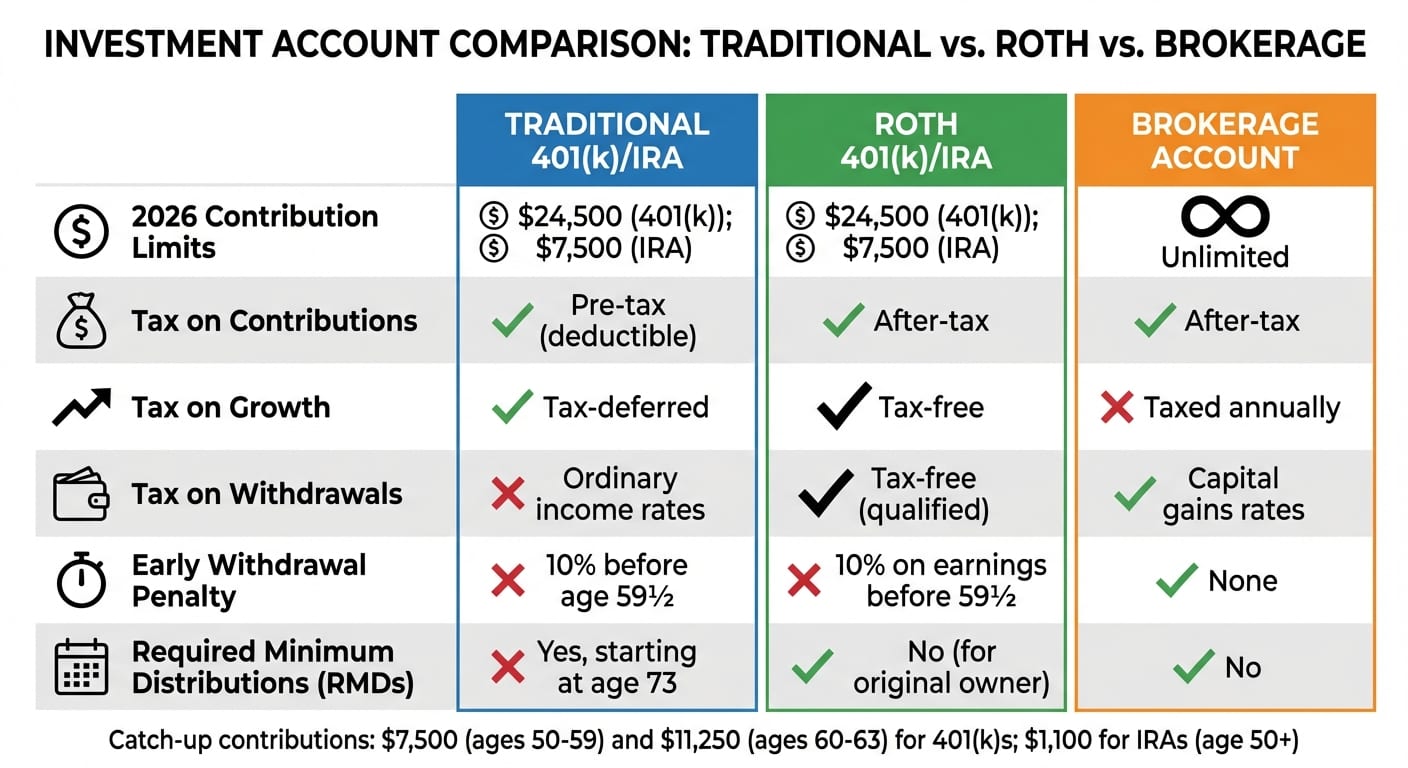
Feature Traditional 401(k)/IRA Roth 401(k)/IRA Brokerage Account
2026 Limit $24,500 (401(k)); $7,500 (IRA) $24,500 (401(k)); $7,500 (IRA) Unlimited
Tax on Contributions Pre-tax (deductible) After-tax After-tax
Tax on Growth Tax-deferred Tax-free Taxed annually
Tax on Withdrawals Ordinary income rates Tax-free (qualified) Capital gains rates
Early Withdrawal Penalty 10% before 59½ 10% on earnings before 59½ None
RMDs Required Yes, starting at 73 No (for original owner) No

Having a clear understanding of these limits and rules helps you make smarter decisions about where to place your investments.

Consolidating and Analyzing Accounts with Mezzi

Mezzi

Handling investments across multiple platforms like a 401(k), IRA, and brokerage account can feel like juggling too many balls at once. Each platform has its own interface and quirks, making it tough to see how your investments work together - or where they might clash. Without a central view, you could inadvertently hold the same S&P 500 index fund in all three accounts, leading to concentration risks that sabotage your diversification efforts. Mezzi simplifies this chaos with its powerful consolidation tools.

Aggregating Accounts for a Unified View

Mezzi connects your 401(k), IRA, and brokerage accounts securely using trusted aggregators like Plaid and Finicity. The result? A single, streamlined dashboard where you can view your entire portfolio in one place. No more bouncing between your employer's 401(k) portal, your IRA custodian's site, and your brokerage platform just to piece together the full picture.

With all your accounts in one view, you can easily compare performance across them. For instance, 401(k) accounts often show money-weighted returns, which include employer contributions and can make performance look better than it is. On the other hand, IRAs and brokerage accounts typically report time-weighted or total returns. Mezzi standardizes these metrics, giving you a clear, apples-to-apples comparison. This clarity sets the stage for deeper insights, which Mezzi delivers through its X-Ray feature.

Spotting Overlaps with the X-Ray Feature

Mezzi's X-Ray feature takes things a step further by analyzing your holdings across all accounts to uncover hidden overlaps and risks. For example, you might find that the same S&P 500 index fund appears in your 401(k), IRA, and brokerage account. While this might seem harmless, it actually reduces diversification and increases risk.

These insights are more than just interesting - they're actionable. By identifying redundant investments, you can fine-tune your portfolio diversification strategy. Plus, the consolidated view can reveal tax optimization opportunities that could boost your annual returns by 1% to 2%. On a $1 million portfolio, that’s an extra $10,000 to $20,000 per year in wealth.

Optimizing Investments Across Account Types

After consolidating accounts and identifying overlaps, the next step is to strategically allocate assets to maximize tax efficiency. Thoughtful asset placement can improve portfolio performance by as much as 30 basis points annually.

Tax-Efficient Investment Placement

The tax characteristics of your accounts should guide where you place different types of investments. For example, tax-inefficient assets - like bonds and REITs - are best suited for tax-deferred accounts, where you can delay paying higher ordinary income tax rates. On the other hand, Roth accounts are ideal for high-growth investments, allowing for tax-free withdrawals down the road. For a $1 million portfolio, this approach could potentially increase your wealth by an average of $112,000.

Taxable brokerage accounts should house tax-efficient investments such as broad-market index ETFs, individual stocks held long-term, and municipal bonds. Stocks held for over a year qualify for long-term capital gains tax rates, capped at 23.8% federally - much lower than ordinary income rates. Index ETFs, with their low taxable distributions, are particularly well-suited for these accounts, where annual tax reporting is unavoidable.

"You can't control market returns, and you can't control tax law, but you can control how you use accounts that offer tax advantages - and good decisions about their use can add significantly to your bottom line."
– Brad Koval, Director of Financial Solutions, Fidelity Investments

Automating Rebalancing for Diversification

Once assets are placed correctly, automated rebalancing becomes more seamless, keeping your portfolio aligned with both tax and diversification goals. Managing allocations across multiple accounts - like 401(k)s, IRAs, and brokerage accounts - can feel like solving a complex puzzle, especially when accounting for deposits, withdrawals, or market swings.

This is where Mezzi's AI tools shine. They streamline rebalancing by coordinating across accounts, factoring in the tax implications of each trade. For example, Mezzi prioritizes trades in tax-advantaged accounts and minimizes tax impacts when selling appreciated assets. This approach avoids costly errors, like triggering wash sales or realizing short-term gains when long-term tax treatment would apply.

Minimizing Fees Across Accounts

Reducing fees is another critical step in optimizing your portfolio. Start by selecting the lowest-cost index fund available in your 401(k) and avoid duplicating high-fee funds across accounts. Then, use the flexibility of IRAs and brokerage accounts - where investment options are nearly unlimited - to complete your desired asset allocation.

Mezzi's fund analyzer identifies areas where expensive funds are concentrated and recommends lower-cost alternatives in more flexible accounts. If one account has higher fees for a specific asset class, consider holding that allocation entirely in the lower-cost account. This "spread" strategy helps reduce your overall expense ratio across the portfolio.

"One key virtue of investing in an IRA is that you can keep almost anything inside of it; you also have leeway to invest in very low-cost investments and administrative fees are usually low or nonexistent."
Morningstar

Another way to cut costs is by consolidating investments to meet higher account minimums. By pooling assets in one account, you can often access lower-cost share classes faster than spreading smaller amounts across multiple accounts. These steps set the stage for even more advanced tax strategies in the next section.

Using Mezzi for Advanced Tax Optimization

Once you've sorted out asset placement, Mezzi's AI can help you tackle two tricky tax strategies: avoiding wash sales and leveraging tax-loss harvesting. These approaches can potentially boost after-tax returns by 1% to 2% annually. For a $1 million portfolio, that could mean an extra $10,000 to $20,000 per year in your pocket. Building on Mezzi's ability to streamline account analysis, this section dives into how it handles these advanced tax strategies. By monitoring all your accounts together, Mezzi catches tax issues that individual brokerages might miss due to their limited scope. Let’s break down how it helps with wash sales and tax-loss harvesting.

Avoiding Wash Sales Across Accounts

Wash sales can be a headache. They happen when you sell a security at a loss in a taxable account and then repurchase the same or a similar security within 30 days before or after the sale. The IRS disallows the loss deduction in such cases. While this rule applies to taxable accounts, it can also be triggered by transactions in tax-advantaged accounts like IRAs. For instance, if you sell 100 shares of XYZ stock at a $2,000 loss in your brokerage account and then buy the same stock in your Traditional IRA, the IRS could disallow the $2,000 deduction - potentially costing you $480 in taxes at a 24% rate.

Tracking these overlaps manually is tough because brokerages don’t share transaction data. Mezzi simplifies this by scanning all your accounts - 401(k), IRA, brokerage - over a 61-day window (30 days before and after a sale). If it spots a potential wash sale, it flags the issue and suggests waiting 31 days before repurchasing or opting for a similar but not identical security. This automated process ensures compliance and protects tax deductions that might otherwise slip through the cracks.

Using Tax-Loss Harvesting Strategies

Mezzi doesn’t stop at avoiding wash sales - it also maximizes the benefits of tax-loss harvesting. This strategy involves selling investments at a loss in taxable accounts to offset capital gains or up to $3,000 of ordinary income annually. Since 401(k)s and IRAs are tax-deferred, this technique is only relevant for taxable accounts.

Mezzi’s AI identifies unrealized losses, like a tech ETF down 15%, and checks for overlaps in your retirement accounts. If it finds one, it might recommend selling the loss-making position and reinvesting in a similar but not identical option to maintain diversification and capture the tax advantage. For example, it could suggest swapping a total market ETF for an S&P 500 ETF.

Studies show that tax-loss harvesting can add 0.47% to 1.27% in annual returns, with some investors seeing an average tax benefit of 1.63% annually over a decade. For a $500,000 portfolio, Mezzi might estimate $2,800 in yearly tax savings while identifying three potential wash sale risks. The platform provides clear metrics - like projected after-tax returns, wash sale risk scores, and cross-account overlap percentages - so you can see how these strategies impact your bottom line in real terms.

Projecting Retirement and Long-Term Outcomes

After optimizing tax strategies and reducing fees, the next step is to forecast how your portfolio might grow over time. Mezzi’s financial calculator brings together data from your 401(k), IRA, and brokerage accounts to create a clear picture of your savings trajectory. By combining key financial inputs, the tool provides detailed retirement projections.

Estimating Growth Across Accounts

To use the calculator, enter details like your total portfolio value, annual contributions, expected returns, and fees. For 2026, you can contribute up to $24,500 to your 401(k) (including catch-up contributions if you're 50 or older) and $7,500 to an IRA. The tool then calculates how each account grows differently over time.

For example, imagine a $500,000 portfolio spread across account types with an average 6% return. In 20 years, it could grow to $1.6 million. However, the type of account matters. Tax-deferred accounts like 401(k)s and IRAs grow without immediate tax impacts, while brokerage accounts are taxed annually on dividends and capital gains. This taxation can reduce an effective return from 7% to about 5.1%, assuming a 15% long-term gains tax.
Fees also play a critical role. Mezzi’s calculator shows the difference between "portfolio value without fees" and "portfolio value with current asset manager." A 1% advisor fee might seem minor, but over 30 years, it could cost a $1 million portfolio over $300,000 in lost growth. The visual comparison makes the impact of fees impossible to overlook. These projections help you explore and refine retirement strategies with confidence.

Scenario Analysis for Retirement Goals

Mezzi also allows you to explore various retirement scenarios, whether you’re aiming for traditional retirement at 67, early retirement at 45 (FIRE), or a semi-retirement approach like "Barista FIRE", where you work part-time. Simply set your goal - like replacing 70% of a $100,000 salary (or $70,000 annually) - and the calculator estimates your probability of success. For instance, if your current plan has a 65% success rate, Mezzi might recommend increasing your 401(k) contributions by $2,000 annually to raise your success rate to 92%.

The tool also evaluates withdrawal strategies, comparing tax-efficient withdrawals vs. traditional approaches like proportional withdrawals across all accounts. Proportional withdrawals can help reduce tax impacts and stretch your savings further. For example, if you have $200,000 in a taxable account, $250,000 in a traditional IRA, and $50,000 in a Roth IRA, withdrawing from one account at a time might create a $5,000 annual tax bump for 11 years and deplete your portfolio in about 23 years. On the other hand, proportional withdrawals smooth out taxes and extend the portfolio’s life to 24 years - giving you an extra year of retirement income simply by adjusting your withdrawal strategy.

Conclusion

Managing your investments across 401(k), IRA, and brokerage accounts doesn’t have to be complicated. It starts with understanding how these accounts function, strategically placing assets to maximize tax efficiency, and keeping a clear, unified view of your overall portfolio. By combining automated rebalancing with proportional withdrawal strategies during retirement, you could potentially increase your annual returns by 1% to 2%, just through tax optimization alone.

Mezzi simplifies this process, offering a seamless way to manage your portfolio. By consolidating your accounts, the platform helps you spot portfolio overlaps and steer clear of costly wash sales. It also provides insights into how fees and taxes impact your wealth over time. Taking a comprehensive approach to your accounts could mean an additional retirement year or even an extra $10,000–$20,000 annually on a $1 million portfolio. Staying mindful of annual contribution limits ensures that every optimized dollar today can grow exponentially in the future.

Ready to take control? Link your accounts and experiment with withdrawal strategies or contribution adjustments. These insights could transform your financial outlook - all without the need for traditional advisor fees.

FAQs

How do I decide which assets go in my 401(k), IRA, vs brokerage?

Deciding where to allocate your investments - whether in a 401(k), IRA, or brokerage account - comes down to balancing tax efficiency and your financial objectives. For taxable brokerage accounts, investments like index funds or ETFs work well because they tend to generate fewer taxable events. On the other hand, assets that aren't as tax-friendly, such as bonds or REITs, are better suited for tax-advantaged accounts like IRAs or 401(k)s.

When optimizing your portfolio, think about factors like tax treatment, contribution limits, and the potential for long-term growth. These considerations can help you make the most of each account type.

How can I rebalance across accounts without creating a big tax bill?

Rebalancing your portfolio without facing a hefty tax bill requires a strategic approach. Start by focusing on tax-advantaged accounts - such as IRAs and 401(k)s - for making adjustments. These accounts let you trade without worrying about immediate tax consequences.

For taxable accounts, consider using tax-loss harvesting. This involves selling investments at a loss to offset gains, which can help lower your taxable income.

To simplify the process, tools like Mezzi can be incredibly useful. They can identify tax-efficient strategies, automate trades, and ensure compliance with rules like avoiding wash sale violations. By combining these tactics, you can keep your portfolio aligned with your goals while keeping taxes in check.

How do I avoid wash sales when trading similar funds in multiple accounts?

To steer clear of wash sales, it's essential to stick to IRS guidelines designed to prevent disallowed losses. A wash sale occurs when you sell a security at a loss and then buy it back (or a substantially identical one) within 30 days before or after the sale.

Here are a few practical ways to avoid this:

  • Wait at least 31 days before repurchasing the same security to ensure the wash sale rule doesn't apply.
  • Consider alternative investments that offer similar market exposure but aren't classified as "substantially identical" to the one you sold.
  • Be cautious with IRAs during the wash sale window, as losses on repurchases made in these accounts cannot be claimed and are permanently disallowed.

Following these steps can help you manage your investments while staying compliant with tax rules.

Table of Contents

Book Free Consultation

Walk through Mezzi with our team, review your current situation, and ask any questions you may have.

Book Free Consultation
Ask ChatGPT about Mezzi