
Choosing between Mezzi and Fidelity Wealth Services depends on how you prefer to manage your investments. Here's a quick breakdown:
- Mezzi is free to get started. Choose Advisory for unlimited advice and advanced features at $39/month or $399/year. Concierge includes the same, plus hands-on support, at $99/month or $999/year. It focuses on tax efficiency, risk analysis, and portfolio insights without moving your funds. Ideal for hands-on investors managing complex portfolios.
- Fidelity Wealth Services: A custodial service requiring assets to be held at Fidelity. It offers robo-advisory (Fidelity Go) for 0.35% annually (free under $25,000) and human advisor support for larger portfolios. Best for those seeking full-service management.
Quick Comparison
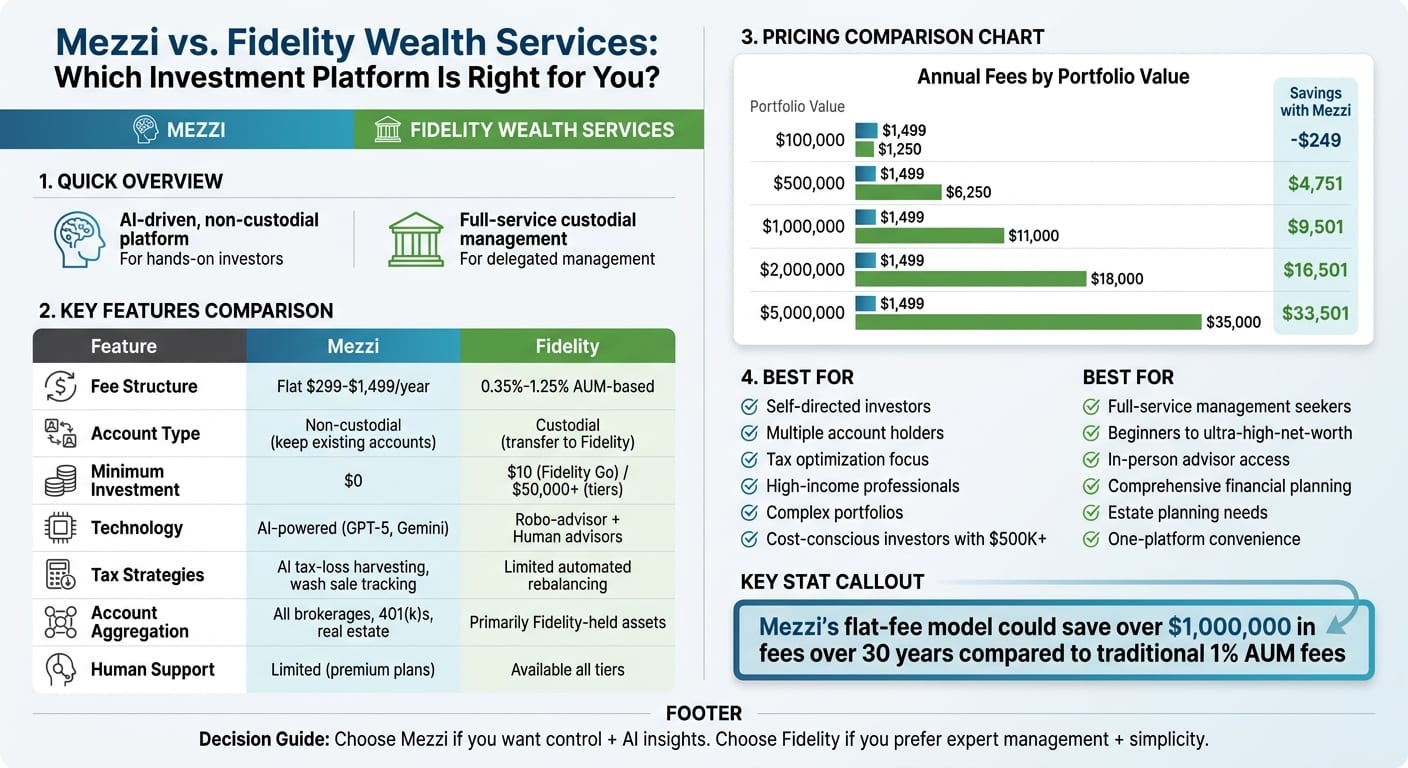
FeatureMezziFidelity Wealth ServicesFee StructureFree to get started; Advisory offers unlimited advice and advanced features for $39/month or $399/year; Concierge adds hands-on support for $99/month or $999/yearAUM-based (0.35%+ or tiered fees)Account TypeNon-custodialCustodial (assets held at Fidelity)Tax StrategiesAI-driven tax-loss harvestingLimited to Fidelity Go (taxable)Minimum Investment$0$10 (Fidelity Go), $50,000+ (tiers)Portfolio InsightsAI "X-Ray" for risks/overlapsStandard tracking/rebalancing
Key takeaway: Mezzi is better for DIY investors wanting advanced tools, while Fidelity suits those preferring professional management and simplicity.
Should You Replace Your Financial Advisor with A.I.?
What Is Mezzi?

Mezzi is an SEC-registered investment adviser designed to integrate seamlessly with all your financial accounts - whether they’re 401(k)s, IRAs, or taxable brokerage accounts. Using secure, read-only connections from trusted providers like Plaid and Finicity (Mastercard), Mezzi ensures your assets stay right where they are, with your existing brokerages.
Instead of charging the typical 1% of assets under management (AUM), Mezzi operates on a flat-fee membership model. This approach could save you over $1,000,000 in fees over a 30-year period. Mezzi doesn’t store your login credentials, execute trades, or move money. Instead, it focuses on offering advice and spotting opportunities, leaving you in full control of your investments.
What makes Mezzi stand out is its use of AI-driven analysis, powered by reasoning models from OpenAI and Google. This technology provides institutional-level portfolio insights and highlights tax-saving strategies that may boost your annual returns by 1% to 2%.
"I've tried a lot of personal finance products. This is the only one with deeply integrated AI".
- Andre, author of FAANG Fire
Let’s dive into Mezzi’s key features and who can benefit most from its services.
Mezzi's Main Features
Mezzi brings a range of tools to the table, designed to simplify complex financial management.
The Portfolio X-Ray feature is a standout. It helps you uncover hidden stock overlaps across ETFs, mutual funds, and individual holdings, giving you a clearer picture of your portfolio’s true exposure.
"Mezzi's X-Ray feature allowed me to uncover exposure to stocks I didn't realize I had".
- Shuping, Founder of Summer AI
Tax optimization is another major focus. Mezzi offers year-round guidance on strategies like tax-loss harvesting, wash sale tracking across accounts, and advice on placing assets in the most tax-efficient accounts (e.g., Roth vs. Traditional or taxable accounts). For instance, it may help you save $10,221 on capital gains taxes - potentially growing to $76,123 over three decades [\[1\], depending on individual circumstances, portfolio composition, market conditions, and fees](https://www.mezzi.com). On top of this, the AI chat interface is available 24/7 to answer financial questions tailored to your linked accounts.
"Mezzi gives me answers and ideas when I need them, no matter what time of day or how big or small the question".
- Mike, a Product Manager
Who Mezzi Is For
Mezzi is ideal for self-directed investors who want to stay in control of their portfolios while leveraging advanced, data-driven insights. It’s particularly suited for high-income professionals - like doctors, tech employees (including those in FAANG companies pursuing early retirement), and CEOs - who deal with complex financial setups across multiple accounts and prefer to avoid hefty AUM fees.
"Absolutely the BEST app to manage your wealth. I've been pleased since the beginning".
- The Smile Investor (@TinyToothDDS)
What Is Fidelity Wealth Services?

Fidelity Wealth Services offers a tiered approach to financial planning and managed investing, designed to provide a seamless experience by requiring clients to hold their assets directly with Fidelity. Unlike platforms that aggregate external accounts, Fidelity keeps everything within its own ecosystem for streamlined management.
The service is divided into four tiers: Fidelity Go, an entry-level robo-advisor with a starting point of $10 and full features for accounts exceeding $25,000; Fidelity Advisory Services, which requires a $50,000 minimum and offers team-based support; Fidelity Wealth Management, tailored for those with $500,000 or more, providing one-on-one planning; and Fidelity Private Wealth Management, designed for ultra-high-net-worth clients with at least $2 million in managed assets and $10 million in total investable assets. All of these tiers operate under a fiduciary standard, ensuring that advisors prioritize your best interests. Below, we’ll explore the platform’s key features and the types of investors who might benefit most from using it.
Fidelity Wealth Services' Main Features
Fidelity's managed accounts include options like Personalized Portfolios, Separately Managed Accounts for targeted goals, and Managed FidFolios, which utilize direct indexing. For those starting out, Fidelity Go stands out, having earned Kiplinger's "Best Robo Advisor of 2025" award. It charges no fees for balances under $25,000 and a 0.35% annual fee for larger accounts, offering features like automated rebalancing and tax-loss harvesting for taxable accounts over $25,000.
With over 200 physical branches across the U.S., Fidelity also provides the option of in-person advisor meetings for those who prefer face-to-face consultations. Additionally, the platform integrates smoothly with Fidelity's broader brokerage services, allowing users to manage managed portfolios alongside self-directed trades in stocks, ETFs, crypto, and more - all within a single interface.
Who Fidelity Wealth Services Is For
Fidelity Wealth Services caters to a wide range of investors, from beginners to those with significant wealth, thanks to its tiered structure. It’s particularly well-suited for those who want a comprehensive financial solution that combines managed portfolios, self-directed trading, and personalized financial planning in one place.
Recognized for its high-quality advice and client satisfaction - earning top rankings in Kiplinger’s Readers' Choice Awards for May 2025 - Fidelity Wealth Management has established a reputation for excellence. This service is especially appealing to investors who value a mix of digital tools and dedicated human support, all within a single, convenient platform.
Mezzi vs. Fidelity Wealth Services: Feature Comparison
When comparing Mezzi and Fidelity Wealth Services, a key distinction lies in how they handle assets. Mezzi operates as a non-custodial platform, meaning your investments remain with your current brokerages. Fidelity, however, requires you to transfer assets into its accounts to use its services.
Another major difference is in their advisory approach. Mezzi utilizes generative AI (GPT-5, Gemini) to provide 24/7 real-time fiduciary advice. In contrast, Fidelity Go combines robo-advisor algorithms with optional human advisor support. Interestingly, a 2025 Fidelity survey highlighted that 80% of wealth management firms using generative AI saw improvements in efficiency.
Account aggregation is also a standout feature for Mezzi. It provides a comprehensive view of your net worth by pulling data from hundreds of U.S. brokerages, bank accounts, and even manual assets like real estate and collectibles. Fidelity, on the other hand, focuses primarily on assets held within its ecosystem, though it does offer limited external account linking for tracking purposes.
When it comes to tax strategies, Mezzi shines with AI-driven tax-loss harvesting, wash sale monitoring, and lot analysis. These tools aim to enhance annual returns by an estimated 1% to 2%. Fidelity offers automated rebalancing and some tax-sensitive strategies, but these are more limited and primarily available through Fidelity Go.
Feature Comparison Table
FeatureMezziFidelity Wealth ServicesPrimary TechnologyGenerative AI (GPT-5, Gemini)Algorithmic Robo-advisor / Human AdvisorsAsset LocationNon-custodial (Keep existing brokerages)Custodial (Assets must be at Fidelity)Fee TypeFree to get started; Advisory offers unlimited advice and advanced features for $39/month or $399/year; Concierge adds hands-on support for $99/month or $999/yearAUM-based (0.35% for Fidelity Go; varies by tier)Account AggregationAggregates diverse assets (brokerages, 401(k), crypto, real estate)Primarily Fidelity-held accountsTax-Loss HarvestingAI-driven guidance with wash sale trackingAutomated (Fidelity Go only; limited)Portfolio AnalysisAI "X-Ray" for hidden risks and overlapping holdingsTraditional portfolio tracking and market dataHuman Advisor AccessLimited human support available on premium plansAvailable across all tiersMinimum Investment$0 (connect existing accounts)$10 (Fidelity Go); $50,000+ (higher tiers)
This table highlights the main differences between the two, helping users decide which platform aligns better with their financial goals and preferences.
Pricing: Mezzi vs. Fidelity Wealth Services
When it comes to fees, Mezzi and Fidelity Wealth Services take very different approaches. Mezzi is free to get started. Choose Advisory for unlimited advice and advanced features at $39/month or $399/year. Concierge includes the same, plus hands-on support, at $99/month or $999/year. Fidelity Wealth Services, on the other hand, uses an Assets Under Management (AUM) model. Their fees start at 1.25% for smaller portfolios and decrease as your assets grow. However, Fidelity requires a minimum investment of $50,000 to get started. Here's a closer look at how their costs stack up.
At the $100,000 portfolio level, the fees are fairly similar. But as your portfolio grows, Mezzi's flat-fee structure provides a clear advantage, with significantly lower costs. The table below breaks it down:
"Saving 1%-plus on an advisor may mean saving over $1M over 30 years, depending on portfolio size, investment returns, and fees." – Mezzi
Pricing Comparison Table
Portfolio ValueMezzi (Advisory)Fidelity Wealth ServicesAnnual Savings with Mezzi$100,000$99/month or $999/year$1,250-$249$500,000$99/month or $999/year$6,250$4,751$1,000,000$99/month or $999/year$11,000$9,501$2,000,000$99/month or $999/year$18,000$16,501$5,000,000$99/month or $999/year$35,000$33,501
For portfolios exceeding $500,000, Mezzi's flat-fee pricing results in substantial savings compared to Fidelity's percentage-based model. This means more of your money stays invested, helping your wealth grow over time.
Another key difference lies in how they handle your assets. Mezzi allows you to keep your investments at your current brokerages, meaning you'll still pay any associated fees, like expense ratios or transaction costs. Fidelity, however, requires you to transfer your assets into its ecosystem. While Fidelity's advisory fee covers services like discretionary management and planning, it doesn’t include underlying fund expenses, regulatory fees, or certain transaction costs.
For investors focused on cost efficiency and flexibility, these distinctions can play a major role in shaping your decision.
Which Platform Is Right for You
Choosing the right platform boils down to your preferences: do you want advanced tools to manage multiple accounts on your own, or would you rather rely on expert guidance to handle everything in one place? If your investments are scattered - say, a 401(k) with one provider, a brokerage account with another, and a Roth IRA somewhere else - Mezzi is built to handle that complexity. It pulls everything together, offering a clear view for tax and risk analysis. Let’s break down which platform might suit your needs better.
When to Choose Mezzi
Mezzi works best for investors who like to stay hands-on but need help organizing and analyzing accounts across different institutions. It shines in its ability to consolidate your financial data without requiring you to move assets. One of its standout features is its tax-focused strategies. Mezzi can:
- Spot tax-loss harvesting opportunities
- Monitor wash sale risks across accounts
- Suggest whether certain assets should go in a Roth IRA or a Traditional IRA
These tools may potentially boost your annual returns by 1% to 2%, making Mezzi a strong choice for those looking to fine-tune their investments for better performance.
"Mezzi gives me answers and ideas when I need them, no matter what time of day or how big or small the question." – Mike, Product Manager
When to Choose Fidelity Wealth Services
While Mezzi is perfect for those who want control and flexibility, Fidelity Wealth Services is the better option if you prefer a fully managed experience. It’s designed for investors who want to take a step back and let professionals handle the complexities. This is especially beneficial if you’re navigating major financial milestones like retirement income planning, estate strategies, or integrating insurance into your portfolio.
Fidelity also stands out for its simplicity. By consolidating all your assets within their ecosystem, advisors gain a complete view of your financial picture, which allows them to manage your portfolio more effectively. Keep in mind, though, that Fidelity Wealth Services tends to cater to investors with larger portfolios.
Making Your Decision
Pros and Cons Comparison
Here’s a quick look at how Mezzi and Fidelity Wealth Services stack up:
FactorMezziFidelity Wealth ServicesCustomizationAI-powered insights with the X-Ray feature to identify hidden exposures.Comprehensive financial planning with human advisors for a personalized approach.FeesFree to get started; Advisory offers unlimited advice and advanced features for $39/month or $399/year; Concierge adds hands-on support for $99/month or $999/yearAnnual fees range from 0.25% to 1.00% of assets under management.Tax EfficiencyOffers daily monitoring for tax-loss harvesting, wash sale risks, and asset location strategies.Provides tax-efficient management, but the robo-advisor lacks tax-loss harvesting capabilities.Technology24/7 AI chat for portfolio questions and read-only account access.Advanced tools like Active Trader Pro and automated rebalancing backed by institutional-level research.LimitationsNo trade execution or estate planning services.Higher fees for managed services, limited specialty portfolios, and larger cash allocations in robo-advisor accounts [3,24].
This breakdown highlights each platform's strengths and helps clarify which might align better with your needs.
Bottom Line
The choice ultimately comes down to how much control you want over your investments. Mezzi caters to independent investors who value expert insights without giving up control. Its AI-driven tools focus heavily on tax efficiency, helping you avoid traditional asset-based fees while seeking to optimize returns.
On the other hand, Fidelity Wealth Services is a great fit for those who prefer full-service management. It’s especially beneficial for investors with complex financial situations or those who want their banking, investments, and research tools centralized within one platform.
"Mezzi identifies and analyzes tax savings opportunities in seconds... You get institutional-grade planning without the 1% AUM advisor fee. Actual tax savings will vary based on individual circumstances, portfolio composition, market conditions, and fees." - Mezzi
If you enjoy managing your own investments, Mezzi provides the flexibility and tools to make that easier. But if you’d rather delegate the work, Fidelity offers expert management - just be ready to pay for the convenience of their full-service approach.
FAQs
Can I use Mezzi without transferring my investments?
Mezzi lets you manage your investments without needing to transfer them. It offers automated, actionable insights, empowering you to take charge of your portfolio on your own terms.
How does Mezzi find tax savings across multiple accounts?
Mezzi quickly pinpoints tax-saving opportunities by diving into strategies like tax-loss harvesting, tracking wash sales, and choosing the right account types (Roth, Traditional, or taxable). These approaches are designed to help rebalance portfolios while boosting after-tax returns.
When does Fidelity’s AUM fee cost more than Mezzi’s flat fee?
Fidelity’s fee structure, based on a percentage of assets under management (AUM), often surpasses Mezzi’s flat fee once annual costs exceed $8,000. For example, with a portfolio of $4–$5 million, Fidelity charges between 0.7% and 1% of AUM, translating to about $35,000 per year - significantly higher than Mezzi’s $8,000 flat fee. On the other hand, for portfolios under $1 million, Fidelity’s fees can be similar to or even lower than Mezzi’s. For portfolios exceeding $8 million, Mezzi’s flat fee tends to become the more budget-friendly choice.
Disclosures:
- This content is for informational purposes only and does not constitute investment advice or a recommendation to buy or sell any security.
- Past performance is not indicative of future results. No guarantee of future performance or outcomes is implied.
- Savings and performance examples are hypothetical and for illustrative purposes only. Actual results will vary based on individual circumstances, portfolio composition, market conditions, and fees.
- Registration does not imply a certain level of skill or that the SEC has approved the company or its services.