
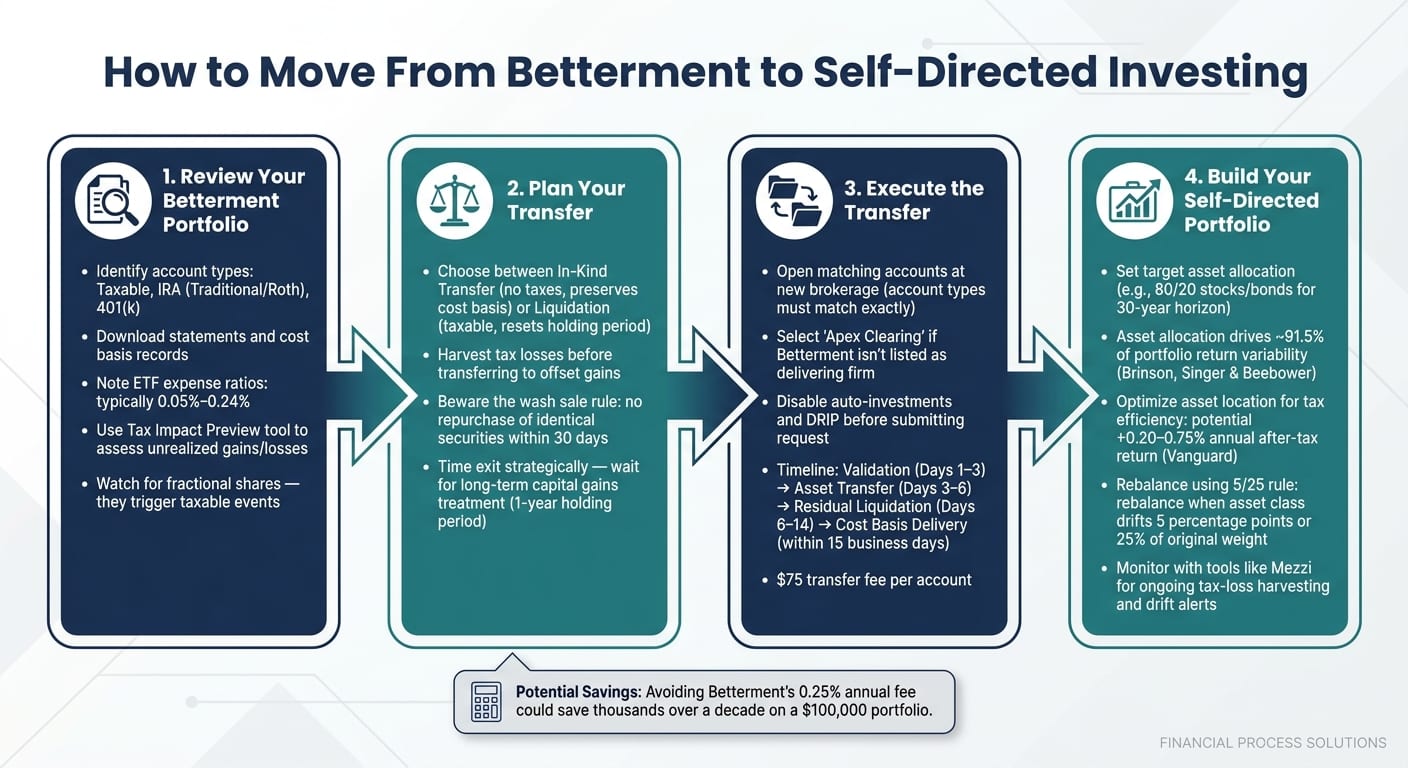
Switching from Betterment to self-directed investing can help you take full control of your portfolio and potentially reduce costs. Betterment charges a 0.25% annual fee, which can add up over time, especially for larger portfolios. Self-directed investing allows you to choose your own investments, optimize tax strategies, and customize your portfolio to suit your goals. Here's a quick overview of the process:
- Review Your Betterment Portfolio: Identify account types, holdings, and any associated fees or tax implications. Fractional shares will be sold during transfers, which may trigger taxable events in non-retirement accounts.
- Plan Your Transfer: Decide between in-kind transfers (preserve holdings and avoid taxes) or liquidation (sell for cash, which may result in taxes but offers flexibility). Use tools like Betterment's "Tax Impact Preview" to minimize costs.
- Execute the Transfer: Open matching accounts at your new brokerage, disable automated features in Betterment, and initiate the transfer. Be prepared for a $75 transfer fee per account and a timeline of up to 15 business days.
- Build Your Portfolio: Define your target asset allocation, optimize asset location for tax efficiency, and use tools like Mezzi to monitor and manage your investments over time.
Taking this step requires careful planning but may lead to greater flexibility and cost savings. The full guide below breaks down each step in detail.
Step 1: Review Your Current Betterment Portfolio
Before transferring any funds, take the time to review your account details thoroughly. Understanding your accounts, holdings, and potential fees can help you avoid unexpected costs or complications.
Identify Your Account Types and Features
Begin by confirming the types of accounts you have and how they can be transferred. Taxable brokerage accounts and IRAs (Traditional and Roth) are eligible for in-kind transfers through the Automated Customer Account Transfer Service (ACATS). However, accounts like 401(k) plans, Cash Reserve, and Cash Goals require separate processes, such as rollovers or manual withdrawals.
Make a note of any automated features linked to your accounts. Features like tax-loss harvesting, automatic rebalancing, dividend reinvestment, and Tax-Coordinated Portfolio optimization will stop functioning once you leave Betterment’s platform. Additionally, transferring one account might trigger rebalancing in other accounts, which could lead to taxable gains.
Once you’ve clarified your account types, shift your focus to your portfolio’s structure.
Review Your Portfolio Allocation and Holdings
Log into your Betterment account and download essential documents, such as monthly statements and cost basis records, by navigating to Settings > Accounts. It’s crucial to do this before initiating a transfer, as your account will be locked once the process begins.
Betterment portfolios are primarily made up of ETFs with annual expense ratios typically ranging from 0.05% to 0.24%. Take note of the specific ETFs in your portfolio and check how many whole shares versus fractional shares you own. Fractional shares cannot be transferred through ACATS and will instead be converted to cash via a residual sweep. This conversion, treated as a realized gain or loss in taxable accounts, generally occurs a few days after the main transfer is completed.
After reviewing your portfolio’s allocation, turn your attention to potential fees and tax considerations.
Calculate Fees and Tax Exposure
Two costs require careful evaluation: Betterment’s $75 outgoing transfer fee per account and any taxes on unrealized gains. Use Betterment’s "Tax Impact Preview" tool to assess each goal’s unrealized gains and losses.
Pay close attention to whether your gains are short-term (held for less than a year) or long-term (held for over a year). Short-term gains are taxed as ordinary income, while long-term gains qualify for lower capital gains rates. Timing your transfer strategically can make a noticeable difference. For instance, in February 2026, an investor named Mike had $18,000 in unrealized long-term gains within a $120,000 taxable account at Betterment. By harvesting $2,500 in losses before initiating an in-kind transfer, he offset other gains and saved between $375 and $500 in federal taxes - more than enough to cover the $75 transfer fee.
"Asset location - which holdings sit in which accounts - can be worth more than stock picking over time." - Mezzi
With a clear understanding of your holdings, fees, and tax exposure, you’ll be better prepared to plan your next steps for leaving Betterment.
Step 2: Plan Your Move Away From Betterment
Now is the time to strategize your asset transfer to help minimize taxes and keep your portfolio intact. The method and timing of your transfer can play a big role in both tax implications and the overall stability of your investments.
In-Kind Transfer vs. Liquidation: Which Option Works Best?
One of the key decisions you'll face is whether to transfer your assets as-is or sell them for cash before moving.
An in-kind transfer through ACATS allows you to move your existing ETF shares directly to the new brokerage without selling. This process doesn’t trigger taxes, and your original cost basis and holding period remain unchanged. On the other hand, a liquidation transfer sells all your holdings for cash before transferring the proceeds. This approach results in capital gains taxes for taxable accounts and resets your holding period to zero.
For taxable accounts with large unrealized gains, in-kind transfers are often the safer choice. Liquidation may make sense if you’re planning a complete portfolio overhaul and the tax impact is manageable - or if your gains are minor. For IRAs, liquidation is sometimes unavoidable since the ETFs Betterment uses may not be available at the receiving brokerage. However, within IRAs, this doesn’t result in tax consequences.
It’s worth noting that ACATS only supports whole shares. Fractional shares will be sold off as cash in a residual sweep after the main transfer, which can create a taxable event in non-retirement accounts.
Plan for Tax Efficiency
Before starting the transfer, Betterment’s Tax Impact Preview tool can help you understand your unrealized gains and losses. If you have positions showing a loss, selling them before the transfer could allow you to harvest those losses to offset gains elsewhere - potentially lowering your tax bill.
Be mindful of the wash sale rule: if you sell a security at a loss and repurchase a “substantially identical” one within 30 days, the IRS disallows the loss for tax purposes. To avoid this, either wait 30 days before rebuying or swap the sold ETF for a similar but not identical one. For instance, you could temporarily replace a Vanguard S&P 500 ETF with a Schwab S&P 500 ETF. Tools like Mezzi can help you monitor your positions across accounts and flag potential wash sale conflicts before they become an issue.
Careful tax planning should go hand in hand with timing your exit for maximum benefit.
Choose the Right Time to Exit
The timing of your exit can have a big impact on your taxes, especially when it comes to your holding period. Positions nearing the one-year mark may qualify for long-term capital gains treatment if you wait, which could lower your tax rate from ordinary income levels (up to 37%) to long-term capital gains rates of 0%, 15%, or 20%, depending on your income.
Your income for the current year also matters. If you expect a drop in income - due to retirement, a job change, or other reasons - you might fall into the 0% long-term capital gains bracket, making it a good time to realize gains without federal taxes. On the flip side, if this year has been high-income, deferring gains to the next tax year might help push the liability into a lower bracket.
Step 3: Execute Your Account Transfer
With your tax strategy in place and the timing of your exit decided, it’s time to move forward with the actual transfer. While this step is more procedural than strategic, even small errors - like mismatched account names or skipping key steps - can lead to delays or rejected transfers.
Open Your New Brokerage Accounts
Start the process at your new brokerage, not at Betterment. Make sure to open accounts that match your existing Betterment accounts exactly - Individual Taxable to Individual Taxable, Roth IRA to Roth IRA, and so on. Account type mismatches are a common reason for transfer issues.
Before you proceed, download your latest monthly statements from Betterment by navigating to Settings > Accounts. Your new brokerage will likely require a statement dated within the past 60 days, along with your Betterment account number. If your new brokerage doesn’t list "Betterment" as an option for the delivering firm, select "Apex Clearing" instead, as Apex is the clearing house Betterment uses for outgoing transfers.
"The process begins at the new firm, not the old one. You open your account and provide a recent statement from your current firm... You do not need to contact your old firm." - Jeffrey Barnett, Founder and Managing Principal, Fintegrity LLC
Move Your Assets From Betterment
Before submitting your transfer request, take a few preparatory steps. Disable automatic investments and dividend reinvestment plans (DRIP), and ensure any recent trades have settled under T+1 rules.
Once your transfer request is submitted, Betterment will lock your account for the duration of the process. During this time, you won’t be able to trade, deposit, or withdraw funds. Here’s a general timeline for what to expect:
It’s important to note that ACATS (Automated Customer Account Transfer Service) only supports whole shares. Any fractional shares will be liquidated, with the proceeds sent as a cash sweep. For taxable accounts, this may result in a small capital gains event. Additionally, Betterment charges a $75 fee for each investing account transferred out. After the transfer is complete, you’ll need to verify everything to ensure accuracy.
Check and Reconcile After the Transfer
Once the transfer is finalized, review all details carefully. Confirm that share counts, purchase dates, and cost basis figures match the information on your original Betterment statements. This process usually takes 15–20 days, as cost basis data is transmitted separately and may arrive later.
If you haven’t received the cost basis information within 20 days, reach out to Betterment support and request a resend. This data is critical for calculating your gains and losses during tax season. To ensure everything lines up, use Mezzi to cross-check your new account’s share counts, purchase dates, and cost basis against your downloaded Betterment statements. This step helps maintain consistency from your initial review.
Step 4: Build and Manage Your Self-Directed Portfolio
Now that your assets are securely in your new accounts, it’s time to take an active role in shaping and managing your portfolio. Instead of relying on a robo-advisor’s decisions, you’ll make your own choices - using Mezzi as a tool to guide you along the way.
Set Your Portfolio Framework
Before you start investing, define your portfolio's purpose and establish a target asset allocation. This involves setting proportions for stocks, bonds, and other asset classes based on factors like your retirement timeline, risk tolerance, and need for liquidity. For example, someone who is 35 years old with a 30-year investment horizon might lean toward an 80/20 stock-to-bond split, while someone nearing retirement in five years might opt for a more conservative 60/40 allocation.
Why does this matter so much? Research by Brinson, Singer, and Beebower shows that asset allocation policy accounts for about 91.5% of the variability in portfolio returns over time. It’s not about picking the perfect stock or timing the market - it’s about your overall allocation.
Once you’ve set your target allocation, connect all your accounts to Mezzi. This includes taxable brokerage accounts, Roth IRAs, traditional IRAs, and any 401(k)s. Mezzi’s read-only aggregation feature provides a complete view of your holdings, which helps identify risks like concentration or overlap and ensures your portfolio aligns with your goals.
With your target allocation in place and your accounts integrated, the next step is figuring out where each asset fits best.
Put Your Asset Allocation Into Practice
Now it’s time to decide which assets belong in which accounts. This process, known as asset location, focuses on placing investments in the account types that best match their tax characteristics. Using Mezzi’s insights, you can assign each asset to its optimal account, potentially increasing tax efficiency.
For example, Mezzi can analyze your holdings and flag situations where poor asset placement might be leading to unnecessary taxes. According to Vanguard, optimizing asset location may improve after-tax returns by 0.20–0.75 percentage points annually, depending on your tax bracket and the types of assets you hold. This small adjustment could make a big difference over time without altering your risk exposure.
Before finalizing your holdings, use Mezzi’s X-Ray tool to check for overlap. For instance, owning a total U.S. stock market ETF alongside an S&P 500 ETF and a large-cap growth fund might lead to significant duplication without adding meaningful diversification. Simplifying your portfolio with fewer, broader funds can make it easier to manage and rebalance.
Set Up a Routine for Ongoing Management
Keeping your portfolio aligned with your goals requires regular maintenance. A practical way to manage this is to rebalance based on pre-determined drift thresholds. Vanguard’s "5/25 rule" is a helpful guide: consider rebalancing when an asset class deviates by 5 percentage points from its target or by 25% of its original weight, whichever is smaller. This approach minimizes unnecessary trades while maintaining your intended risk level.
When rebalancing, prioritize directing new contributions toward underweight assets to correct imbalances without triggering taxable sales. If selling is unavoidable, Mezzi can identify tax-loss harvesting opportunities and track the 30-day wash sale rule, alerting you when it’s safe to repurchase a similar position. This helps you stay invested while preserving any tax benefits.
Mezzi also monitors your portfolio’s performance against relevant benchmarks and tracks your progress toward retirement using data from your actual accounts - not generic estimates. If your allocation drifts, fees increase, or a position becomes too large relative to your target, Mezzi will notify you so you can address the issue before it grows into a larger problem.
Conclusion: Taking Control of Your Investments
Switching from Betterment to self-directed investing puts you in charge. You decide how to review your holdings, plan your transfer, move your assets, and create a portfolio that reflects your personal goals. It’s a step not everyone takes, but it can be a rewarding one.
This shift may also lead to potential savings. By avoiding Betterment's 0.25% fee and managing your investments directly, you could save thousands over a decade on a $100,000 portfolio.
To succeed, having the right tools and support is key. Mezzi helps by linking all your accounts - 401(k), Roth IRA, traditional IRA, taxable brokerage - and offering insights similar to what you’d get from a high-cost advisor. Whether your allocation shifts or tax-loss harvesting opportunities appear, Mezzi identifies these moments, helping you make informed decisions.
Self-directed investing doesn’t mean you need to be an expert. What it does require is consistency - maintaining your target allocation, contributing regularly, and reviewing your portfolio on a schedule. With Mezzi’s AI-driven insights, staying on top of rebalancing and portfolio reviews can become a regular habit. Over time, this steady approach may help keep your investments aligned and on track for growth.
FAQs
Will transferring trigger taxes?
Transferring investments can have tax consequences based on how the transfer is handled. In-kind transfers typically allow you to move assets without selling them, which may help you avoid capital gains taxes in taxable accounts. On the other hand, cash transfers involve selling your investments, which could result in a taxable event. Even with in-kind transfers, certain assets, like fractional shares, might need to be liquidated, potentially triggering taxes.
For retirement accounts, using a direct trustee-to-trustee transfer can help you sidestep taxes and penalties. Since these situations can get complicated, it's a good idea to consult a tax professional to better understand your specific circumstances.
What happens to fractional shares?
When using the Automated Customer Account Transfer Service (ACATS), it's important to note that it only deals with whole shares. Any fractional shares in your account will be sold automatically as part of the transfer process. This sale is considered a taxable event, meaning you may incur capital gains taxes depending on the sale's outcome. After the sale, any accrued management fees will be deducted, and the remaining cash proceeds will be transferred to your new brokerage firm.
How do I pick my asset allocation?
To begin, clarify your financial goals - whether that's saving for retirement, building an emergency fund, or something else entirely. Next, evaluate your risk tolerance by considering how much uncertainty you're comfortable with when it comes to potential gains and losses. Based on this, select an investment mix that suits both your timeline and comfort level. This could include a combination of stocks for growth, bonds for stability, and cash for liquidity.
Diversification is key to managing risk. Spread your investments across various sectors, company sizes, and geographic regions to create a balanced portfolio. Tools like Mezzi can help simplify this process by consolidating your accounts, giving you a clear overview of your holdings, and making it easier to adjust your portfolio to meet your target allocation and match your risk preferences.
Disclosures:
- This content is for informational purposes only and does not constitute investment advice or a recommendation to buy or sell any security.
- Past performance is not indicative of future results. No guarantee of future performance or outcomes is implied.
- Savings and performance examples are hypothetical and for illustrative purposes only. Actual results will vary based on individual circumstances, portfolio composition, market conditions, and fees.
Related Blog Posts
- What are the tax and fee implications of transferring brokerage accounts between custodians?
- How to leave Wealthfront and manage your own investments
- How to leave Betterment
- Leaving Your Robo-Advisor: A Step-by-Step Checklist
Transferring investments can have tax consequences based on how the transfer is handled. In-kind transfers typically allow you to move assets without selling them, which may help you avoid capital gains taxes in taxable accounts. On the other hand, cash transfers involve selling your investments, which could result in a taxable event. Even with in-kind transfers, certain assets, like fractional shares, might need to be liquidated, potentially triggering taxes.
For retirement accounts, using a direct trustee-to-trustee transfer can help you sidestep taxes and penalties. Since these situations can get complicated, it's a good idea to consult a tax professional to better understand your specific circumstances.
When using the Automated Customer Account Transfer Service (ACATS), it's important to note that it only deals with whole shares. Any fractional shares in your account will be sold automatically as part of the transfer process. This sale is considered a taxable event, meaning you may incur capital gains taxes depending on the sale's outcome. After the sale, any accrued management fees will be deducted, and the remaining cash proceeds will be transferred to your new brokerage firm.
To begin, clarify your financial goals - whether that's saving for retirement, building an emergency fund, or something else entirely. Next, evaluate your risk tolerance by considering how much uncertainty you're comfortable with when it comes to potential gains and losses. Based on this, select an investment mix that suits both your timeline and comfort level. This could include a combination of stocks for growth, bonds for stability, and cash for liquidity.
Diversification is key to managing risk. Spread your investments across various sectors, company sizes, and geographic regions to create a balanced portfolio. Tools like Mezzi can help simplify this process by consolidating your accounts, giving you a clear overview of your holdings, and making it easier to adjust your portfolio to meet your target allocation and match your risk preferences.