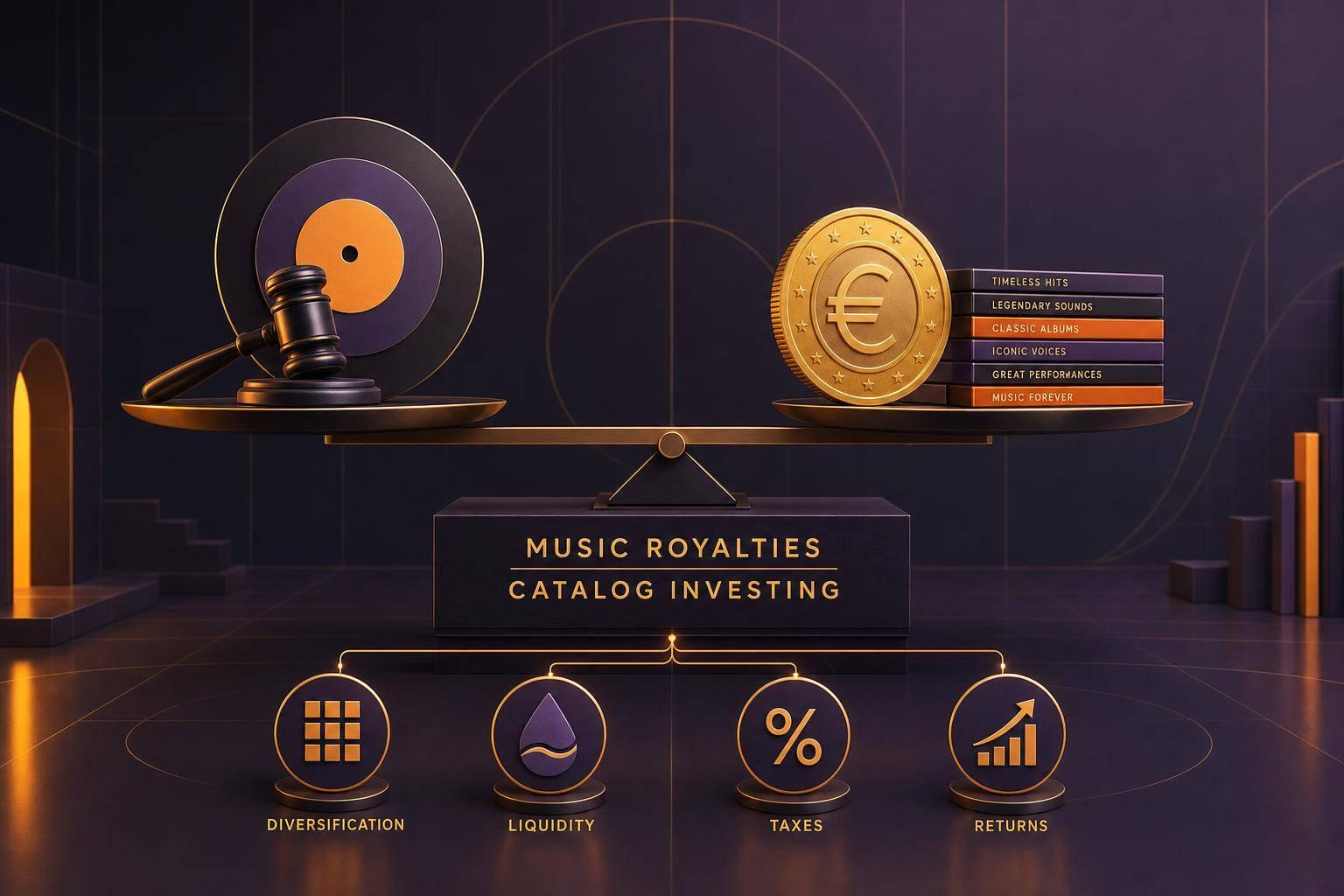
If I had to sum it up in one line: Royalty Exchange may suit people who want one royalty stream in U.S. dollars, while ANote may suit people who want small slices of a music catalog in euros.
Music royalty investing means I’m buying a right to future song income - not the song itself. And that difference may shape everything from cash flow to taxes to resale options.
Here’s the short version:
- Royalty Exchange uses auctions for individual royalty streams
- ANote offers fractional shares of music catalogs
- Royalty payments may come from performance, mechanical, streaming, or sync income
- Royalty Exchange may feel more direct, but exposure may be more concentrated
- ANote may spread risk across more tracks, but it may add FX and cross-border tax friction
- ANote has a secondary market, though liquidity may still be limited
- Music royalties may fit better as a small, speculative part of a portfolio than as core income
A few facts from the article stand out:
- U.S. statutory mechanical rates for physical formats are about $0.131 per song per unit
- One ANote catalog example was valued at €388,000 and split into 10,000 shares
- ANote cites an average annual return of 9.66%, though that figure may not reflect any single listing
How to Invest in Music Royalties for Passive Income!
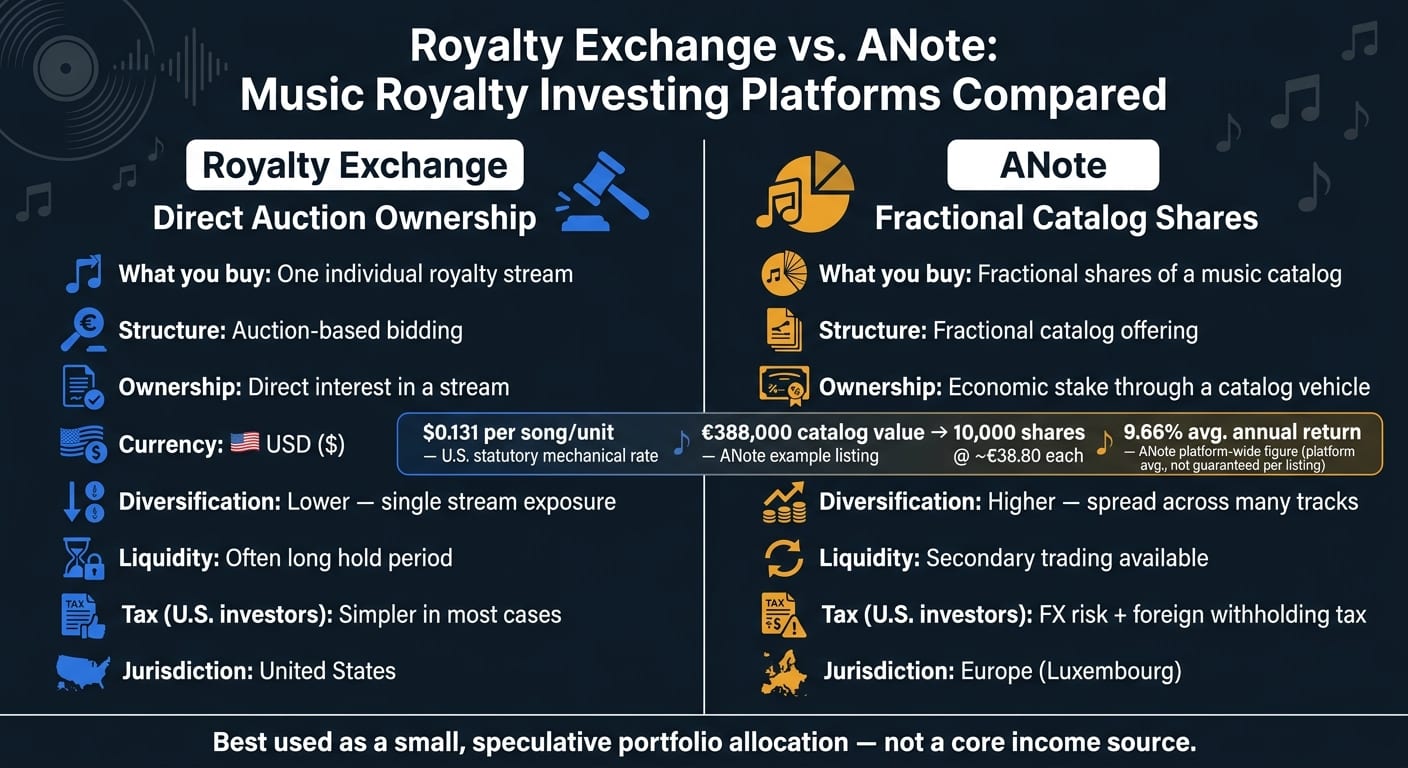
Quick Comparison
So the core trade-off may be simple: Royalty Exchange may offer more direct exposure, while ANote may offer more built-in spread across songs. From there, the choice may come down to rights terms, price, payout history, taxes, and whether I may be comfortable holding something that may not sell fast.
Royalty Exchange: auction-based access to individual royalty streams
Royalty Exchange is a marketplace where rights holders list royalty interests for sale, and investors bid on them. The setup is pretty simple: you review a listing, decide what that income stream may be worth to you, and place a bid. If your bid wins, you buy the royalty stream.
What gets listed and how auctions work
Listings usually involve royalty interests tied to music copyrights and related royalty interests. These deals are often set up as income shares or songwriter/publisher shares. As an investor, you’re a non-managing owner. The original rights holders keep control over management and the creative use of the catalog.
That detail matters. You may have a claim on income, but not control over how the music gets handled.
Before bidding, it makes sense to read the listing documents closely. Each one should spell out the rights being sold and the territories covered. Territory limits may matter a lot, because leaving out the U.S. may reduce cash flow in a material way.
This is also where the single-asset nature of many listings comes into focus. If one royalty stream sits at the center of the deal, valuation and concentration risk may deserve a closer look.
Payouts, fees, and holding period expectations
Distributions usually arrive monthly, quarterly, or semiannually. Net yield may depend on platform fees, taxes, and how long the stream is held.
This also doesn’t look like something built for frequent trading. In many cases, holders may end up keeping a stream for years rather than moving in and out of positions.
Due diligence on Royalty Exchange: rights, statements, and concentration risk
Due diligence often starts with a few plain questions:
- What rights are actually being sold?
- What do the historical royalty statements show?
- How much of the income may depend on one track or one rights holder?
Past statements may give you evidence of what the asset has paid before, but they may not serve as a forecast. That’s the big distinction here. With a single royalty stream, concentration risk may be much higher than in a catalog-share model like ANote’s.
ANote: share-based catalog investing with secondary trading
ANote sells fractional shares of music catalogs, not single royalty streams. That setup is different from Royalty Exchange. Instead of tying your money to one stream of royalties, ANote gives you exposure to a bundle of tracks inside one catalog. That may spread risk across more songs, but it also puts more weight on valuation and currency moves.
How catalog shares are issued and purchased on ANote
When a rights holder lists a catalog on ANote, the platform splits that catalog into fractional shares and offers them through an auction. In June 2022, a catalog with more than 300 tracks was listed at a total valuation of €388,000 and divided into 10,000 shares priced at about €38.80 each. The rights sold did not include U.S.-recorded tracks.
When you buy, you're purchasing a proportional interest in the catalog rights, not control over the songs themselves. In plain English: you may get an economic stake, but the original rights holders keep 100% control over how the catalog is managed. That leaves investors in a passive role.
Distributions, trading liquidity, and platform costs
Royalty payouts go to shareholders on a pro-rata basis. Depending on the catalog, distributions may be monthly, quarterly, or semi-annually. ANote shows that schedule in each listing, so many investors may want to check it before putting money in.
The other big difference from Royalty Exchange is ANote's secondary marketplace. After the first auction ends, investors may trade shares with other users. That may give the market more room to set prices over time, but liquidity still depends on whether buyers show up. If demand is thin, selling may take longer or happen at a lower price than expected.
Due diligence on ANote: catalog quality, valuation multiples, and cross-border risk
Before buying shares in an ANote listing, many investors may start with catalog quality and income stability. Older catalogs with long track records, along with genres like jazz and blues, may be easier to assess than newer pop-heavy catalogs. The Sundance Music ApS listing is one example of a jazz and blues catalog on the platform.
Valuation matters too. A simple way to frame it is to compare the auction price with past royalty income and ask whether the multiple looks reasonable. ANote reports a 9.66% average annual return for investors, but that's a platform-wide figure. It may not reflect what any one catalog may do.
Then there's tax and FX friction. ANote is euro-denominated and based in Europe, so U.S. investors may want to look into withholding tax rules, the possible availability of foreign tax credits, and the effect of exchange-rate moves on returns in U.S. dollars. Those trade-offs may become more important when comparing ANote's catalog-share model with Royalty Exchange's single-stream auctions.
Royalty Exchange vs. ANote: which structure fits your portfolio
Direct auction ownership vs. catalog-share exposure
The main difference comes down to what you’re buying.
On Royalty Exchange, investors buy direct ownership interests in individual royalty streams through an auction model. On ANote, investors buy fractional shares in broader catalog vehicles. Neither setup may be better across the board. They may simply fit different preferences.
Royalty Exchange may give you more direct exposure to a specific royalty stream. For some investors, that may feel easier to review because the underlying asset is more visible. ANote spreads exposure across a catalog vehicle, so the focus may shift from one stream to the portfolio as a whole.
Here’s the basic structure side by side:
Liquidity, return expectations, and the risks that can break the thesis
For U.S. investors, the tradeoff may come down to simplicity versus diversification.
Royalty Exchange’s direct ownership model may be easier to understand and review. You’re looking at a specific royalty stream, not a pooled vehicle. That may make the structure feel more straightforward.
ANote’s catalog-share setup may offer broader diversification. But it also adds euro-denominated exposure and cross-border tax complexity. There’s also more distance between the investor and the underlying royalty income, since the economic stake runs through a catalog vehicle rather than direct ownership of a single stream.
For a U.S. investor who values clarity and simplicity, Royalty Exchange may be easier to assess. ANote may broaden exposure, but that broader setup also may bring extra moving parts.
Conclusion: when music royalties fit a self-managed wealth plan
After looking at both platforms side by side, the main point is pretty simple: music royalties may fit best as a small, speculative part of a self-managed portfolio, not as a core source of income. Before putting money into either platform, it may make sense to confirm the exact rights attached to the asset and to view any future royalty payments as uncertain, not guaranteed.
Royalty Exchange offers direct exposure to a single royalty stream. ANote adds diversification across catalogs and a secondary market, though it also brings more moving parts, especially around cross-border taxes and currency exposure.
At that point, the choice may be less about headline yield and more about portfolio fit. Mezzi is designed to help investors track how a royalty position may affect allocation, taxes, and account-level strategy across the rest of their holdings.
FAQs
How are music royalties taxed?
Music royalties are taxable income and need to be reported to the IRS, whether they come from U.S. or foreign sources.
If you earn royalties from abroad, you may be able to use the Foreign Tax Credit on Form 1116 to reduce the chance of double taxation. The tax treatment may also vary depending on the type of account that holds the assets.
What can cause royalty income to fall?
Royalty income may fall if the underlying songs are used or performed less over time. Lower listener demand, changing consumer trends, and shifts in how audiences interact with music may all reduce payouts.
That’s why historical cash flow matters, but it does not guarantee future performance.
How do I value a royalty listing?
Value a music royalty listing by looking at historical cash flow, the rights structure, and future income potential. A single asking price may not tell you much on its own. Using a few inputs may give you a better baseline and a clearer view of what ownership you may actually be buying.
It also makes sense to factor in uncertain future earnings, platform fees, and limited liquidity. Before buying, some investors look for an income stream that may have shown longevity and reliability over time.Disclosures:
- This content is for informational purposes only and does not constitute investment advice or a recommendation to buy or sell any security.
- Past performance is not indicative of future results. No guarantee of future performance or outcomes is implied.
- Savings and performance examples are hypothetical and for illustrative purposes only. Actual results will vary based on individual circumstances, portfolio composition, market conditions, and fees.
Related Blog Posts
- The Complete Guide to Alternative Investments including farmland, art, pre-ipo, and private credit
- Pre-IPO Liquidity: How to Cash Out Before the IPO
- Carbon Credit Investing: KRBN, GRN, and Direct Offset Markets
- Collectible Cars as Investments: Ferrari, Porsche, and Classic Appreciation
Music royalties are taxable income and need to be reported to the IRS, whether they come from U.S. or foreign sources.
If you earn royalties from abroad, you may be able to use the Foreign Tax Credit on Form 1116 to reduce the chance of double taxation. The tax treatment may also vary depending on the type of account that holds the assets.
Royalty income may fall if the underlying songs are used or performed less over time. Lower listener demand, changing consumer trends, and shifts in how audiences interact with music may all reduce payouts.
That’s why historical cash flow matters, but it does not guarantee future performance.
Value a music royalty listing by looking at historical cash flow, the rights structure, and future income potential. A single asking price may not tell you much on its own. Using a few inputs may give you a better baseline and a clearer view of what ownership you may actually be buying.
It also makes sense to factor in uncertain future earnings, platform fees, and limited liquidity. Before buying, some investors look for an income stream that may have shown longevity and reliability over time.Disclosures:
- This content is for informational purposes only and does not constitute investment advice or a recommendation to buy or sell any security.
- Past performance is not indicative of future results. No guarantee of future performance or outcomes is implied.
- Savings and performance examples are hypothetical and for illustrative purposes only. Actual results will vary based on individual circumstances, portfolio composition, market conditions, and fees.