
If you hold company stock in a 401(k), NUA may change how part of that stock is taxed. Instead of having the full value taxed later as ordinary income, some people may pay ordinary income tax only on the stock’s cost basis, while the built-in gain may later get long-term capital gains treatment.
Here’s the short version:
- NUA applies only to employer stock held in a qualified workplace plan
- A triggering event must happen, such as leaving the job, turning 59½, death, or certain disability cases
- The shares generally must move in kind to a taxable brokerage account
- The full plan balance for that employer’s same-type plans generally must be distributed within one tax year
- Rolling the stock into an IRA may end the NUA option
- The setup may look more favorable when the cost basis is low compared with the stock’s current value
- The tradeoff may include upfront tax, single-stock risk, and state-tax issues
A simple example shows why people look at it. If company stock has a $50,000 cost basis and a $200,000 market value, the $150,000 gain may later be taxed at long-term capital gains rates instead of ordinary income rates. Under sample rates of 24% ordinary income tax and 15% capital gains tax, total tax may be about $34,500 with NUA versus about $44,000 if the shares end up fully taxed as ordinary income through an IRA path.
That said, the rules may be easy to miss. One wrong step - like selling the shares inside the plan or taking the wrong prior distribution - may end the tax treatment. So the main question usually isn’t just “Does NUA save tax?” It may be: “Do the rules fit, and does the tax math still work after risk, timing, and state taxes?”
I may look at NUA as a tax-rate tradeoff, not a blanket win. It may fit some people with highly appreciated company stock, but it may be less useful when the basis is high, the tax-rate gap is small, or the concentration risk feels too high.
NUA Rules 2026: How Do I Lower Taxes on My Company Stock?
What qualifies for NUA treatment
NUA treatment isn't automatic. The IRS sets narrow rules, and missing just one may knock out the strategy. Those rules decide whether the ordinary-income/capital-gains split described above may apply.
Eligible plans, stock types, and triggering events
NUA applies only to employer securities - company stock - held inside a qualified employer retirement plan such as a 401(k), profit-sharing plan, or ESOP. Stock already held in a taxable brokerage account or an IRA doesn't qualify.
Before anything else, a triggering event has to happen. The IRS recognizes four qualifying events:
- Separation from service - the most common path when someone leaves a job
- Reaching age 59½
- Death - the NUA opportunity may pass to the beneficiary
- Total and permanent disability - this applies only to self-employed participants, not common-law employees
After the triggering event, the full distribution has to occur in the same tax year.
Lump-sum distribution and in-kind transfer rules
The IRS requires a lump-sum distribution: all vested balances from that employer's plans of the same type must be distributed in the same tax year. The plan has to be fully distributed by December 31 of that year.
The stock must move in kind to a taxable brokerage account. If the plan sells the stock and sends cash instead, the NUA tax break no longer applies. Some people roll non-stock assets to an IRA in the same tax year to satisfy the lump-sum rule while limiting ordinary income tax.
One big warning here: a partial distribution taken before the full strategy is carried out may permanently disqualify the account from NUA treatment. And once the employer stock is rolled into an IRA, that NUA opportunity disappears.
Eligibility checklist before you do any tax math
Before running the numbers, confirm these points:
If the plan can't transfer shares in kind, or if the account wasn't fully distributed within the tax year, NUA treatment won't apply - no matter how attractive the tax math may look. If these rules are met, the next step is comparing NUA with an IRA rollover.
When NUA may beat an IRA rollover
Situations where NUA can create a tax advantage
If you meet the IRS distribution rules, the next step may be weighing the tax tradeoff.
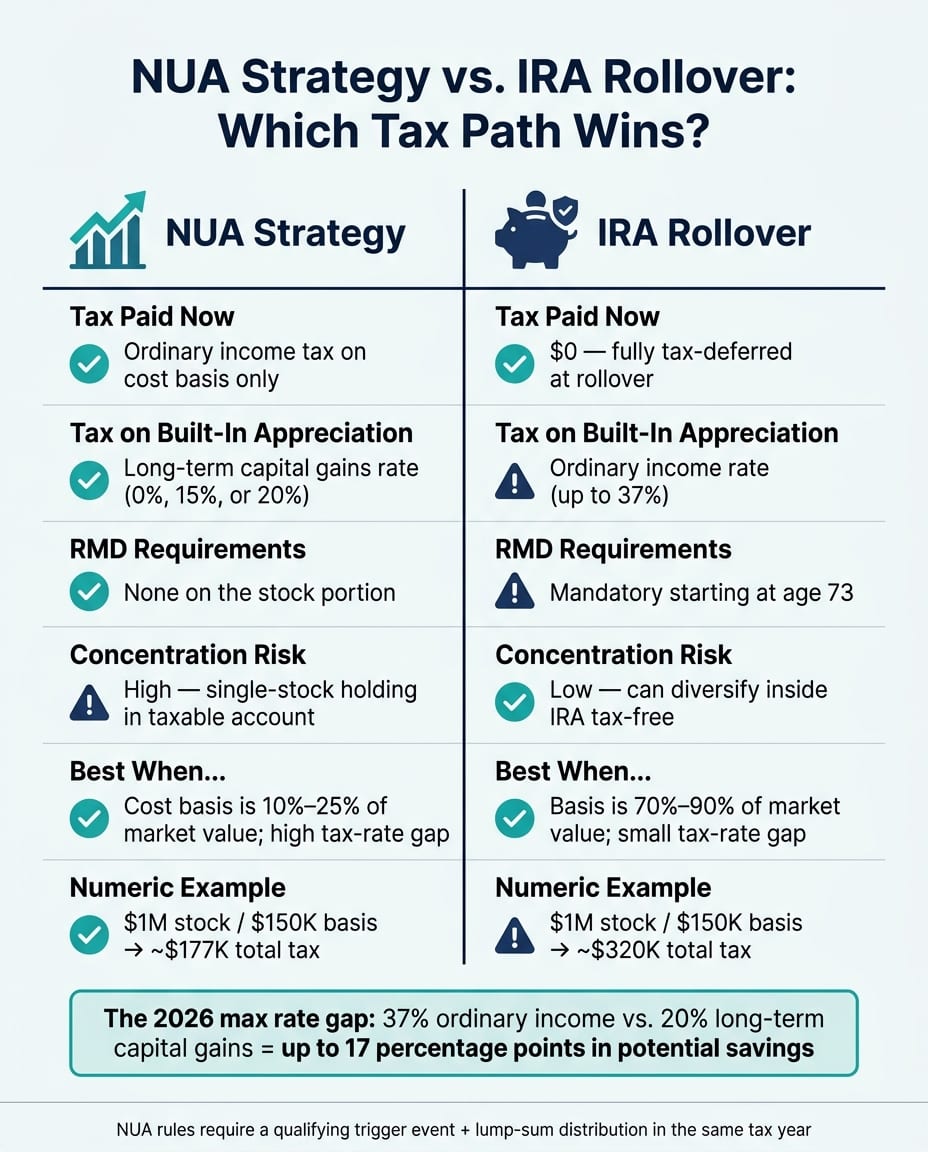
NUA may look best when the stock's cost basis is low compared with its market value, and your ordinary income tax rate is much higher than your long-term capital gains rate. For 2026, that gap may be as wide as 17 percentage points between the top ordinary income rate of 37% and the top long-term capital gains rate of 20%.
A common rule of thumb: NUA may work best when the cost basis is about 10% to 25% of the stock's market value. Here's why that gets attention. A $1,000,000 stock position with a $150,000 basis may lead to about $177,000 in total tax under NUA, versus about $320,000 if the full amount were later taxed as ordinary income inside an IRA.
NUA may also shrink your future IRA balance. That may mean less money subject to Required Minimum Distributions (RMDs) starting at age 73, and it may also be associated with lower Medicare IRMAA surcharges later on.
Cases where the tax break may be small or not worth the tradeoff
The flip side is pretty simple: the same setup that may create an edge may also wipe it out if the basis is too high.
When basis climbs to about 70% to 90% of market value, the upfront ordinary income tax may cancel out much of the capital-gains benefit. At a 10% basis, NUA may save money. At a 90% basis, it may cost more than a standard rollover.
Then there's concentration risk. NUA means the stock moves into a taxable account as a single-stock holding. If you keep holding it to delay capital gains, your results may become more tied to that one company's performance.
Two other cases may make NUA less appealing:
- If the gap between ordinary income and capital gains tax rates is small
- If you're many years away from needing the money, and tax-deferred compounding inside an IRA may outweigh the one-time rate break
State taxes may also change the math. In some cases, they may reduce or erase the federal edge if the state taxes the full distribution as ordinary income.
NUA vs. IRA rollover: side-by-side comparison
The core tradeoff is straightforward. An IRA rollover defers all tax for now, but the full amount may later be taxed as ordinary income. NUA means paying ordinary income tax on the cost basis in the year of distribution, while the built-in appreciation may shift to long-term capital gains treatment - on your timeline, not the government's.
One detail that may matter: the original NUA amount is exempt from the 3.8% Net Investment Income Tax (NIIT), though any appreciation after the shares move to the brokerage account may still be subject to NIIT.
If NUA still looks favorable, the next step may be following the distribution sequence exactly.
How the NUA process works from plan to sale
If NUA still looks favorable after the comparison, execution may determine whether the tax treatment stays intact.
The step-by-step distribution sequence
If you already meet the NUA eligibility rules, follow this transfer sequence.
Request a written cost-basis statement from the plan administrator before the transfer. Then make sure you have a taxable brokerage account ready to receive the employer stock. When the time comes, instruct the plan administrator to transfer the shares in kind - as shares, not cash. If the stock is sold first, NUA is lost.
After that, roll the remaining plan assets into a traditional IRA. You also need to distribute all vested balances from same-type qualified plans within one tax year.
Each step is meant to preserve the split between taxed basis and deferred appreciation.
What gets taxed when the shares leave the plan
NUA is taxed in two stages: basis now, appreciation later.
When the shares leave the plan, you may owe ordinary income tax on the cost basis - and no more than that at that stage. The built-in appreciation is taxed at sale, once the shares are sold. When that sale happens, the original NUA is taxed at long-term capital gains rates, no matter how long the shares were held after distribution.
Any growth after the distribution date follows normal taxable-account rules: short-term if the shares are sold within a year, long-term if they are held longer. And if you're under age 59½ at distribution and no exception applies, the 10% early withdrawal penalty may apply to the cost-basis portion.
Records and tax forms to review
After the distribution, your plan may issue a Form 1099-R. Use that tax form to check whether the plan reported the split correctly.
Check Box 6 carefully. If the NUA amount is missing or incorrect, you may end up paying ordinary income tax on gains that may otherwise have been deferred. Report the full distribution on Form 1040, but exclude the NUA amount from taxable income in the distribution year.
Conclusion: Key decision points before using NUA
NUA may make sense only when the tax break may outweigh the risks. First, check for a qualifying trigger: separation from service, age 59½, disability, or death. If that applies, the next step may be the tax math: does the potential tax upside justify the concentration risk?
A big part of that math may come down to the gap between cost basis and market value, plus whether you have cash available to cover the tax bill due that year. Even if the tax treatment looks favorable on paper, the stock itself may still change the final result.
Choosing NUA means moving company stock into a taxable account. That may leave you heavily concentrated in a single stock, which may add risk to the picture. If the tradeoff still looks favorable, the last step may be a close review of the plan data and tax forms that shape the outcome.
The decision may depend on your plan's cost basis, your federal and state tax brackets, and your full portfolio. Mezzi may help you review concentrated stock exposure, model tax tradeoffs, and look at account-level details across connected accounts.
FAQs
Is NUA worth it if I want to diversify fast?
Yes, NUA may help if you want to diversify quickly, but it may take careful planning.
By moving employer stock in kind to a taxable brokerage account, you may be able to sell right away or over time and reinvest elsewhere. That move may lock in long-term capital gains treatment on the appreciation instead of ordinary income tax on the full value. But it may make sense to weigh that against concentration risk and the upfront tax on the cost basis.
Can I use NUA if I own company stock in both a 401(k) and an ESOP?
Yes, but you must meet the strict lump-sum distribution rules.
To qualify, you may need to distribute the entire vested balance of all qualified plans of the same type within a single tax year. That may include accounts such as your 401(k) and ESOP.
If those plans are with the same employer, all of those account balances may need to be distributed in that same year to preserve NUA eligibility.
What cash do I need to cover taxes in the year I use NUA?
You need enough cash on hand to cover ordinary income tax on the cost basis of the distributed shares in the same tax year you use the Net Unrealized Appreciation (NUA) strategy.
How much that may be depends on your marginal tax bracket for that year. If you separate from service before age 55, you may also owe an extra 10% early-distribution penalty on that taxable portion.
Related Blog Posts
- How to avoid a concentrated position in your own employer's stock
- Deferred compensation: how to track and plan around NQDC plans
- Should You Sell RSUs When They Vest? Timing and Tax Analysis
- Deferred Compensation Plans: NQDC and Tax Deferral Strategies
Yes, NUA may help if you want to diversify quickly, but it may take careful planning.
By moving employer stock in kind to a taxable brokerage account, you may be able to sell right away or over time and reinvest elsewhere. That move may lock in long-term capital gains treatment on the appreciation instead of ordinary income tax on the full value. But it may make sense to weigh that against concentration risk and the upfront tax on the cost basis.
Yes, but you must meet the strict lump-sum distribution rules.
To qualify, you may need to distribute the entire vested balance of all qualified plans of the same type within a single tax year. That may include accounts such as your 401(k) and ESOP.
If those plans are with the same employer, all of those account balances may need to be distributed in that same year to preserve NUA eligibility.
You need enough cash on hand to cover ordinary income tax on the cost basis of the distributed shares in the same tax year you use the Net Unrealized Appreciation (NUA) strategy.
How much that may be depends on your marginal tax bracket for that year. If you separate from service before age 55, you may also owe an extra 10% early-distribution penalty on that taxable portion.