
Pledged Asset Lines (PALs) offer a way to borrow money using your taxable investment portfolio - like stocks, bonds, or ETFs - as collateral. This lets you access cash without selling your investments, helping you avoid immediate capital gains taxes and keep your portfolio growing. PALs are often used for real estate, business funding, or large expenses, but they come with risks like interest rate changes and potential margin calls.
Key Takeaways:
- What It Is: A credit line secured by non-retirement investments.
- Why Use It: Access cash without selling assets or triggering taxes.
- Common Uses: Real estate, tax payments, business opportunities.
- Risks: Margin calls during market drops, rising interest rates.
- Costs: Interest rates often tied to SOFR plus a margin, with no setup fees.
PALs can be a flexible option for those with significant portfolios, but careful planning is critical to manage risks and borrowing limits effectively.
How Pledged Asset Lines Work
Eligibility and Approval Requirements
To qualify for a pledged asset line (PAL), you’ll need to meet specific portfolio and account standards. Most lenders set a minimum loan amount of $100,000, though some may require more. The collateral must come from non-retirement, taxable brokerage accounts - assets in retirement accounts like IRAs or 401(k)s are not eligible.
PALs are open to individuals, trusts, and businesses, but approval depends on both creditworthiness and the quality of the pledged collateral. Once approved, the assets are moved into a separate "Pledged Account." This account doesn’t allow for margin trading, check-writing, or debit card transactions, ensuring the collateral remains secure.
The eligibility of your assets plays a key role in determining your borrowing potential.
Assets That Qualify as Collateral
Not every type of investment can be used as collateral for a PAL. Lenders typically prefer liquid, marketable securities with relatively stable values. For instance:
- U.S. Treasuries and government bonds: These are highly favored, often with advance rates of 80%–95%.
- Blue-chip stocks and broad-market ETFs: These usually qualify with advance rates between 50%–70%.
- Investment-grade corporate bonds: These may offer advance rates of 70%–85%.
- Mid-cap and small-cap stocks: Due to higher volatility, these are generally assigned lower advance rates, ranging from 30%–50%.
On the other hand, certain assets are excluded or heavily restricted. Highly concentrated single-stock positions often come with advance rates of 0%–30% or may be ineligible altogether. Lenders typically reject penny stocks, leveraged ETFs, options, annuities, and issuer-related securities. To help borrowers, many institutions provide an "Advance Rate Lookup" tool, allowing you to check the eligibility and borrowing power of specific securities.
Borrowing Limits and Advance Rates
Your borrowing limit is directly tied to the advance rates assigned to your eligible assets. For example, if you hold $100,000 in U.S. Treasury bonds with a 90% advance rate, you may secure a $90,000 credit line. Similarly, $100,000 in blue-chip stocks at a 60% advance rate would yield $60,000.
Interest rates for PALs vary and are typically based on the SOFR (Secured Overnight Financing Rate) plus a spread. At Schwab Bank, for example, spreads range from SOFR + 4.40% for credit lines between $100,000 and $250,000, to SOFR + 2.40% for lines exceeding $2.5 million, as of 2026. High net worth individuals with portfolios over $1 million may negotiate even better rates, sometimes as low as prime plus 0.5%. Additional discounts may also be available through programs like Investor Advantage Pricing for portfolios of $250,000 or more.
To minimize risks during market downturns, financial advisors often recommend borrowing no more than 50%–60% of your maximum credit limit. This approach helps protect against margin calls if the value of your collateral drops, reducing the need to add cash, pledge additional securities, or face forced liquidation. This strategy can support both liquidity and long-term portfolio growth.
Pledged Asset Line of Credit: Access Stock Value Without Selling
Pros and Cons of Pledged Asset Lines
Main Benefits of PALs
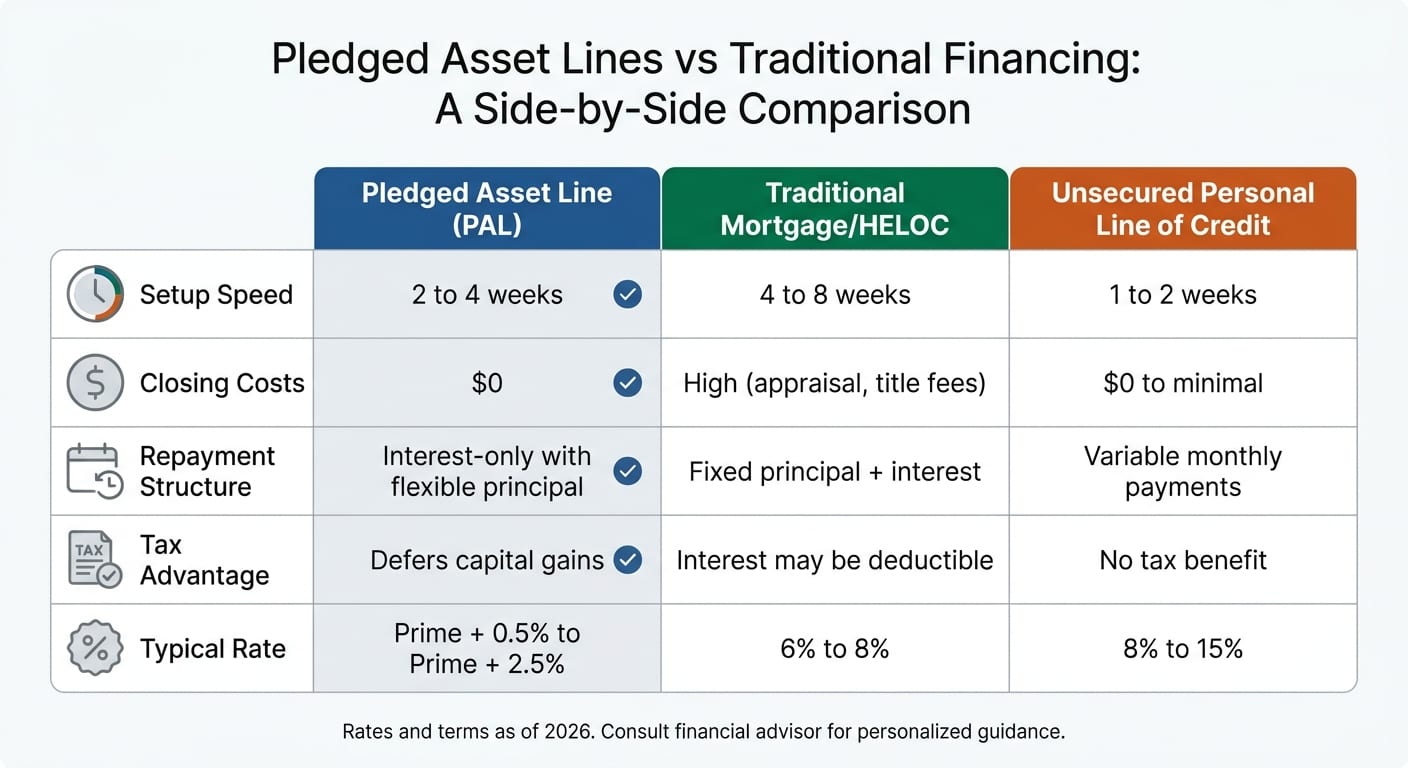
Pledged asset lines (PALs) offer a way to access liquidity without selling off your investments. This means you can secure cash for major expenses - like buying property, starting a business, or paying taxes - while keeping your portfolio intact. By doing so, you may continue to benefit from market growth, dividends, and interest over time.
One standout benefit is the potential for tax deferral. Instead of selling assets and triggering capital gains taxes, borrowing against your portfolio allows you to avoid immediate tax liabilities. This can be especially appealing to individuals with significant unrealized gains.
PALs also come with cost advantages. They typically have no application, opening, or maintenance fees. Plus, their interest rates are often lower than those of unsecured loans, ranging from Prime + 0.5% to Prime + 2.5%. Borrowers also benefit from interest-only monthly payments, offering flexibility in managing cash flow.
These features make PALs an appealing option for individuals seeking liquidity while preserving their portfolio’s potential for growth. But, as with any financial tool, there are risks to weigh carefully.
Risks and Downsides to Consider
While PALs offer flexibility and tax perks, they come with risks that require thoughtful management.
One major concern is the possibility of a margin call. If your portfolio’s value drops below the required threshold, you may need to quickly provide additional funds or collateral. If you’re unable to do so, the lender might liquidate your assets, which could lead to losses and unexpected capital gains taxes.
Another challenge is the variable interest rates tied to benchmarks like SOFR or Prime. If market rates rise, your borrowing costs may climb, potentially straining your finances. Additionally, accounts pledged as collateral often lose certain conveniences, such as check-writing capabilities and bill payment features. You’ll also need lender approval to transfer or sell assets in the pledged account.
To manage these risks, many financial professionals recommend a conservative borrowing approach. While some lenders allow borrowing up to 70% of your portfolio’s value, limiting yourself to 25–30% may provide a buffer against market volatility. For example, if the market drops by 40% and your maintenance margin is set at 30%, overextending could result in forced liquidation.
While PALs can be a powerful tool for accessing liquidity, they require careful planning and disciplined borrowing to avoid pitfalls. Balancing the benefits with these risks is key to making the most of this financial option.
When to Use Pledged Asset Lines
Using PALs for Quick Access to Cash
Pledged asset lines (PALs) are an option for accessing liquidity without having to sell your investments. One common scenario is real estate. If you're buying a new home but want to hold onto your current property, a PAL can act as bridge financing. This way, you can secure your new property without rushing to sell your existing home, especially if the market conditions aren’t ideal.
Business owners also turn to PALs to fund opportunities like launching a startup or expanding operations. With an average approval time of just 1.4 days, they provide the speed needed to act on time-sensitive opportunities. That quick turnaround can be the difference between moving forward on a deal or missing out.
PALs are also useful for handling unexpected expenses or significant life events. Whether it’s a large tax bill, tuition, or medical costs, borrowing against your portfolio can help cover these without requiring you to sell investments. This is especially helpful during market downturns when selling securities could lock in losses due to lower prices.
Whether it's for buying a home, growing a business, or managing emergencies, PALs allow you to maintain your portfolio's growth potential while addressing immediate financial needs. On top of that, they can also offer tax-related advantages.
PALs for Tax Planning
Beyond providing quick liquidity, PALs can be a tool for managing taxes. Borrowing against your portfolio delays capital gains taxes, helping you preserve your investments' growth and long-term strategy. In some cases, this approach may even eliminate capital gains taxes altogether through strategies like "buy, borrow, die", where heirs benefit from a stepped-up cost basis upon inheritance.
"This can help you keep your long-term investment strategy intact and avoid the tax consequences that come with selling securities." - Charles Schwab Bank
For example, imagine you hold stocks with significant unrealized gains and need $200,000 for a down payment. Selling those shares would likely trigger substantial capital gains taxes. Instead, using a PAL gives you access to the $200,000 while your investments remain intact, continuing to grow and generate dividends. Borrowing costs for a PAL are estimated to be about 12 percentage points lower than the tax rate you'd face by selling those assets.
PALs can also help with large tax payments, such as quarterly estimated taxes or year-end liabilities from stock options. This allows you to meet obligations without creating additional taxable events. In places like Canada, where the capital gains inclusion rate is 50% as of 2026, this strategy becomes even more appealing.
How AI Helps Manage Pledged Asset Lines
Pledged Asset Lines (PALs) provide liquidity while allowing investments to continue growing. Mezzi's AI tools enhance this process by helping high-net-worth individuals manage risks and explore tax-saving opportunities.
Using Mezzi to Monitor and Manage PALs
Effectively managing a pledged asset line means keeping a close eye on your portfolio's value and risk exposure. Market shifts can quickly affect your Loan-to-Value (LTV) ratio, and without real-time updates, you might not notice you're approaching a maintenance call until it becomes urgent. This is where Mezzi's AI-driven platform steps in.
Mezzi aggregates data from over 10,000 institutions through Plaid and Finicity, presenting it all on a single dashboard. It tracks your LTV ratio in real time, monitors your portfolio's cushion, and sends automatic alerts if you're nearing margin call thresholds.
One standout feature is the Exposure X-Ray, which dives deep into your ETFs and mutual funds to uncover the actual stock exposure in your portfolio. For instance, it can identify over-concentration in stocks like Apple or Microsoft and suggest diversification strategies.
"Mezzi's X-Ray feature allowed me to uncover exposure to stocks I didn't realize I had".
Additionally, Mezzi evaluates your portfolio's concentration and volatility, flagging assets that may increase risks to your pledged line's stability. You can set personalized alert thresholds - more conservative than your lender's requirements - to give yourself extra time to adjust your portfolio in response to market changes.
Beyond risk monitoring, Mezzi also integrates tools for improving tax efficiency.
Tax Optimization with Mezzi
Mezzi doesn't stop at managing risks; it also helps identify tax-saving opportunities. The platform scans your portfolio for tax-loss harvesting possibilities, guiding you on when to sell underperforming assets to offset capital gains.
It also highlights potential wash sale risks across accounts and suggests lower-cost fund alternatives using its fee analyzer. According to Mezzi, users may save over $1,000 annually in taxes and fees. For example, reinvesting a $10,221 tax saving could grow to $76,123 over 30 years, assuming a 7% annual return.
"Mezzi leverages AI to educate and inform users, and offer ideas and suggestions, but the user remains in control and makes all final decisions about their investments".
Conclusion: Making the Most of Pledged Asset Lines
Pledged asset lines (PALs) provide a flexible way for high-net-worth individuals to access liquidity without selling investments or triggering capital gains taxes. They allow borrowers to maintain market exposure while funding needs like real estate purchases, tax obligations, or business ventures. This approach can help preserve the growth potential and income generated by existing investments.
PALs also align with strategies like "Buy, Borrow, Die", which aim to defer taxes and maximize wealth preservation. However, they come with risks. Market volatility may lead to maintenance calls within a short timeframe, and interest rates tied to the Secured Overnight Financing Rate (SOFR) can fluctuate. To mitigate these risks, borrowers may benefit from maintaining conservative loan-to-value ratios and ensuring their collateral is well-diversified with a balanced portfolio.
"The key to effective PAL utilization lies in working with experienced financial advisors who can assess whether this borrowing strategy aligns with your overall financial plan, risk tolerance, and long-term investment objectives."
– Sidra Jabeen, Content Manager, Paperfree Magazine
FAQs
How much should I borrow on a PAL to avoid a margin call?
When using a Pledged Asset Line (PAL), it’s wise to limit borrowing to about 50-60% of the value of your pledged assets. This approach helps keep your collateral above the usual loan-to-value range of 40-50%, which may lower the chances of triggering a margin call. Regularly reviewing your portfolio can also help ensure you have enough collateral to cover your borrowing.
What happens if my collateral drops and my PAL is called?
If the value of your collateral decreases and your Pledged Asset Line (PAL) is called, the lender may require immediate repayment. To address this, you might need to provide additional collateral, such as securities or cash, to meet the necessary threshold. Failing to do so could result in the lender selling your pledged assets to recover the loan amount, potentially leading to taxable gains. Keeping a close eye on your collateral can help you manage this risk more effectively.
Can a PAL fit into a long-term tax strategy like buy, borrow, die?
A pledged asset line (PAL) may align well with a long-term tax approach such as the "buy, borrow, die" strategy. By offering liquidity without forcing the sale of investments, it allows you to potentially maintain the tax benefits of your portfolio. This method can be a useful tool in financial strategies that aim to reduce taxable events while keeping funds accessible.
Disclosures:
- This content is for informational purposes only and does not constitute investment advice or a recommendation to buy or sell any security.
- Past performance is not indicative of future results. No guarantee of future performance or outcomes is implied.
- Registration does not imply a certain level of skill or that the SEC has approved the company or its services.
- Savings and performance examples are hypothetical and for illustrative purposes only. Actual results will vary based on individual circumstances, portfolio composition, market conditions, and fees.
- Users should not rely solely on AI-driven tools for financial decision-making.
- All links to external sources are provided for reference only.
Related Blog Posts
- High-Net-Worth investing strategies
- High-Net-Worth Financial Planning Guide
- What is the right Fidelity bond fund or stable value fund for conservative cash management?
- How can I optimize my portfolio for better risk-adjusted returns while managing unrealized gains?
When using a Pledged Asset Line (PAL), it’s wise to limit borrowing to about 50-60% of the value of your pledged assets. This approach helps keep your collateral above the usual loan-to-value range of 40-50%, which may lower the chances of triggering a margin call. Regularly reviewing your portfolio can also help ensure you have enough collateral to cover your borrowing.
If the value of your collateral decreases and your Pledged Asset Line (PAL) is called, the lender may require immediate repayment. To address this, you might need to provide additional collateral, such as securities or cash, to meet the necessary threshold. Failing to do so could result in the lender selling your pledged assets to recover the loan amount, potentially leading to taxable gains. Keeping a close eye on your collateral can help you manage this risk more effectively.
A pledged asset line (PAL) may align well with a long-term tax approach such as the "buy, borrow, die" strategy. By offering liquidity without forcing the sale of investments, it allows you to potentially maintain the tax benefits of your portfolio. This method can be a useful tool in financial strategies that aim to reduce taxable events while keeping funds accessible.