
Your investment portfolio doesn’t manage itself. Over time, market changes can shift your asset allocation, increasing your risk beyond what you intended. Rebalancing is the process of realigning your portfolio back to its target allocation - like bringing a 75/25 stock-to-bond mix back to 60/40. This helps you maintain your desired risk level while supporting a disciplined investment approach.
Key Takeaways
- Why Rebalancing Matters: Prevents your portfolio from becoming too risky and keeps volatility in check.
- How Often to Rebalance: Many investors may benefit from rebalancing annually or semiannually. Monitoring portfolios every 6-12 months can help balance cost and effectiveness.
- Rebalancing Strategies:
Time-Based: Adjust on a set schedule (e.g., yearly).
- Threshold-Based: Rebalance when allocations drift beyond a set percentage (e.g., 5%).
- Hybrid: Combine both approaches for flexibility.
- Tax-Saving Tips: Prioritize tax-advantaged accounts like IRAs, use new contributions to adjust allocations, and apply tax-loss harvesting to offset gains.
Platforms like Mezzi can automate monitoring, suggest tax-efficient trades, and simplify the process. By sticking to a routine, investors can help manage risks and stay aligned with your financial goals.
Portfolio Rebalancing Explained - What, When, Why, and How
How Often Should You Rebalance Your Portfolio?
Rebalancing your portfolio is all about finding the sweet spot between keeping your asset allocation on track and avoiding unnecessary costs. If you rebalance too often, you'll face higher trading fees and tax consequences. But if you wait too long, your portfolio could drift into a riskier position than you intended.
Annual Rebalancing: A Practical Choice
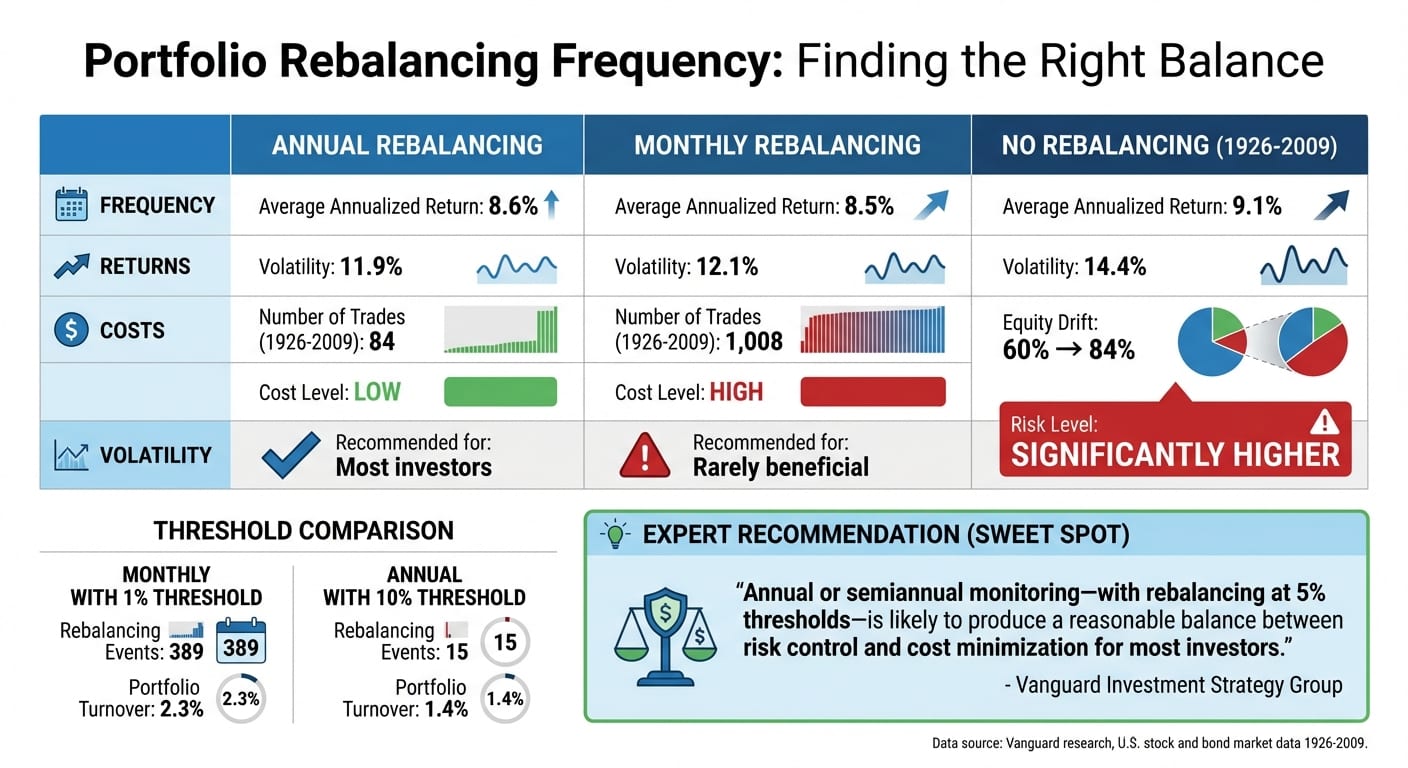
For most investors, rebalancing once a year is a straightforward and cost-effective option. Research from Vanguard, which examined U.S. stock and bond market data from 1926 to 2009, shows that annual rebalancing delivered an average annualized return of 8.6% with 11.9% volatility. By comparison, monthly rebalancing produced a slightly lower return of 8.5% and higher volatility at 12.1%.
Here’s the kicker: annual rebalancing required far fewer trades - just 84 compared to 1,008 for monthly rebalancing - resulting in significantly lower costs.
"Annual or semiannual monitoring - with rebalancing at 5% thresholds - is likely to produce a reasonable balance between risk control and cost minimization for most investors." - Colleen M. Jaconetti, Yan Zilbering, Francis M. Kinniry, Vanguard Investment Strategy Group
By reviewing your portfolio once or twice a year, you can keep things simple and minimize expenses. Tools like Mezzi's AI can make this process even easier by monitoring your portfolio year-round, alerting you when it’s time to rebalance, and suggesting tax-efficient trades or rebalancing without selling to maintain your target asset allocation.
Let’s take a closer look at why rebalancing more frequently doesn’t always pay off.
Quarterly or Monthly Rebalancing: Is It Worth It?
Rebalancing every month or quarter might sound like a good idea, but the reality is it often leads to higher costs without much improvement in risk management. For example, monthly rebalancing with a 1% threshold triggered 389 rebalancing events and 2.3% turnover, compared to just 15 events and 1.4% turnover for annual monitoring with a 10% threshold.
While quarterly rebalancing could make sense for large portfolios or investors working closely with advisors, it’s generally unnecessary for most self-directed investors. The added costs and effort rarely translate into better returns or reduced risk.
Now, let’s explore why delaying rebalancing for too long can be just as problematic.
The Risks of Rebalancing Too Rarely
On the flip side, waiting too long to rebalance can leave your portfolio exposed to risks you didn’t sign up for. For example, a portfolio left untouched between 1926 and 2009 saw its equity allocation climb from 60% to over 84%. While this resulted in a higher return (9.1% versus 8.6%), it also came with much greater volatility - 14.4% compared to 11.9% for a regularly rebalanced portfolio.
If you delay rebalancing for two years or more, a 60/40 portfolio could shift to a 75/25 allocation after a bull market . That might look good when stocks are soaring, but it also means you’re taking on significantly more risk. And when markets take a downturn, that extra risk could lead to steep losses. By sticking to an annual schedule - or using tools like Mezzi's AI to monitor your portfolio’s drift - you can catch these imbalances before they become a problem.
2 Rebalancing Strategies: Time-Based vs. Threshold-Based
Once you've decided that rebalancing is important, the next step is figuring out how often to rebalance. There are two main strategies to consider, each with its own pros and cons.
Time-Based Rebalancing
With time-based rebalancing, you review and adjust your portfolio on a set schedule - whether that's annually, semiannually, or quarterly. This approach is straightforward and easy to implement. You don’t have to keep an eye on the market constantly or worry about short-term fluctuations. Simply pick a date (like December 31 or June 30), check your allocations, and make adjustments as needed.
This method works well for planning around tax-efficient rebalancing and new contributions since it follows a predictable routine. However, one downside is that your portfolio might drift significantly from its target allocation between those scheduled check-ins, especially during periods of market volatility.
Threshold-Based Rebalancing
Threshold-based rebalancing, on the other hand, is triggered whenever an asset class moves beyond a specific percentage (say 5% or 10%) from its target allocation. This method keeps your portfolio more aligned with its intended risk level by responding more quickly to market changes.
The catch? It requires more frequent monitoring. For example, between 1989 and 2009, a 1% threshold triggered over 5,300 rebalancing events, while a 10% threshold required only four. Unless you’re using automated tools, this approach can be a bit overwhelming for self-directed investors.
Platforms like Mezzi simplify this by automatically tracking portfolio drift and sending alerts when your allocations stray beyond your chosen threshold. This removes the need for constant manual monitoring.
How to Choose Your Rebalancing Strategy
Picking the right rebalancing method is all about aligning it with your investing style. Both strategies have their strengths, so the choice depends on what works best for you.
If you prefer a low-maintenance approach and want to limit trading costs and taxes, time-based rebalancing might be your best bet. But if you’re more hands-on and managing a larger portfolio, threshold-based rebalancing lets you react more quickly to market shifts.
A popular option for many investors is a hybrid strategy. For instance, you could review your portfolio on a set schedule (like once or twice a year) but only rebalance if your allocations have drifted beyond a certain threshold (like 5%). This combines the simplicity of time-based rebalancing with the precision of threshold-based adjustments. Tools like Mezzi can make this even easier by consolidating all your portfolio data and providing clear, actionable guidance on how to realign your investments.
How to Rebalance Your Portfolio: A Step-by-Step Guide
Once you've picked your rebalancing strategy, it's time to take action. The process boils down to three main steps: reviewing your current allocations, figuring out the trades you need, and executing those trades while keeping detailed records.
Step 1: Review Your Current Allocations
Start by listing all your investments across every account - whether it's a 401(k), brokerage, IRA, or another type. Break down the percentage of each asset class and compare it to your target allocation. For instance, if your goal is 60% stocks and 40% bonds, but your portfolio shows 65% stocks and 35% bonds, you've identified a 5% drift that might need adjusting.
If you’re juggling multiple accounts, it can be tough to get the full picture of your finances. That’s where tools like Mezzi come in. Mezzi pulls data from all your accounts into one dashboard, giving you a clear view of your portfolio. This consolidated perspective helps you manage risk and returns effectively. Its X-Ray feature goes even further by identifying hidden stock exposures in mutual funds or ETFs, which could lead to unintentional risk. Shuping, Founder of Summer AI, shared:
Mezzi's X-Ray feature allowed me to uncover exposure to stocks I didn't realize I had.
A common rule of thumb is to rebalance when your portfolio drifts 5% or more from your target allocation. Once you’ve pinpointed these deviations, you’re ready to calculate the trades needed to bring your portfolio back in line.
Step 2: Calculate Which Trades to Make
Next, figure out the exact amounts to buy or sell to restore balance. This step connects your analysis to actionable steps, ensuring your trades align with your strategy. It can get tricky, especially if you’re managing different types of accounts. Mezzi’s AI-driven recommendations simplify this process, suggesting which accounts - like a Roth IRA, Traditional IRA, or taxable account - are best for each transaction to maximize tax efficiency. Studies suggest that tax-smart strategies canmay add 1% to 2% to annual returns, which could mean an additional $10,000–$20,000 per year on a $1 million portfolio.
To minimize costs, consider using new contributions, dividends, or interest payments to adjust your allocations instead of selling assets. And with most brokers offering $0 commissions for stocks and ETFs, rebalancing is now more affordable. Keep in mind, though, that mutual funds or individual bonds might still carry fees.
Step 3: Execute and Document Your Trades
With your calculations done, it’s time to execute the trades and keep thorough records. Use your brokerage accounts to carry out the trades you’ve planned. While Mezzi provides detailed recommendations and calculates optimal trades using read-only access to your accounts, the actual execution is up to you.
Documenting your trades is essential for staying disciplined and ensuring tax compliance. Record key details like the date of rebalancing, your portfolio’s allocation before and after the trades, and the specific transactions you made. Include the reasoning behind each trade (e.g., "Equity exceeded target by 5%") to maintain a systematic approach. This is especially important for taxable accounts, where tracking cost basis and realized gains or losses is crucial for accurate tax reporting.
Mezzi also helps track wash sales across all your accounts, protecting your tax efficiency during rebalancing. Its unified view makes it simpler to review your rebalancing history over time. As Mike, a Product Manager, put it:
Mezzi gives me answers and ideas when I need them, no matter what time of day or how big or small the question.
How to Minimize Taxes When Rebalancing
Rebalancing is essential for maintaining your portfolio’s target allocation, but it can come with tax consequences, especially in taxable accounts. Selling appreciated assets can trigger capital gains taxes, potentially cutting into your returns by 50 to 100 basis points annually if not managed carefully. By using strategic methods, you can reduce tax impacts while keeping your portfolio on track.
Rebalance in Tax-Advantaged Accounts First
When rebalancing, prioritize tax-advantaged accounts like 401(k)s and IRAs. Trades in these accounts don’t result in immediate capital gains taxes, allowing you to adjust your portfolio without triggering a tax bill. For instance, if your IRA is underweight in bonds and your taxable account is overweight in stocks, rebalance the IRA first. This approach avoids taxable events and can save you significant amounts over time, all while achieving the same portfolio balance.
Use New Contributions and Tax-Loss Harvesting
Instead of selling high-performing assets, direct new contributions toward underweighted areas of your portfolio. For example, if you’re contributing $10,000 monthly, allocate that money to asset classes that have fallen below your target allocation. This method restores balance without realizing taxable gains.
Tax-loss harvesting offers another way to reduce taxes. By selling securities at a loss, you can offset capital gains dollar-for-dollar and even deduct up to $3,000 of ordinary income annually. For example, a $5,000 loss can offset a $5,000 gain from rebalancing trades, lowering your overall tax burden. According to a Vanguard study from July 2024, tax-loss harvesting may add between 0.47% and 1.27% annually to your returns. Combining these strategies helps you rebalance efficiently while staying aligned with your long-term goals.
How to Avoid Wash Sales
The wash sale rule prevents you from claiming a tax loss if you buy a substantially identical security within 30 days before or after selling it at a loss. This rule applies across all accounts, so it’s easy to unintentionally violate it. For instance, if you sell a stock at a loss in a taxable account and your 401(k)’s target-date fund automatically buys the same stock within that 30-day window, you’ve triggered a wash sale.
To avoid this, tools like Mezzi monitor your accounts in real time, helping you track potential wash sales and suggesting alternative timing to comply with the 30-day rule. These precautions ensure your tax strategies remain effective and compliant.
Create Your Rebalancing Routine
Now that we've broken down the mechanics and purpose of rebalancing, it's time to establish a routine that fits your investment strategy.
Key Takeaways
Rebalancing your portfolio is all about risk control. It ensures your investments stay aligned with your financial goals. Without it, a balanced portfolio, like a 60/40 stock–bond mix, can easily shift to 70/30 or even 80/20 during a strong market, exposing you to more risk than you might be comfortable with.
To maintain balance, review your portfolio regularly - every six to 12 months is a good rule of thumb. You can choose between three main strategies:
- Time-based rebalancing: Stick to fixed dates, like quarterly or annually.
- Threshold-based rebalancing: Act only when asset allocations drift by 5% or more.
- Hybrid approach: Combine both methods for added flexibility.
When rebalancing, focus on tax-advantaged accounts like 401(k)s or IRAs to avoid unnecessary capital gains taxes. If possible, use new contributions or dividends to adjust your portfolio instead of selling high-performing assets.
"Remember, it's time in the market that counts, not timing the market." - Lori Schock, Former Director of the SEC's Office of Investor Education and Assistance
Tools like Mezzi simplify rebalancing by tracking portfolio drift across all your accounts. It offers tax-efficient trade recommendations and integrates strategies like tax-loss harvesting. Mezzi’s AI also gives you a clear picture of your current and target allocations, answering questions like, "What trades should I make to rebalance tax-efficiently?" in seconds.
By sticking to a routine that incorporates these strategies, you can manage risk effectively while implementing smart tax-saving tactics.
Your Next Steps
Here’s how to put your rebalancing plan into action:
- Choose a specific date for rebalancing - your birthday, the start of the year, or the first day of each quarter. Add it to your calendar so you don’t forget.
- Link all your accounts to get a complete view of your finances.
- Set a target allocation, like 80% stocks and 20% bonds, so tools like Mezzi can monitor your portfolio and alert you when adjustments are needed.
- Reassess your portfolio after major life changes, such as marriage, having children, or approaching retirement.
Let Mezzi handle the calculations and trade recommendations, helping you focus on your investment strategy. With a disciplined approach, you may be able to keep your investments on track while minimizing unnecessary risks.
FAQs
What target allocation should I choose?
Your investment allocation should align closely with your financial goals, risk tolerance, and time horizon. One popular approach is to match your portfolio's allocation to your comfort level with risk while keeping an eye on regular rebalancing to stay on track.
To manage risk and potentially enhance tax efficiency, you might explore strategies like threshold-based rebalancing or even AI-driven tools that can automate the process. These methods can help ensure your portfolio stays balanced without requiring constant manual adjustments.
How do I rebalance across multiple accounts?
Mezzi’s AI-driven tools make rebalancing across multiple accounts straightforward and efficient. By offering a unified view of your portfolio, the platform analyzes your holdings in real-time to spot over-concentrations. It then suggests adjustments that align with your financial goals. Mezzi is designed to factor in tax considerations and cost efficiency, helping any changes remain both strategic and compliant. Additionally, it keeps an eye on your allocation and recommends trades to help you maintain your preferred risk-return balance with ease.
How can I rebalance without triggering big taxes?
When rebalancing your portfolio, minimizing taxes is key. To achieve this, consider using tax-advantaged accounts like IRAs or 401(k)s for adjustments, as these accounts often shield you from immediate tax consequences. You can also harvest tax losses to offset any gains, reducing your taxable income. If you need to sell assets, aim for long-term capital gains, which are typically taxed at a lower rate than short-term gains.
For an extra edge, AI tools can assist in optimizing your trades and determining the best asset placement, helping you improve tax efficiency throughout the rebalancing process.
Related Blog Posts
- Threshold-Based Rebalancing: How It Works
- How should I adjust my holdings to match a target market sector allocation?
- Can I manage portfolio without advisor
- The Real Cost of Not Rebalancing Your Portfolio for 5 Years
Your investment allocation should align closely with your financial goals, risk tolerance, and time horizon. One popular approach is to match your portfolio's allocation to your comfort level with risk while keeping an eye on regular rebalancing to stay on track.
To manage risk and potentially enhance tax efficiency, you might explore strategies like threshold-based rebalancing or even AI-driven tools that can automate the process. These methods can help ensure your portfolio stays balanced without requiring constant manual adjustments.
Mezzi’s AI-driven tools make rebalancing across multiple accounts straightforward and efficient. By offering a unified view of your portfolio, the platform analyzes your holdings in real-time to spot over-concentrations. It then suggests adjustments that align with your financial goals. Mezzi is designed to factor in tax considerations and cost efficiency, helping any changes remain both strategic and compliant. Additionally, it keeps an eye on your allocation and recommends trades to help you maintain your preferred risk-return balance with ease.
When rebalancing your portfolio, minimizing taxes is key. To achieve this, consider using tax-advantaged accounts like IRAs or 401(k)s for adjustments, as these accounts often shield you from immediate tax consequences. You can also harvest tax losses to offset any gains, reducing your taxable income. If you need to sell assets, aim for long-term capital gains, which are typically taxed at a lower rate than short-term gains.
For an extra edge, AI tools can assist in optimizing your trades and determining the best asset placement, helping you improve tax efficiency throughout the rebalancing process.