
Skipping portfolio rebalancing for five years may lead to increased financial risks, higher taxes, and missed opportunities. Here's why it matters:
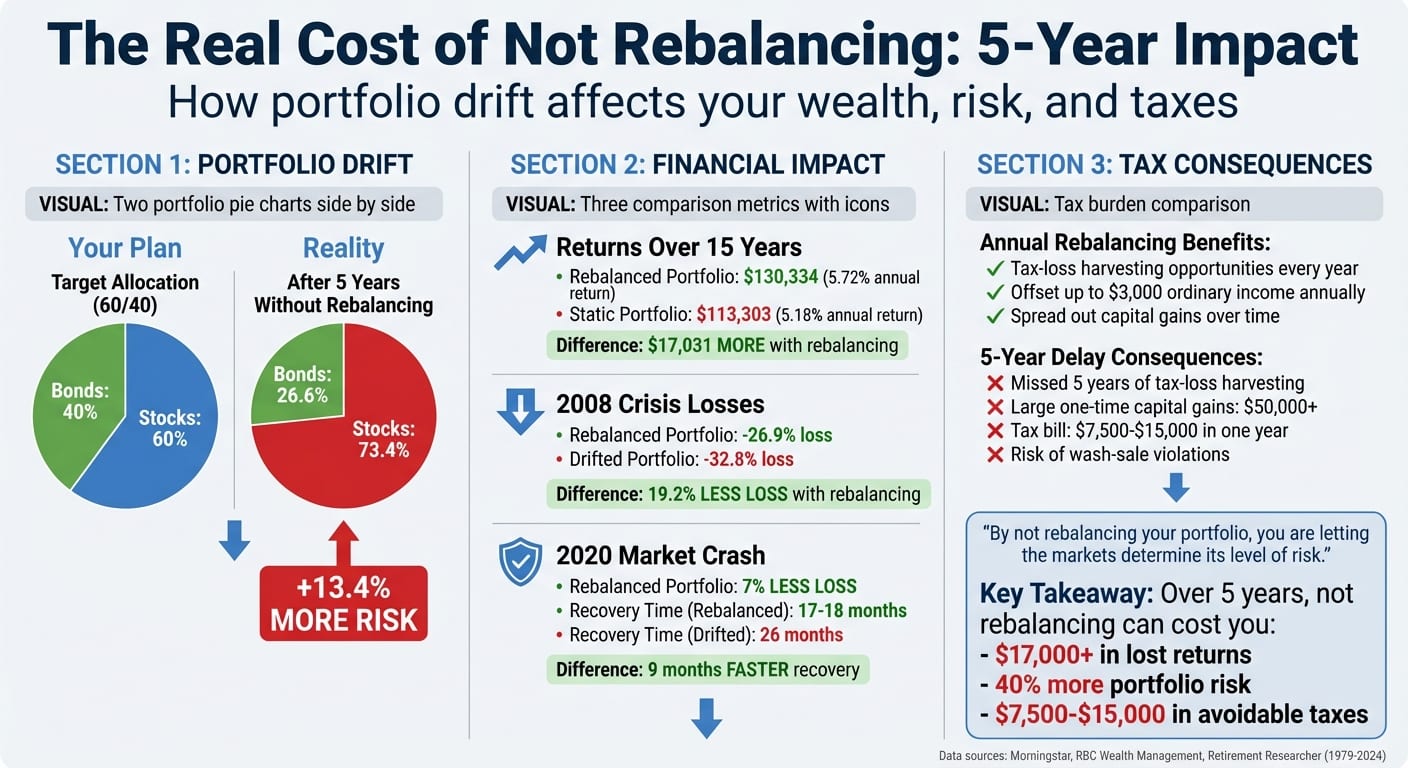
- Risk Increases: A 60/40 stock-bond portfolio can drift to 73.4% stocks, exposing you to more volatility and deeper losses during downturns.
- Missed Savings and Gains: Historical analysis shows rebalanced portfolios may have higher returns and reduced losses compared to drifted ones. For instance, during the 2020 market crash, rebalanced portfolios lost 7% less than drifted ones.
- Tax Challenges: Delaying rebalancing can lead to large unrealized gains, triggering higher taxes when you finally adjust. Regular rebalancing spreads out tax liabilities and enables tax-loss harvesting.
Neglecting rebalancing doesn't just alter your portfolio's risk—it may also impact your asset allocation returns and tax outcomes. Automated tools like Mezzi can simplify this process by monitoring drift, optimizing tax strategies, and keeping your portfolio balanced.
Portfolio Rebalancing Explained - What, When, Why, and How
The Financial Cost of Not Rebalancing
Skipping rebalancing doesn't just shift your risk exposure - it can hit your wallet hard. The evidence is clear: failing to rebalance can lead to lower returns and greater losses.
Lower Returns and Missed Gains
Rebalancing regularly may help you realize gains and reinvest in assets that are undervalued, potentially creating a compounding effect over time. Holding onto winners without rebalancing might seem appealing, but it may not provide the same long-term benefits.
Consider this: a 15-year analysis found that a rebalanced 60/40 portfolio delivered an annual return of 5.72%, compared to 5.18% for a static portfolio - a difference of 54 basis points. On a $100,000 investment, that seemingly small gap adds up to $17,031 over 15 years. The rebalanced portfolio grew to $130,334, while the static one lagged behind at $113,303.
"A rebalanced portfolio may actually do better than the two assets on their own, because rebalancing forces you to buy low and sell high." - William Bernstein, Financial Theorist
The "Lost Decade" (2000–2008) offers another striking example. During this turbulent period, a rebalanced portfolio achieved a 2.5% annualized return, compared to just 1.0% for a non-rebalanced portfolio - a 150% improvement. In volatile markets, rebalancing becomes even more crucial, as it helps stabilize returns and capture opportunities over time.
Increased Volatility and Deeper Losses
Beyond limiting growth, skipping rebalancing exposes you to more volatility and bigger losses during market downturns. As your portfolio drifts toward higher-risk assets like stocks, you're not just increasing your risk - you could face severe financial setbacks when markets take a turn.
Take the 2008 financial crisis, for example. Investors who rebalanced their portfolios saw their losses reduced by 19.2% compared to those who let their allocations drift. In a 25-year study (1988–2012), a 70/30 portfolio that was rebalanced ended with $907,694, while a drifted portfolio finished at $882,268. Even more telling, during the 2008 crash, the rebalanced portfolio limited its annual loss to 26.9%, while the drifted version dropped by 32.8% - a nearly 6-percentage-point difference.
Fast forward to 2022, and the same pattern emerged. Investors with portfolios that had drifted to over 74% equity (from an initial 60/40 split) suffered losses about 1 percentage point deeper than those who rebalanced consistently. For a $500,000 portfolio, that extra percentage point translated to an additional $5,000 loss.
Source: Retirement Researcher [[9]](https://retirementresearcher.com/rebalancing-frequency)
While drifted portfolios might see slightly higher returns during bull markets, they endure significantly more volatility - 36% higher, to be exact. This added instability not only increases the risk of deeper losses but can also lead to emotional, costly decisions during downturns. The trade-off simply isn’t worth it when you weigh the heightened risk against the marginally better returns.
The Risk Problems Created by Portfolio Drift
Skipping rebalancing for an extended period, like five years, can drastically change your portfolio's risk profile. Portfolio drift occurs when different assets grow at varying rates, causing your portfolio's actual allocation to stray far from your original plan. The consequence? You could find yourself carrying a level of risk you never intended to take on.
Taking On More Risk Than You Intended
Take a typical 60/40 stock-bond portfolio as an example. It might seem balanced at first, but leave it untouched for five years, and the risk profile can shift dramatically. By November 30, 2024, a 60/40 portfolio left unbalanced for five years had drifted to over 73% stocks. What started as a moderate allocation morphs into something far more aggressive.
Morningstar's analysis of a five-year period ending in November 2024 highlights this issue. A portfolio that began with 40% in U.S. stocks saw that allocation swell to 56.4%. Growth stocks, initially targeted at 20%, expanded to 31.7% of total assets. This kind of drift can push a portfolio to resemble a 75/25 allocation, adding about 40% more equity risk than intended.
"Absent rebalancing, portfolios naturally drift towards assets that have delivered higher returns, which tend to be more volatile and riskier than other parts of the portfolio." - RBC Wealth Management
The dangers of drift became painfully clear during the COVID-19 correction. Portfolios that had shifted to 80% equity exposure suffered far steeper losses compared to those that maintained their target allocation. These shifts aren't just numbers on a spreadsheet - they translate into real financial setbacks during volatile markets.
Case Studies: How Drift Hurts Portfolios
Let’s look at the 2017–2021 tech boom as an example. Imagine an investor starts 2017 with a $100,000 portfolio allocated 60% to stocks and 40% to bonds, including $10,000 (10%) in FAANG stocks. By the end of 2021, that tech allocation would have grown to $38,500 - 24% of the total portfolio - if left unchecked. The overall allocation would have shifted to 73/27 stocks to bonds. When tech stocks crashed in 2022, this overconcentration turned what could have been a manageable downturn into a much larger loss, far beyond what the original 60/40 strategy was designed to handle.
The cost of drift becomes even clearer when you consider recovery times. A drifted 60/40 portfolio took an average of 26 months to recover from major drawdowns, compared to just 17–18 months for portfolios that were regularly rebalanced. That’s nine extra months of waiting for your portfolio to recover - time that’s especially critical if you’re approaching retirement.
Source: RBC Wealth Management [[10]](https://ca.rbcwealthmanagement.com/documents/520123/520139/Long+Terme+Perspectives+-+Rebalancing+2025-05.pdf/7eb1297b-f6a4-4928-845b-45ec9bf37785)
Portfolio drift increases exposure to risk and may reduce your portfolio’s ability to recover during market downturns.
The Tax Costs of Skipping Rebalancing
Skipping rebalancing doesn't just expose your portfolio to market risks - it can also result in greater tax consequences. The tax impact of neglecting rebalancing may be significant. Letting your portfolio drift for years not only increases risk but also leaves valuable tax-saving opportunities on the table.
Missing Out on Tax-Loss Harvesting
Rebalancing regularly allows you to take advantage of tax-loss harvesting. This strategy involves selling underperforming assets to offset gains, which can reduce your tax bill. If you delay rebalancing for five years, you miss out on this annual benefit. Harvested losses can offset capital gains or even reduce up to $3,000 of ordinary income each year.
The problem becomes even clearer when you finally decide to rebalance a portfolio that has been left to drift. For example, selling overweight positions might trigger a $50,000 capital gain, resulting in federal taxes of $7,500 to $15,000. The situation worsens if you have to sell assets held for less than a year, as those gains are taxed at higher ordinary income rates rather than the lower long-term capital gains rates. Over time, dividends and interest that could have been used to rebalance underweight positions often get reinvested into already overgrown ones, further inflating the eventual tax burden.
"It is shortsighted to allow a portfolio to take unintended risks in an attempt to avoid taxes, and delaying a rebalancing decision is not advisable, as declines in the value of the investment can quickly erase any slight advantage gained from delaying the realization of gains." - Brown Brothers Harriman & Co.
Inaction not only erodes tax efficiency but also compounds the overall cost of neglecting proper portfolio management.
Avoiding Wash Sales and Improving Tax Efficiency
Skipping rebalancing can also lead to complications with wash sales. The IRS wash-sale rule prohibits claiming a tax loss if you sell a security at a loss and then buy a substantially identical one within 30 days before or after the sale. This rule applies across all accounts, including IRAs, 401(k)s, and even your spouse's accounts. If a wash sale involves a retirement account, the loss isn't just postponed - it’s permanently disallowed.
When rebalancing is neglected for years, automated actions like dividend reinvestments or scheduled deposits can unintentionally trigger wash sales. For instance, you might sell a losing position to harvest the loss, only to have an automatic 401(k) contribution repurchase the same fund a week later. Automated rebalancing tools can help prevent such errors by monitoring all accounts and executing "tax-efficient swaps" to maintain exposure without violating IRS rules.
The way you approach rebalancing matters. Research comparing rebalancing methods found that a 5% trigger strategy resulted in 7 rebalancing events over 15 years, compared to 63 events with quarterly rebalancing. Fewer transactions mean fewer chances for wash-sale mistakes and lower overall tax exposure. Ultimately, tax efficiency isn’t just about what you earn - it’s about how much you keep after taxes.
How Mezzi Solves the Problem: AI-Driven Rebalancing
Portfolio drift can quietly undermine your financial goals, leading to increased risk, missed returns, and unnecessary tax burdens. Ignoring rebalancing isn’t just costly - it’s avoidable. Mezzi’s AI-powered platform tackles this head-on by keeping a constant eye on your investments, implementing tax-efficient rebalancing strategies, and highlighting risks that might otherwise go unnoticed.
Real-Time Portfolio Monitoring with Mezzi
Mezzi simplifies portfolio management by tracking all your linked accounts - IRAs, 401(k)s, and taxable brokerage accounts - in real time. It identifies portfolio drift as soon as it occurs, ensuring timely action. You start by setting a target allocation, like 80% equity and 20% cash, within the Mezzi system. From there, the platform continuously monitors market movements and notifies you the moment your portfolio strays from your desired risk profile.
Need answers fast? Mezzi’s AI lets you ask questions like, "How do I rebalance tax-efficiently?" or "What’s my current vs target allocation across all accounts?" and delivers instant, actionable insights. By offering a full view of your entire financial portfolio - not just individual accounts - Mezzi ensures your rebalancing decisions are always informed and aligned with your overall strategy. This comprehensive monitoring also sets the stage for smarter tax management.
Tax Optimization Through Automation
Taxes can be a major pain point when rebalancing, but Mezzi uses automation to ease the burden. It prioritizes tax-smart rebalancing, starting with trades in tax-advantaged accounts like IRAs to avoid triggering immediate tax liabilities. If rebalancing in taxable accounts is necessary, the platform employs tax-loss harvesting to offset gains, reducing your tax exposure.
Mezzi also keeps a close watch to prevent costly mistakes, like violating the IRS wash-sale rule, which can disqualify losses if retirement accounts are involved. By coordinating trades across all your accounts, Mezzi minimizes taxable events and ensures you retain more of your hard-earned money.
X-Ray Feature for Hidden Risks
Diversification is key to a healthy portfolio, but hidden risks can creep in without you realizing it. Mezzi’s X-Ray feature digs deep into your portfolio, exposing concentration risks and overlaps across different funds and accounts. For instance, you might unknowingly hold multiple index funds that heavily invest in the same sector, increasing your vulnerability to market swings. By uncovering these blind spots, the X-Ray feature helps you maintain balanced diversification and avoid the long-term effects of portfolio drift.
What’s remarkable is that this level of risk analysis, often used by professional managers, is available through Mezzi’s automated platform.
Conclusion: The High Price of Doing Nothing
Skipping portfolio rebalancing for years can come with serious financial consequences. For example, a typical 60/40 stock-bond portfolio left untouched from 2019 to November 2024 would have shifted to 73.4% equity exposure. This drift in allocation isn't just theoretical - it has real-world implications. During the COVID-19 market correction in early 2020, portfolios that weren't rebalanced experienced losses of 27.8%, compared to 20.6% for rebalanced portfolios. That difference represents a tangible financial hit. On top of that, ignoring tax-loss harvesting over the same period could lead to a higher tax bill. Meanwhile, your portfolio's risk level quietly moves away from your original plan, putting your long-term financial goals at risk.
"By not rebalancing your portfolio, you are letting the markets determine its level of risk." - Optimized Portfolio
These avoidable costs make it clear why regular rebalancing is essential. Mezzi’s AI-powered platform simplifies the process, keeping your portfolio on track by automatically monitoring your accounts, executing tax-smart rebalancing strategies to minimize IRS liabilities, and identifying hidden risks with its X-Ray feature. Mezzi may help you monitor and manage your investments more efficiently.
Letting your portfolio drift unchecked only increases financial, tax, and risk-related consequences over time. Mezzi's automated tools help you stay aligned with your financial goals, protecting your wealth while giving you the freedom to focus on what matters most.
FAQs
How often should I rebalance my portfolio?
Rebalancing your portfolio is typically advised at least once a year or whenever your asset allocation drifts significantly - usually by 5-10% - from your target. This practice helps keep your risk level in check and ensures your investments remain aligned with your financial objectives.
What’s the most tax-efficient way to rebalance in a taxable account?
When managing a taxable account, rebalancing can be tricky if you want to avoid unnecessary tax consequences. One smart approach is to use tax-advantaged accounts - like IRAs or 401(k)s - to adjust your portfolio allocations. This lets you make changes without triggering taxes on capital gains.
Another key strategy is tax-loss harvesting. This involves selling investments that have lost value to offset gains from other investments, helping to reduce your overall tax bill.
Lastly, think about where you hold your investments. Place tax-efficient assets, like index funds or ETFs, in your taxable accounts. Meanwhile, tax-inefficient investments, such as bonds or actively managed funds, are better suited for tax-deferred accounts. By combining these approaches, you can keep your portfolio balanced while minimizing tax burdens.
How do I choose the right drift threshold to trigger rebalancing?
To pick the right drift threshold, you'll need to balance your risk tolerance and financial goals. Smaller thresholds, like 3%, help minimize drift but lead to more frequent trades (and potentially higher costs). On the other hand, larger thresholds, such as 10%, mean fewer trades but allow for more deviation from your target allocation. Many investors start with a 5% threshold, but this isn't a one-size-fits-all solution. Tailor your choice based on factors like your comfort with risk, the current market environment, and any tax implications of frequent trading.
Related Blog Posts
- How AI Simplifies Tax-Efficient Rebalancing
- Tax-Optimized Rebalancing: Strategies for 2025
- Rebalancing Without Selling: Tax-Saving Strategies
- Can I manage portfolio without advisor
Rebalancing your portfolio is typically advised at least once a year or whenever your asset allocation drifts significantly - usually by 5-10% - from your target. This practice helps keep your risk level in check and ensures your investments remain aligned with your financial objectives.
When managing a taxable account, rebalancing can be tricky if you want to avoid unnecessary tax consequences. One smart approach is to use tax-advantaged accounts - like IRAs or 401(k)s - to adjust your portfolio allocations. This lets you make changes without triggering taxes on capital gains.
Another key strategy is tax-loss harvesting. This involves selling investments that have lost value to offset gains from other investments, helping to reduce your overall tax bill.
Lastly, think about where you hold your investments. Place tax-efficient assets, like index funds or ETFs, in your taxable accounts. Meanwhile, tax-inefficient investments, such as bonds or actively managed funds, are better suited for tax-deferred accounts. By combining these approaches, you can keep your portfolio balanced while minimizing tax burdens.
To pick the right drift threshold, you'll need to balance your risk tolerance and financial goals. Smaller thresholds, like 3%, help minimize drift but lead to more frequent trades (and potentially higher costs). On the other hand, larger thresholds, such as 10%, mean fewer trades but allow for more deviation from your target allocation. Many investors start with a 5% threshold, but this isn't a one-size-fits-all solution. Tailor your choice based on factors like your comfort with risk, the current market environment, and any tax implications of frequent trading.