
An IPO may turn paper wealth into a big number fast. But selling, taxes, and concentration may keep that money out of reach for months.
If I were boiling this down to the main point, it would be this: post-IPO planning may come down to three moving parts - when shares may be sold, how sales may be set up, and what may happen to the cash after the sale.
Here’s the short version:
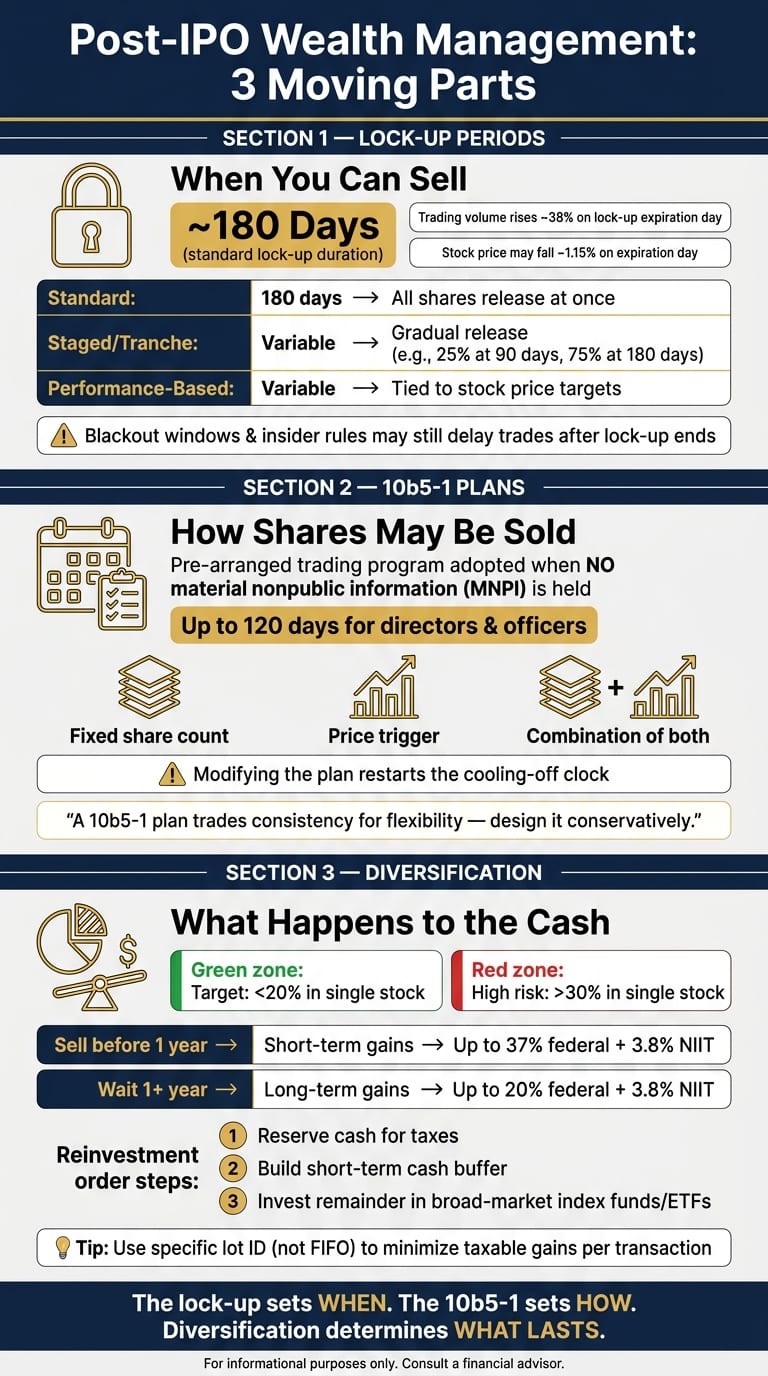
- Lock-up periods may block sales for around 180 days after the IPO.
- Even after a lock-up ends, blackout windows and insider-trading rules may still delay trades.
- A 10b5-1 plan may let insiders pre-set sales when they do not hold material nonpublic information.
- Post-IPO wealth may be heavily concentrated, with 50%–80% of net worth sometimes tied to one stock.
- Lock-up expiration days may bring extra volatility, with trading volume rising by about 38% and stock prices falling by an average of 1.15% in some research.
- Selling too early may mean short-term capital gains, while waiting past one year may shift shares into long-term capital gains treatment.
- Some investors set a target to keep company stock below 20% of investable assets, while exposure above 30% may be viewed as high.
The big idea: a 10b5-1 plan may set the sale schedule, but it may not answer the portfolio question. The harder part may be deciding how much company stock to keep, how much cash to hold for taxes, and how sale proceeds may be reinvested.
Rule 10b5-1 Insider Trading Plans & Material Nonpublic Information | Office Hours with Gary Gensler
Quick Comparison
In other words: getting liquid after an IPO may be only step one. Turning stock into a durable financial base may take timing, tax awareness, and a clear exposure limit.
Lock-Up Periods: Know When You Can Sell and What Can Still Block You
A lock-up is a contract rule that bars insiders from selling pre-IPO shares for a set period after the IPO, usually 180 days. But the end of the lock-up may not mean you’re free to trade that same day. Company trading rules and blackout windows may still apply. So the first place to look is the agreement itself, because it sets the first date you may be allowed to sell.
What your lock-up agreement actually controls
Read the agreement for the exact release date and for how shares are released. Some lock-ups end all at once. Others release shares in parts.
A standard lock-up usually releases everything on a single day, often day 181 after IPO pricing. Research suggests trading volume may jump by about 38% on lock-up expiration day, and stock prices may fall by an average of 1.15%. In plain English: the first trading day after the lock-up ends may be more volatile.
Staged or performance-based unlocks work differently. Shares may come out in tranches, such as 25% after 90 days and the remaining 75% after 180 days. In other cases, shares may unlock only if the stock reaches a stated price target. That setup may soften the supply shock, but it also means you may need to track more than one date or trigger.
Many lock-ups also block hedging moves such as puts, collars, and covered calls.
The structure tells you how shares unlock. The next step is figuring out whether anything else may keep you from trading on time.
The checklist to review 30–60 days before your lock-up expires
The expiration date is just the first hurdle. The prep work usually starts 30–60 days before that date.
A few items are worth checking:
- Confirm the exact release date in your lock-up agreement. The count usually runs from the IPO pricing date.
- Review your company’s insider trading policy for earnings blackout periods. If the lock-up expires two to three weeks before an earnings announcement, you may still be blocked from selling.
- If your shares sit in a transfer-agent platform such as Shareworks or E*Trade's equity plan service, start the brokerage transfer early. Moving shares to a personal account may take several days or longer.
- If you’re a Section 16 insider, volume limits and filing rules may slow down sales even after the lock-up ends.
Then there’s taxes. Pull your cost basis and acquisition dates before you place any trade. Selling at the 180-day mark may trigger short-term capital gains taxed at ordinary income rates of up to 37% federally, plus the 3.8% Net Investment Income Tax (NIIT). Waiting until the one-year mark may lower the federal rate to 20%, plus NIIT. Because the gap may be large, some people model the tax rate before making a first sale.
10b5-1 Plans: Pre-Arrange Sales Before Volatility and Trading Restrictions Hit
A Rule 10b5-1 plan is a prearranged trading program that lets insiders schedule future stock sales when they do not possess material nonpublic information (MNPI). Trades then execute automatically based on preset instructions. That automatic setup is what may provide legal protection against insider-trading claims. If the lock-up sets when you may sell, the 10b5-1 plan sets how the sales may happen.
A 10b5-1 plan sets trade timing, not portfolio allocation.
When a 10b5-1 plan makes sense after an IPO
This type of plan may make sense for executives who face repeated blackout windows, founders with highly concentrated positions, and employees who want a process that may reduce emotional decision-making during volatile periods. Many people use the lock-up period to adopt the plan early enough for the cooling-off period to end before they want shares sold.
For directors and officers, the cooling-off period may run up to 120 days. So if someone wants shares sold as soon as the lock-up ends, the plan may need to be adopted before that date.
Key plan terms that affect real-world outcomes
Sale formulas may be based on fixed share counts, price triggers, or both. Price floors block sales below a set minimum. Fixed-share or price-trigger rules may be simpler to carry out, while any modification may restart the cooling-off clock.
Section 16 insiders, including officers and directors, still have reporting obligations under a plan. A Form 4 must be filed with the SEC within two business days of any trade.
"A 10b5-1 plan trades consistency and risk mitigation for flexibility, so design the selling plan conservatively." - Adam Broughton, Partner and Senior Wealth Advisor, Mission Wealth
Once the sale schedule is set, the next step is deciding how much stock may be sold and where the proceeds may go.
Diversification: Reduce Single-Stock Risk Without Ignoring Taxes
After your sale schedule is set, the next question is pretty simple: how much stock do you want to keep, and where should the money go after you sell?
Diversification may matter here because your salary, bonus, and equity may already be tied to the same company. If you also hold a large position in that stock, your income and your net worth may both lean on one source. That's a lot riding on one name.
"Holding too much of any single stock - even if successful - can increase risk in ways that may be difficult for many investors." - Aaron Brickley, CFP®, CPWA®, Brickley Wealth Management
Set a target exposure before the first sale
Before you sell a single share, decide how much company stock you may be willing to hold over the long run as a share of your total investable assets, and review that limit each year. One common benchmark is getting single-stock exposure below 20% of investable assets, while positions above 30% may be treated as dominant risks that call for faster action.
A simple gut check may help: if the stock dropped 50% tomorrow and your plans changed, your holdings may be too concentrated.
Start with the dollar amount tied to your next goal. Then sell only enough shares to fund that goal. That may give the rest of the sale plan a clear anchor and connect your exposure limit to your long-term financial stability.
Reinvest sale proceeds into a diversified allocation
The first job for sale proceeds is setting aside cash for taxes. After that, some people build a short-term cash buffer for near-term spending needs and possible income disruptions. The remaining amount may then go into broad-market holdings such as index funds or ETFs, which may reduce the link between your portfolio and your employer's stock.
Don't swap one concentrated position for another. If your new investments overlap with the stock you already own, your mix may be less diversified than it looks. Mezzi X-Ray may help spot overlap across your 401(k), brokerage account, and IRA before you reinvest.
After that, the last moving piece may be tax timing.
Taxes and timing: the order of your sales matters
The order of your sales may affect tax drag. When shares are sold, some investors ask their broker to use specific lot identification instead of the default first-in, first-out (FIFO) method. Selling the highest-cost-basis shares first may reduce the taxable gain on each transaction. Spreading sales across two or more tax years may also lower the chance that one large gain pushes income into a higher bracket or adds NIIT exposure.
For appreciated shares held for more than one year, some people use a donor-advised fund. That approach may avoid capital gains tax on the donated shares and may provide a deduction based on full fair-market value.
"A 10b5-1 plan is not the portfolio plan. It is the sale schedule. The investment work is deciding what each sale is supposed to accomplish before the broker starts executing." - Sumeet Ganju, Founder & Investment Adviser, InverseWealth LLC
Once exposure, taxes, and reinvestment are mapped, execution may come down to sticking with the plan.
Conclusion: Turn Post-IPO Stock Into a Long-Term Financial Plan
An IPO may create wealth fast. But that wealth may stay fragile until it’s tied to a plan. The goal isn’t to predict where the stock price may go next. It’s to reduce dependence on one company.
The same sequence still applies at the end: timing, trading method, then diversification. Know your lock-up date, blackout windows, and trading-policy limits. If you’re an officer or director, a 10b5-1 plan adopted during an open window may allow the cooling-off period to finish before the lock-up ends. It also makes sense to set a diversification target before any shares become liquid.
Once the sale timeline is in place, taxes may play a big role in how much you keep. Tax timing matters. Waiting for long-term capital gains treatment may improve after-tax proceeds compared with selling right at lock-up expiration. For some people, it may make sense to view that outcome as part of the diversification plan, not as a separate call.
That’s the point of post-IPO planning: turning paper wealth into a more durable financial base. The lock-up date is fixed. The planning window is limited. Using that window with intent may be one way to turn IPO gains into longer-term financial security.
FAQs
When should I set up a 10b5-1 plan after an IPO?
Set up a 10b5-1 trading plan well before insider trading windows close, ideally 90 to 120 days before your lock-up expires.
If you do that during the lock-up, the SEC cooling-off period may run at the same time. That setup may let automated sales begin when the lock-up ends, without extra delay and with fewer insider trading concerns.
How much company stock is too much to keep?
Too much company stock may add risk because your paycheck, career path, and future equity grants may already be linked to the same business. If that company runs into trouble, a large share of your wealth may be exposed at the same time.
There’s no universal limit. Still, some people use 20% or less of total net worth in a single company stock as a rough target.
A simple gut check may help: if you had cash in hand today, would you put this much of it into this one stock?
Should I sell at lock-up expiration or wait for lower taxes?
It may depend on your liquidity needs, risk, and tax approach. Selling when the 180-day lock-up ends may trigger short-term capital gains. Waiting until one year from the IPO date may qualify for lower long-term capital gains rates.
A common order of priorities may look like this:
- Cover near-term cash needs and any potential tax bill first
- Assess your outlook for the stock
- Then look for ways to optimize for taxes
A 10b5-1 plan may help automate phased sales and may reduce emotion-driven decisions.Disclosures:
- This content is for informational purposes only and does not constitute investment advice or a recommendation to buy or sell any security.
- Past performance is not indicative of future results. No guarantee of future performance or outcomes is implied.
- Tax information provided herein is general in nature and should not be construed as tax advice. Please consult your tax advisor regarding your individual circumstances.
Related Blog Posts
- Concentrated stock position: when and how to diversify
- How to manage wealth after a company acquisition or IPO exit
- How to avoid a concentrated position in your own employer's stock
- Concentrated Position Management: Collars, Prepaid Forwards, Exchange Funds
Set up a 10b5-1 trading plan well before insider trading windows close, ideally 90 to 120 days before your lock-up expires.
If you do that during the lock-up, the SEC cooling-off period may run at the same time. That setup may let automated sales begin when the lock-up ends, without extra delay and with fewer insider trading concerns.
Too much company stock may add risk because your paycheck, career path, and future equity grants may already be linked to the same business. If that company runs into trouble, a large share of your wealth may be exposed at the same time.
There’s no universal limit. Still, some people use 20% or less of total net worth in a single company stock as a rough target.
A simple gut check may help: if you had cash in hand today, would you put this much of it into this one stock?
It may depend on your liquidity needs, risk, and tax approach. Selling when the 180-day lock-up ends may trigger short-term capital gains. Waiting until one year from the IPO date may qualify for lower long-term capital gains rates.
A common order of priorities may look like this:
- Cover near-term cash needs and any potential tax bill first
- Assess your outlook for the stock
- Then look for ways to optimize for taxes
A 10b5-1 plan may help automate phased sales and may reduce emotion-driven decisions.Disclosures:
- This content is for informational purposes only and does not constitute investment advice or a recommendation to buy or sell any security.
- Past performance is not indicative of future results. No guarantee of future performance or outcomes is implied.
- Tax information provided herein is general in nature and should not be construed as tax advice. Please consult your tax advisor regarding your individual circumstances.