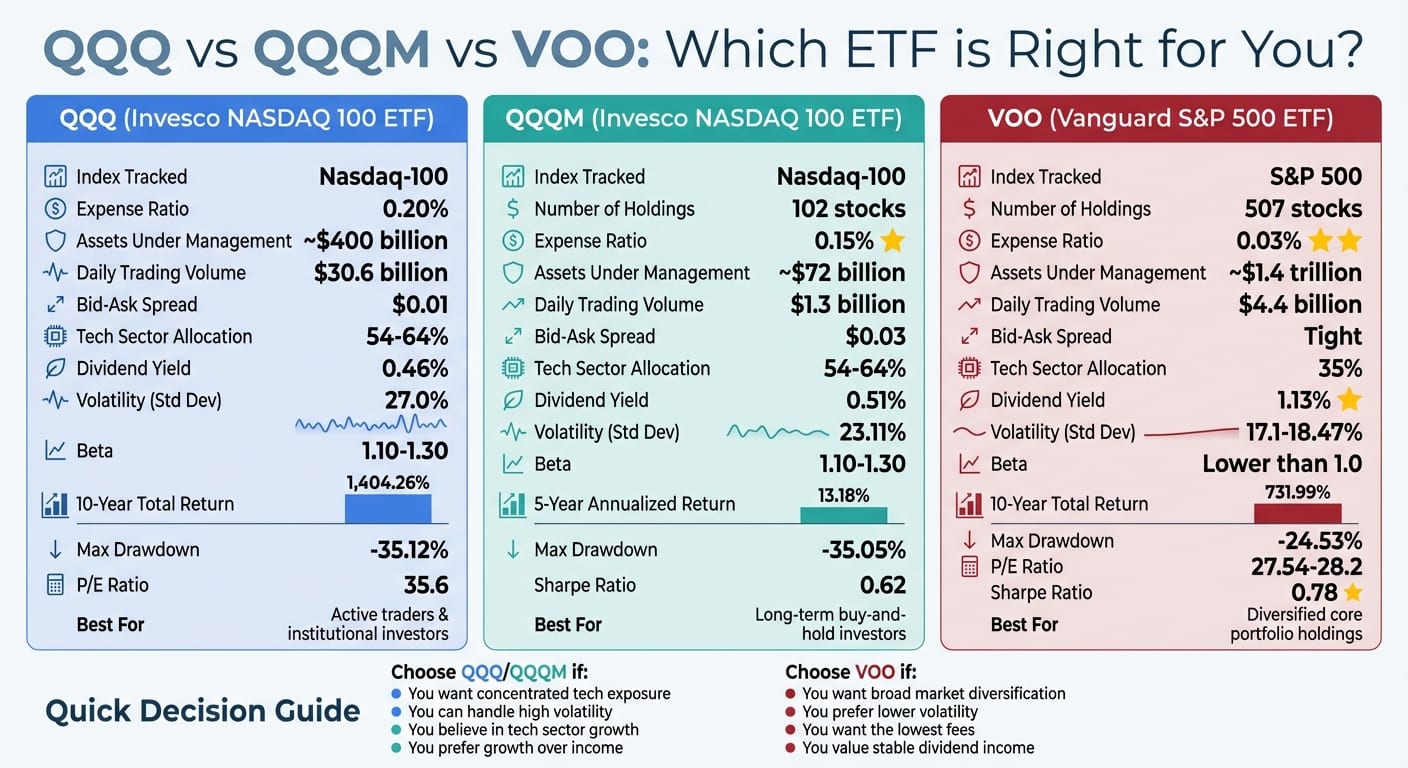
Choosing between QQQ, QQQM, and VOO comes down to your investment goals: growth or diversification. Here's the quick breakdown:
- QQQ and QQQM: Focused on the Nasdaq-100, offering high exposure to tech-heavy growth stocks like Apple, Microsoft, and NVIDIA.
- QQQ is better for traders due to its liquidity.
- QQQM is ideal for long-term investors with its lower expense ratio (0.15% vs. QQQ's 0.20%).
- VOO: Tracks the S&P 500, providing broad market exposure across 500 U.S. companies. It’s cost-efficient (0.03% expense ratio) and less volatile, making it a stable core portfolio choice.
Quick Comparison
| ETF | Index Tracked | Expense Ratio | Focus | Assets Under Management (2026) | Volatility | Dividend Yield |
|---|---|---|---|---|---|---|
| QQQ | Nasdaq-100 | 0.20% | Tech-heavy growth | ~$400 billion | High | ~0.46% |
| QQQM | Nasdaq-100 | 0.15% | Tech-heavy growth | ~$72 billion | High | ~0.51% |
| VOO | S&P 500 | 0.03% | Broad diversification | ~$1.4 trillion | Lower | ~1.13% |
Key Takeaway:
- Choose QQQ or QQQM if you want concentrated exposure to tech and can handle volatility.
- Opt for VOO if you prefer stability, lower fees, and more balanced sector diversification.
Your decision ultimately depends on your risk tolerance and investment strategy.
QQQ vs QQQM vs VOO ETF Comparison: Key Metrics and Performance
QQQ vs VOO: The 2 Best ETFs in Comparison

sbb-itb-e429e5c
QQQ, QQQM, and VOO Explained

Understanding how these ETFs are structured and their cost profiles can help you align your investment strategy with your financial goals.
QQQ: Invesco NASDAQ 100 ETF

QQQ (Invesco QQQ Trust Series I) operates as a Unit Investment Trust (UIT) and has been around since 1999. It mirrors the Nasdaq-100 Index, which consists of the 100 largest non-financial companies on the Nasdaq exchange. With approximately $400 billion in assets and a daily trading volume exceeding $12 billion, QQQ is a favorite among institutional investors and active traders due to its high liquidity.
Technology dominates this ETF, accounting for 54%-64% of its holdings. Its average bid-ask spread is just $0.01, making it an efficient choice for high-frequency trading. However, this convenience comes at a price: the fund's expense ratio is 0.20%, which is higher than other comparable ETFs.
"QQQ is a better choice for short-term traders and institutional investors who prioritize liquidity and fast, efficient trades." - Kent Thune, Senior Content Editor, etf.com
QQQM: Invesco NASDAQ 100 ETF
QQQM (Invesco NASDAQ 100 ETF) also tracks the Nasdaq-100 Index but is structured as an open-ended ETF. Launched in 2020, it was designed for retail investors who prefer a "buy-and-hold" approach and don't require the institutional-level liquidity of QQQ. By February 2026, QQQM had amassed over $72 billion in assets.
The standout feature of QQQM is its lower annual expense ratio of 0.15%, which is 0.05% less than QQQ's. While its bid-ask spread is slightly wider at $0.03, this difference is negligible for long-term investors who trade infrequently. Over time, the lower expense ratio can lead to significant savings, all while retaining exposure to the Nasdaq-100's growth potential. For those seeking broader market exposure, however, VOO may be a better fit.
VOO: Vanguard S&P 500 ETF
VOO (Vanguard S&P 500 ETF) follows the S&P 500 Index, which includes 500 large U.S. companies across a variety of sectors, such as financials and utilities - sectors not represented in the Nasdaq-100. With assets ranging from $872 billion to $1.4 trillion and an expense ratio of just 0.03%, VOO offers broad market exposure at one of the lowest costs available.
Technology makes up about 35% of VOO's holdings - a significant portion, but far less concentrated than the Nasdaq-100. Additionally, VOO provides a higher dividend yield of around 1.13%, compared to QQQ's 0.46% and QQQM's 0.51%. This mix of broad diversification, minimal fees, and consistent income makes VOO a solid choice for a core portfolio holding.
Costs, Fees, and Trading Considerations
Expense Ratio Breakdown
When comparing the annual fees for these three ETFs, the differences may seem small, but they can add up significantly over time. VOO charges an ultra-low 0.03%, which amounts to just $3 annually per $10,000 invested. QQQM comes in at 0.15% ($15 per $10,000), while QQQ is the most expensive at 0.20%, or $20 per $10,000.
That 0.05% fee difference between QQQ and QQQM might not sound like much, but for a fund like QQQ, it translates to nearly $100 million in annual revenue for Invesco. For individual investors, opting for QQQM over QQQ means keeping more of your returns compounding over time, especially in tax-advantaged accounts where switching funds doesn't trigger capital gains taxes.
VOO’s rock-bottom 0.03% expense ratio makes it the standout choice for those focused on minimizing costs. Over a 30-year horizon, this fee advantage could save you thousands of dollars on a six-figure portfolio - money that stays invested and compounds on your behalf.
Of course, expense ratios are only part of the picture. Liquidity and trading costs also play a role in determining the total cost of ownership.
Trading Volume and Spreads
Trading efficiency is another key factor to consider when choosing an ETF.
QQQ leads the pack in liquidity, with an average daily trading volume of $30.6 billion. That’s nearly seven times VOO’s $4.4 billion and far ahead of QQQM’s $1.3 billion. This high trading activity keeps QQQ’s bid-ask spread razor-thin at just $0.01, compared to $0.03 for QQQM.
For long-term investors, the $0.02 spread difference between QQQ and QQQM might only amount to about $20 on a $10,000 trade - a one-time cost that is easily offset by QQQM’s lower expense ratio. However, if you’re an active trader or dealing with large institutional trades, QQQ’s superior liquidity becomes a critical advantage. As John Williamson from Optimized Portfolio explains:
"If you're a day trader or you're buying a huge block of shares, use QQQ for the smaller spread and greater liquidity. If you're a retail investor looking to buy and hold the NASDAQ 100 Index, use QQQM".
VOO offers a balanced approach, with strong liquidity and tight spreads that make it efficient for both trading and long-term investing. Its $872 billion in assets ensures smooth transactions, so you don’t have to worry about trading costs eating into your returns.
What's Inside Each ETF
Largest Holdings Comparison
When comparing the holdings of these ETFs, the differences in concentration and diversification become clear. Both QQQ and QQQM hold identical portfolios of 102 stocks, as they track the NASDAQ-100 Index. On the other hand, VOO provides broader exposure with 507 companies from the S&P 500, offering a more diversified mix of sectors and industries.
The top 10 holdings of QQQ and QQQM make up 48.00% of the fund, reflecting a heavy focus on a few mega-cap tech giants. In contrast, VOO spreads its weight more evenly across its top holdings, resulting in lower individual allocations to each stock.
| Holding | QQQ/QQQM Weight | VOO Weight |
|---|---|---|
| NVIDIA Corp. (NVDA) | 8.92% | 7.74% |
| Apple Inc. (AAPL) | 7.87% | 6.86% |
| Microsoft Corp. (MSFT) | 5.98% | 6.14% |
| Amazon.com Inc. (AMZN) | 4.31% | 3.83% |
| Meta Platforms Inc. (META) | 3.84% | 2.45% |
| Tesla Inc. (TSLA) | 3.66% | 2.16% |
| Alphabet Inc. Class A (GOOGL) | 3.61% | 3.11% |
| Alphabet Inc. Class C (GOOG) | 3.35% | 2.49% |
| Walmart Inc. (WMT) | 3.33% | 0.83% |
| Broadcom Inc. (AVGO) | 3.13% | 2.79% |
This table highlights how QQQ and QQQM concentrate more heavily on tech companies compared to VOO's broader allocation. For example, Walmart represents 3.33% of the Nasdaq-focused funds but only 0.83% of VOO. Moreover, QQQ and QQQM exclude financial companies entirely, so holdings like Berkshire Hathaway or JPMorgan Chase - found in VOO - are absent. This difference in holdings creates distinct sector allocations, which impacts the risk and growth potential of each ETF.
Sector Breakdown
The sector allocations of these ETFs reveal their differing investment strategies. QQQ and QQQM are dominated by technology, with about 54% of their portfolio dedicated to the sector. This includes 34.95% in Electronic Technology and 27.90% in Technology Services. VOO, however, takes a more balanced approach, allocating 24.84% to Electronic Technology and 20.77% to Technology Services.
This tech-heavy focus in QQQ and QQQM comes at the cost of other sectors. For example:
- The finance sector accounts for 14.21% of VOO but is completely absent in QQQ and QQQM.
- Health Technology makes up 7.88% of VOO, compared to just 5.10% in the Nasdaq funds.
- Utilities represent 2.31% in VOO versus 1.35% in QQQ/QQQM.
- Energy Minerals take up 2.20% in VOO but only 0.25% in the Nasdaq funds.
Cory Renauer from The Motley Fool explains:
"QQQ's focus on 101 companies means less diversification and greater exposure to tech sector swings".
This concentrated exposure to technology also affects volatility. Over the last decade, QQQ has been about 22% more volatile than the S&P 500. Additionally, QQQ carries an average P/E ratio of 35.6, compared to VOO's 28.2. For investors willing to embrace higher risk in pursuit of tech-driven growth, the Nasdaq ETFs might align with their goals. However, those prioritizing stability and diversification across multiple sectors may find VOO's approach more appealing. These sector differences play a significant role in shaping each ETF's risk-return profile, tying back to earlier performance trends.
Returns and Risk Analysis
Past Performance Comparison
The performance gap between QQQ and VOO has shifted significantly depending on market conditions. Over the last decade, QQQ achieved 20.94% annualized returns, outpacing VOO's 16.04%, thanks largely to the tech sector's dominance. However, recent data highlights how market shifts can change the narrative.
In 2023, QQQM skyrocketed 55.01%, far exceeding VOO's 26.32%. But just a year earlier in 2022, QQQM tumbled 32.52%, while VOO declined a more modest 18.17%. Fast forward to February 2026, and the five-year annualized returns of these ETFs have nearly aligned: QQQM at 13.18% and VOO at 13.38%. In fact, a $10,000 investment made in October 2020 would have nearly doubled with either ETF. This variability underscores the importance of understanding how sector concentration impacts your portfolio strategy.
So far in 2026, VOO has shown greater resilience with a -0.10% return compared to QQQM's -2.21%, hinting that the market may be shifting beyond tech-heavy stocks. These differences in performance reflect the importance of assessing both volatility and risk before making investment decisions.
Volatility and Risk Metrics
With QQQM's higher growth potential comes increased volatility. Its daily standard deviation stands at 23.11%, noticeably higher than VOO's 18.47%. The Nasdaq-100 ETFs also have a beta of 1.10, meaning they tend to move 10% more dramatically than the overall market.
David Dierking of The Motley Fool provides valuable insight:
"The QQQ Trust has been about 22% more volatile than the S&P 500. That turns a clear absolute performance winner into only a marginal risk-adjusted performance winner."
When it comes to risk-adjusted returns, VOO takes the lead. Its Sharpe ratio of 0.78 outpaces QQQM's 0.62, signaling better returns for the level of risk taken. Similarly, the Sortino ratio, which focuses on downside risk, favors VOO at 1.21 compared to QQQM's 1.03.
Maximum drawdowns highlight the potential pain points for investors. QQQM experienced a steep -35.05% drawdown in November 2022, while VOO's worst was -24.52% in October 2022 - a notable 10-percentage-point difference. For investors who might need liquidity during downturns, this disparity can make a big difference. Despite their high correlation of 0.92, which shows they generally move in tandem, Nasdaq-100 funds tend to amplify both gains and losses. Understanding these risk profiles is key to choosing the ETF that best aligns with your goals for growth and stability.
Choosing Between Nasdaq 100 and S&P 500 ETFs
For Growth-Oriented Portfolios
If you're aiming for growth and can handle market ups and downs, QQQ or QQQM might be a good fit, especially if you believe tech will continue to dominate. Over the past decade, these ETFs have delivered impressive returns, with a 10-year total return of 1,404.26%, far outpacing VOO's 731.99%. However, this performance comes from a concentrated bet on around 100 companies, where technology makes up 54-64% of the portfolio.
For long-term investors focusing on the Nasdaq-100, QQQM offers better value due to its lower 0.15% expense ratio compared to QQQ's 0.20%. Over time, this fee difference can lead to significant savings. As John Williamson from Optimized Portfolio advises:
"If you're a retail investor looking to buy and hold the NASDAQ 100 Index, use QQQM."
On the other hand, traders who prioritize liquidity and tighter bid-ask spreads might find QQQ more appealing. Both ETFs, however, come with a beta of 1.15 to 1.30, meaning they are 15-30% more volatile than the broader market.
It's also worth noting that the Nasdaq-100 tends to trade at a premium. In early 2026, its average stock was valued at 33.25 to 34.77 times trailing earnings, compared to the S&P 500's 27.54 times. This higher valuation means tech earnings need to keep up, or the risk of larger pullbacks increases.
For Balanced, Diversified Portfolios
For those who value stability and broader market exposure, VOO is a solid choice. It offers a well-rounded portfolio with 500+ holdings across various sectors, including technology, healthcare, utilities, and consumer staples - areas that the Nasdaq-100 lacks. This diversification leads to lower volatility (17.1% standard deviation versus QQQ's 27.0%) and smaller drawdowns.
While the S&P 500 has a 35% tech exposure, it balances this with sectors like financial services, healthcare, and industrials, providing a more stable growth profile. As David Dierking from The Motley Fool points out, even though QQQ has historically outperformed, its higher volatility makes it "only a marginal risk-adjusted performance winner".
VOO also stands out with its 0.03% expense ratio, which is significantly lower than either Nasdaq-100 ETF. Additionally, its 1.1% dividend yield offers more income compared to QQQM's 0.4-0.51%.
Nathaniel Stone, Quantitative Strategist at AInvest, highlights VOO's importance as a foundational investment:
"VOO's broad diversification and lower beta provide a stable core for managing systematic risk. QQQ should be considered only as a deliberate, tactical allocation on top of that core."
If you already hold VOO and are thinking about adding QQQ or QQQM, it's important to understand that you're not diversifying in the traditional sense. The Nasdaq-100 already makes up roughly 42% of the S&P 500 by weight, so adding it would act more as a tactical overlay.
Using Mezzi to Analyze ETF Choices

Mezzi simplifies ETF analysis by offering tools that break down overlap, fees, and tax considerations. With its X-Ray tool, you can get a clear picture of what you're buying with ETFs like QQQ, QQQM, and VOO. For instance, the top 10 holdings in these ETFs - featuring companies like Apple, Microsoft, Amazon, and NVIDIA - are almost identical. The X-Ray reveals how closely these ETFs move together, highlighting the potential risk of over-concentration during market downturns. This feature integrates effortlessly with Mezzi's broader suite of analysis tools.
The X-Ray tool is especially useful if you're already holding one of these ETFs and thinking about adding another. Instead of just showing portfolio weights, it demonstrates how adding QQQM to a VOO-heavy portfolio could increase your exposure to tech stocks without offering much diversification.
Mezzi's financial calculator provides valuable insights into how expense ratios can affect your wealth over time. Even a slight difference in fees can snowball into significant amounts over decades, as the calculator shows. It also uses metrics like the Sharpe Ratio - 0.78 for VOO versus 0.62 for QQQM - to illustrate VOO's better risk-adjusted returns, even though their 1-year performance is nearly identical (14.31% for VOO vs. 14.32% for QQQM).
For those mindful of taxes, Mezzi's tax optimization features are a game-changer. They can identify potential wash sales across accounts, a tricky rule that’s easy to violate when trading similar ETFs. If you're thinking about switching from QQQ to QQQM to save on fees, Mezzi guides you through the process to help you avoid unnecessary tax events - critical for taxable accounts. These tax insights align perfectly with Mezzi's comprehensive portfolio management approach.
Finally, Mezzi's AI-driven insights help you evaluate whether the Nasdaq-100's higher volatility - 23.11% for QQQM compared to 18.47% for VOO - matches your risk tolerance. Instead of guessing, you get tailored projections based on your portfolio, financial goals, and time horizon - offering a level of detail that usually requires a financial advisor.
Conclusion
Deciding between QQQ, QQQM, and VOO depends on what you're looking to achieve with your investments and how much risk you're comfortable taking. Each ETF serves a specific purpose and caters to different strategies.
QQQ and QQQM focus on the Nasdaq-100, which includes the 100 largest non-financial companies, with technology making up about 64% of their portfolios. This tech-heavy concentration has driven impressive returns, like QQQ's 10-year total return of +1,404.26%, compared to VOO's +731.99%. However, this comes with more volatility - QQQ's maximum drawdown hit -35.12%, while VOO's was a lower -24.53%.
On the other hand, VOO provides broader diversification across 500 U.S. companies, covering sectors that the Nasdaq-100 excludes. With an expense ratio of just 0.03%, a 1.13% dividend yield, and lower volatility, VOO is a solid choice for those seeking a stable, core investment.
For growth-focused investors, QQQM offers Nasdaq-100 exposure with a lower 0.15% expense ratio, making it a good fit for long-term strategies. Meanwhile, active traders might lean toward QQQ for its superior liquidity. If you're aiming for a balanced portfolio, VOO's broader diversification and reduced risk make it a dependable option.
Mezzi's tools help simplify these decisions by offering personalized insights. Instead of guessing whether the Nasdaq-100's higher volatility matches your risk profile, Mezzi provides tailored projections using your portfolio data. It helps you evaluate concentration risk, invest with tax efficiency, and analyze your investments based on your financial goals and time horizon.
Ultimately, your choice comes down to whether you need a core, diversified holding or a focused bet on tech. With Mezzi's advanced analysis, you can make that decision confidently and with the kind of insights that were once only accessible through costly financial advisors.
FAQs
Should I hold both VOO and QQQM, or is that too much overlap?
Diversifying your portfolio by holding both VOO and QQQM can be beneficial. VOO provides exposure to the broader S&P 500, while QQQM hones in on the tech-heavy Nasdaq 100. That said, keep in mind there’s some overlap between the two, as both include large-cap U.S. stocks. This overlap could lead to a higher concentration in certain sectors, particularly technology. It’s important to weigh your investment goals and determine if the additional tech focus fits your overall strategy.
Is switching from QQQ to QQQM a taxable event in my account?
Switching from QQQ to QQQM usually isn't considered a taxable event since both ETFs follow the same index. However, if you sell or transfer shares, you might incur capital gains or losses based on your individual circumstances. It's always a good idea to consult a tax professional to get advice tailored to your situation.
How much tech exposure is “too much” for my risk tolerance?
The amount of tech exposure you should aim for really hinges on your personal risk tolerance and financial goals. For example, tech-focused ETFs like QQQ can deliver higher growth, but they also bring more ups and downs - think about ~27% volatility and a ~35% maximum drawdown. On the other hand, more diversified ETFs like VOO carry less risk, with ~17% volatility and a ~24% maximum drawdown, making them a safer choice for those who prefer a more conservative approach. Striking a balance between tech-heavy options and broader funds can help you stay aligned with your comfort zone and long-term investment strategy.
Table of Contents
Book Free Consultation
Walk through Mezzi with our team, review your current situation, and ask any questions you may have.