
A private stock sale before IPO may give you cash sooner, but it may also come with approval limits, lower pricing, fees, and tax tradeoffs. If I were sizing this up, I’d focus on five things right away: whether the shares may be sold, who may buy them, how much discount may apply, what taxes may apply, and whether selling part of the position may reduce single-company risk.
Here’s the short version:
- Private-company shares may sometimes be sold before an IPO through tender offers, marketplaces, or direct deals
- Sellers may need to clear vesting, exercise, board approval, and ROFR limits before a deal may move ahead
- Secondary buyers may price common stock at a discount to the last preferred round, often around 10% to 30%, and in some cases more
- Seller costs may include exercise cost, platform fees, legal fees, and taxes
- Taxes may vary based on whether the seller holds ISOs, RSUs, common stock, or QSBS-eligible shares
- Some people sell only a slice - often 10% to 20% - to get liquidity while keeping some upside
A few numbers may frame the decision:
- Median time from founding to IPO may run past 12 years
- Platform seller fees may run around 3% to 5%
- Tender offers may close in about 20 to 30 days
- Marketplace sales may take 60 to 90+ days
- Post-IPO lockups may last about 180 days
How Does Pre-IPO Selling Work? | EquityZen
Quick Comparison
So the core question may be simple: Is getting cash now worth the lower price and tax cost of selling early? This piece lays out that tradeoff in plain English.
2. Can you actually sell your shares?
Vesting, exercise requirements, and transferability
Before you think about buyers or price, check whether the equity may be transferred at all.
Unvested shares and options generally may not be transferred. Only vested awards may be eligible for a secondary sale.
You also may not sell options directly. In most cases, you would need to exercise them first and then sell the shares. Double-trigger RSUs may not become saleable until both vesting and a liquidity event happen. If you leave the company, vested options usually expire after 90 days.
Vesting, exercise requirements, and transferability
Even vested shares may still need company approval. Many private companies require board consent for any transfer. Boards may refuse a sale to block competitors or to keep the cap table from getting too crowded.
Most private companies also have a ROFR. That usually gives the company 30 days, and sometimes 60, to match an outside offer. Companies waive ROFR in roughly 80% to 90% of secondary deals, but approval and timing may still vary.
Many companies also limit when sales may happen. Transfers may be allowed only during set liquidity windows or company-sponsored tender offers. Outside those windows, approval may simply be denied, no matter who the buyer is.
Before you reach out to a buyer, it helps to gather the paperwork they may ask for.
Documents and facts to gather before contacting a buyer
There are a few more limits that may apply before a sale moves ahead.
Federal securities law generally requires a one-year holding period before restricted securities in a private, nonreporting company may be resold. If your shares qualify as QSBS under Section 1202, selling before five years may forfeit the federal capital gains exclusion. In a community property state, spousal consent may also be required.
Once the transfer path looks clear, the next question may be who wants to buy and what price they may offer.
3. Who buys private shares and how deals get done
Who typically buys private shares
Once your shares are transferable, they usually may be sold only to accredited investors and eligible institutions. In practice, that buyer pool often includes secondary funds, family offices, crossover hedge funds, and existing investors.
That narrows the field pretty fast. You're not listing shares on a public exchange and waiting for anyone to click "buy." You're usually dealing with a smaller group of buyers that already knows this market.
Once you know who may buy, the next step is picking the route that may get the deal across the finish line.
Platform-mediated sales and company-sponsored tender offers
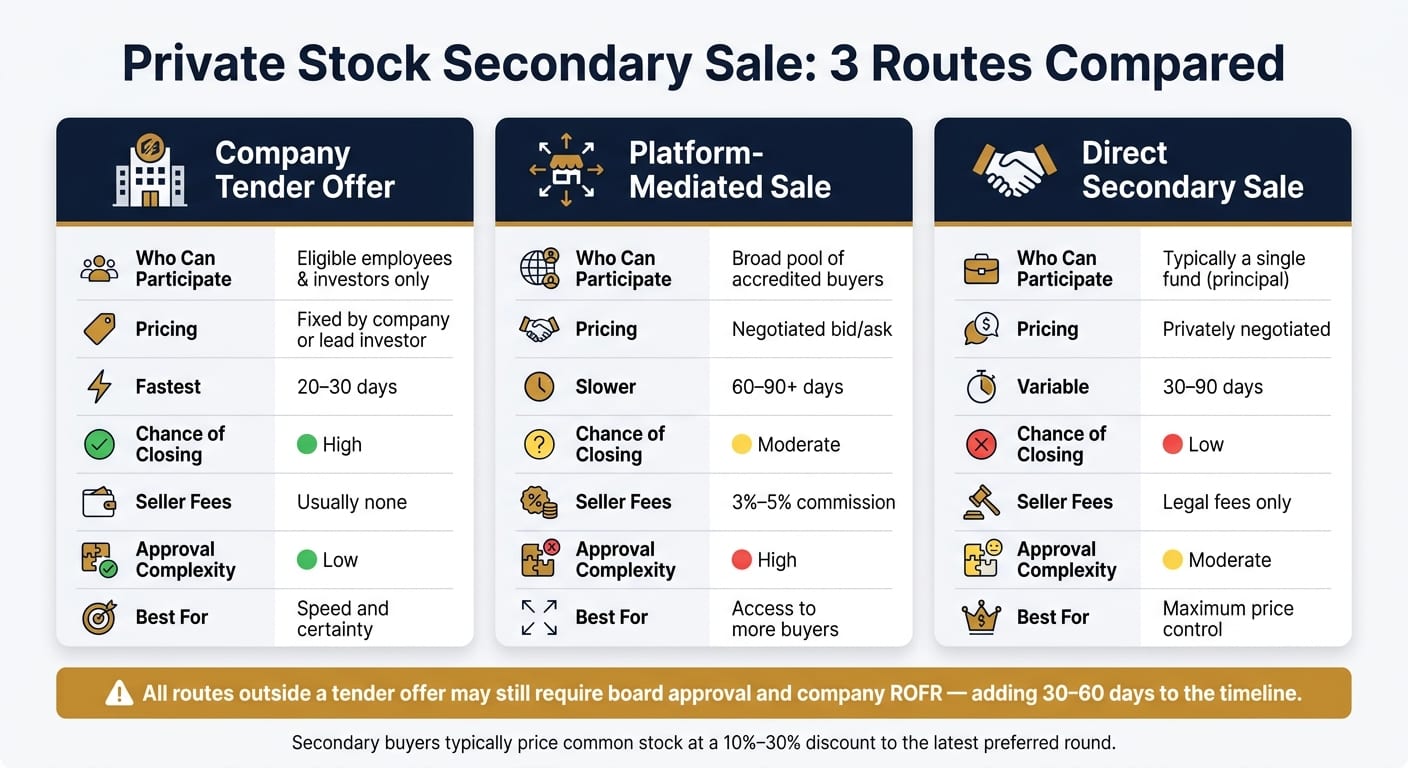
If you don't have a direct buyer relationship, platforms like Forge Global and EquityZen may match you with accredited buyers. Marketplace commissions for sellers usually run about 3% to 5%.
Company-sponsored tender offers work a different way. The company - or a lead investor - sets a fixed price, decides who may take part, and handles the paperwork. Tender offers are usually simpler because the pricing and paperwork are standardized.
Comparing buyer routes: access, speed, and price
These routes tend to differ most in speed, control, and how much value you may keep. The table below shows which route may fit best based on your share count, timing, and tolerance for lower pricing.
Outside of a tender offer, most private sales still may require company approval and may be subject to the company's right of first refusal (ROFR). That means a deal that looks simple at first may still run through internal review before it closes.
4. Pricing, taxes, and the real cost of selling early
Why private shares often sell at a discount
The last funding price usually applies to preferred shares, not the common stock employees often sell.
That difference matters. A 409A valuation exists for tax purposes, not as a live market quote. And secondary-market prices may come in well below it. Buyers often price in illiquidity and weaker control rights, so private shares often trade below the headline valuation. In many cases, secondary buyers price common stock at a 10% to 30% discount to the latest preferred round. If a company's valuation has already been marked down from a 2021 peak, that discount may get much wider - sometimes 40% to 70%.
A simple example shows how fast the math changes.
If an employee holds 12,000 vested ISOs with a $2 strike price in a Series C company that last raised at $35 per share, and a buyer values the common stock at $24, the gross sale amount at that secondary price would be $288,000. After subtracting the $24,000 exercise cost, the seller would net $264,000 before tax. That's a $156,000 gap versus the $420,000 headline figure tied to the last round.
How your shares are taxed when you sell
Taxes depend on what you hold and how the deal is set up.
Gains on shares you already own may be taxed as capital gains. Higher earners - over $200,000 for single filers and $250,000 for married couples - may also owe the 3.8% Net Investment Income Tax (NIIT). California residents may also face state tax treatment that pushes capital gains rates as high as 13.3%.
Options add another layer. If you sell ISOs before holding the shares for one year after exercise and two years after grant, that sale becomes a disqualifying disposition. That may convert what might have been capital gains into ordinary income. Exercising ISOs may also trigger the Alternative Minimum Tax (AMT). For 2026, the AMT exemption is $90,100 for single filers and $140,200 for married couples.
There may also be a tax break on the other side of the ledger. If you hold shares in a qualifying domestic C-corp with less than $50 million in assets and have held them for at least five years, Section 1202 (QSBS) may allow you to exclude up to $10 million in federal gains.
These rules are highly fact-specific, so it may make sense to check the details with a qualified tax professional before signing anything.
The next step is comparing that after-tax cash with the value of waiting.
Sell now versus hold for IPO
Compare after-tax cash now, concentration reduction, and forgone upside.
If the position is highly concentrated, or if you need cash for an emergency or major expense, selling some or all of the shares may be worth the discount. Those after-tax proceeds, the upside you may give up, and the concentration risk all feed into the checklist that follows.
5. A step-by-step framework for deciding whether to sell
Assess the position against your full balance sheet
After you estimate after-tax proceeds, stack the sale up against your full balance sheet. Before you contact a buyer, look at the shares in the context of your total net worth, not just the headline number on paper.
Two questions may help frame the decision:
- Do you may need the cash soon?
- May you absorb a 50% drop before IPO without added stress?
If either answer points to strain, a sale may deserve a closer look.
If selling still appears to make sense, some founders and early employees use a simple sizing rule. A common rule of thumb may be selling 10% to 20% of the position - enough to reduce concentration risk in a meaningful way without fully exiting the company.
A pre-sale checklist to avoid costly mistakes
Once the decision feels clear, shift to the details. Before reaching out to any buyer, work through the basics below.
- Confirm transferability: Pull your stock plan documents and shareholder agreement. Recheck transfer rules, ROFR, board approval, and any lockup windows.
- Check the QSBS clock: If your shares may qualify under Section 1202, verify the 5-year holding period from your exercise date. Selling at year 4.5 may forfeit a federal gains exclusion of up to $10 million or 10x basis.
- Verify your share class and cost basis: Common stock, preferred stock, and unexercised options each come with different pricing and tax treatment. Know exactly what you hold.
- Estimate net proceeds - not gross: Subtract exercise costs, platform fees, legal costs, and estimated taxes before deciding if the deal still works.
- Plan for quarterly taxes: A large secondary sale may trigger underpayment penalties if estimated tax payments aren't adjusted before the funds arrive. Some people loop in a CPA before signing anything.
If the math still works after fees and taxes, the last issue may be whether the liquidity premium justifies the discount. A secondary sale may make sense only when transfer rights, buyer access, and after-tax proceeds still support the tradeoff.
FAQs
How do I know if my shares can be sold before an IPO?
Start by reviewing your stock purchase, option, or shareholder agreements. Those documents usually set the ground rules for whether a sale may be allowed.
Check a few things as you go:
- Whether your shares are fully vested and exercised
- Whether there are transfer limits or a board approval step
- Whether the company has a Right of First Refusal
- Whether sales may be allowed only through company-sponsored tender offers
A small detail in one of these documents may change what options are on the table, so it may help to read them closely before assuming a sale is open.
Is it better to sell in a tender offer or a private secondary sale?
It depends on whether you may value convenience more than control, or the other way around.
A tender offer may be the simpler, lower-friction path: a fixed price, a clear timeline, and less paperwork in many cases. A private secondary sale may offer more flexibility on timing and share count, but it often comes with company approval, ROFR, fees, a 10%–40% discount to the last-round valuation, and a 30–90 day closing process.
If a tender offer is available, many sellers may prefer it for the simpler process.
How much would I actually keep after fees and taxes?
Start with the final sale price. In many cases, that price may land 10%–30% below the company’s latest preferred share valuation.
From there, subtract marketplace fees, which may range from 3%–5%, plus any transfer fees. Those transfer fees may fall between $500 and $5,000.
Taxes may depend on your cost basis, holding period, and the structure of the deal. Shares held for more than one year may qualify for long-term capital gains treatment, while an earlier sale may affect QSBS eligibility.Disclosures:
- This content is for informational purposes only and does not constitute investment advice or a recommendation to buy or sell any security.
- Past performance is not indicative of future results. No guarantee of future performance or outcomes is implied.
- Tax treatment varies based on individual circumstances. Consult a qualified tax professional for personalized advice.
Related Blog Posts
- Pre-IPO stock: how to track value before a liquidity event
- Pre-IPO Liquidity: How to Cash Out Before the IPO
- Post-IPO Wealth Management: Lock-Up Periods, 10b5-1 Plans, Diversification
- Founder Liquidity: Secondary Rounds, Tender Offers, Structured Sales
Start by reviewing your stock purchase, option, or shareholder agreements. Those documents usually set the ground rules for whether a sale may be allowed.
Check a few things as you go:
- Whether your shares are fully vested and exercised
- Whether there are transfer limits or a board approval step
- Whether the company has a Right of First Refusal
- Whether sales may be allowed only through company-sponsored tender offers
A small detail in one of these documents may change what options are on the table, so it may help to read them closely before assuming a sale is open.
It depends on whether you may value convenience more than control, or the other way around.
A tender offer may be the simpler, lower-friction path: a fixed price, a clear timeline, and less paperwork in many cases. A private secondary sale may offer more flexibility on timing and share count, but it often comes with company approval, ROFR, fees, a 10%–40% discount to the last-round valuation, and a 30–90 day closing process.
If a tender offer is available, many sellers may prefer it for the simpler process.
Start with the final sale price. In many cases, that price may land 10%–30% below the company’s latest preferred share valuation.
From there, subtract marketplace fees, which may range from 3%–5%, plus any transfer fees. Those transfer fees may fall between $500 and $5,000.
Taxes may depend on your cost basis, holding period, and the structure of the deal. Shares held for more than one year may qualify for long-term capital gains treatment, while an earlier sale may affect QSBS eligibility.Disclosures:
- This content is for informational purposes only and does not constitute investment advice or a recommendation to buy or sell any security.
- Past performance is not indicative of future results. No guarantee of future performance or outcomes is implied.
- Tax treatment varies based on individual circumstances. Consult a qualified tax professional for personalized advice.