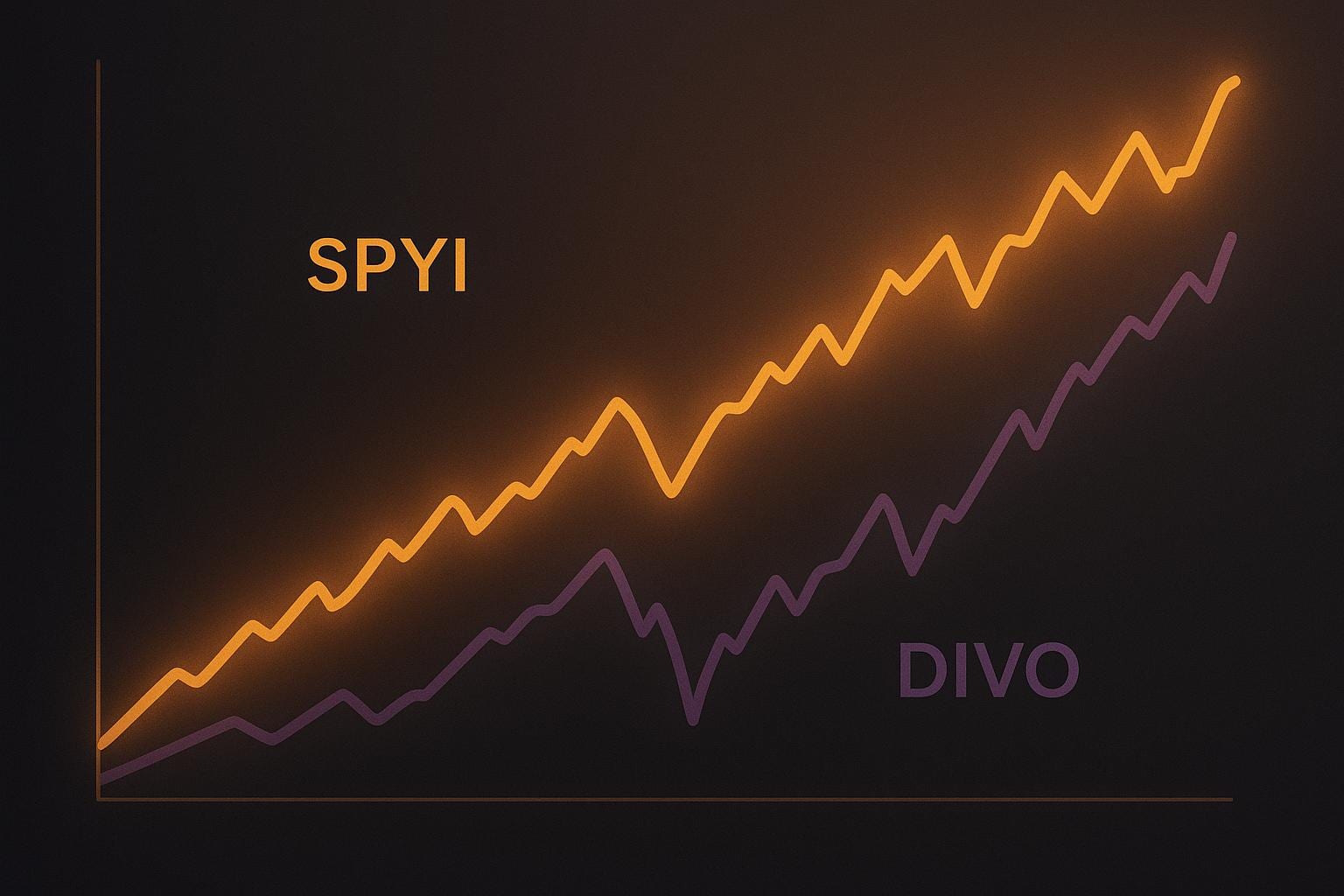
When comparing SPYI (NEOS S&P 500 High Income ETF) and DIVO (Amplify CWP Enhanced Dividend Income ETF), the key differences come down to their income strategies, risk profiles, and sector focus. Both are monthly income ETFs, but they cater to different investor needs:
- SPYI: Higher income focus with an 11.59% yield, leveraging S&P 500 call options. It has broader market exposure with 438 holdings and a strong tilt toward tech (36.3%). Launched in 2022, it prioritizes cash flow but caps upside during market rallies.
- DIVO: Balanced income and growth with a 4.50–4.53% yield, focused on high-quality dividend-paying stocks. It holds just 37 positions, emphasizing financials (22.11%) and tech (21.89%). Active since 2016, it offers a longer track record and steadier income.
Quick Comparison
SPYI is ideal for those seeking maximum income, while DIVO suits investors balancing income with growth. Your choice depends on your financial goals, risk tolerance, and tax considerations.
SPYI Analysis: Strategy, Returns, and Yield
SPYI's Investment Approach
This analysis is a key part of our comparison with DIVO. SPYI employs a strategy involving sold and purchased S&P 500® Index call options to generate premium income while retaining exposure to the broader market. Its actively managed structure allows portfolio managers to adapt their options strategies based on market conditions. By adjusting call option positions, SPYI's managers aim to optimize income.
The fund achieves diversification through 438 securities, offering exposure across the entire S&P 500® spectrum. Its sector allocation mirrors the broader market, with Information Technology leading at 36.3%, followed by Financials at 11.33% and Consumer Discretionary at 10.6%. This broad exposure reduces single-stock risk while the options strategy adds an income layer.
Top holdings like NVIDIA, Microsoft, and Apple highlight its market-cap weighted design. As of September 2025, NVIDIA accounts for 7.81%, Microsoft for 6.72%, and Apple for 6.62% of the portfolio. The top 15 holdings make up 44.26% of total assets, ensuring significant exposure to leading companies while maintaining overall diversification. This blend of strategies supports the fund's strong distribution yield performance.
SPYI Distribution Yield History and Consistency
Since its launch on August 30, 2022, SPYI has delivered noteworthy insights, despite its shorter yield history. It offers a dividend yield of 11.59% through monthly distributions. This high yield stems from SPYI's options strategies, particularly the premiums earned from selling call options on the S&P 500® Index.
However, there’s a distinction between SPYI's dividend yield and its 30-day SEC yield of 0.56%. The SEC yield measures income over the most recent 30 days, while the dividend yield reflects the fund's actual distribution rate. This gap underscores the variability of options-based income, which can shift based on market conditions and options premiums.
The fund's main goal is to deliver high monthly income in a tax-efficient way. Its performance since inception indicates progress toward this objective. Still, investors should recognize that options-based income is often more volatile than traditional dividends, as it depends on market volatility and options pricing.
SPYI 5-Year Total Return Performance
SPYI's focus on income generation is balanced with capital appreciation. However, since the fund began on August 30, 2022, a full five-year total return analysis isn’t available. With roughly three years of operation, existing data offers insight into how SPYI balances income with market exposure.
By combining income generation with S&P 500® exposure, SPYI provides regular distributions alongside potential portfolio growth. This dual strategy appeals to investors looking for both cash flow and market participation.
SPYI’s 0.68% expense ratio reflects the cost of active management and its options strategies. While higher than passive index funds, this fee supports the expertise needed to manage complex options positions effectively. For income-focused investors, this cost may be offset by the fund’s ability to deliver yields above 11%.
When evaluating SPYI, it’s essential to consider its income-first strategy. Unlike growth-focused ETFs that reinvest returns, SPYI distributes a significant portion of its earnings as monthly income. As a result, total return comparisons with growth-oriented funds may not fully capture its value for those prioritizing regular cash flow.
The fund’s 36.3% allocation to Information Technology ties its performance closely to the tech sector. This concentration has likely boosted returns during strong periods for tech but could introduce volatility during downturns. The options strategy helps to manage some of this volatility while continuing to generate income.
DIVO Analysis: Strategy, Returns, and Yield
DIVO's Investment Approach
DIVO is an actively managed income ETF designed to generate consistent income and potential capital growth by investing in high-quality, dividend-paying stocks. The fund maintains a focused portfolio with 37 positions, emphasizing companies with strong dividend payment histories.
Unlike SPYI and other covered-call ETFs, which offer broader market exposure, DIVO leans heavily into Financials (22.11%) and Technology (21.89%) as its primary sector allocations. This narrower focus allows portfolio managers to carefully select stocks with solid fundamentals and dependable dividend records.
With an expense ratio of 0.55%, DIVO is slightly more cost-efficient than SPYI, reflecting its straightforward dividend-focused strategy. To enhance income, the fund employs a covered call strategy, writing options on its equity holdings. This approach not only generates additional premiums but also preserves dividend income from the underlying stocks.
DIVO Distribution Yield History and Reliability
DIVO's current distribution yield ranges between 4.50–4.53%. While limited historical data makes it harder to fully assess its income consistency, this yield aligns well with its long-term total return goals.
The fund's dual-income approach combines dividends from high-quality stocks with premiums earned through its covered call strategy. This blend often results in more stable income compared to strategies that rely solely on options. By focusing on established dividend payers, DIVO demonstrates a commitment to generating sustainable income.
Since its inception in December 2016, DIVO has built a longer operating history compared to newer ETFs in the income-focused space. This track record provides more data for evaluating its reliability in delivering consistent payouts.
DIVO 5-Year Total Return Performance
Over the past five years, DIVO has delivered returns that balance dividend income with modest capital appreciation. While specific data on volatility and downside protection is unavailable, the fund's performance reflects a steady approach to income and growth.
By concentrating on 37 dividend-paying stocks, DIVO targets companies with strong balance sheets and consistent earnings. This selectivity can offer better downside protection during market turbulence compared to broader market-focused funds.
The fund's covered call strategy trades some upside potential for enhanced income and reduced volatility. This approach is particularly appealing to income-focused investors who value steady cash flow over maximum growth. It also shines during flat or slightly declining markets, where income from dividends and call premiums can help offset potential losses.
Next, we’ll directly compare DIVO and SPYI to explore how they cater to different income investment goals.
SPYI vs DIVO: Side-by-Side Comparison
Performance Metrics Comparison Table
Here's a quick look at how SPYI and DIVO stack up across key metrics:
The standout difference here is SPYI's impressive 11.59% yield, far surpassing DIVO's 4.50–4.53%. This reflects their contrasting strategies - SPYI’s covered call approach on the S&P 500 generates higher income, while DIVO takes a more conservative path, focusing on dividend-paying stocks. These differences lay the groundwork for understanding how each fund performs under varying market conditions.
Upside and Downside Capture Analysis
The structural differences between SPYI and DIVO result in distinct risk-return profiles, particularly in varying market environments.
SPYI employs a covered call strategy on the S&P 500, which can limit its upside during strong bull markets. When stocks rally, the fund's call options may be exercised, capping potential gains. However, the premiums collected from writing these calls can act as a buffer during market downturns, helping to mitigate losses.
DIVO, with its more concentrated portfolio of 37 dividend-paying stocks, offers a different risk profile. Its focus on high-quality companies can provide some protection during periods of market stress. On the flip side, this concentration can expose the fund to sector-specific risks if one or more of its key holdings underperform.
Both funds use a covered call overlay, reducing overall portfolio volatility. This makes them appealing to income-focused investors who prioritize consistent cash flow over aggressive growth.
Which ETF Matches Different Investment Goals
Based on the performance and risk metrics discussed, here’s how these ETFs align with different investment priorities:
- SPYI is ideal if your primary goal is maximizing current income. With an 11.59% yield and steady monthly payouts ranging from $0.46 to $0.53 per share in 2025, SPYI is well-suited for retirees or investors needing higher cash flow to cover living expenses. Since its inception in August 2022, SPYI has consistently delivered monthly distributions, paying $6.13 per share over the past year.
- DIVO is a better choice for those seeking a balance between income and capital appreciation. Its concentrated portfolio and longer track record provide a clearer picture of its performance across different market cycles.
- Tax considerations matter. SPYI’s higher yield could result in increased taxable income, making it less tax-efficient for some investors. DIVO’s more moderate yield may be better suited for taxable accounts.
- Assess your risk tolerance. SPYI’s broad exposure to the S&P 500 offers diversification, while DIVO’s focused portfolio introduces higher individual stock risk. However, DIVO’s active management may allow for more responsive adjustments to changing market conditions.
If you’re using Mezzi’s platform, the X-Ray feature can help you identify any overlap between these ETFs and your existing holdings, ensuring your portfolio remains well-diversified.
Action Steps for Income-Focused Investors
Optimizing Income with SPYI and DIVO
If you're an investor focused on generating income, SPYI stands out with its higher yield. However, this comes with a catch. SPYI's covered call strategy, while boosting income, limits your potential for capital gains and may lead to higher taxable distributions.
DIVO, on the other hand, takes a more balanced approach. Its concentrated portfolio aims to deliver consistent income alongside capital appreciation. This could be a better fit if you're looking for steady income without excessive tax burdens and still want to benefit from market growth.
Your investment timeline matters here. For those approaching retirement and needing immediate cash flow to cover living expenses, SPYI's regular distributions might be more appealing. However, if you have more time and can balance income with growth, DIVO's strategy might better align with your goals.
Using Mezzi for ETF Selection and Portfolio Management
Mezzi offers tools that simplify the decision-making process when selecting ETFs like SPYI or DIVO. The X-Ray tool is particularly useful for spotting overlapping exposures in your portfolio, helping you avoid putting too much weight in a single sector or strategy.
The Financial Calculator takes it a step further, letting you model different investment scenarios. By comparing the trade-offs between higher immediate income and potential capital growth - while factoring in fees and other costs - you can make informed choices about which ETF, or combination of ETFs, best fits your long-term retirement plan.
These tools complement the distinct strategies of SPYI and DIVO, making it easier to tailor your investments to your needs.
Final Recommendations
If your main goal is to maximize current income and you're okay with limited upside during strong market rallies, SPYI might be the better choice - especially if you're nearing retirement and need reliable cash flow. However, if you're drawn to a strategy that balances steady income with growth potential and tax efficiency, DIVO could be the way to go.
For some, a blended approach may strike the right balance, offering both high income and growth potential while reducing concentration risk. Regardless of your choice, it's crucial to regularly assess the sustainability of distributions and ensure your ETF selection continues to meet your evolving needs.
Ultimately, your decision should align with your personal timeline, tax situation, and income requirements - not just the allure of a higher yield.
DIVO vs JEPI vs SPYI: Is It Time For Me to Add SPYI to the List?
FAQs
How does SPYI's covered call strategy impact its ability to benefit from market rallies?
SPYI's covered call approach comes with a trade-off: it can curb the ability to fully benefit from sharp market rallies. By selling call options, SPYI secures a steady stream of income but places a cap on the potential gains when stock prices see significant upward movement. This strategy tends to appeal more to investors who value consistent income over chasing maximum growth during bullish market periods.
What are the tax differences between SPYI and DIVO based on their yield strategies?
SPYI employs an options-based strategy that benefits from 60/40 tax treatment. This means 60% of its gains are taxed at the lower long-term capital gains rate, while the remaining 40% are taxed as short-term gains. In contrast, DIVO's distributions are generally taxed as ordinary income, which could lead to a higher tax burden depending on your income bracket.
These distinctions are crucial when assessing the after-tax returns of each ETF, particularly if tax efficiency is a priority in your investment approach.
How can a near-retiree decide between SPYI's higher income focus and DIVO's balance of income and growth?
For investors nearing retirement, choosing between SPYI and DIVO comes down to your financial priorities and how much risk you're comfortable taking. SPYI focuses on delivering higher monthly income, making it a solid option if maintaining a steady cash flow is your top priority. In contrast, DIVO strikes a balance, offering consistent income alongside the potential for long-term growth. This makes it appealing for those aiming to combine stability with opportunities to grow their capital.
When deciding, think about your current income requirements, how long you plan to invest, and your tolerance for market ups and downs. If generating immediate income is your main goal, SPYI might be the better choice. But if you're aiming to preserve and grow your wealth while still earning income, DIVO could be the more suitable option.
Related Blog Posts
- How does JEPI’s yield and risk profile compare to SCHD and DIVO for an income portfolio?
- DIVO vs SCHD: fees, dividend stability, and total-return differences.
- If the Fed cuts rates, how might SPYI and DIVO behave versus a plain S&P 500 ETF?
- What is the average annual return for SPY over the past 1, 5, and 10 years (CAGR and drawdowns)?
SPYI's covered call approach comes with a trade-off: it can curb the ability to fully benefit from sharp market rallies. By selling call options, SPYI secures a steady stream of income but places a cap on the potential gains when stock prices see significant upward movement. This strategy tends to appeal more to investors who value consistent income over chasing maximum growth during bullish market periods.
SPYI employs an options-based strategy that benefits from 60/40 tax treatment. This means 60% of its gains are taxed at the lower long-term capital gains rate, while the remaining 40% are taxed as short-term gains. In contrast, DIVO's distributions are generally taxed as ordinary income, which could lead to a higher tax burden depending on your income bracket.
These distinctions are crucial when assessing the after-tax returns of each ETF, particularly if tax efficiency is a priority in your investment approach.
For investors nearing retirement, choosing between SPYI and DIVO comes down to your financial priorities and how much risk you're comfortable taking. SPYI focuses on delivering higher monthly income, making it a solid option if maintaining a steady cash flow is your top priority. In contrast, DIVO strikes a balance, offering consistent income alongside the potential for long-term growth. This makes it appealing for those aiming to combine stability with opportunities to grow their capital.
When deciding, think about your current income requirements, how long you plan to invest, and your tolerance for market ups and downs. If generating immediate income is your main goal, SPYI might be the better choice. But if you're aiming to preserve and grow your wealth while still earning income, DIVO could be the more suitable option.